The loss mitigation process at the intake desk, read honestly, is a list of deadlines. The specialist (also called a loss mitigation processor or intake specialist) takes in a delinquent borrower's application for help, checks every page against what the loan's investor requires, sends a written notice within five business days saying whether the application is complete and exactly what is missing, chases the gaps, and hands a complete file to the workout underwriter while the borrower is still protected from a foreclosure sale. The work is hard because the pages arrive in pieces, by fax, portal, mail and phone, and each investor defines "complete" differently. Botminds' Loss Mitigation Application Processing exists for that part of the job: agents read and match every page as it lands and draft the missing-items letter, and the specialist checks, signs and talks to the family.
This guide builds the intake desk's duties from the rules that create them, follows one intake morning at a fictional sample servicer, Cinderbrook Mortgage Servicing, and sets out what the role needs from the people who hold it. The people, loans and figures from Cinderbrook are sample data, not a customer's results.
Four clocks the rule hands every intake desk
36days
into a delinquency, live contact with the borrower, or good faith efforts to reach them
45days
into a delinquency, a written notice and a named contact assigned
5days
business days to acknowledge an application and say whether it is complete
30days
to evaluate a complete application received more than 37 days before a sale
What does a loss mitigation specialist do?
A loss mitigation specialist turns a borrower's request for help into a complete application the servicer can evaluate, inside the time limits of Regulation X and the investor's own guide. In most shops the role splits in two: an intake or processing specialist who collects and checks the package, and a workout underwriter who decides which option, if any, the investor will offer. This page is about the first half, where most of the deadlines sit.
The intake half has four duties. The specialist receives every page and matches it to the right loan, because an application, which can begin with information the borrower gives on a call, starts the five-day acknowledgment clock whether or not anyone has opened it. The specialist reads each document against the investor's list: who signed, what period a pay stub or statement covers, whether a page is missing. The specialist writes the acknowledgment notice, which must say complete or incomplete and, when incomplete, name the missing documents and a date to send them. And the specialist keeps after the borrower until the file is complete, then hands it on.
Volume makes it hard. The Financial Stability Oversight Council put the reason plainly in its 2024 report on nonbank servicing: "servicing delinquent loans is more labor-intensive than servicing performing loans and requires additional personnel with expertise in addressing such loans" (FSOC, 2024). When delinquency rises, the intake desk is where the queue forms first.
The duties Regulation X already wrote
A servicer's intake procedure should copy its duties from 12 CFR 1024.39 to 1024.41, because examiners test the desk against those sections, not against the procedure manual. Section 1024.40 is the closest the regulation comes to a role profile. By the 45th day of a delinquency the servicer must have "personnel" assigned to the borrower, reachable by phone, and those people must be able to give the borrower "accurate information about" the options from the loan's owner, the "actions the borrower must take to submit a complete loss mitigation application", and "the status of any loss mitigation application that the borrower has submitted to the servicer" (12 CFR 1024.40(b)(1)).
The same section requires those people to retrieve, "in a timely manner", the payment history and "all written information the borrower has provided" in connection with the application, including what went to a prior servicer. That one sentence describes most of the intake specialist's day. A borrower who calls to ask whether the bank statement arrived is entitled to an accurate answer, and the specialist can give one only if every page has been matched to the loan and read.
Duties the loss mitigation intake desk owns, and the rule behind each
| Duty | What it means on the desk | Where it comes from |
|---|---|---|
| Reach the borrower early | Live contact, or good faith efforts, by day 36 of a delinquency and again after each missed due date; tell the borrower that help may be available. | 12 CFR 1024.39(a) |
| Be the named contact | Assigned by day 45; answers by phone on options, documents needed, application status and deadlines, until two on-time payments under a permanent workout. | 12 CFR 1024.40(a), (b) |
| Log every page in | Date and channel of receipt for each submission, matched to the loan, available to anyone who evaluates the file. | 1024.40(b)(2); 1024.38(c) |
| Acknowledge and list the gaps | Within 5 business days: received, complete or incomplete, what is missing, a reasonable date to send it. | 1024.41(b)(2) |
| Chase with reasonable diligence | Ask promptly, follow up, and get what the servicer can obtain itself without asking the borrower. | 1024.41(b)(1); comment 41(b)(1)-4 |
| Protect the timeline | Know the sale date; flag files near the 37, 45 and 90-day lines; tell foreclosure counsel the moment a file completes. | 1024.41(c), (f), (g) |
| Hand off a decidable file | Every item in, dated, in order, to the underwriter with the 30-day evaluation date. | 1024.41(c)(1) |
An intake morning, hour by hour
The morning below is one day at the fictional sample servicer, with times, where they were logged, taken from its sample contact log. It shows where the minutes go on a single application when agents have already read the pages, and what the same step takes when they have not.
One intake lead's Tuesday morning, Tuesday 13 October, on one application
| Time | What happens | Without agents, the same step means |
|---|---|---|
| 07:12 | A four-page mail envelope is scanned: the 2025 tax return and a disability benefit letter, matched to the loan by the number on the letter and read in 31 seconds. | The envelope waits in a scan queue, then someone keys the loan number and opens each page. |
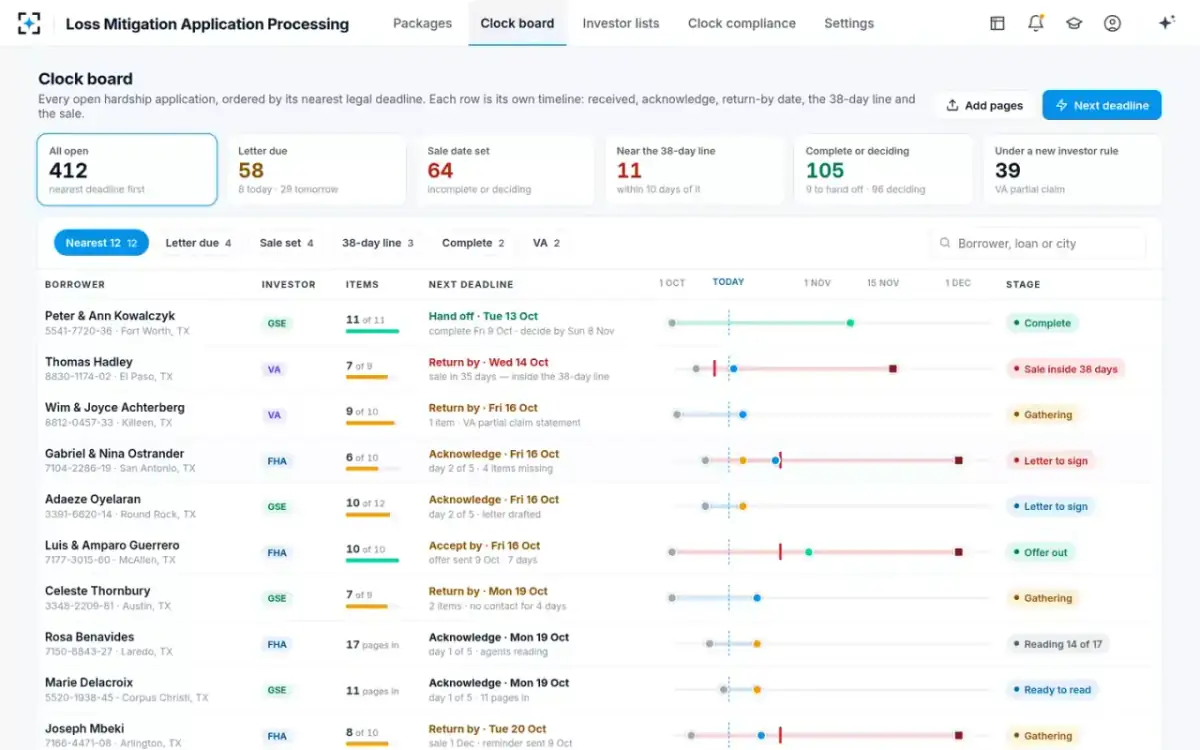
| Early | The intake lead opens the clock board: 412 open applications, 58 letters due, 64 with a sale date set, 11 within ten days of the 38-day line. | A spreadsheet of received dates, rebuilt by hand, with the sale dates copied from the foreclosure system. |
| Then | She opens one package: 6 of 10 items in, four gaps already named on their pages: a blank co-borrower signature, a stale pay stub, a missing month of bank statements, an unsigned letter from a family member who helps with the payment. | Reading 21 pages from four channels against the investor list, and working out which stub dates count. |
| 09:29 | She adds a ready-to-sign letter for the family member to the enclosures. | A note to the borrower to "provide a contribution letter", with no form. |
| 09:30 to 09:45 | She checks the drafted letter (each item says what and why, the return date beats the 38-day line), signs it, and it goes by mail, portal and email. Reminders are set for Friday and the following Tuesday. | Drafting the letter from a template, then a second person checks it; the letter often goes on day 4 or 5. |
| 14:00 | The named contact calls the borrower with the four items in the letter’s own words. | The call happens when the contact sees the letter in the file. |
Two things stand out. The specialist's judgement is concentrated in a few minutes: deciding that the family member's contribution belongs in the file, and signing a letter that will set a family's deadline. And almost none of the morning is spent on the phone. The talking happens in the afternoon, after the letter, which is the order the regulation intends.
The clock board the intake lead starts from
Where a loss mitigation processor's hours go
Most of a loss mitigation processor's working time goes on reading documents against the investor's list, not on writing to or talking with borrowers. The split below is our estimate of the hands-on work in one typical hardship application handled by hand, leaving out the days spent waiting for the borrower.
Reading pages against the list takes more desk time than the letter
Hands-on work on one application by hand: about 5.5 working days in all (our estimate)
- Sorting pages to the loan · 18%
- Reading against the investor list · 37%
- Drafting, signing, sending the letter · 27%
- Building the package for the underwriter · 18%
The estimate explains a pattern compliance officers see in testing: the acknowledgment letter is late not because writing it is slow, but because nobody can write it until the pages are read. The CFPB's own survey of housing counselors for its 2019 assessment of the servicing rules named the five-day acknowledgment as one of the provisions servicers complied with least. Fix the reading and the letter follows.
How many files does a loss mitigation specialist handle?
No regulator sets a caseload, so the answer is "as many as the clocks allow". The best-documented failure is Flagstar Bank. In announcing its 2014 action, the CFPB said that "in 2011, Flagstar had 13,000 active loss mitigation applications but only assigned 25 full-time employees and a third-party vendor in India to review them" (CFPB, 2014). That is 520 open applications for each employee. Flagstar paid $27.5 million to borrowers and a $10 million penalty.
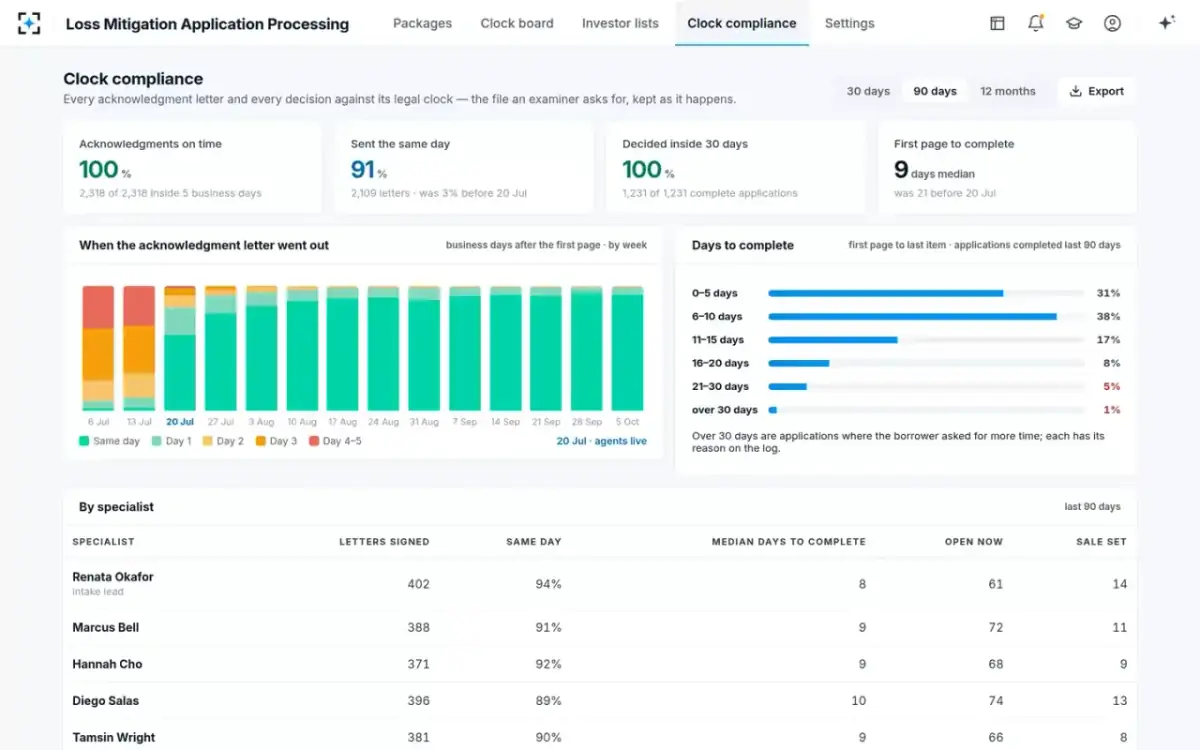
A workable caseload depends on how much of the reading people do by hand. At the sample servicer, the five specialists shown on its compliance screen each carried between 61 and 74 open applications, with agents reading the pages. A team that sorts and reads by hand should expect a lower number, and should measure it the way examiners will: acknowledgments inside five business days, and decisions inside 30 days of a complete application, by specialist and by week. The sibling guide on how long loss mitigation takes to process prices what each day of backlog costs.
Caseload and clocks, by specialist and by week
How much clerical time the work takes, by the official count
The Bureau of Labor Statistics does not publish a separate occupation for loss mitigation specialists. The closest standard occupation is loan interviewers and clerks (SOC 43-4131), the clerical line that holds most document-checking jobs in lending, which counted 164,790 people in May 2025 (BLS OEWS, May 2025).
HUD, estimating the paperwork cost of FHA loss mitigation in September 2026, priced each burden hour at $25.25 across 1,458,337 hours a year (HUD, 2026). That figure covers the forms servicers and borrowers fill in, but it shows how much clerical time the government itself assumes the work takes.
What the official data say about the work, and what they leave out
164,790
loan interviewers and clerks in the US, the closest BLS occupation
1.46M
hours a year of FHA loss mitigation paperwork, by HUD’s 2026 estimate
0
BLS occupations named for loss mitigation
What the intake desk must be good at
The skills that matter are the ones the regulation tests: reading documents precisely, counting days correctly and writing requests a family can act on. Phone manner matters, but a warm call that gives the wrong status is still an inaccurate answer under 1024.40. A servicer that trains for the skills below trains for what the examiner will look at.
Skills to hire and train for on the intake desk
- Reads a document for what it proves
Who signed, the pay period, the statement dates, the page count, whether a benefit ends. A stub dated three months ago is a page received, not an item complete.
- Knows each investor’s definition of complete
FHA, VA, USDA, Fannie Mae, Freddie Mac and portfolio loans ask for different things; FHA no longer requires financial documents at all.
- Counts business days without a calendar error
Saturdays, Sundays and legal public holidays do not count toward the five days. Columbus Day and Juneteenth are the ones that are easy to miss.
- Works backwards from the sale date
The return-by date must fall before the next milestone: 120 days delinquent, 90 days before a sale, or 38 days before a sale.
- Writes a request a family can act on
Each item names the document, whose it is, why it is needed and the page it concerns. "Other documents as needed" is not a request.
- Never fills a gap themselves
A missing signature or date is asked for, not inferred. The file is complete when every page is in, not when it looks likely.
- Knows when to escalate
A sale within 45 days, a borrower in bankruptcy, a successor in interest, or a transfer mid-application each change the rules.
The single point of contact: the role the rule names
The single point of contact is not a separate statute; it is industry shorthand for the continuity-of-contact duty in 12 CFR 1024.40, and many servicers give it its own seat. The rule requires that the borrower can reach assigned personnel by phone, that the servicer gives "a live response in a timely manner" when they do not answer at once, and that those people stay available until the borrower has made two consecutive on-time payments under a permanent workout.
The contact's value depends entirely on what the intake specialist has done. A contact who can see every page received, the gaps named and the return-by date can answer a status call in a sentence. One who has to ask the back office cannot. The CFPB's examiners have found the cost of that gap in the other direction too: in its Spring 2024 Supervisory Highlights the CFPB reported servicers that "failed to make good faith efforts to establish live contact with hundreds of delinquent borrowers" and failed to document live contact in their systems at all (CFPB, 2024).
What the job looks like when agents read the pages
When agents take the sorting, reading and first drafting, the specialist's job does not disappear; it moves to the decisions and the signature. Botminds' Loss Mitigation Application Processing runs six agents on the intake work, each with limits it may not cross: it never discards a page, never guesses a loan, never fills in a missing signature or number, and never sends a letter without a person's signature.
Four roles on one hardship application, before and after the reading is automated
Today
Finds the pages, matches them to the loan, reads each against the investor list and drafts the letter, often on day 4 or 5.
With agents
Starts from the gaps already named on their pages and the letter already drafted; checks it and signs on day 1 or 2.
Still theirs: the decision that a file is complete, and every signature
Today
Answers status calls by asking the back office what has arrived.
With agents
Gets a call task the moment the letter goes, with the items in the letter’s own words.
Still theirs: the conversation with the family
Today
Receives a file that still needs pages chased and income worked out.
With agents
Receives every document in order, the hardship and dates, and the decision date.
Still theirs: the choice of workout option
Today
Samples files after the fact to test the five-day and 30-day clocks.
With agents
Reads every page in and letter out on one log, by week and by specialist.
Still theirs: the investor lists and the rules they encode
The letter isn’t the hard part. Knowing exactly what’s missing, on which page, is.
That line, from the intake lead in the sample, is the best one-sentence description of the desk we know. The specialist who knows what is missing on which page can write the letter in minutes, answer any call about the file and hand the underwriter something decidable. The sibling guides cover what the incomplete-application notice must say and every Regulation X clock from day 36 to the sale, and the solution page shows the whole desk at Loss Mitigation Application Processing.
Questions people ask
What is the difference between a loss mitigation specialist and a loss mitigation processor?
Titles vary by servicer. A processor usually handles intake: collecting, logging and checking documents and sending the acknowledgment notice. A specialist may do the same work or also talk to borrowers as their named contact, while an underwriter decides the workout option under the investor's waterfall.
When must live contact be made with a delinquent borrower?
No later than the 36th day of delinquency, and again within 36 days of each later due date while the borrower stays delinquent, under 12 CFR 1024.39(a). The rule requires live contact or good faith efforts to make it, and the servicer must then tell the borrower about loss mitigation options where appropriate.
Do small servicers need a loss mitigation specialist?
A small servicer, one with 5,000 or fewer loans that it or an affiliate owns or originated, is exempt from most of 1024.39 to 1024.41, including the five-day notice. It is still barred from starting foreclosure before 120 days of delinquency, and from moving to sale while a borrower performs under a workout agreement.
What does a loss mitigation specialist need to know about FHA loans?
Since 1 October 2025, under HUD Mortgagee Letter 2025-12, an FHA borrower is not required to give financial documents to be evaluated, and hardship proof is needed only for some hardships, such as a divorce decree or a death certificate. FHA also requires an evaluation before four monthly installments are due and unpaid.
Can agents replace loss mitigation specialists?
Agents can take the reading, matching, date-counting and first drafts, which our estimate puts at most of the hands-on time on an application. They should not decide completeness alone, choose a workout, move a sale date or send a letter, and regulators hold the servicer responsible for whatever its tools produce.