A borrower response package is what a delinquent borrower sends a mortgage servicer in reply to a loss mitigation solicitation: the mortgage assistance application, the hardship statement, and the income and hardship documents the investor requires. For Fannie Mae loans the Servicing Guide sets the test for a complete package: Form 710 "completed in its entirety", income documentation by income type that is "no more than 90 days old", hardship documentation "as outlined in Form 710 based on hardship type", and submission by "all parties whose income was used to qualify for the original mortgage loan and who signed the mortgage loan note", unless one has died or divorced (Fannie Mae Servicing Guide D2-2-05). Regulation X then puts the servicer on a clock from the day the first page arrives. The intake work is hard because packages come in pieces, by fax, portal and mail, against investor lists that differ and change, while a foreclosure date may already be set. Botminds' Loss Mitigation Application Processing reads each arrival as it lands, checks it against the investor's versioned list, names each gap on the page it concerns, and drafts the missing-items notice for an intake lead to sign.
The household, servicer and documents in the examples are fictional sample data from the solution; the rules are real and linked where they appear.
One sample servicer's open loss mitigation pipeline on a Monday
412
open applications on the clock board
58
missing-items letters due
64
with a foreclosure sale date set
11
within 10 days of the 38-day line
What makes a borrower response package complete?
Every item the investor's list and the servicer's requirements call for, from every borrower who must sign. Regulation X defines a complete application as one for which "a servicer has received all the information that the servicer requires from a borrower in evaluating applications for the loss mitigation options available to the borrower", and adds that "a servicer shall exercise reasonable diligence in obtaining documents and information to complete a loss mitigation application" (12 CFR § 1024.41(b)(1)). The investor's rulebook supplies the content of "all the information".
What Fannie Mae requires for a complete borrower response package
| Item | The rule | What intake checks |
|---|---|---|
| Form 710, or equivalent | Completed in its entirety | Every section answered; every required signature and date present |
| Who must submit | All parties whose income qualified the loan and who signed the note, unless deceased or divorced | A co-borrower's blank signature line keeps the package incomplete |
| Income documentation | By income type per Form 710; no more than 90 days old when completeness is first determined | The date on every stub and statement against the 90-day limit |
| Hardship documentation | As outlined in Form 710, by hardship type | The hardship named, and the proof that type requires |
| Non-borrower income | Voluntary, documented and verified to borrower standards; contributor occupies the home | A contributor's statement, occupancy evidence, and only the amount routinely contributed |
| IRS Form 4506-C | Signed, to reconcile inconsistencies or if Fannie Mae requests it | Whether the application and the income documents disagree |
Which hardship documents does a servicer have to verify?
The ones the investor's form requires for the hardship type the borrower names, and no more than the servicer's own requirements add. Fannie Mae ties hardship proof to Form 710 "based on hardship type", so the first job is to read which hardship the borrower selected and what the statement says about it: the category, the start date, whether it has ended, and every income source it mentions. Each of those can create a document requirement.
The statement matters as a source of dates, amounts and names, not as prose. In the sample package the hardship statement named a reduction in hours from 14 June and a disability benefit from 3 August that runs to the end of January, and it mentioned that the borrowers' adult son pays $400 a month toward the mortgage. The first two told the underwriter the hardship was partly temporary; the third added an item to the list, because a contribution the servicer counts has to be documented. How a hardship letter is read line by line, and how its mentions become requests, is set out in the incomplete loss mitigation application.
Counting income from someone who is not on the loan
Only under conditions, and only the amount actually contributed. Fannie Mae lets a servicer include a non-borrower's income "if the income is voluntarily provided by the borrower, is documented and verified by the servicer using the same standards used for verifying a borrower's income", if the servicer "verifies that the non-borrower occupies the subject property as a principal residence based on a review of the credit report or any other available document", and if "there is documentary evidence to support that the income has been, and reasonably can continue to be, relied upon". The servicer "must not consider the expenses of a non-borrower household member and may only consider the amount of the non-borrower's income that they routinely contribute to the household".
Income the borrower names must also be considered fairly. The CFPB reported in 2020 that lenders "violated ECOA and Regulation B by maintaining a policy and practice that excluded certain forms of public assistance income, without considering the applicant's actual circumstances including unemployment compensation and SNAP benefits", from loss mitigation eligibility (CFPB Supervisory Highlights, Issue 22). Disability benefits, unemployment compensation and support payments listed in a hardship statement are income to be documented, not reasons to discount the file. Fannie Mae's rule for non-taxable income works the other way: the servicer grosses it up by 25% to an "adjusted gross income" where the income and its tax-exempt status are likely to continue.
The sample household's income, as the package documents it
| Source | Monthly gross | Document that supports it |
|---|---|---|
| Borrower's wages, reduced hours | $2,017.60 | A current pay stub; the stub first on file was 102 days old and not counted |
| Co-borrower's disability benefit | $1,486.00 | The benefit letter with its amount and end date |
| Adult son's contribution | $400.00 | His signed statement, with occupancy evidence |
| Total | $3,903.60 | Each line cited to its page in the package |
The clocks a package starts
Regulation X runs from receipt, not from completeness. If a servicer receives an application 45 days or more before a foreclosure sale, it must review it promptly and "notify the borrower in writing within 5 days (excluding legal public holidays, Saturdays, and Sundays)" that it has the application and whether it is complete, and if not, what is missing and by when. A complete application received more than 37 days before a sale must be evaluated for all options "within 30 days of receiving the complete loss mitigation application". Fannie Mae's guide sets the same 30-day decision limit for a complete package and requires an Incomplete Information Notice "no later than 5 business days from receipt of documentation" when items are missing.
The sample package from first page to complete, against the sale date
- Acknowledged on day 2 of 5
- Borrower returns the four items
- Complete: 30-day evaluation clockevaluate by
- Margin before the sale
The notice is where intake quality shows. Fannie Mae requires it to list "missing documents or information needed to begin an evaluation", give a toll-free number and the HUD counselor resource, and warn that failure to submit "may result in ineligibility for a workout option". A notice that says "pay stubs" when the servicer has one stale stub, or "bank statements" when it has five pages of a six-page statement, produces a second round trip and spends days the borrower may not have. What the acknowledgment must contain is set out in the loss mitigation acknowledgement letter.
What changes when a package arrives close to the sale?
The protections narrow at fixed lines, and intake has to know which side of each line a package is on. The five-day acknowledgment duty applies to applications received 45 days or more before a sale. The 30-day evaluation duty and the bar on proceeding with the sale apply to a complete application received more than 37 days before it. Fannie Mae's guide reflects the same edge: the servicer "is authorized, but not required, to send an Incomplete Information Notice to a borrower who submits incomplete documentation 37 days or less prior to a scheduled foreclosure sale".
The practical consequence is that the return-by date on a missing-items notice is not an administrative courtesy. It has to fall early enough that the borrower can send the items and the package still becomes complete before the 38th day. In the sample case the package arrived 54 days before the sale, the 38-day line fell on a Saturday, and the notice gave a return-by date three days earlier than the servicer's own target required, so a borrower who used every day available would still be protected. The package became complete 47 days before the sale.
Where the 90-day line has passed, as here, Regulation X's appeal right for a loan modification denial does not apply, because it attaches to complete applications received 90 days or more before a sale, so the first evaluation has to be right. That raises the cost of an incomplete income picture at hand-off: an underwriter who denies for insufficient income because the son's contribution was never documented cannot be corrected by appeal. A sale date also changes who must be told: once the package is complete, foreclosure counsel receives the hold, with no notice of sale while the evaluation is pending.
Why intake reads each page as it arrives
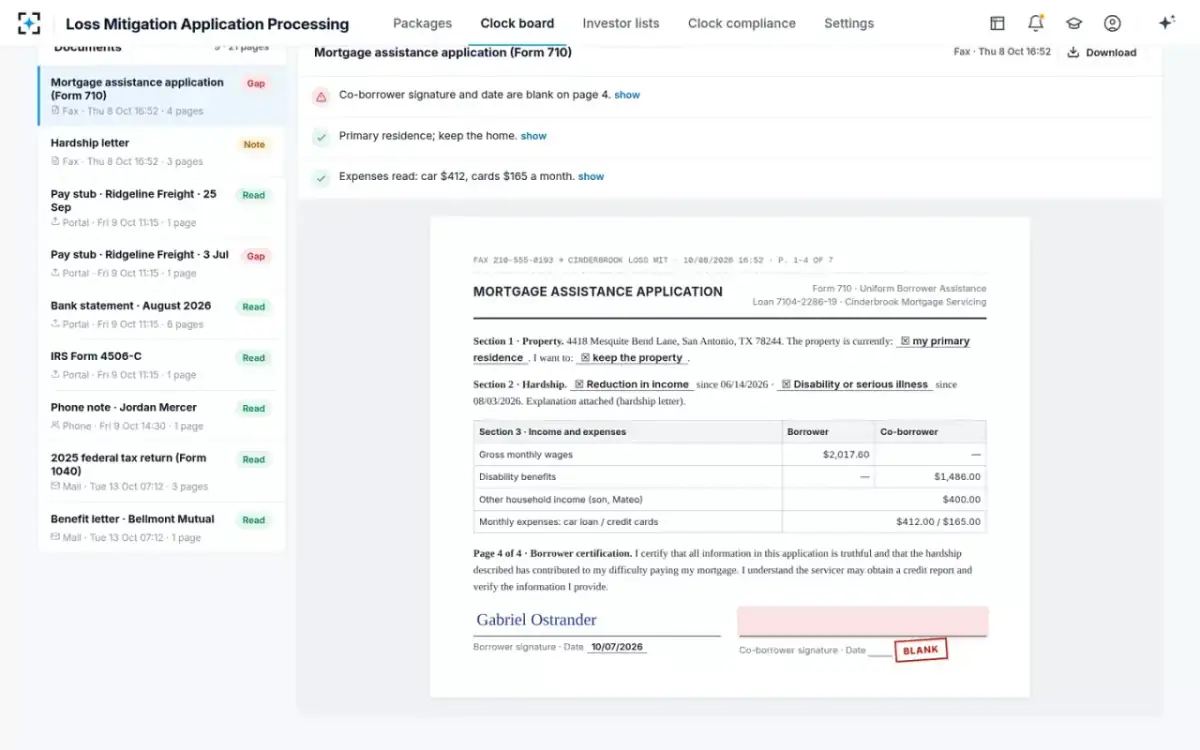
Because a package arrives in pieces and every gap found late costs days of the borrower's protection. In the sample case the fax was read in 58 seconds and matched to the loan, the portal upload in 44 and the mailed pages in 31. Each finding was shown on the page it concerned: page 4 of Form 710 signed by the borrower with the co-borrower line blank; a pay stub 102 days old; the August statement complete at six pages and September missing; the son's contribution mentioned but undocumented.
The gap shown on the page it is about, in Loss Mitigation Application Processing
The CFPB's assessment of the servicing rules found that "it took borrowers longer to go from initiating a loss mitigation application to completing the application in 2015 (post-Rule) than in 2012 (pre-Rule)", possibly because complete packages became more comprehensive. In its survey of housing counselors, where the acknowledgment notice did not help, "more than one-half of the respondents said that it is often or always because the notice is not specific enough" (CFPB Mortgage Servicing Rule Assessment, 2019). Both findings point at intake: the faster and more precisely the servicer says what is missing, the sooner the borrower can send it.
Two missing-items notices for the same package
A generic list: "Signed application."
Named items, each with its reason: "Page 4 of the application, signed and dated by the co-borrower; the borrower's signature is already in."
A generic list: "Recent pay stubs."
Named items, each with its reason: "The borrower's most recent pay stub; the one we have is from June and is too old to use."
A generic list: "Bank statements."
Named items, each with its reason: "The September statement from the credit union, every page, even blank ones."
A generic list: Not asked.
Named items, each with its reason: "A signed letter from your son saying he pays $400 a month; a filled-in letter is enclosed for him to sign."
A generic list: "Return promptly."
Named items, each with its reason: A return-by date that beats the 38-day line, and why it protects the home.
What compliance should test on borrower response packages
The clocks, the notices and the list behind them. A servicer that can show, for any application, when each page arrived, what the investor's list required at that date, what the notice asked for and when, and when the package became complete has answered most of what an examiner will ask about intake.
Six tests for borrower response package handling
- An investor list with a version and a date
Fannie Mae, Freddie Mac, FHA, VA, USDA and portfolio requirements differ and change; the list applied must be the one in force on receipt.
- Receipt dated per page and channel
Fax, portal and mail each start or move the clocks; the business-day calendar excludes legal public holidays.
- Notices within five business days, naming items
Each missing item named with its reason, and a return-by date tied to the sale date.
- Income documents within their age limit
Ninety days under Fannie Mae's rule, measured when completeness is first determined.
- Non-borrower and benefit income handled to rule
Contributions verified with occupancy evidence; public assistance income considered on the applicant's actual circumstances.
- A decision within 30 days of complete
And foreclosure counsel told of the hold while the evaluation is pending.
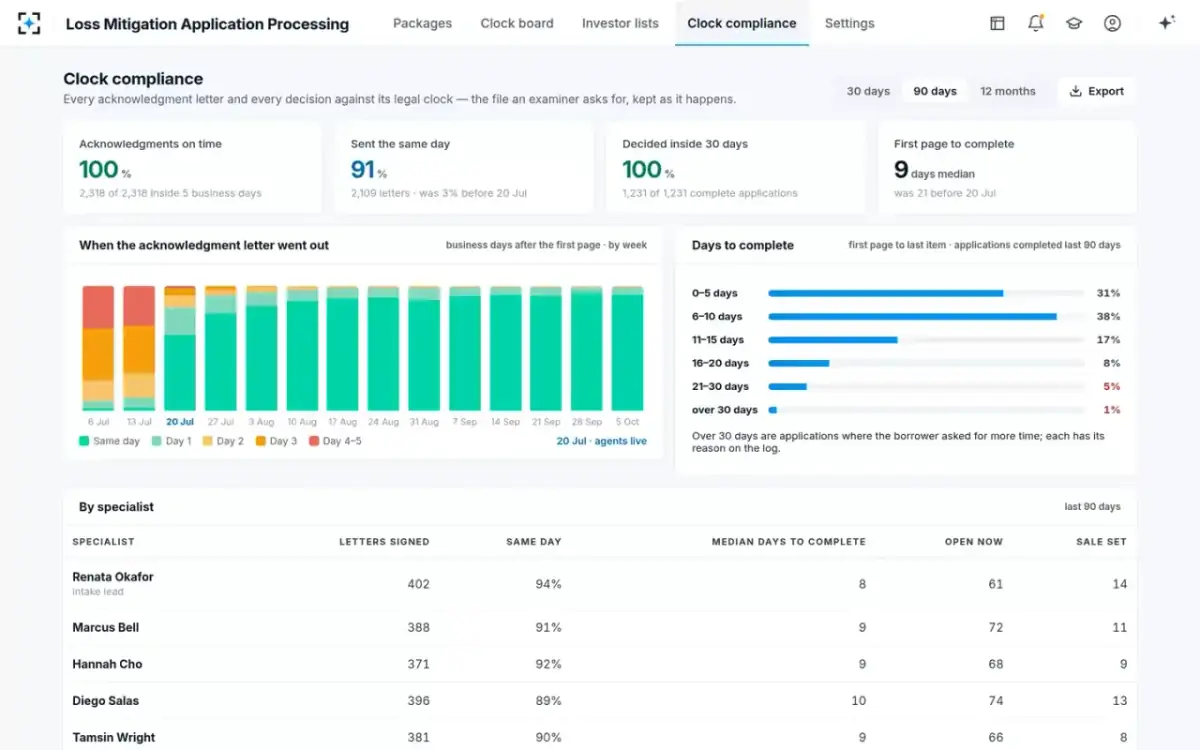
Acknowledgments, letters and decisions on time, by week and by specialist
Where Loss Mitigation Application Processing fits
The solution's agents read each fax, upload and mailed page within seconds of arrival, match it to the loan, check it against the investor's versioned list for that household, compute every Regulation X and investor clock on the servicer's business-day calendar, and draft the acknowledgment and missing-items notice with each item named and explained. An intake lead reviews and signs every notice before it goes; the underwriter receives a complete package with its income summary cited line by line, and counsel receives the foreclosure hold. What it applies are the servicer's settings: acknowledgment target, return-by rule, document staleness and approvals.
It does not evaluate the borrower or choose an option; that is the underwriter's decision. What it changes is the number of round trips between first page and complete, and the evidence of every step. Where the days go before a package is complete is measured in loss mitigation cycle time; to see packages checked against your own investor lists, start from Loss Mitigation Application Processing.
Questions people ask
What is a borrower response package?
The servicer's term, used in the GSE servicing guides, for everything a borrower returns in response to a loss mitigation solicitation: the mortgage assistance application, usually Form 710, the hardship statement and the documents the investor requires. Regulation X calls it a loss mitigation application.
Who must sign a Fannie Mae borrower response package?
All parties whose income was used to qualify the loan and who signed the note, unless a borrower or co-borrower is deceased or divorced. A blank co-borrower signature keeps the package incomplete.
How old can income documents be?
Under Fannie Mae's guide, no more than 90 days old when the servicer first determines the package is complete, or up to 180 days for a post-disaster evaluation. Other investors set their own limits.
Can a servicer count income from a relative living in the home?
Under Fannie Mae's rule, yes, if the borrower volunteers it, it is documented and verified to borrower standards, the relative occupies the home as a principal residence, and it can reasonably continue. Only the amount routinely contributed counts, and the relative's expenses are ignored.
How fast must a servicer acknowledge a package?
Within five business days, excluding legal public holidays, Saturdays and Sundays, for an application received 45 days or more before a foreclosure sale, saying whether it is complete and, if not, what is missing and by when.
Does Form 710 apply to non-GSE loans?
The CFPB has described Form 710 as the loss mitigation application used by most mortgage servicers, and many use it or a version of it across investors. The documents required with it still follow each investor's own list.