Unlicensed mortgage loan originator activity happens when someone without a license takes a residential mortgage application and offers or negotiates its terms, or tells the public they can. The SAFE Act requires every state to have "a mechanism to assess civil money penalties for individuals acting as mortgage originators in their State without a valid license" (12 U.S.C. 5107), and the penalties reach the company. In December 2025, California's Department of Financial Protection and Innovation ordered one lender to pay $160,000 and $500 more for every past or present employee an independent audit finds to have done the work unlicensed (DFPI consent order). The people involved were not loan officers. Botminds' Lender License Management keeps every license, branch and sponsored loan originator on one register, which is the record any test for unlicensed activity starts from. This guide shows where the line runs and which roles cross it.
Four roles where unlicensed origination hides, and what Lender License Management keeps for each
Today
Takes a borrower’s details by phone and keys them into the online application while the loan officer is with another client. Under Regulation H, that can be taking an application.
With agents
Each loan’s originator NMLS ID is checked when the call report is built; a loan with none is flagged and fixed from the closing disclosure before it files.
Still theirs: deciding which tasks an unlicensed assistant may do
Today
Runs the branch, steps in on pricing exceptions and talks terms with a borrower the loan officer is struggling to close.
With agents
The register lists every branch with the licensed loan officers it sponsors in each state, so the branch’s licensed people are a fact, not a memory.
Still theirs: getting a license for any manager who quotes terms, or keeping them out of pricing
Today
Works for several lenders and does only processing, which an employee could do without a license.
With agents
Contractor licenses, sponsorships and education sit on the same register and renewal calendar as employed loan officers.
Still theirs: confirming each contractor holds a license in every state they work in
Today
Licensed in three states, takes an application from a referral buying in a fourth.
With agents
The call report counts every application by property state, and the register shows who is licensed in each.
Still theirs: stopping the file before terms are offered
What counts as unlicensed loan originator activity?
Acting as a loan originator in a state without a license from that state, or a federal registration where the employer is a bank or credit union. The SAFE Act defines a loan originator as an individual who "takes a residential mortgage loan application" and "offers or negotiates terms of a residential mortgage loan for compensation or gain" (12 U.S.C. 5102). Regulation H adds that a person also engages in the business if they represent "to the public, through advertising or other means", including "business cards, stationery, brochures, signs, rate lists", that they can do so (12 CFR 1008.103(b)).
The definition is about what a person does, not their job title. Regulation H's appendix of examples is blunt about it. Someone takes an application even if they only key the borrower's information into an online application system, and even if they are "not responsible for verifying information" or not involved in approving the loan. Someone offers terms even if "the offer is conditional", "other individuals must complete the loan process", or they lack "authority to negotiate the interest rate". Responding to a borrower's request for a different rate or fees "by presenting … a revised loan offer" is negotiating, "even if a mutual understanding is not subsequently achieved".
Clerical work and origination work, line by line
The safe harbor is narrow: clerical or support duties, done "at the direction of and subject to the supervision and instruction of" a licensed originator. The regulation lists what that covers and, more usefully, what it does not.
Where the SAFE Act and Regulation H draw the line
Clerical or support (no license, if supervised): Receiving a completed application in the mail and forwarding it "without review"; explaining where information goes on the form.
Origination (license required): Receiving the application to facilitate a decision on terms, directly or indirectly, including keying it into an online system.
Clerical or support (no license, if supervised): General explanations of loan terminology and of the application process, without discussing particular products.
Origination (license required): Presenting particular terms, even conditionally; sending a revised offer when the borrower asks for a better rate.
Clerical or support (no license, if supervised): Collecting and distributing information for processing or underwriting; asking the borrower for missing items.
Origination (license required): Counseling the borrower about rates or terms while collecting them.
Clerical or support (no license, if supervised): Collecting basic identifying information about a borrower responding to a lender’s prequalified offer.
Origination (license required): Recommending, referring or steering a borrower to a particular lender or terms for a fee or incentive.
Clerical or support (no license, if supervised): An employee doing clerical work under a licensed originator.
Origination (license required): An independent contractor processor or underwriter, even for clerical work, needs a license.
Clerical or support (no license, if supervised): A title that does not suggest origination.
Origination (license required): A business card, signature or rate sheet saying the person can take applications or quote terms.
Where the risk sits: the people around the loan officer
The risk sits with the people next to the loan officer, because their work touches the borrower at the two moments the definition cares about: when the application arrives, and when terms move. Assistants take calls when the loan officer is busy. Processors hear first when a borrower wants a better rate. Branch managers step in when a deal is slipping. None of them is hired to originate, and none of them usually holds a license, so none of them appears in the licensing team's register. That is the gap: a licensing team tracks the people it sponsors, and the people who cross the line are, by definition, the ones it does not.
California's Fairway order describes exactly that pattern. It concerned a "branch location where unlicensed, non-loan officer employees conducted activities that required licensure in California as a mortgage loan originator". The company paid an administrative penalty of $160,000 and agreed to an independent audit of unlicensed originator activity from 1 January 2023, at $500 for each employee the audit finds. The branch and its manager had left the company by 2022; the order came three years later.
Two California orders on unlicensed activity, 2025 and 2026
$160,000
penalty for non-loan-officer staff at one branch doing originator work
Fairway, Dec 2025
$500
more for each past or present employee an independent audit finds
Fairway, Dec 2025
$4M
penalty for lending without a California Financing Law license, found at application
Navitas, June 2026
Can a new hire originate before the license is issued?
Only under temporary authority, and only inside its terms; outside them, a new hire who takes applications is an unlicensed loan originator. The SAFE Act's 120-day temporary authority covers an originator moving from a bank or credit union to a licensed mortgage company, or between states with a licensed employer (12 U.S.C. 5117); the SAFE Act guide sets out its conditions. The unlicensed exposure is in the cases that fall just outside them.
Four are common. The hire starts quoting before the license application, with fingerprints and credit authorization, has been submitted, which is the day the authority begins. The hire comes from a bank but was never registered, because Regulation G excuses bank staff who originated five or fewer loans in a year, and temporary authority needs a registration within the past year. The gap between jobs runs past fourteen days. Or the application sits incomplete on day 121. Each is a date, and each can be checked the day the person starts.
Can an unlicensed loan officer receive documents from a borrower?
Yes: receiving, collecting and passing on the information needed to process or underwrite a loan, and asking the borrower for it, is administrative or clerical work that needs no license when done under a licensed originator's supervision (12 CFR 1008.23). The risk is not in the documents. It is in what is said while collecting them, because the same phone call can cross into offering terms in one sentence.
Regulation H's appendix draws that line with unusual precision. An unlicensed employee may arrange the closing and talk to the borrower about it, provided any mention of loan terms "only verifies terms already agreed to". They may tell a borrower that a written offer has been sent, "without providing any details of that offer". They may explain what debt-to-income means, or describe in general the steps to a loan offer. They may not present particular terms, even conditionally, or answer a request for a better rate with a revised offer. And the licensing duty cannot be routed around: an originator who offers terms "cannot avoid licensing requirements simply by having another person physically receive the application".
Five borrower conversations an unlicensed assistant may handle, and the sentence that turns each into origination
| Conversation | Clerical: no license needed | Origination: license needed |
|---|---|---|
| Missing documents | “We still need your last two pay stubs.” | “Send the pay stubs and I can get you the 6.25% rate.” |
| Closing | “Closing is set for Thursday at 2pm; your rate is the 6.5% you locked.” | “If you close Thursday we can drop a point.” |
| The offer | “Your loan estimate was sent this morning.” | “Your estimate shows 6.5% with $3,200 in fees.” |
| Loan terms | “Debt-to-income is your monthly debts divided by your income.” | “At your income, you would qualify for the 7/1 adjustable.” |
| A rate request | “I will pass your question to your loan officer.” | “I can ask for 6.375% if you lock today.” |
What is the penalty for unlicensed mortgage loan origination?
Each state sets its own, because the SAFE Act requires every state to have a way to fine people who originate without a license but leaves the amount to state law. New Jersey's statute, for one, allows a civil penalty of up to $25,000 for each violation of its licensing act and counts every violation separately (NJ DOBI, May 2026). Counted per loan, unlicensed origination over a year is not one violation but dozens.
The fine is the smaller part of the cost. A consent order is public, appears on NMLS Consumer Access, and becomes a reportable event that the company must disclose in NMLS, as the lender in a 2016 Connecticut order acknowledged of its own (Connecticut Department of Banking). Every license application the company files afterwards, in every state, has to answer for it. California's Fairway order adds a third cost, the independent audit the company pays for, which reaches back years and prices each finding.
Holding out: titles, cards and signatures
The definition reaches beyond what a person does with a borrower to what the company says they can do. Regulation H treats an individual as engaged in the business of a loan originator if they represent to the public, "through advertising or other means of communicating or providing information (including the use of business cards, stationery, brochures, signs, rate lists, or other promotional items)", that they can take applications or offer terms (12 CFR 1008.103(b)(2)). A processor whose email signature reads "mortgage advisor", or a branch manager listed on a rate sheet, can create the appearance of origination even if they never quote a rate. Marketing review and licensing review meet here, and neither usually owns the email signature.
The company side: lending where you hold no license
The same risk exists one level up. In June 2026 the DFPI ordered Navitas Credit Corp. to pay a $4 million penalty for "unlicensed lending activities – a violation of the California Financing Law". The violations were found when the company applied for the license: during review, the regulator "uncovered that the company had previously: (1) engaged in unlicensed lending; (2) paid compensation to unlicensed and nonexempt brokers; and 3) charged borrowers unlawful interest" (DFPI, June 2026). Applying for a license is the moment a regulator looks hardest at what the company was doing before it had one.
A company license also ends. A non-bank lender whose renewal is not completed by its state's deadline loses the license and, with it, the right to take new applications in that state until it is reinstated. Lending through the gap turns a missed filing into unlicensed lending. Renewal season covers the deadlines and late paths, and the bond case shows how a lapsed bond can put a renewal at risk.
Finding it before an examiner does
The test is a comparison: the people and loans that touched the origination moments, against the people licensed to touch them in that state. Lender License Management holds one side of that comparison. Its license record keeper reads the company, branch and individual records from NMLS every morning and compares them with HR and the branch leases. Its call report preparer builds the quarterly loan activity report from the loan system, and the report does not validate while a loan lacks its originator's NMLS ID. On a fictional sample lender's third quarter, three Nevada loans were missing the loan officer's ID; each was filled in from the closing disclosure before the report could file.
A call report that will not validate while loans lack an originator's ID
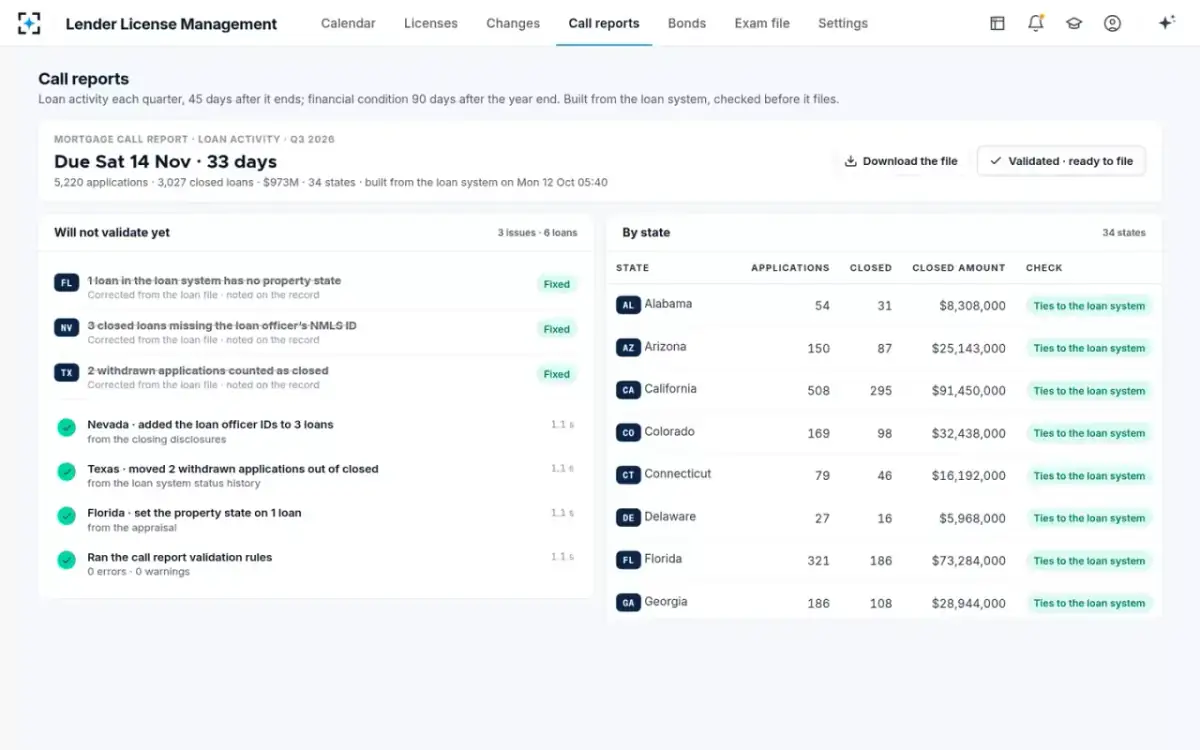
Applications are counted by state, which is how a loan in a state with no licensed originator stands out.
The other side of the comparison, who actually spoke to which borrower about what, lives in call recordings, email and the loan system's activity history, and testing it is a compliance review, not a licensing task. What the licensing record does is make that review possible: a current, cited list of who is licensed where, sponsored by whom, and through which date. The exam-ready licensing file shows how examiners use the same list.
A self-test for unlicensed originator activity
- List the roles that touch borrowers
Assistants, processors, closers, branch managers, call-center staff, contractors. Write down what each actually does at the application and when terms change.
- Compare HR’s roster with NMLS sponsorships
Every person who originates should appear as a sponsored, licensed individual in each state they work in.
- Test the loan system’s originator field
Every application should name a licensed originator for the property state. A blank or a mismatch is a finding.
- Read the scripts and templates
Assistant phone scripts, processor email templates and rate-change messages are where negotiation slips in.
- Check contractors separately
Independent contractor processors and underwriters need their own license even for clerical work.
- Read the marketing
Business cards, email signatures and rate sheets that say a person can take applications count as holding out.
Questions people ask
Does a loan processor need an NMLS license?
An employee processor doing only clerical or support work under a licensed originator does not. A processor who is an independent contractor does, and so does any processor who takes applications or presents terms, whatever their title.
Can an unlicensed assistant tell a borrower the rate?
Presenting particular loan terms to a borrower is offering terms under Regulation H, even if someone else set them. General explanations of loan terminology are not. Most lenders keep unlicensed staff out of rate conversations altogether.
Can a licensed loan officer take an application in a state where they are not licensed?
No. A license is granted state by state, for property in that state. The only bridge is temporary authority, which needs a pending application in the new state and a licensed employer there; a referral from another state is not one.
Does a salaried employee count as acting for compensation?
Yes. Regulation H reads "compensation or gain" as anything of value, including a salary or bonus, whether or not it depends on the loan closing. Only a genuine volunteer who expects nothing falls outside it.
Do closers and closing coordinators need a license?
Not for arranging the closing, as long as any talk about terms only confirms what the borrower already agreed. A closer who renegotiates fees or the rate at the table is offering terms.
Is the employer liable for an employee's unlicensed activity?
It can be. California's 2025 order penalized the lender, not the individuals, and priced each unlicensed employee the audit finds at $500. California also requires a lender to report a sponsored originator who fails to update their own record within five days of being asked.