All 50 states, the District of Columbia, Puerto Rico, Guam and the US Virgin Islands use NMLS to license mortgage companies, branches and loan originators, according to Virginia's 2026 report to its General Assembly on the system (Virginia SCC, July 2026). Across every industry it serves, NMLS is the official system for licenses "managed by 67 state or territorial regulators" covering "98 state-licensed nonbank financial activities" (CSBS Annual Report 2025). State licensing is how a non-bank lender earns the right to lend, state by state, and keeps it through yearly renewals, quarterly reports, bonds and notices of change. Botminds' Lender License Management puts all of those obligations for one lender on one calendar. The figures below describe the system around that calendar. Every one comes from a regulator, a statute or the Conference of State Bank Supervisors, which runs NMLS for the states.
The licensing map: one system, 67 rulebooks
67
state and territorial regulators license through NMLS
98
kinds of state-licensed non-bank financial business: mortgage, servicing, money services, consumer finance, debt
54
jurisdictions license mortgage companies, branches and loan originators in NMLS: 50 states, DC, Puerto Rico, Guam, USVI
2008
the year NMLS launched, with seven states
How many licensed loan officers are there in the US?
About 550,000. CSBS reports that NMLS "maintained the licenses or registrations of the more than 549,294 mortgage loan originators operating in the United States" in 2025 (CSBS Annual Report 2025). That count joins two groups the SAFE Act keeps apart: state-licensed originators, who work for non-bank lenders and brokers, and federally registered originators, who work for banks and credit unions and need no state license. No public figure splits the 549,294 cleanly between them. The CFPB's own paperwork estimate for the federal registration rule counts 261,638 respondents and 249,628 hours of work a year (Federal Register, February 2026), but that measures filings under the rule, not a head count, and should not be subtracted from the CSBS figure.
Licenses outnumber licensed people, because a state-licensed originator holds a separate license in each state where they take applications. That is why CSBS can count more than 915,000 loan originator and company licenses eligible to renew in 2026 against roughly 550,000 individuals, and why the licensing burden of a lender grows with the number of states each of its loan officers works in, not only with its headcount. The number is also rising: individual licenses eligible to renew were up 8% in 2025 and 9% in 2026 (CSBS, October 2025; CSBS, October 2026).
How many states use NMLS?
All of them, for mortgage licensing. NMLS "launched with seven states on January 2, 2008", and by 31 December 2025 every state and four other jurisdictions used it for mortgage companies, branches and originators (Virginia SCC). Coverage of other activities is wider than it once was but still varies: a consumer finance license, a servicer license or a debt collection license may or may not go through NMLS, depending on the state. NMLS itself "does not grant or deny licenses"; each regulator does, under its own law.
That split, one system and 67 rulebooks, is the heart of the licensing job. The form a lender files is uniform; the bond amount, the net worth test, the fee, the notice clock and the penalty for missing it are not.
How many mortgage companies are there in the US, and what share do they originate?
No public source counts mortgage companies alone, but the system-wide figure is 34,700 companies holding a state license in 2025, across all 98 licensed activities, and another 7,500 holding a federal registration, according to CSBS. State-licensed non-banks are not a fringe of mortgage lending; they are most of it. State-licensed mortgage companies "originated $1.2 trillion in loans (61% of mortgage originations in the United States)" and serviced $10.9 trillion, 47% of the national total.
Who holds the licenses: state-licensed lenders made 61% of US mortgages
34,700+
companies held a state license in 2025
549,294
mortgage loan originators licensed or registered through NMLS
61%
of US mortgage originations were made by state-licensed mortgage companies: $1.2 trillion
47%
of US mortgage servicing: $10.9 trillion
How many licenses renew in NMLS each year?
More than 915,000 mortgage licenses are eligible in the 2026 season alone. Every one of those licenses renews once a year, and most of them in the same eight weeks. For 2026, "MLOs and mortgage companies account for more than 915,000 state licenses eligible to be renewed" between 1 November and 31 December, with individual licenses up 9% and company licenses up 4% on 2025 (CSBS, October 2026). Alongside the annual cycle runs the quarterly one: the residential mortgage loan activity part of the mortgage call report is due 45 days after each quarter ends, on 15 May, 14 August, 14 November and 14 February (Washington DFI).
Mortgage licenses eligible to renew grew by 65,000 in one year
Two calendars every mortgage licensee lives on
61days
the renewal window in most states, 1 November to 31 December
45days
after each quarter, the loan activity call report is due
Virginia alone licenses 20,898 loan originators: one state's book
A single state's numbers show how much each regulator handles. At the end of 2025, Virginia alone had 20,898 loan originators approved through NMLS, plus 3,313 approved but inactive, along with 180 mortgage lenders, 713 brokers, 364 companies licensed as both, and 2,792 branch licenses (Virginia SCC). A lender licensed in Virginia is one of about 1,257 company licensees there, each renewing its company license and every branch every year.
Virginia's mortgage book at the end of 2025: nearly 17 loan originators for every company
What is the NMLS exam pass rate?
About half pass on the first attempt: in 2025, 13,237 of 25,159 first attempts at the national loan originator test passed, 52%, against 37% of retakes and 47% of all 39,089 tests (Virginia SCC). The pass mark is set in the SAFE Act at "not less than 75 percent correct answers" (12 U.S.C. 5104). Read as a pipeline, the 2025 figures mean that roughly 13,000 people a year clear the test on their first try, and nearly 14,000 retakes are spent by those who did not.
The national loan originator test in 2025: retakes pass less often than first attempts
How much are NMLS processing fees?
$120 a year for each company license, $25 for each branch and $35 for each loan originator license, on top of every state's own fees (NMLS). Those amounts date from 1 March 2025, the first increase "since the NMLS was launched in 2008", applied "to all industries on NMLS" (CSBS, February 2025); the company fee had been $100. Small per license, the fee scales with the count, which is the point of every number on this page: the bill, like the work, is set by licenses times states. What a license costs to keep adds them up with the hours.
Nearly 9,000 shared supervisory activities, and the orders that follow
States examine the companies they license, increasingly together. CSBS's State Examination System lets several states run one exam, and "state regulators have conducted nearly 9,000 supervisory activities through the system" (CSBS Annual Report 2025). Since 2025, every exam by the Multistate Mortgage Committee, which focuses on lenders and servicers operating in ten or more states, runs under a protocol called One Company, One Exam (CSBS, October 2024). The public record of what those exams find has also shifted: the CFPB rescinded its registry of non-bank orders from 29 October 2025 (90 FR 48760), which makes NMLS Consumer Access, with more than six million visitors in 2025, the main public view of state actions against licensees.
Exams are shared, and what they find is public
~9,000
supervisory activities run through the State Examination System to date
6M+
visitors to NMLS Consumer Access in 2025, where state actions against licensees are public
The enforcement record shows how the calendar becomes a penalty. Each case below is a state order against a licensee for a licensing duty rather than a lending practice.
Licensing duties that became state orders
| Duty missed | State and year | Outcome |
|---|---|---|
| Annual financial condition call report filed late | Connecticut, 2016 | $4,500 penalty; the order became a reportable NMLS disclosure event |
| Notice to the regulator of an indictment | New Jersey, 2026 | License revoked and $10,000 penalty, alongside a fraud count |
| Non-loan-officer staff doing originator work | California, 2025 | $160,000, plus $500 for each unlicensed employee an independent audit finds |
| Lending without a California Financing Law license | California, 2026 | $4 million, found when the company applied for the license |
Five dates from 2025 and 2026 that changed the numbers
Several of the figures above are moving, and the reasons are dated. Read together, they describe a licensing system that is getting busier, more consolidated in how it examines, and more public about what it finds.
What changed for state lender licensing in 2025 and 2026
| Date | Change | What it means for a licensing team |
|---|---|---|
| 1 March 2025 | NMLS processing fees rose for the first time since 2008, across all industries on the system. | A per-license cost that had not changed in 17 years; the board that runs NMLS reviews it every year. |
| 2025 | Every Multistate Mortgage Committee exam began running as One Company, One Exam. | A lender in ten or more states faces one coordinated request instead of overlapping ones. |
| 29 October 2025 | The CFPB’s registry of non-bank orders was rescinded. | State actions are seen through NMLS Consumer Access rather than a federal registry. |
| 16 September 2026 | CSBS released an AI Supervisory Framework for state examiners, covering state-licensed non-banks. | Examiners have a common set of questions about AI tools, including those used for compliance. |
| 21 October 2026 | CSBS announced 915,000+ mortgage licenses eligible to renew, with new disclosure and employment steps required first. | More licenses, and a prerequisite that has to be finished before the window opens. |
Two of these deserve a closer reading. The fee change is small per license, but it ended a long period in which the cost of the system itself could be treated as constant, and the board that governs NMLS reviews fees every year. The exam change is larger in effect. One Company, One Exam "right-sizes the number of agencies participating in the exam, and uses examination standards tailored to the size, complexity, and business activities of the company" (CSBS). For a 34-state lender, that means its licensing record is read as a whole, by states comparing notes, rather than piece by piece. A filing that is late in one state and on time in another is easier to see.
The numbers also show what they do not count. No public source counts surety bonds across states, measures the hours a licensing team spends per license, or tracks how many renewals are filed late. Those are the figures a lender has to produce for itself, from its own records, and they are the ones that decide its costs. The exam-ready licensing file takes the examiner's view of the same record.
What the numbers look like from inside one lender
The national figures describe a system; a licensing team experiences it as dates. Take a fictional sample lender as it runs through Lender License Management: Calder Ridge Lending holds 61 company licenses in 34 states, with 22 branches and 412 sponsored loan originators. Over twelve months that adds up to 268 filings: 113 renewals, 57 bond actions, 48 state reports, 38 change notices, 7 financial statements and 5 call reports. One new chief financial officer alone triggers 35 filings, and December holds 108. Sixty-one surety bonds, $4,200,000 in all, each have to stay in force past the renewal they secure.
None of those sample figures is a benchmark; they show the shape of the work at one size. The point the national numbers make is the same one: the volume is set by how many states a lender is in, and each state adds its own clocks. In the solution, six agents re-read each state's rules every Monday and the lender's NMLS records every morning, place each filing on that state's clock and draft it with its sources; the licensing manager attests and files. Renewal season shows what those 108 December filings are, and the change notice clock shows how one officer becomes 35 of them.
268 filings from one sample lender's twelve months, on one calendar
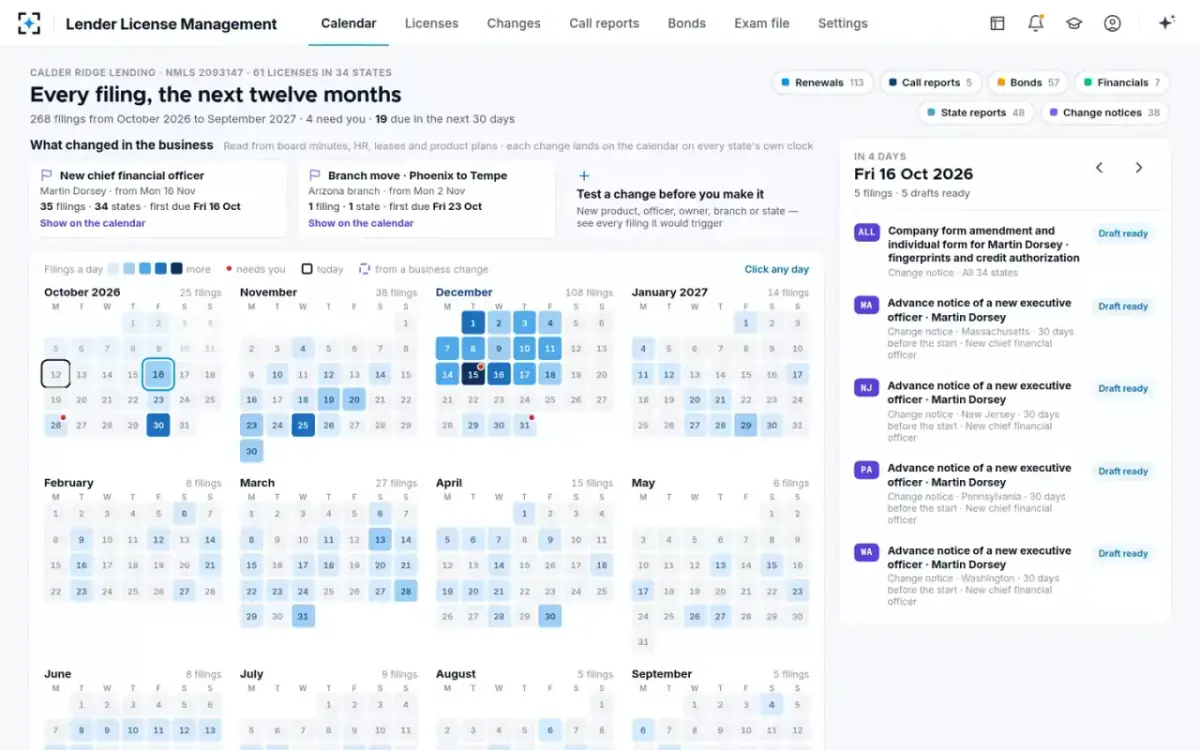
Six kinds of filing share one calendar; the counts at the top right add up to the 268.
Questions people ask
How many mortgage lenders are there in the US?
No regulator publishes a single count of mortgage lenders. NMLS reports 34,700 companies with a state license across all non-bank activities and 7,500 with a federal registration; one state's book gives the scale of the mortgage part, with Virginia alone licensing 180 lenders, 713 brokers and 364 companies that are both.
Is the number of licensed loan officers going up?
Yes, on the renewal counts. Individual state licenses eligible to renew rose 8% in the 2025 season and 9% in 2026, against 4% a year for company licenses, so each lender's originators are holding more licenses each.
How many people take the NMLS test each year?
In 2025 the national test was sat 39,089 times, of which 25,159 were first attempts. A candidate may retake it three times in a row, 30 days apart, before a six-month wait.
Does NMLS issue the licenses?
No. NMLS "does not grant or deny licenses"; each of the 67 state and territorial regulators does, under its own law. NMLS holds the forms, the fees, the education and test records and the public Consumer Access site.
What share of mortgage servicing do non-banks hold?
State-licensed mortgage companies serviced $10.9 trillion of loans in 2025, 47% of US mortgage servicing, on top of originating 61% of new loans. Servicing licenses renew in the same NMLS window as lending licenses.