AI for mortgage licensing compliance can do most of the work behind an NMLS filing and none of the parts that make it a statement. Reading each state's licensing law, comparing the company's NMLS record with HR's officer list, working out which states need notice of a new officer and by when, drafting a renewal with every answer cited: those are reading and assembly, and agents do them well. Answering the disclosure questions, attesting that a renewal is true and complete, and pressing submit are the licensee's own representations to a regulator, and a wrong one has consequences that attach to the company and the person. Botminds' Lender License Management draws its line there. This guide sets out the line task by task, why it sits where it does, and what regulators have said about AI in work like this.
State licensing, task by task: what an agent may do and what a person must do
| Task | An agent may | A person must | Why the line sits there |
|---|---|---|---|
| Read each state’s rules and checklists | Read statutes, regulations, guidance and NMLS checklists; write each obligation with its clock, amounts and source paragraph; re-read weekly. | Decide what an ambiguous rule means for the company. | Interpreting the law for the company is a judgment the company owns. |
| Keep the license record | Read NMLS every morning, read-only, and compare it with HR, the officer list and leases. | Resolve each difference between two systems. | Either side can be wrong; only a person can say which. |
| Draft renewals, reports and notices | Answer each question from a record, cite it, and leave unanswered anything no record answers. | Review the draft and answer what the agent could not. | A drafted answer is a proposal; the filing is a statement. |
| Disclosure questions | Point to the orders, actions and events in the records it reads that may bear on an answer. | Answer each question for the company or the individual. | The answers are the licensee’s representations about its own history. |
| Attest and submit | Nothing. | Attest that the answers are true and complete, and file. | An attestation binds the person who makes it; NMLS stays read-only to the agents. |
| Change-of-control notices and new licenses | Find the change, place every state’s filing, draft them. | Sign off (the Chief Compliance Officer, by default). | A change of control can open a regulator’s review of the company. |
| Bonds | Warn when a bond runs out before its renewal and draft the request to the surety. | Approve the premium (Finance) and send the request. | Spending and contracts with third parties stay with their owners. |
| Call reports | Build the report from the loan system, run the validation rules and propose each fix from the loan file. | Accept the fixes and file. | The report is the licensee’s report of condition. |
Can AI do NMLS filings?
It can prepare every filing, but it should not be the one that files. A renewal in NMLS is an attestation that the answers are true and complete, made by an identified person on behalf of the licensee. For 2026, NMLS also requires licensees to complete updated disclosure questions and the new employment reporting before they can submit a renewal at all (CSBS, October 2026). Those answers describe the company's and its people's regulatory, civil and criminal history. An agent can find the relevant records; deciding what they mean for each answer, and standing behind it, is a person's job.
The stakes of a wrong answer are concrete. A licensing order becomes part of the record the next filing has to disclose: a 2016 Connecticut consent order over a late call report recorded that it "is a public record and is a reportable event for purposes of the regulatory disclosure questions on NMLS" (Connecticut DOB). A missed fact in one state's filing can therefore travel into every other state's renewal. That is the reason the agents in Lender License Management never answer without a source, and turn anything no record answers into a question for a person.
Can AI attest a license renewal?
No, and a tool that offers to should be read as a warning. Accountability for a licensing filing cannot be delegated to software, whoever supplies it. The Federal Reserve's Consumer Compliance Outlook put the general rule plainly: "Although a financial institution may hire a reliable vendor, the institution remains responsible for ensuring that the output from vendor-provided systems and services meets regulatory requirements" (Consumer Compliance Outlook, 2019). An agent's draft is vendor output. The attestation is the moment the institution takes responsibility for it, and it should be taken by someone who has read it.
What licensing tasks can AI automate, and how much time does it give back?
The reading and assembly, which is most of the hours. Our estimate for a 34-state lender's renewal season done by hand is about 30 working days of licensing time: six re-reading state rules and checklists, five pulling records from NMLS, HR and leases, ten drafting, three chasing bonds, four placing change notices and two attesting and filing. With agents doing the first five, we estimate about six days: half a day each for rules, records, bonds and notices, two for reviewing drafts, and the same two for attesting and filing.
The line that does not move is the useful one to look at. Attesting and filing stays at two days because it stays with a person, and reviewing drafts takes two days because a person still reads every one. A tool that claims to shrink those two lines is not saving time; it is removing the review. What automation buys is the other 24 days, and with them the ability to do the reading in October instead of December, when a problem found still has time to be fixed. Renewal season shows where those days fall on the calendar.
Preparing a filing and making it: the two halves of every licensing task
Prepare (agents): Read every state’s rules and checklists, each obligation with its source paragraph.
Decide and attest (people): Settle what an ambiguous rule requires of the company.
Prepare (agents): Read NMLS, HR, leases and minutes; report differences with both values.
Decide and attest (people): Decide which value is right, and fix the source.
Prepare (agents): Place every filing on its state’s clock the day a change is found.
Decide and attest (people): Decide whether to make the change at all, having seen its filings.
Prepare (agents): Draft every answer from a record and cite it.
Decide and attest (people): Answer what no record answers; review the rest.
Prepare (agents): Queue the filing with its conditions written into it.
Decide and attest (people): Attest, sign and file; the name and time go on the record.
What do state regulators say about AI?
That existing law applies in full and that examiners will ask how the tool is governed; no regulator has written a rule about AI in state licensing filings. What exists points the same way. State examiners now have a tool for it: CSBS released an AI Supervisory Framework on 16 September 2026 "to support state examiners in assessing the use and risks of artificial intelligence (AI) at state-chartered banks and state-licensed nonbank financial institutions", and said institutions "can use the framework to assess their own AI programs, establish sound AI governance and risk management, and prepare for examinations" (CSBS, September 2026). Each state decides how far to use it.
Federal sources describe the same posture from their side. Regulators that use AI on data institutions file told the GAO "they were not using AI to make decisions autonomously or relying on it as a sole source of input" (GAO, May 2025). Treasury advises that AI use cases be checked "for compliance with existing laws and regulations before deployment" (Treasury, December 2024), and a Federal Reserve governor put it in one line: "AI is not exempt from current legal and regulatory requirements, nor is its use exempt from scrutiny" (Governor Bowman, November 2024). The interagency model risk guidance issued in April 2026 leaves generative and agentic AI outside its scope for now, pending a request for information (SR 26-2). The safe reading for a licensing team is that the law it already follows applies in full, and that examiners will ask who decided.
Financial institutions can use the framework to assess their own AI programs, establish sound AI governance and risk management, and prepare for examinations.
CSBS, AI Supervisory Framework announcement, September 2026
What is the CSBS AI supervisory framework?
It is a principles-based guide that state examiners can use to find, understand and assess the AI a bank or licensed non-bank uses, and to decide when a deeper review is warranted. CSBS describes it as "a discretionary tool", scaled to "each institution's size, complexity, risk profile, and use of AI", and built on three existing references: the National Institute of Standards and Technology's AI Risk Management Framework, the Cyber Risk Institute's financial services AI risk framework and Treasury's AI Lexicon (CSBS). It also tells institutions "the types of questions, and the information" an examiner may request about AI-based tools, which makes it the nearest thing a licensing team has to an exam script.
The NIST framework underneath it organizes AI risk work into four functions: govern, map, measure and manage (NIST). Read against a licensing tool, each becomes a question a team can answer in advance, and the answers are the documentation an examiner will want.
The four NIST functions, read as questions about an AI licensing tool
| Function | The question for licensing | What a good answer looks like |
|---|---|---|
| Govern | Who decided what the tool may do, and who is accountable for its output? | Written limits: read-only NMLS access, no attestation or submission, named approvers for each kind of filing. |
| Map | Which licensing tasks does it touch, and what goes wrong if it errs? | A task list like the one at the top of this page, with the consequence of a wrong answer for each. |
| Measure | How do you know it is right? | Every answer cites its source; rules carry the date last checked; differences between records are counted and resolved. |
| Manage | What happens when it is unsure or wrong? | Ambiguous rules and unclear changes route to a named person; every fix and every override is on the record. |
Where does AI for licensing compliance go wrong?
An agent that reads rules and records can fail in three distinct ways, and each calls for a different control. The first is a stale rule: a state amends its regulation, and the tool keeps applying last year's clock. The second is a wrong record: NMLS says one thing, HR another, and the tool picks one without saying so. The third is acting without authority: a tool that can submit will, sooner or later, submit something no one has read.
The controls follow from the failures. Against stale rules, every obligation carries its source paragraph and the date it was last checked, and the rules are re-read on a schedule, every Monday in Lender License Management, with changes reported rather than silently applied. Against wrong records, a difference between two systems is reported with both values for a person to resolve. Against acting without authority, the tool has no authority to act: NMLS access is read-only, and the drafter cannot attest or submit. None of these controls is unusual. They are what an examiner using the CSBS framework, or an internal auditor, would expect to see written down.
What should you ask an AI licensing compliance vendor?
Ask what the tool is not allowed to do before asking what it can do, then ask for proof that each answer can be traced. Many tools track license expiry dates and course hours; fewer read state rules, and fewer still draft filings with sources. Those are different products, and a lender should know which one it is buying. A tracker tells you a renewal is due. A drafting tool tells you what the renewal will say and where each answer came from, which is the only kind of output a licensing manager can review in minutes rather than redo.
Fit matters as much as features. The case for agents rises with the number of states, licenses and sponsored originators, because that is what multiplies the reading. A lender in three states with a dozen loan officers can run its calendar on a spreadsheet; one in thirty states with hundreds of originators, branches and bonds cannot keep every clock in a person's head. Lender License Management is built for the second case, and for teams that want the filing work done before the season rather than during it.
Six questions to ask of any AI tool used for licensing filings
- Can it submit or attest?
If yes, who decided that, and what stops it filing an unread draft?
- Does every answer cite a source?
A statute paragraph, an NMLS record, a financial statement page, a receipt. An answer without one is a guess.
- What happens when two records disagree?
The tool should report both values, not choose.
- How does it know a rule changed?
A schedule for re-reading each state’s rules, and a record of when each was last checked.
- What does it do with an ambiguous rule?
It should route it to a named person, not resolve it.
- Can an examiner follow what happened?
Every agent step, send, attestation and fix on one record, with the person and the time.
The six agents, and what each is barred from
Each agent in Lender License Management is defined as much by what it may not do as by what it does. The limits are not preferences; they are how the solution is set up, and they are visible to the people who use it.
Lender License Management: six agents prepare, two people decide
Agent
Rule readerReads each state’s licensing laws, regulations, guidance and NMLS checklists; writes each obligation with what is filed, when, the amounts and the source paragraph. Re-reads every Monday.
Never: guesses at an ambiguous rule; it goes to the Licensing Manager
Agent
License record keeperReads company, branch and individual records and electronic bonds from NMLS at 06:00 and compares them with HR, the officer list and leases.
Never: edits NMLS or resolves a difference alone
Agent
Business change watcherReads minutes, officer changes, product proposals, leases and ownership records; places each filing a change triggers on every state’s clock.
Never: files a tested change; unclear changes go to the CCO
Agent
Bond and net worth watcherTracks every bond against its renewal; drafts the request to the surety; counts net worth each state’s way.
Never: changes a bond amount; Finance approves every premium
Agent
Call report preparerBuilds the quarterly report from the loan system, runs the validation rules, proposes each fix from the loan file.
Never: files
Agent
Renewal drafterDrafts renewals, reports and notices 60 days before they are due, every answer from a record.
Never: attests, submits, or answers without a source
A person decides
Chief Compliance OfficerSigns off change-of-control notices and new licenses; decides unclear changes.
A person decides
Licensing ManagerAttests and files every renewal, report and notice; resolves ambiguous rules and record differences.
Where the line sits in practice
On a fictional sample lender with 61 licenses in 34 states, the line shows up in one dialog. The renewal drafter has prepared the California finance lender renewal with nine answers, eight ready and one waiting on a bond continuation from the surety. The licensing manager opens the attestation, which states what she is attesting to: the license number, eight of nine answers ready with the continuation asked, the fee. She attests; her name and the time go on the record, and the filing waits in a queue until the window opens and the certificate is attached. That renewal, day by day, follows the rest.
The one step no agent takes: the attestation
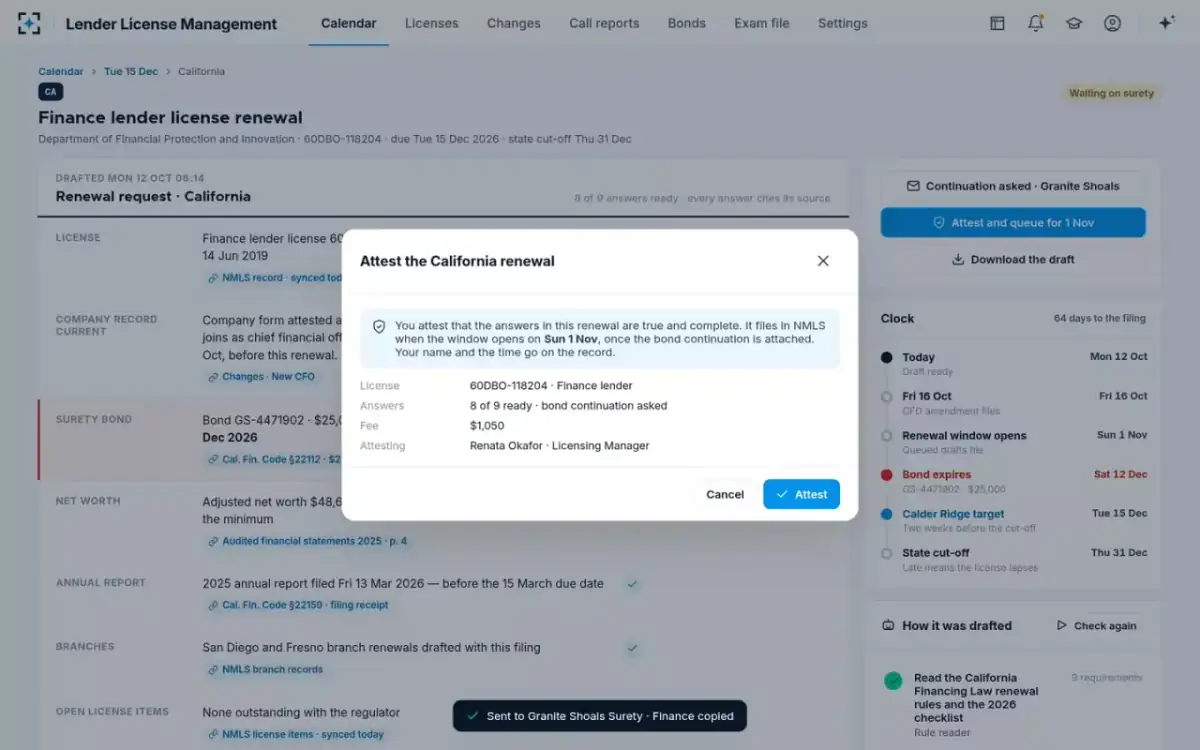
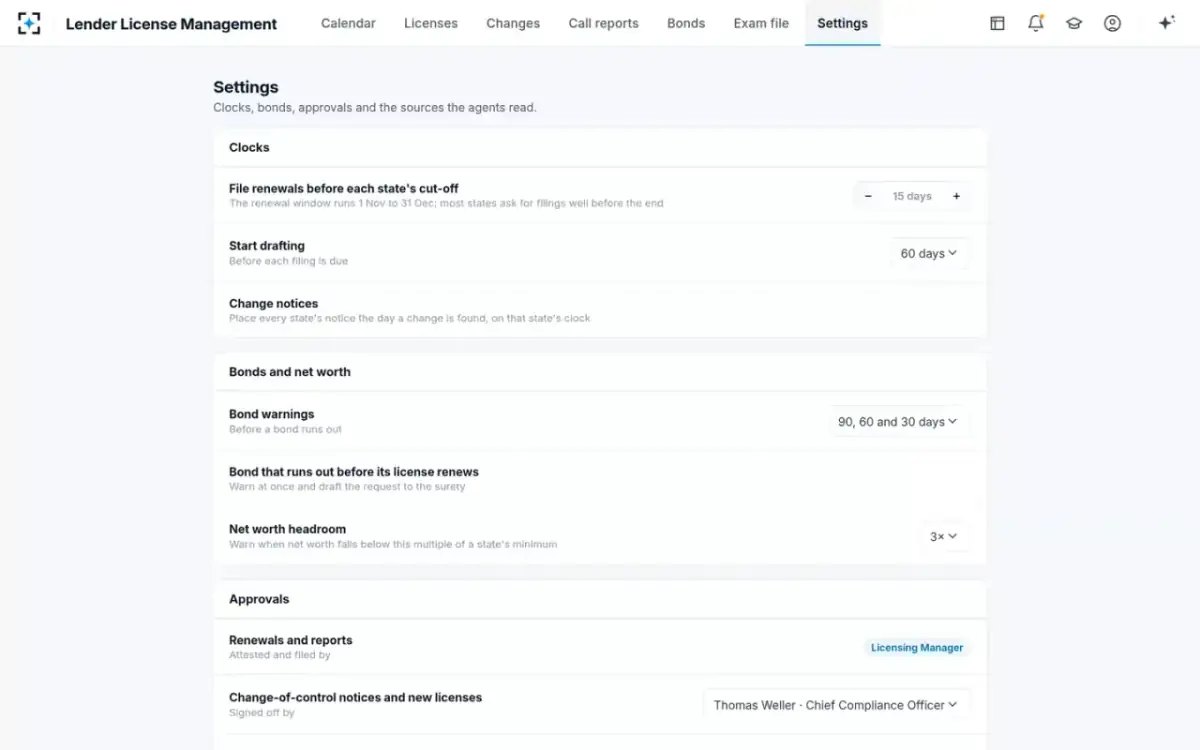
The other half of the line lives in settings. Who signs change-of-control notices and new licenses, who approves bond premiums, how early drafting starts and how far before each state's cut-off renewals file are choices the lender makes and can change. Whether an agent may attest or submit is not among them. The exam-ready licensing file shows how the same record of who did what answers an examiner's questions.
Approvals are settings; attesting is not delegable
Questions people ask
Is it allowed to use AI to prepare NMLS filings?
No statute or NMLS policy forbids preparing a filing with software, and nothing in either relieves the licensee of responsibility for it. NMLS filings end with an attestation by an authorized user, so whatever prepared the draft, a person at the company stands behind what is submitted.
Can AI answer the NMLS disclosure questions?
It can find the orders, actions and events in the records it reads that may bear on an answer. The answers themselves are the company's and each individual's statements about their own regulatory, civil and criminal history, and in 2026 the updated questions must be completed before any renewal can be submitted.
Will examiners ask about AI used for compliance?
They can. The CSBS framework gives state examiners questions and information requests about an institution's AI-based tools, covering state-licensed non-banks, and each state agency decides how far to use it.
Does AI replace a licensing specialist?
It changes the job more than the headcount. On our estimate, a 34-state renewal season falls from about 30 working days to about 6, and what remains is reviewing drafts, resolving the questions agents route to people, and attesting.
What is agentic AI in licensing compliance?
Software agents that each carry one task through several steps, such as reading a state's rules, comparing NMLS with HR, placing a filing on its clock and drafting it, and hand the result to a person. The word matters less than the limits: what each agent may read, what it may write, and what it may never do.