A non-bank lender must notify the state regulators that license it when it appoints a new executive officer, and the deadline depends on the state. In NMLS terms this is a change of control: a new chief financial officer is presumed to control the company, so the change runs through an amendment to the company record, the new officer's own individual filing, and whatever separate notice each state demands. Some want notice before the person starts, some within days after, some simply "promptly", and the definition of who counts differs too. For a lender licensed in 34 states, one board resolution therefore starts 34 separate clocks, plus an amendment to the company's NMLS record that every state reads. Botminds' Lender License Management was built for that moment: it reads board and committee minutes, HR's officer list, leases and product proposals, and places each filing a change triggers on each state's own clock. This guide walks through the rules, a worked example with a new chief financial officer, and what happens when a notice is missed.
From a line in the board minutes to 35 filings: who does each step in Lender License Management
Agent
Business change watcherReads board and committee minutes, the HR officer list, leases, product proposals and ownership records as they arrive, and recognizes a change that triggers filings.
Never: decides an unclear change; it goes to the Chief Compliance Officer
Agent
Rule readerSupplies each state’s rule for that kind of change: before or after, how many days, and which form, with the source paragraph.
Never: guesses at an ambiguous rule; it goes to the Licensing Manager
Agent
Renewal drafterDrafts the company form amendment and every state notice, with the new officer’s personal history attached, and links any renewal that would otherwise attest to a stale officer list.
Never: attests or submits
A person decides
Chief Compliance OfficerSigns off the notices due before the start date and any change-of-control notice.
A person decides
Licensing ManagerAttests and files each notice in NMLS or with the state; her name and the time go on the record.
Agent
License record keeperReads NMLS the next morning and confirms the company record now matches the officer list.
Never: edits NMLS; it reports differences with both values
Do you have to notify state regulators about a new officer?
Yes, in every state that licenses you, and usually in two ways at once. The company's record in NMLS must be amended so that the officer list is current, and many states also require a notice to the regulator in a set window, often with the new officer's own personal history attached. NMLS is one system, but it serves "67 state or territorial regulators" and each applies its own law (CSBS Annual Report 2025). The form is shared; the clock is not.
The trigger is broader than a new chief executive. Depending on the state, the same duty can attach to a new director, a new owner above a threshold, a new branch address, a new line of business, or a change in who handles complaints. And a renewal sits on top of all of it: when a company renews, it attests that its record is current, so an officer change left open in October becomes a false statement in December.
How many days do you have to notify the state of an officer change?
It runs from weeks before the change to a few business days after it, and each state sets its own number. The variation is easiest to see in the text of the rules. Four states, each read from its current regulation, give four different answers to the same question.
Notice of a new officer or other change: four states, four clocks
| State | What triggers it | The clock | What the rule says |
|---|---|---|---|
| Massachusetts | A change in control of ownership, or among officers, partners or directors | 15 days before the change | A notice "shall forthwith be filed", and the Commissioner may investigate "as if it were a new license". Control: 10% of the stock. |
| Virginia | Any change to address, principal officers or other NMLS information | Within 5 business days after it takes effect | "As soon as is practicable, but in no event later than five business days." Sponsorship changes within 5 days. |
| California | Any change to the company’s NMLS forms; an originator’s own form | Promptly; 20 days for an originator’s form | The licensee "shall … promptly file an amendment". An originator cannot renew until open changes are filed. |
| Maryland | A new line of mortgage activity; a new complaint designee | Within 10 business days after | Notice through NMLS. A "principal officer" includes the CCO and anyone, "regardless of title", who directs policy. |
Three things in the table matter more than the day counts. First, direction: Massachusetts counts back from the change, Virginia forward from it, so the same appointment can be late in one state before it has happened and not yet due in another. Second, consequence: a Massachusetts notice can open an investigation "as if it were a new license", which is why a lender wants it filed well before the start date, not on it. Third, scope: Maryland's definition reaches anyone "who has the power to direct the management or policies" of the business, whatever their title, so a new head of capital markets can count where a new chief marketing officer may not.
Who is a control person in NMLS?
Anyone who directly or indirectly has "the power to direct the management or policies" of the company, and NMLS presumes that power in four cases (NMLS Policy Guide). Executive officers are presumed to control: the policy guide names the chief executive, chief financial, chief operations, chief legal, chief credit and chief compliance officers, directors, and "individuals occupying similar positions or performing similar functions". So is anyone who can vote, or direct the sale of, 10% or more of a class of voting securities; the managing member of an LLC; and, in a partnership, anyone entitled to 10% or more of the capital.
The presumption has a filing attached. Every individual identified as a control person, qualifying individual or branch manager must complete the individual form, the MU2, which carries their personal history, disclosures and the authorizations for background checks (NMLS Policy Guide). A new chief financial officer is therefore not one amendment but two records: the company's MU1 naming them, and their own MU2.
State law then layers its own tests on the NMLS definition, and the states' tests cluster around the same three ideas: ownership above a percentage, a seat or title in senior management, and actual power to direct the business. Maryland lists them in one place: owners of 10% or more, directors and managers, named senior officers from the president to the chief compliance officer, and "an individual, regardless of title, who has the power to direct the management or policies" (COMAR 09.03.06.04). Massachusetts defines control of a corporation as acquiring 10% of the stock or the ability to elect a majority of the board (209 CMR 42.12).
The practical consequence is that a lender cannot rely on job titles. A licensing team needs the officer list from HR, the cap table from legal and the board minutes from the corporate secretary, and it needs them when they change, not at renewal.
How do you file a new officer or change of control in NMLS?
By amending the company (MU1) record, attaching the new person's individual (MU2) form, and filing an advance change notice first wherever a state requires one. NMLS describes the steps: create an MU1 amendment filing, edit the owners and control section, resolve the completeness checks, enter the advance change notice details and upload supporting documents if the state requires them, then attest and submit (NMLS). Amendments usually carry no NMLS fee, though some states charge for certain changes.
The step most teams underestimate is the advance change notice. NMLS says some amendments "must be reported in advance" before the effective date, and that the timing and documents "differ by state"; the state's amendment checklist in NMLS lists both. Ownership changes can need approval, not just notice. Indiana gives itself 120 days after receiving a change-in-control application to approve it, and advises licensees to notify it "at least 120 days prior to any planned consummation or merger transaction" (Indiana DFI). For an acquisition, that makes licensing a closing condition with a four-month lead time.
Filing a new chief financial officer in NMLS, in order
| Step | What it involves | Who |
|---|---|---|
| 1. Find every state that wants advance notice | Read each state’s amendment checklist for the change type; list the advance change notices with their dates. | Licensing |
| 2. Collect the new officer’s MU2 | Personal history, employment, disclosure answers, fingerprints and credit authorization, as each state requires. | The new officer, with licensing |
| 3. File the advance change notices | Through NMLS where the state accepts it, by letter where it does not, with supporting documents. | Licensing; sign-off by compliance |
| 4. Amend the MU1 | Update owners and control; resolve completeness checks; attest and submit. | An authorized company user attests |
| 5. File the after-the-fact notices | States that count forward from the effective date: within their business-day windows. | Licensing |
| 6. Remove the outgoing officer | The departure is a change too, with its own clocks. | Licensing |
One board decision, 35 filings: a worked example
Take a fictional sample lender as it runs through the solution. Calder Ridge Lending holds 61 company licenses in 34 states. Its board minutes of 7 October, item 4, record that Martin Dorsey will replace Elaine Fisk as chief financial officer on Monday 16 November. The business change watcher reads the minutes on Thursday 8 October at 09:12 and places 35 filings: the company form amendment that all 34 states read, then 34 state notices on four clocks. Four are due 30 days before the start, seven 15 days before, thirteen within 10 days after and ten within 30 days after.
The sample lender's 35 filings: the first is due eight days after the minutes are read
- 5 filingsFri 16 Oct
- 7 noticesFri 30 Oct
- Until the startMon 16 Nov
- 13 noticesWed 25 Nov
- 10 noticesWed 16 Dec
The shape of that timeline is the lesson. Twelve of the 35 filings are due before Mr Dorsey starts, and the first five fall on Friday 16 October, eight days after the minutes were read and a month before his first day. A team that learns of the appointment from an announcement email in early November has already missed them. The same change also reaches the renewals: the California renewal drafted on 12 October links its company record answer to the pending amendment, so it cannot attest to an officer list that is about to be wrong.
A new CFO found in the board minutes, with every state's filing placed
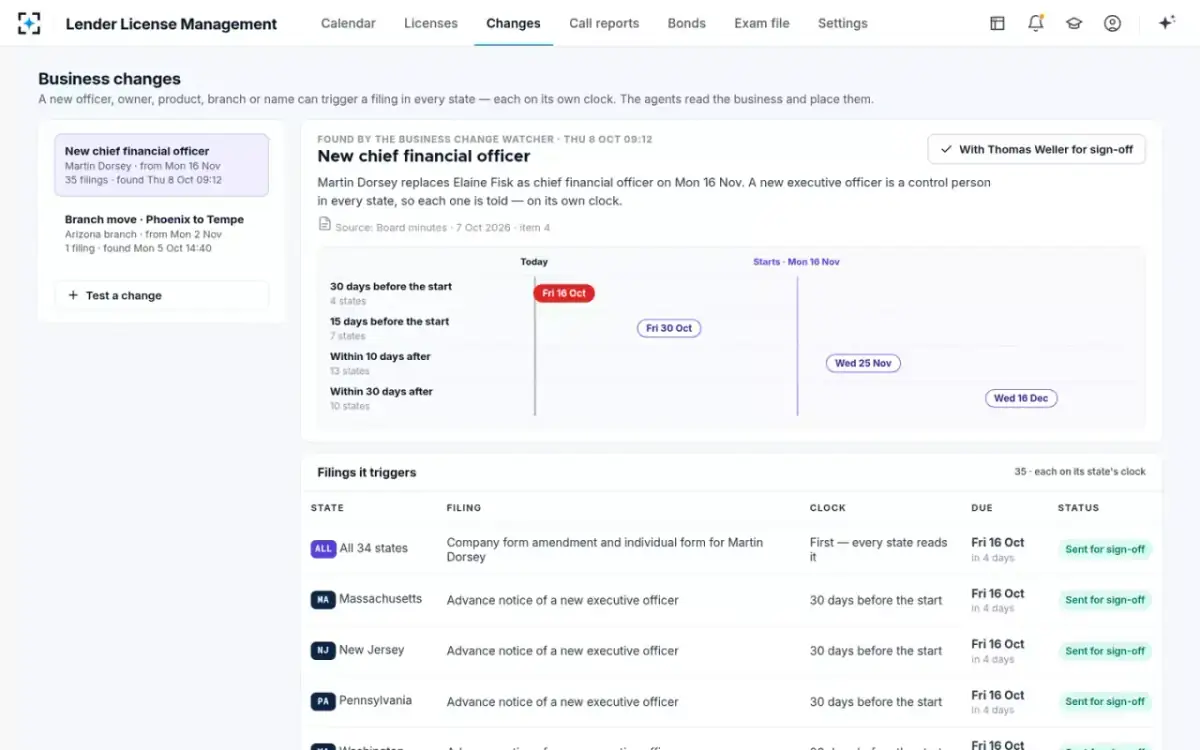
The state clocks on this sample screen show the spread between states; the table above gives four states' real rules.
Branches, addresses and new products: the smaller changes with the same clocks
Officers and owners get the attention, but most change notices at a growing lender come from smaller decisions: a branch moves, a head office changes floors, the company starts servicing loans it used to sell, a new product reaches a state where the existing license may not cover it. Each has its own rule, and the rules are as varied as the officer rules. California wants notice of an address change "at least ten days prior to the move", with a civil penalty of up to $500 for failing to give it (DFPI). Virginia counts five business days after an address or principal officer change takes effect (10VAC5-160-90). Maryland requires notice through NMLS within ten business days of beginning a mortgage activity, lender, broker or servicer, that the licensee did not designate when it was licensed or last renewed (COMAR 09.03.06.04).
A new product is the change with the widest reach, because it can need a license rather than a notice. A consumer loan offered through merchants, a servicing book bought from another lender or a home equity line can each fall under a different license type from the one a mortgage lender already holds, state by state. The time to find that out is before the product is approved, when the answer can still change the launch date or the list of states. In Lender License Management, a proposed change can be tested before it is decided: the agents read each state's rules for it and show the filings it would trigger, dashed on the calendar and worked back from the launch date, and none of them files unless the change goes ahead. Unlicensed in plain sight shows what lending ahead of a license has cost one company in California.
What a missed notice costs
A missed notice is a violation in its own right, and it rarely travels alone. In May 2026, New Jersey revoked a loan originator's license and imposed a $10,000 penalty; one of the two counts was that he "failed to notify the Department of the indictment" as its rules require (New Jersey DOBI, Order OCF26-08). The main count in that case was fraud, but the order states the notice duty as a separate violation, and New Jersey's statute treats "each violation" as "a separate offense" with a civil penalty of up to $25,000.
The less visible cost is what a stale record does to everything filed on top of it. Every renewal and many state reports restate the company's officers and owners. Massachusetts requires notice "within one business day" of a list of significant events, from a regulatory action in another state to a fall in net worth below the minimum, and automatically suspends a license whose cancelled bond is not replaced (209 CMR 42.12). Each of those obligations depends on someone noticing the event on the day it happens. And a consent order is itself, in the words of a 2016 Connecticut order, "a reportable event for purposes of the regulatory disclosure questions on NMLS" (Connecticut DOB), so one missed notice can surface again in every state at the next renewal. The licensing file an exam asks for shows how examiners test for it.
Massachusetts counts back from the change; Virginia counts forward from it. The same appointment can be late in one state before it has happened.
Placing every notice the day the change is found
The fix is to move the work to the day the change is decided, and to read the business rather than wait to be told. In Lender License Management, the change watcher reads the minutes, leases and proposals as they arrive, and the settings decide what happens next: change notices are placed the day a change is found, each on its state's clock, and change-of-control notices and new licenses go to the Chief Compliance Officer for sign-off. A change that has not been decided yet can be tested first, as described above, so the Chief Compliance Officer sees its filings before the board does.
Smaller changes follow the same path. On the sample lender, an Arizona branch moving from Phoenix to Tempe on 2 November produced one filing, a branch address amendment due on 23 October, and the Arizona company renewal in December is held until that amendment is approved.
The day a change is decided: six questions to answer
- Is this person a control person anywhere?
Test against each state’s definition: ownership, title and actual power to direct. Do not stop at the title.
- Which states count back from the change?
Advance notices are the ones a late announcement misses. List them first, with their dates.
- What does each notice need from the person?
Personal history, fingerprints, a credit report authorization. Ask the new officer in the first week, not the week before.
- Which renewals and reports restate the officer list?
Hold them until the amendment is filed, so nothing attests to a stale record.
- Who signs?
Decide who approves change-of-control notices before the first one is due.
- What else changes with it?
A new owner can change the net worth calculation; a new branch can need its own license and bond.
Questions people ask
Is a new officer the same as a change of control?
Not always. "Change of control" usually refers to ownership crossing a threshold, such as Massachusetts' 10% of the stock, and it can draw a regulator's review of the company; a new officer may be a separate, lighter notice. Massachusetts puts both in the same 15-day advance notice. Check how each state draws the line.
Does updating NMLS count as notifying the state?
Often, but not always. Virginia treats a written notice submitted through NMLS as compliance where the system allows it. Where a state wants a separate letter or form, the NMLS amendment does not replace it.
How long does a branch relocation notice take?
It varies by state and license. California's finance lender rules want the regulator told at least ten days before an address change; Virginia gives five business days after the change takes effect.
Does the outgoing officer need a filing too?
Yes. Removing a control person is an amendment to the company record like adding one, and states that want notice of a change in officers count the departure as a change. Virginia's five business days apply to both.
Is there an NMLS fee for a change of control amendment?
NMLS does not normally charge for MU1 amendments, though some states assess a fee for certain changes and NMLS asks for payment when one applies. An ownership change that needs state approval can carry an application-style review, as in Indiana's 120-day process.
Can a new officer start before the state approves?
For a notice-only state, yes, once the notice is filed on time. Where a state treats the change as needing review, as Massachusetts can "as if it were a new license", starting first leaves the regulator reviewing a change already made, which is why advance notices go out weeks before the start date.