What happens when a surety bond expires depends on the state, but in most it is the same in substance: the license loses a condition it is held on, and the renewal that relies on the bond cannot honestly be filed. A lender's surety bond and its license run on different calendars. The license renews each year in the NMLS window from 1 November to 31 December; the bond runs from its own anniversary, set when it was written. When the bond expires before the renewal it secures, the renewal has nothing to stand on, and the lender learns it either from a reminder email or from the regulator. The consequences can be immediate. In Maryland, when a lender's bond is cancelled or expires with no substitute in place, the licensee "shall immediately cease doing any business as a mortgage lender" and the license "is suspended" (COMAR 09.03.06.04).
Botminds' Lender License Management tracks every bond against the renewal it secures and warns at once when one will run out first. Take a fictional sample lender as it runs through the solution: Calder Ridge Lending, with 61 licenses in 34 states and 61 bonds worth $4,200,000 in all. Its California finance lender license renews in December. Its $25,000 bond expires three days before Calder Ridge means to file. The company, the people and the surety are invented; licensing managers will know the shape of the problem.
Two calendars for one California license: the bond runs out inside the renewal window
- In force12 Oct – 12 Dec
- Lapsed unless continued12 – 31 Dec
- Drafted, surety asked, attested, queued12 Oct – 1 Nov
- Window open; files once the certificate is attached1 Nov – 15 Dec
- Margin to the state’s cut-off15 – 31 Dec
What happens when a surety bond expires before renewal?
The license loses one of the conditions it is held on. The SAFE Act makes a net worth or surety bond requirement, or a state recovery fund, one of the minimum standards for a mortgage license (12 U.S.C. 5104(b)(6)), and state lending laws carry their own bond rules beside it. California's finance lender licensees must keep a surety bond in force, sized under the Department's rules (DFPI). A renewal attests that those conditions are met; one filed on a bond that will lapse before the license year begins attests to something about to be false.
States differ on what follows. Maryland suspends the license on the bond's termination and requires a new application if the gap lasts more than 30 days. Massachusetts requires notice within one business day if the licensee cancels its bond, and "shall automatically suspend the license until the Licensee has provided the required bond" (209 CMR 42.12). Neither state waits for the renewal to find the problem. The renewal is simply where the two calendars collide.
What happens if a surety bond is cancelled rather than expiring?
The license is exposed from the cancellation's effective date, and the surety has to give the regulator the notice the state requires before that date arrives. Not every bond expires: NMLS recognizes a "perpetual bond", one that "doesn't have an expiration date", which ends only when it is cancelled (NMLS). For a bond already delivered to the regulator, a notice of cancellation "must comply with state advance notice requirements", and the bond shows as Notice of Cancellation in NMLS until the date passes.
That status is the warning a licensing team can act on. Until the effective date, the surety can rescind the cancellation and the bond returns to Executed; after it, the surety can still reinstate the bond back to the cancellation date. Once cancelled, the bond is inactive in NMLS but, as NMLS puts it, "sometimes continues to hold the obligations" in its terms for what happened while it was in force. None of that helps the license: in Massachusetts a licensee that cancels its bond must tell the Commissioner within one business day, and the license is suspended until a replacement is in place (209 CMR 42.12).
Why bond dates and license dates drift apart
Because they are set by different people for different reasons. A license renews on the state's calendar, the same window every year. A bond runs from the day the surety wrote it, often the day the license was first applied for, or the day a bond was last replaced. A company first bonded in June can carry a June anniversary for years, while its license renews every December. Over dozens of states, the bonds' anniversaries scatter across the year and the renewals bunch at its end.
The amount can drift too. Some states scale the bond to the lender's loan volume, California among them for finance lenders that originate residential mortgages (DFPI), so a lender that grows can outgrow its bond as well as outlive it. A renewal attests to both: that a bond is in force, and that it is the right size. Neither is visible from the license record alone, and both live with Finance, which pays the premium, rather than with licensing, which files the renewal.
What is an NMLS electronic surety bond?
It is a license bond created, signed and delivered inside NMLS instead of on paper, so the regulator, the surety and the licensee all see the same bond, its amount and its status. NMLS built Electronic Surety Bond tracking because "many state laws or regulations require financial services licensees to obtain a surety bond as a condition of licensure", and the states define the amount (NMLS Policy Guide). In the electronic bond, the licensee is the principal and the state agency is the obligee; the surety company, or a bond producer it authorizes, writes the bond.
Two features matter for renewals. First, a bond is not finished when the surety signs it. It waits in Pending Principal Signature until the licensee, or an individual named on its record, signs too; only then is it Executed and delivered to the regulator (NMLS). Second, a change to a delivered bond, such as a new amount or term, travels as a rider, and only one rider can be open at a time: each must be signed by the licensee before the next can be created. A continuation the surety has issued but nobody at the lender has signed is, in NMLS, not yet a bond the regulator can rely on.
The life of an electronic surety bond in NMLS, and who moves it
| Status | What it means | Who acts next |
|---|---|---|
| Requires Rep Signature | The surety has entered the bond but not signed it. | The surety or its producer |
| Pending Principal Signature | The surety has signed; the bond is waiting for the licensee. | The licensee signs, or returns it to the surety for correction |
| Executed | Both have signed; the bond is delivered to the regulator (or held for a pending application). | Nobody, until a rider or cancellation |
| Notice of Cancellation | The surety has given notice; the state’s advance notice period runs. | The licensee finds a replacement, or the surety rescinds |
| Cancelled | Coverage has ended; the bond is inactive in NMLS. | The licensee, with a new bond; the license may already be suspended |
How much is the California finance lender bond?
$25,000 for a finance lender that does not originate residential mortgages, and $25,000 to $200,000 for one that does, scaled by its mortgage volume (DFPI). The Department sets four tiers for licensees whose loan originators make residential mortgage loans: up to $1 million of aggregate loans, $25,000; up to $50 million, $50,000; up to $500 million, $100,000; above that, $200,000. Net worth follows the same split: $25,000 for every licensee, and at least $250,000 at all times for one that employs loan originators and makes residential mortgage loans.
The tiers are why a bond can be the right length and the wrong size. A lender whose volume crosses a threshold during the year needs a rider raising the amount, and the renewal that follows attests to the new figure, not the old one. The sample license below is a finance lender license on the base $25,000 bond; its problem is the date.
California's finance lender bond grows with residential mortgage volume
Day 0, Monday 12 October: the draft that found it
The license record keeper reads NMLS at 06:00, read-only: company, branch and individual records and the electronic bonds. At 06:14 the renewal drafter has the California renewal request ready, 64 days before Calder Ridge's target date, with nine answers, each citing its source. Eight are ready: the license itself from the NMLS record; the 2025 annual report, filed on 13 March, from its receipt; adjusted net worth of $48,640,000 from page 4 of the audited 2025 financial statements; the San Diego and Fresno branch renewals, drafted with it. One is not.
The bond answer shows bond GS-4471902, $25,000, with Granite Shoals Surety Co., expiring Saturday 12 December. The margin note says what it means: "The bond runs out three days before this renewal. A license cannot renew on a lapsed bond — ask the surety for a continuation certificate." A second note links the company record answer to a change still pending: a new chief financial officer starts on 16 November, so the renewal will not attest to the old officer list.
The California renewal, drafted at 06:14 with every answer cited
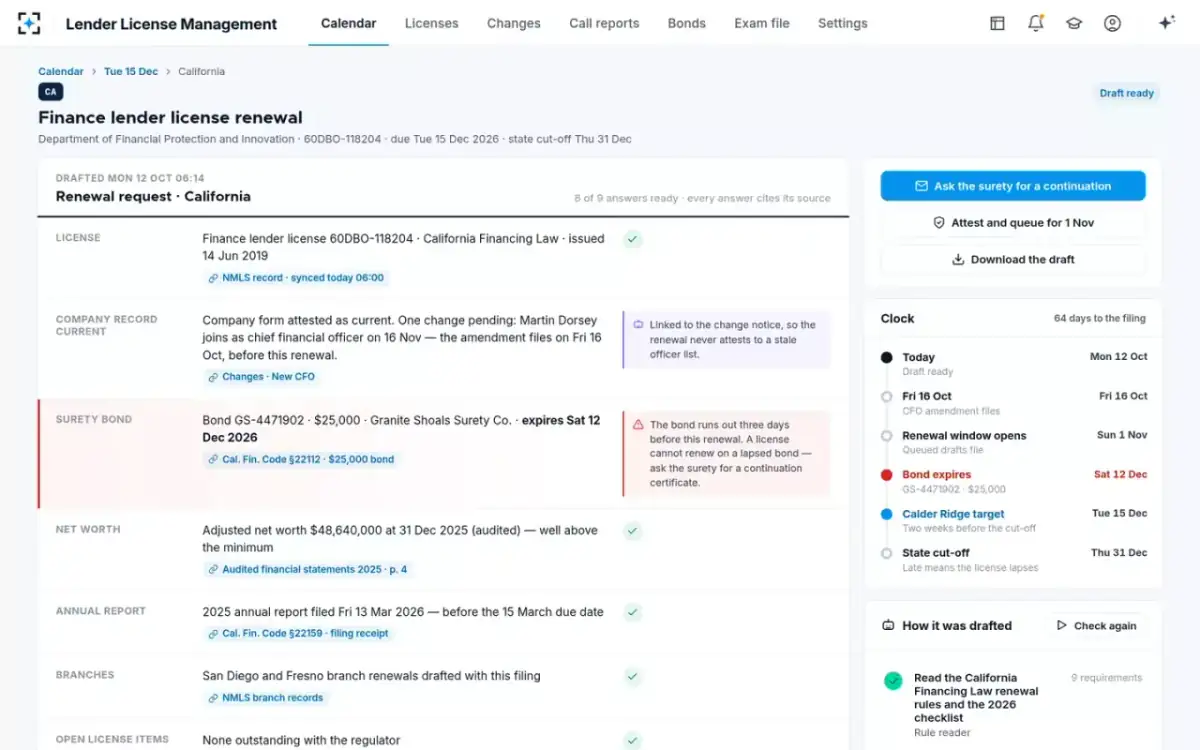
The clock is the point: the bond expires inside the renewal window, three days before the target.
Days 0 to 4: the continuation, the premium and the attestation
The bond and net worth watcher has already drafted the message to the surety's bond desk. Renata Okafor, the licensing manager, reads it: Dana Whitlock at Granite Shoals is asked to issue a continuation certificate for the bond, currently expiring 12 December 2026, to run to 12 December 2027, and to attach it to the electronic bond. Priya Nandakumar, the controller, is copied, because Finance pays the premium and approves it before any continuation is ordered. Renata sends it. On the bonds screen, the California line changes from a warning to "Asked today".
The request to the surety, already written
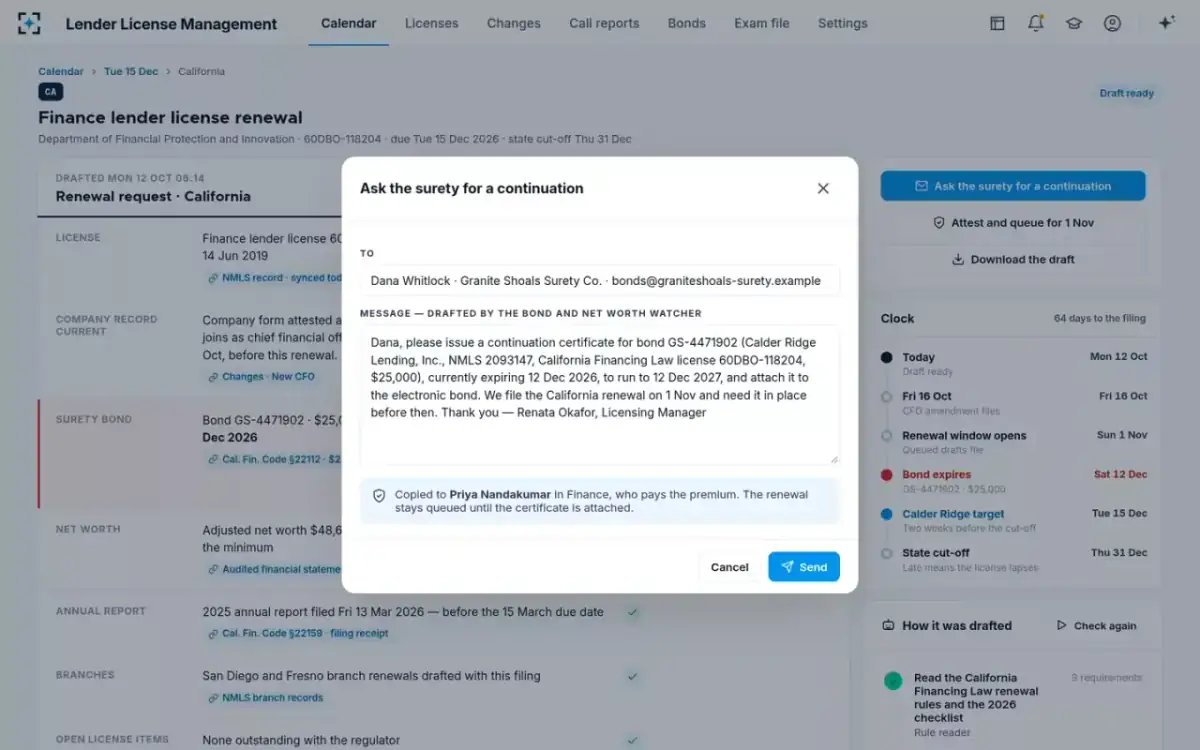
Then she attests. The attestation records what she is attesting to: license 60DBO-118204, eight of nine answers ready with the bond continuation asked, a fee of $1,050. The renewal is queued to file in NMLS when the window opens on Sunday 1 November, once the continuation is attached; her name and the time go on the record. In the same week, on Friday 16 October, the amendment for the new officer files, which settles the other open answer.
Attested, and queued until the certificate arrives
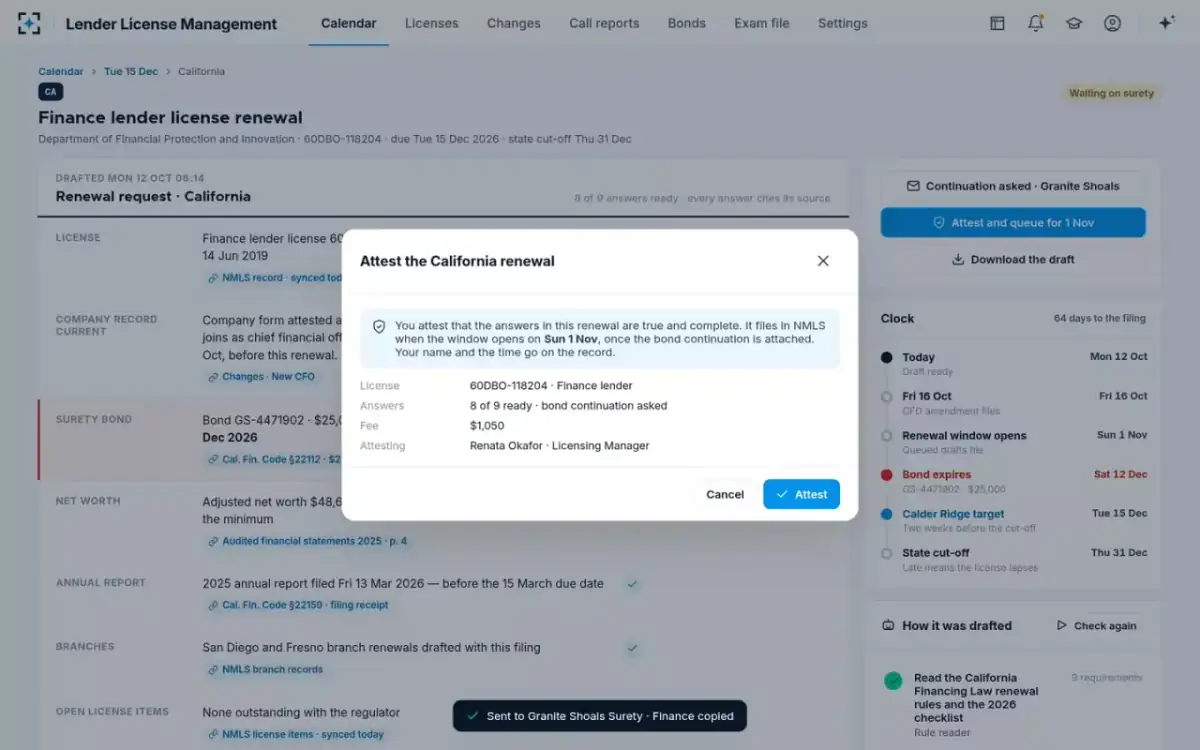
1 November: queued, not filed
The window opens and the renewal is ready, but it does not file on a promise. It stays queued until the certificate is attached to the electronic bond and the next morning's NMLS read confirms the new expiry date. That is a deliberate order of events. Filing first and fixing the bond later would leave a renewal in NMLS attesting to a bond that, on the day it was filed, ran out before the license year began.
The margin is what makes the order affordable. With the gap found on 12 October, the surety has seven weeks before the window's busiest days and two months before the bond's expiry. Found on 12 December, when a renewal drafted in a hurry first tries to cite the bond, the same certificate would have to be issued, paid for and attached inside nineteen days that also hold Christmas and the state's cut-off.
Found on 12 October, the gap gave the surety two months. Found on 12 December, it would have given nineteen days, with Christmas in them.
The two neighbors with the same problem
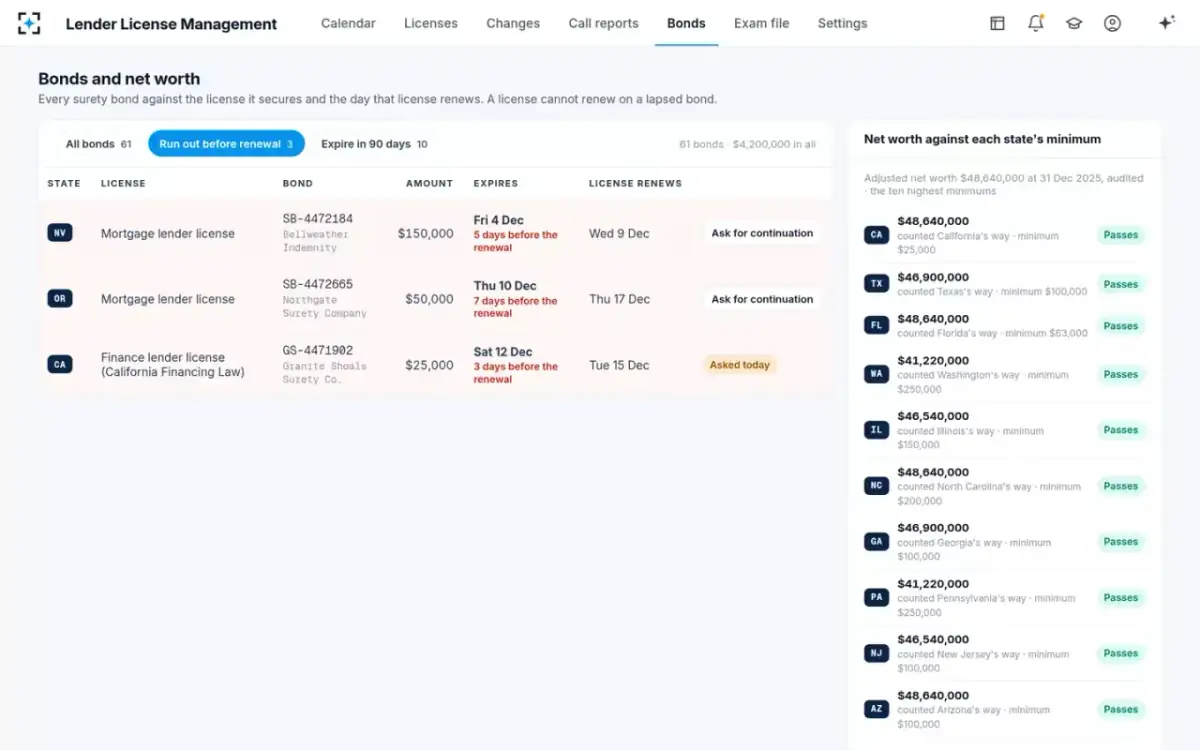
The California bond was not alone. Of the sample lender's 61 bonds, three run out before the renewals they secure. Nevada's $150,000 bond expires on Friday 4 December, five days before its renewal on Wednesday 9 December. Oregon's $50,000 bond expires on Thursday 10 December, seven days before its renewal on Thursday 17 December. The watcher flags all three at once, because "runs out before its license renews" is a rule, not a reminder. The standing warnings at 90, 60 and 30 days say that a bond is ending; they do not say that it ends before the renewal, and that is the fact that decides what to do and by when.
Three of the sample lender's 61 bonds run out days before the renewal they secure
The bonds screen sets each bond against the renewal it secures, with the ones that run out first on top and a button to ask for each continuation. Beside them, the watcher counts adjusted net worth each state's way against that state's minimum, because a renewal restates net worth as well, and warns when it falls below a multiple of the minimum the lender chooses; the default is three times.
Every bond against the renewal it secures
What the case teaches about bonds and renewals
The fix was not a better reminder. It was putting the bond and the renewal on the same calendar and comparing them as soon as the renewal existed in draft. Lender License Management does that comparison with five steps, two of them human.
How a bond gap is closed before the renewal window opens
Agent
Bond and net worth watcherSets every bond’s expiry against the renewal date of the license it secures; warns at once when the bond runs out first, and at 90, 60 and 30 days before any expiry.
Never: changes a bond amount
Agent
Bond and net worth watcherDrafts the continuation request to the surety, naming the bond, the license, the dates and the reason, with Finance copied.
A person decides
ControllerApproves the premium before any continuation is ordered.
A person decides
Licensing ManagerSends the request, then attests the renewal; it stays queued until the certificate is attached.
Agent
License record keeperReads the electronic bond in NMLS the next morning and confirms the new expiry date; only then does the queued renewal go ahead.
Never: edits NMLS
Five habits the case argues for
- Compare each bond with its renewal, not with today
A countdown to expiry misses a bond that ends a few days before a renewal two months away.
- Ask in October
A continuation needs the surety, the premium and the electronic attachment. Give it weeks, not days.
- Copy Finance at the start
Whoever pays the premium should see the request when it is sent, not when the invoice arrives.
- Never file on a promise
Hold the renewal until the certificate is attached and visible in NMLS.
- Know each state’s consequence
In some states a lapsed bond suspends the license at once, renewal or not.
The same pattern, two calendars that only meet at renewal, explains most of what makes renewal season hard. A bond is the clearest example because its expiry date is known the day it is written. What a license costs to keep puts a figure on the lapse it avoids.
Questions people ask
Can you renew a mortgage license with an expired surety bond?
Not in a state that requires the bond. The SAFE Act makes a bond, net worth or recovery fund a condition of the license, and a renewal attests that the conditions are met; in Maryland the license is suspended the moment the bond terminates, before any renewal is filed.
What is a surety bond continuation certificate?
It is the surety's written extension of a term bond for another period, so the same bond number stays in force without a new bond being written. In NMLS, a change to a delivered electronic bond travels as a rider, which the licensee must sign before it takes effect.
How much does a mortgage surety bond cost?
The state sets the bond amount; the surety sets the premium, and no regulator publishes a price for it. What a licensing team can plan is the amount, which in California runs from $25,000 to $200,000 with mortgage volume, and who approves the premium before it is ordered.
Who signs an electronic surety bond in NMLS?
Both sides. The surety or its authorized producer signs first; the licensee, or an individual on its NMLS record, then reviews and signs, and only then is the bond Executed and delivered to the regulator. A bond left waiting for the licensee's signature protects no one.
Does a cancelled bond still cover past claims?
It can. NMLS notes that a cancelled bond is inactive but "sometimes continues to hold the obligations" in its terms, which typically means claims for acts while it was in force. It does nothing for the license going forward.