State mortgage examination preparation, for a non-bank lender, means a licensing file that proves four things: that every required filing was made on time, that every change was notified, that everyone who originated was licensed in that state, and that every bond and net worth requirement was met throughout. State examiners now often arrive together. Since 2025, every multistate exam by the Multistate Mortgage Committee, which "focuses primarily on mortgage lenders and servicers operating in 10 or more states", runs under a protocol called One Company, One Exam (CSBS, October 2024). Botminds' Lender License Management keeps every filing, notice, bond and receipt on one record as the work is done, so the file exists before anyone asks for it. This guide turns four recent state orders into tests and shows what a file that passes them looks like.
A weak licensing file and a defensible one, item by item
Weak file: A spreadsheet row saying “renewed”, with the date someone remembers.
Defensible file: Each renewal with its NMLS submission receipt, the answers as filed, their sources, and who attested and when.
Weak file: The quarter’s file, re-exported from the loan system when asked.
Defensible file: Eight quarters of reports as filed, each with its validation result, the fixes made and the loan-file evidence for each.
Weak file: An email trail showing the officer change was “sent to licensing”.
Defensible file: For each change: the source (minutes, item), every state’s rule and clock, each notice with its receipt and sign-off.
Weak file: HR’s roster, with license numbers typed in at hire.
Defensible file: Each sponsored originator’s license and education by state, read from NMLS, and every loan tied to a licensed originator’s ID.
Weak file: The current bond certificate.
Defensible file: Each bond’s history against the renewals it secured, continuations with dates, and net worth as each state counts it.
Weak file: Unknown, or a name in an email signature.
Defensible file: Every send, attestation, fix and approval on one activity record with the person and the time.
How does a mortgage company prepare for a state examination?
Start from what the examiner will test, not from what the company happens to have. State regulators have the authority, required of every SAFE Act licensing system, to examine "any books, papers, records, or other data of any loan originator operating in the state" and to summon the people who hold them (Regulation H, §1008.111). An exam usually opens with a request letter listing what to produce and by when, followed by fieldwork. For a multistate lender the request increasingly comes through CSBS's State Examination System, through which "state regulators have conducted nearly 9,000 supervisory activities", with "one point of contact" and "fewer single-state exams" (CSBS Annual Report 2025).
What is the Multistate Mortgage Committee, and what is One Company, One Exam?
The Multistate Mortgage Committee is the body of state mortgage regulators, appointed by CSBS and the American Association of Residential Mortgage Regulators, that "represents the examination interests of the combined states" and focuses on lenders and servicers licensed in ten or more states (CSBS). One Company, One Exam is the protocol under which it has run every multistate mortgage exam since 2025. One Company, One Exam changes the shape of the request rather than its content. The protocol "right-sizes the number of agencies participating in the exam, and uses examination standards tailored to the size, complexity, and business activities of the company", and its pilot taught the committee to "streamline the process and eliminate similar" state requests (CSBS). For the lender, that means one consolidated list, with every licensing state's interest folded into it, and less tolerance for answering the same question differently in two states.
State exams of non-bank lenders, by the numbers
10+states
the Multistate Mortgage Committee’s main focus: lenders and servicers licensed this widely
2025
since then, every MMC multistate exam runs as One Company, One Exam
~9,000
supervisory activities run through the State Examination System to date
What do state mortgage examiners review in the licensing file?
Whether the company was licensed for everything it did, on every day it did it, and whether every person and loan can be tied to a license. Regulation H requires each state to be able to examine "any books, papers, records, or other data of any loan originator operating in the state" (§1008.111), and the licensing part of an exam usually moves from the company's licenses outward to its people and its loans.
The loan file is where licensing becomes testable. Regulation Z requires the lender's name and NMLS ID, and the name and NMLS ID of the individual originator with primary responsibility for the loan, on four documents: the credit application, the loan estimate and closing disclosure, the note and the security instrument (12 CFR 1026.36(g)). An examiner can take any sampled loan, read the originator's ID from the note, look the person up in NMLS and check that they were licensed in the property's state on the application date. A loan that fails that check is an unlicensed-origination finding, whatever the company's licensing spreadsheet says. Preparing for the exam means running the same check first, on every loan in the period, not on a sample.
Four state orders, and the test each one becomes
The fastest way to see what an examiner will look for is to read what regulators have penalized. Four orders, each over a licensing duty rather than a lending practice, translate directly into tests a file can be held to.
Four licensing failures, and the test each one becomes
| The order | What failed | The test for your file |
|---|---|---|
| Connecticut, Lightning Mortgage, 2016 | The annual financial condition call report, due 30 March, was filed late. The late filing also revived an allegation from a 2013 consent order. $4,500 penalty; the order became a reportable NMLS disclosure event. | Can you show the receipt and filing date for every call report in the exam period, and that each was on time? |
| New Jersey, Order OCF26-08, 2026 | A loan originator failed to notify the Department of his indictment, a separate violation alongside the main fraud count. License revoked; $10,000 penalty. | For every event your rules require you to report, can you show when you learned of it and when you notified each state? |
| California, Fairway, 2025 | Non-loan-officer staff at one branch did originator work without licenses. $160,000, plus $500 for each unlicensed employee an independent audit finds. | Can you tie every application to a licensed originator in the property’s state, and show what unlicensed staff are permitted to do? |
| California, Navitas, 2026 | Lending without a California Financing Law license, discovered when the company applied for one. $4 million. | For every state and product, can you show the license that covered it on the date of each loan? |
The Connecticut case repays a closer look, because it shows how a small filing failure grows. The company's "failure to timely file formed the basis to revive the allegation" from a consent order three years earlier, and the new order acknowledged that it "is a public record and is a reportable event for purposes of the regulatory disclosure questions on NMLS" (Connecticut DOB). A $4,500 penalty in one state became a disclosure the company had to make in every state at every renewal after it. That is the general shape of licensing risk: penalties are usually modest, and their afterlife in the record is not.
When are mortgage call reports due, and what does a late one cost?
The loan activity part is due 45 days after each quarter ends, on 15 May, 14 August, 14 November and 14 February, and the financial condition part follows the company's fiscal year (Washington DFI). Washington's page, written for mortgage brokers, gives the financial condition component as due within 90 days of fiscal year end; other states and license types set it differently, and lenders should read each state's requirement rather than assume one schedule. The annual audited financial statement is a separate NMLS filing, also due within 90 days of fiscal year end, as a searchable PDF whose key figures must match the statement to the dollar (NMLS).
A late report is penalized on its own, and the penalty is the smaller cost. Connecticut fined one lender $4,500 for a financial condition report due 30 March 2016 and filed late, and the late filing revived an allegation from a consent order three years earlier (Connecticut DOB). Deadlines can also move in a lender's favor: Washington once gave licensees a 60-day grace period for a first-quarter report, which is a reason to read each state's notices rather than a fixed calendar.
The mortgage call report year, and the annual statement beside it
| Filing | Covers | Due |
|---|---|---|
| Loan activity, Q1 | 1 January – 31 March | 15 May |
| Loan activity, Q2 | 1 April – 30 June | 14 August |
| Loan activity, Q3 | 1 July – 30 September | 14 November, inside the renewal window |
| Loan activity, Q4 | 1 October – 31 December | 14 February |
| Financial condition | The fiscal year (brokers, in Washington’s schedule) | Within 90 days of fiscal year end |
| Annual financial statement | The fiscal year, audited or as each state requires | Within 90 days of fiscal year end, through NMLS |
The call report is the exam's first data
The mortgage call report is the one licensing filing that is also data about the business, and examiners read it before they arrive. The SAFE Act requires each mortgage licensee to submit "reports of condition" through NMLS (12 U.S.C. 5104(e)), and states such as Virginia require them quarterly (10VAC5-160-90). Volumes by state, closed loans, withdrawn applications and loan originator IDs in the report are what an examiner compares with the loan files. A report that counted withdrawn applications as closed, or named no licensed originator on a loan, has told the examiner where to look.
That makes validation before filing the cheapest exam preparation there is. Take a fictional sample lender as it runs through the solution: Calder Ridge Lending's third-quarter 2026 report, built from its loan system on 12 October, covered 5,220 applications and 3,027 closed loans worth $973 million across 34 states. It would not validate at first. One Florida loan had no property state, three Nevada loans lacked the loan officer's NMLS ID, and two Texas withdrawn applications were counted as closed. Each fix came from the loan file, the appraisal, the closing disclosure or the status history, and is recorded beside the report.
Each fix to the call report, with the loan file it came from
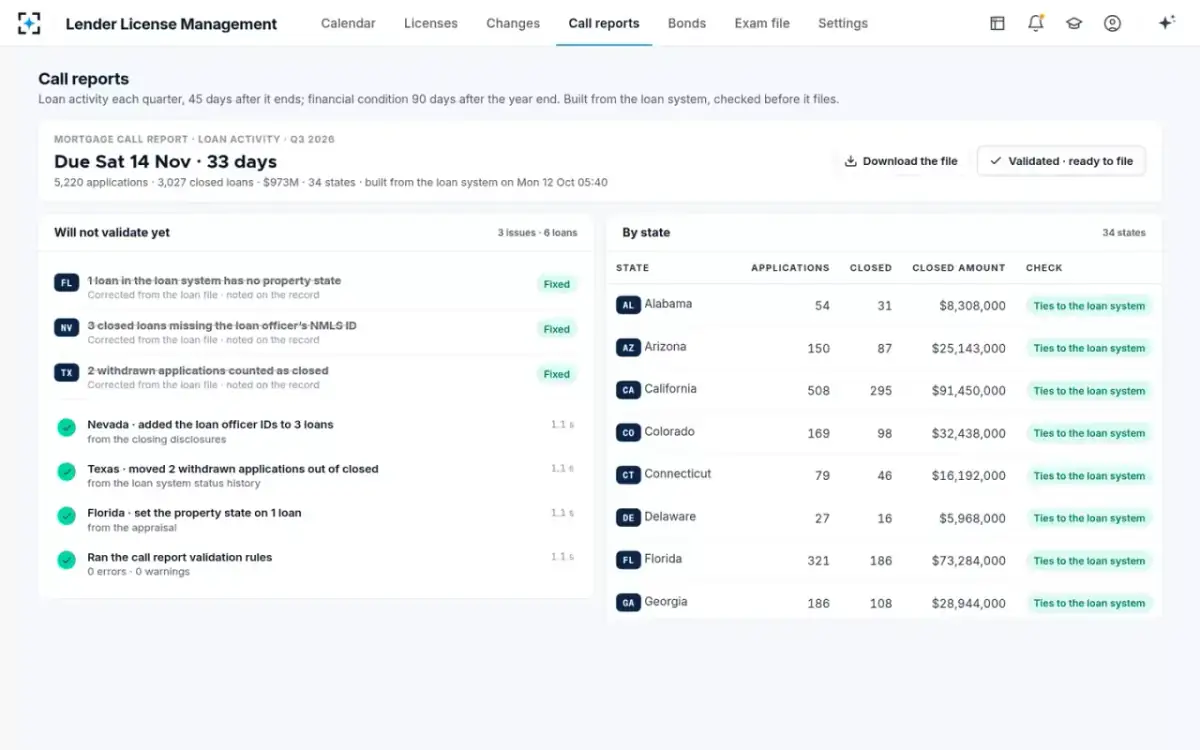
The fix sources (closing disclosure, status history, appraisal) are the documents an examiner would pull.
What documents are on a state exam request list?
Expect the licensing record itself first, licenses, renewals, call reports, bonds and change notices with their receipts, and then the policies, training and complaint records that show how the company runs. If every filing, receipt and decision is recorded as it happens, most of an exam request is a retrieval, not a project. On the sample lender, the Washington Department of Financial Institutions sends a request letter on 28 September 2026 with 46 items: documents due Monday 26 October, fieldwork from Monday 9 November. Thirty-two items are already gathered from the filing record, each with its submission receipt: licenses and certificates, renewal filings from 2024 to 2026, eight quarters of call reports with their validation records, and surety bonds with their riders. The remaining 14, among them change notices, policies, loan originator education and the complaint log, are gathered by the agents from the record or requested from their owners.
An examiner's request list, gathered from the filing record
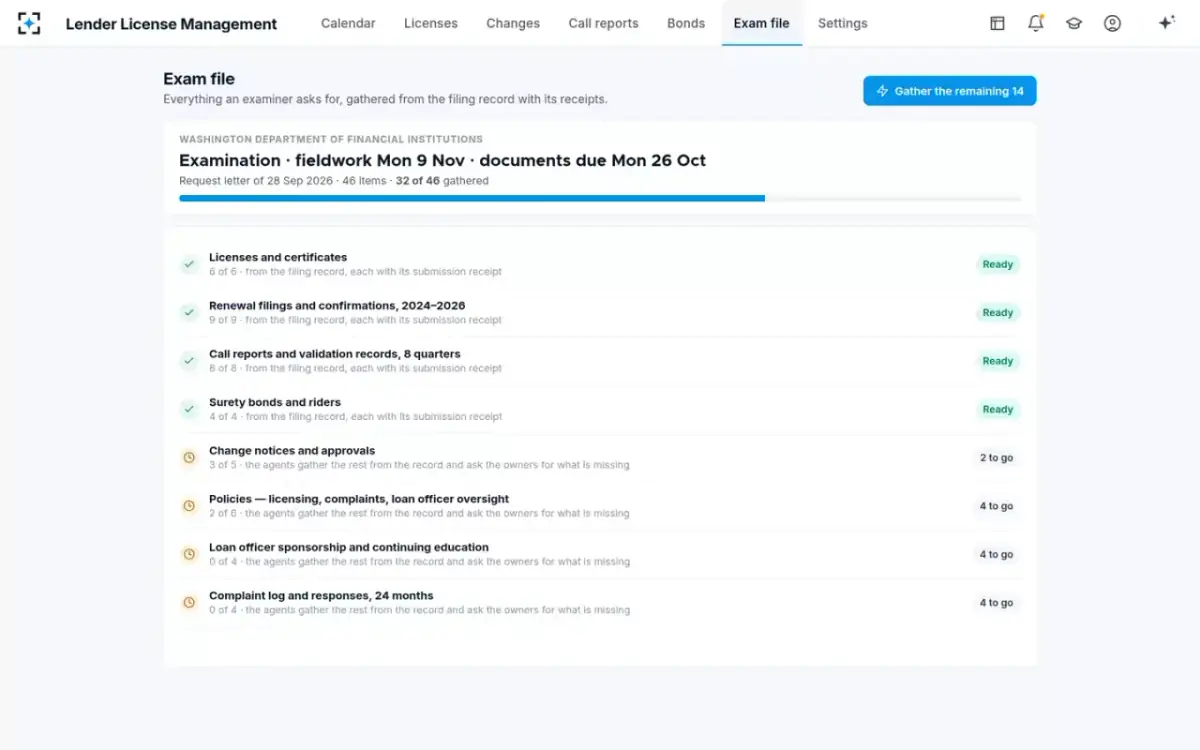
The split on that screen is where the work is. Filings are easy to evidence when they were made through one record. Policies, training and complaint handling live elsewhere and still need their owners. A licensing team that knows on day one of the request which 14 items those are has four weeks to gather them rather than four days. Who attests and files explains why every item carries a person's name and a time, and the change notice clock covers the notices that most often leave gaps.
Eight questions to answer before the request letter arrives
- Every renewal in the exam period, with its receipt
And the answers as filed, not as they would be answered today.
- Every call report, on time, with validation
Filing dates against the 45-day deadline; the fixes and their sources.
- Every change notice, against its clock
The date you learned of the change, each state’s deadline, the date filed.
- Every originator, licensed in each loan’s state
Loan originator IDs on every loan, matched to NMLS licenses on the loan date.
- Every bond, in force throughout
Expiry and continuation dates against each renewal.
- Net worth, each state’s way
The figure each state’s definition produces, against its minimum, at each reporting date.
- Every disclosure answer, supported
The orders and events behind each answer, including reportable events from other states.
- Who did each thing, and when
An activity record an examiner can follow without a guide.
One record, read by every state at once
A multistate exam rewards consistency more than any single filing does. Under One Company, One Exam the participating states examine one company together, through one coordinated request, and the State Examination System lets them "review exams from other state regulators" and "determine if institutions are meeting supervisory expectations across multiple states" (CSBS Annual Report 2025). The same officer change notified in one state in October and in another in January, or a bond that lapsed in one state and not in its neighbors, is easier to notice when the states compare notes.
The practical test is whether the company can answer one question the same way everywhere. When did you learn that the chief financial officer was changing? When did each state hear about it? Which bond secured each license on each day of the exam period? A file built state by state, in separate folders by separate people, tends to answer those questions slightly differently in each state. A file built from one record of filings, receipts and decisions answers them once.
Findings have a longer life than the exam. An order that follows an exam is public, and it becomes part of what the company must disclose in its NMLS record and at every renewal. The Connecticut order above was over a single late report, and it carried that consequence. The cheapest finding is the one that is never made, and in licensing most findings are about dates the company already had.
Questions people ask
What is the penalty for filing a mortgage call report late?
It is set state by state. Connecticut's 2016 order against a lender for a late financial condition report imposed $4,500 and became a reportable NMLS disclosure event; repeat or prior issues raise the stakes.
Do state examiners review licensing, or only lending?
Both. Licensing records, call reports, originator licenses and notices are the regulator's own instruments, and the orders above show each one tested and penalized on its own.
What is the State Examination System?
CSBS's shared platform through which several states run one exam of a licensed company, exchange findings and handle complaints. State regulators have run nearly 9,000 supervisory activities through it, and 25 state agencies have managed 8,700 consumer complaints in it.
Are annual financial statements filed through NMLS?
Yes, within 90 days of fiscal year end, as one searchable PDF of up to 8MB. The key financial figures typed into the filing must match the attached statement to the dollar, and the filing is attested before it is submitted.
Which loan documents must show the NMLS ID?
Four, under Regulation Z: the credit application, the loan estimate and closing disclosure, the note and the security instrument. Each must carry the lender's name and NMLS ID and the name and ID of the originator primarily responsible for the loan.
Is an order that follows an exam public?
Yes. State actions against licensees appear on NMLS Consumer Access, which drew more than six million visitors in 2025, and a consent order is typically a reportable event the company must disclose in NMLS from then on.