The NMLS renewal period for 2026 opens on 1 November and, in most states, closes on 31 December. Every state license a mortgage company, branch or loan originator holds through the Nationwide Multistate Licensing System must be renewed inside those eight weeks, and this year more than 915,000 mortgage licenses are eligible (CSBS, October 2026). The work is hard because each renewal rests on things that change all year: a bond, a net worth figure, an officer list, a branch lease, a loan officer's education hours. Botminds' Lender License Management exists to keep those facts current between seasons, so that renewal week is attestation rather than archaeology. This guide sets out the dates, what changed for 2026, what a miss costs, and where a licensing team's December actually goes.
The licensing year, drawn to scale: renewals land in 61 days
- Late renewal1 Jan – 28 Feb
- Between seasons: amendments, bonds, education1 Mar – 31 Oct
- NMLS renewal window1 Nov – 31 Dec
- Q4 reportdue 14 Feb
- No report due
- Q1 reportdue 15 May
- No report due
- Q2 reportdue 14 Aug
- No report due
- Q3 reportdue 14 Nov
- No report due
When does NMLS renewal start, and when is it due in 2026?
NMLS renewal starts on 1 November and is due by 31 December 2026 in most states, for companies, branches and state-licensed loan originators alike. Federally registered loan originators at banks and credit unions renew their registrations in NMLS by the same 31 December. A license renewed in the window runs for the next calendar year; Virginia's rule is typical in saying a license "shall expire at the end of each calendar year unless it is renewed by a licensee on or after November 1" (10VAC5-160-90).
Two things are new this year. Before a licensee can submit a renewal request at all, it must complete NMLS's updated disclosure questions and the new employment reporting. CSBS said on 21 October that "approximately 80% of individuals and companies have completed the new requirements", which leaves about one in five with a prerequisite still open as the window opens. The volume is also higher: individual licenses eligible for renewal are up 9% on last year and company licenses up 4%, after a 2025 season of more than 850,000 (CSBS, October 2025).
NMLS renewal season 2026 in four numbers
915k+
more than 915,000 mortgage company and loan originator state licenses eligible to renew
61days
from 1 November to 31 December, the window in most states
+9%
individual licenses eligible to renew, against last year; company licenses +4%
~80%
of individuals and companies had finished the new disclosure and employment steps by 21 October
Why one sample lender's December holds 40% of its filings
On one sample calendar, because renewals are not the only thing that falls due in the window, and a lender sets its own internal deadline well before the state's. Take a fictional sample company as it runs through the solution: Calder Ridge Lending holds 61 company licenses in 34 states, with 22 branches and 412 sponsored loan officers. Its calendar from October 2026 to September 2027 holds 268 filings. December alone holds 108 of them, and the busiest day, Tuesday 15 December, holds 14.
One sample lender's twelve months: 108 of 268 filings fall in December
The December bar is not only renewals. It carries bond continuations that have to be in place before the renewal they secure, branch renewals that travel with each company license, loan officer renewals that depend on each person's education hours, and change notices that a renewal cannot attest past. Calder Ridge also files about two weeks before each state's cut-off, so a state that closes on 31 December appears on its calendar in mid-month. That is a choice most licensing teams make for a good reason, as the next section shows.
The darkest day on the sample calendar, opened
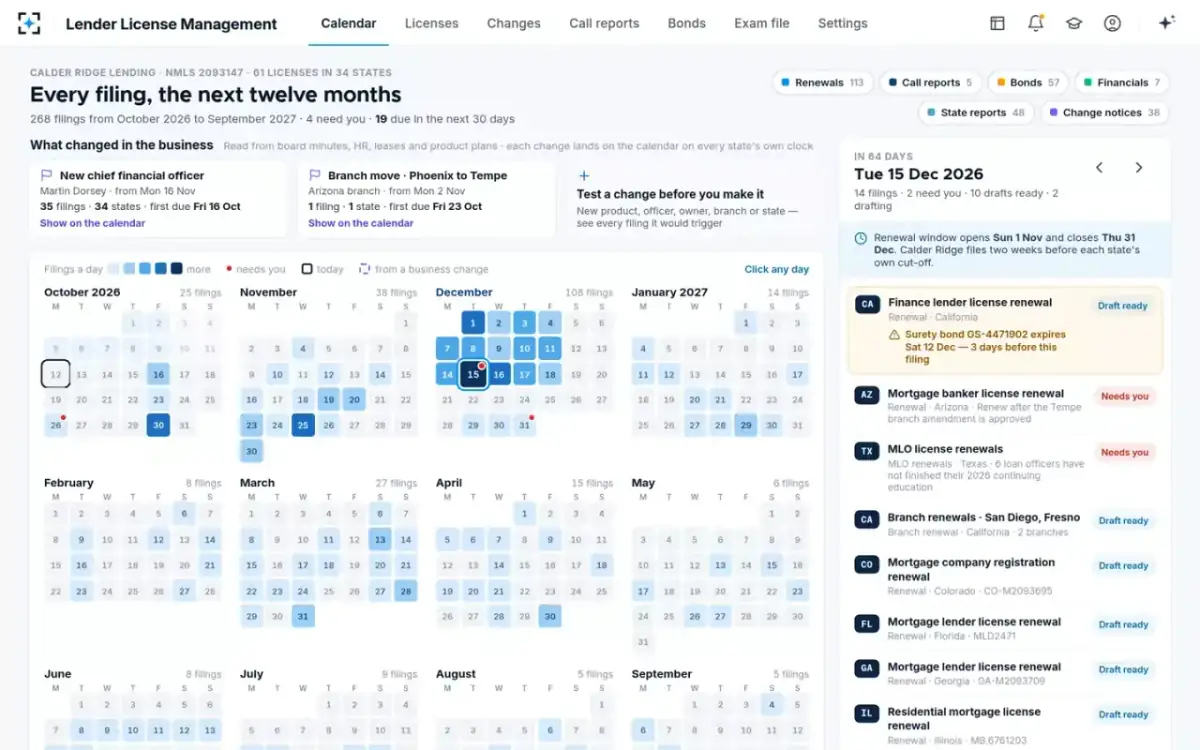
The three blockers are each a fact that changed months before December.
What blocks an NMLS renewal request?
Seven conditions stop a renewal request from going through, and NMLS lists them itself: a license in a status that cannot be renewed, continuing education not completed and reported, an unpaid agency fee invoice, a regulator's prevent-renewal flag, an unverified identity status, a fingerprint exception on the background check, and a license someone marked Do Not Renew (NMLS). Four of the seven sit on individual loan officers' records, which is why a company that sponsors 400 originators meets them as volume rather than as exceptions.
The list of renewable statuses is wider than many teams assume. A license that is Approved – Deficient, Approved – Inactive, Suspended or even Terminated – Failed to Renew can still be put forward for renewal unless a regulator prevents it (NMLS). What renewal does not do is clear the regulator's open items: a company can mark a license item as handled in its own task list, but only the system or the state removes it. NMLS's advice to companies is to prepare before 1 November by reviewing the company (MU1) and branch (MU3) records, confirming every license is renewable, clearing outstanding license items and checking that sponsored loan originators have met their education (NMLS). That is, in effect, an NMLS renewal checklist, and every item on it can be done in October.
Seven things that stop an NMLS renewal request, and how each one clears
| Blocker | Whose record | How it clears |
|---|---|---|
| License status not renewable | Company, branch or loan officer | Work with the state agency to resolve the status first. |
| Continuing education not done | Loan officer | Eight approved hours, taken this year and reported to NMLS by the course provider. |
| Unpaid agency fee invoice | Company or loan officer | Pay the invoice in NMLS; the license item clears when payment is processed. |
| Prevent-renewal flag | Any license | Only the agency that placed it can lift it, so the call is to the state. |
| Unverified identity | Loan officer | Resubmit the credit authorization in the individual (MU4) form. |
| Fingerprint exception | Loan officer | Resolve the criminal background check exception before the request can go. |
| Marked Do Not Renew | Any license | Recall the setting before 31 December, or the license lapses by choice. |
What happens if my NMLS license expires on 31 December?
It expires at midnight, and the company immediately loses the authority to conduct licensed business in that state. NMLS warns that a lapsed company license can also take its branch licenses and its loan officers' sponsorships down with it, which turns one missed renewal into a stack of re-applications (NMLS). The license moves to Terminated – Failed to Renew, a status in which the licensee "is not authorized to conduct business" (NMLS).
The NMLS reinstatement period runs from 1 January to the last day of February, but only for states that take part, and reinstatement can carry its own fees or penalties on top of the renewal fee (NMLS). Reinstatement restores the license; it does not retroactively authorize loans taken in the gap. Within those limits, each state sets its own late path. Virginia reinstates a company license whose renewal requirements are met "before March 1 of the following calendar year", but a branch office not renewed by then "shall be deemed to be closed as of the preceding January 1" (10VAC5-160-90). Maryland accepts a renewal filed within 30 days after expiry; after that, the company files for a new license with all the application and investigation fees (COMAR 09.03.06.04).
Maryland's rule also explains the mid-December habit. A licensee that files its renewal "at least 2 calendar weeks before the license expires" may keep processing and closing loans while the Commissioner decides. One that files later "shall cease processing and closing loans when the license expires" if approval has not come through. The renewal window says 31 December; the practical deadline, for a lender that wants to keep closing loans over New Year, is earlier. For loan originators, the same calendar is tied to education: the SAFE Act lets a state renew an originator only once the year's continuing education is complete, and a course counts only "in the year in which the course is taken" (12 U.S.C. 5105). The SAFE Act requirements for loan originators sets out those hours.
How much does it cost to renew an NMLS license?
NMLS charges a processing fee of $120 for each company license renewal, $25 for each branch and $35 for each loan originator license, and each state adds its own renewal fee, late fees or assessments on top (NMLS). Those processing fees rose on 1 March 2025, the first change since NMLS launched in 2008; the company fee had been $100, the branch fee $20 and the individual fee $30 (CSBS). Fees are paid through NMLS, free by ACH or with a 2.5% surcharge by card (NMLS).
The arithmetic scales with the license count, not the company. The sample lender's 61 company licenses carry $7,320 in NMLS processing fees before a single state fee. If each of its 412 loan officers held only one state license, they would add $14,420; originators licensed in several states add $35 for each. The state fees are usually the larger part, and they differ by license type and state. What a license costs to keep works through the fees, the bonds and the hours together.
NMLS processing fees for each renewal, since March 2025
$120
each company (MU1) license renewal, up from $100
$25
each branch (MU3) license renewal, up from $20
$35
each loan originator (MU4) license renewal, up from $30
2.5%
surcharge to pay by card; ACH carries no service fee
Renewal season week by week, from 1 November to the late-renewal deadline
The window looks like one deadline but behaves like five. Each has its own work and its own way of going wrong, and a licensing team that plans the season as a sequence rather than a single date tends to find its problems in the first fortnight instead of the last.
Five deadlines inside one renewal window
| When | What falls due | What usually goes wrong |
|---|---|---|
| 1 November | The window opens. Renewals prepared in October can be submitted, once the 2026 disclosure questions and employment reporting are done. | A renewal held up by a prerequisite nobody owned, or by an amendment still pending in NMLS. |
| First half of November | Change notices for anything decided in the autumn: officers, owners, branches. Some states want them before the change takes effect. | A notice found only when the renewal asks whether the record is current. |
| 14 November | The third-quarter mortgage call report, 45 days after the quarter ends. | Validation errors from the loan system found on the due date, in the same week as the first renewals. |
| Early to mid December | The lender’s own target for each state, usually some days before the state’s cut-off. Loan originator renewals, once each originator’s education is complete. | A bond that expires before the renewal it secures; loan originators short of their eight hours. |
| 31 December, then the late paths | The window closes in most states. Some states allow late renewal or reinstatement into January or February. | A license that expired on 1 January, discovered when a loan cannot close. |
Read down the column of what usually goes wrong and a pattern appears: every failure is a fact that existed weeks earlier. A prerequisite was open in October. An officer change was in September's minutes. The loan system had the call report's errors from the day the loans closed. A bond's expiry date was printed on it when it was written. Renewal season is where those facts are finally tested, which is why the cure is earlier sight rather than longer hours.
The third-quarter call report deserves particular attention because it is the one hard date inside the window that has nothing to do with renewals. It reports loan activity by state, and its data comes from the loan system rather than from licensing. A Florida loan with no property state, a Nevada loan without its originator's NMLS ID, a Texas withdrawn application counted as closed: each is a small error, and each stops the report validating. On the sample lender those three kinds of error were found and fixed from the loan files on 12 October, a month before the report was due and three weeks before the renewals began.
The people who carry renewal season
Five roles carry the season at a typical multistate non-bank lender, and only two of them sit in licensing. The licensing manager attests. Specialists split the states and the loan officers between them. The chief compliance officer signs off notices of change in control. Finance owns the bonds and the net worth figure that every renewal restates. Each of them holds a piece of the record that December depends on.
Five people in the sample lender's renewal season, and what stays theirs
Today
“December is a wall. I find out a bond lapsed when the renewal bounces.”
With agents
Sees all 268 filings on one calendar and opens each as a draft with every answer cited.
Still theirs: attesting and filing every renewal, report and notice
Today
“Every officer change is 34 forms on 34 clocks.”
With agents
Gets each state’s notice placed the day a change is found, drafted, with the personal history attached.
Still theirs: checking each notice against the state’s own form
Today
“Six Texas loan officers still haven’t done their hours.”
With agents
Sees every license, branch and loan officer on one register, with the six short of education flagged on the calendar.
Still theirs: working with each loan officer and their manager
Today
“Tell me what a change costs us in filings before we make it.”
With agents
Sees the filings a proposed officer, product, branch or state would trigger before it is decided.
Still theirs: signing off change-of-control notices and new licenses
Today
“Don’t let me find out about a bond from the regulator.”
With agents
Sees each bond against the renewal it secures, and net worth counted each state’s way.
Still theirs: approving every premium before a continuation is ordered
Most of the peak is re-checking, not filing
Most of a renewal season's working days go on reading and gathering, not on writing or submitting. Our estimate for a 34-state lender doing the work by hand is about 30 working days of licensing time. Six go on re-reading each state's rules and checklists, five on pulling records from NMLS, HR and leases, three on chasing bonds and continuation certificates and four on placing change notices state by state. Drafting takes ten; attesting and filing, two.
Almost every item in the first group could have been settled earlier. A bond's expiry date is known when the bond is written. An officer change is known the day the board minutes are signed. A loan officer's education hours are visible in NMLS all year. The season concentrates them because the renewal is the first moment anyone is forced to look at all of them together.
Where a renewal season's days go, by hand and with Lender License Management (our estimate)
By hand · about 30 working days
- Reading state rules · 20%
- Pulling records · 17%
- Drafting · 33%
- Chasing bonds · 10%
- Change notices · 13%
- Attest, file · 7%
With the agents · about 6 working days
- Rules · 8%
- Records · 8%
- Reviewing drafts · 34%
- Bonds · 8%
- Notices · 8%
- Attest, file · 34%
Moving the season into October with Lender License Management
The solution's answer is to treat each renewal as the end of a year-long record, not the start of a December project. Six agents keep that record. One reads NMLS every morning at 06:00, read-only, and compares the company, branch and individual records and the electronic bonds with HR's officer list and the branch leases. One reads each state's licensing rules and NMLS checklists and re-reads them every Monday. One watches every bond against the renewal it secures. One reads board minutes, leases and product proposals for changes that trigger notices. The renewal drafter starts each filing 60 days before it is due, which is a design target, and answers every question from the record with its source cited.
On the sample lender, that puts the California finance lender renewal in draft on Monday 12 October, nine answers with sources, and it is how the bond that runs out on 12 December surfaces two months before it lapses and three weeks before the window opens, rather than on the day the renewal is refused. That renewal, followed day by day, shows what the extra weeks buy. Officer changes work the same way: a new chief financial officer triggers 35 filings on the sample calendar, and the renewal will not attest to a stale officer list while they are open.
Before 1 November: six things to settle in October
- Finish the 2026 NMLS prerequisites
The updated disclosure questions and employment reporting must be done before NMLS accepts a renewal request.
- Set every bond against its renewal date
A bond that expires before the renewal it secures needs a continuation certificate before the window opens.
- Count each loan officer’s education hours
Eight hours, taken this year, approved by NMLS. Find who is short now, not on 28 December.
- Close the open amendments
Officer, owner, branch and address changes pending in NMLS. A renewal attests that the record is current.
- Pull the Q3 call report forward
It is due 14 November, in the middle of the window. Validate it before the renewals start.
- Write down each state’s real deadline
The window closes 31 December, but rules like Maryland’s two-week cut-off for continued lending set the date you plan to.
Questions people ask
Can I submit my NMLS renewal before 1 November?
No. Renewal requests open in NMLS on 1 November, and in 2026 only once the updated disclosure questions and the new employment reporting are complete. Everything a renewal depends on can be prepared earlier: the company and branch records, open license items, bonds and each loan officer's education.
Can a loan officer renew without continuing education?
Not under the SAFE Act's minimum standard, which makes the year's eight hours of approved education a condition of renewal. The one exception in NMLS's uniform policy is an originator who met the pre-licensing education requirement in the same year the license was approved (NMLS). A course repeated from last year does not count either: NMLS reads the Act's "successive years" as two years in a row (NMLS).
Do federally registered loan officers renew in NMLS too?
Yes. Loan officers at banks and credit unions renew their federal registrations in NMLS by 31 December, in the same window. They have no test or education requirement to meet; those apply only to state-licensed originators.
Can an inactive license be renewed?
Yes. Approved – Inactive is a renewable status in NMLS; a loan officer's license moves to it when the last sponsorship is removed, for example between employers. Renewing keeps the license alive, but the originator cannot originate on it until a licensed company sponsors it again.
Is the renewal fee the same in every state?
No. The NMLS processing fee is the same everywhere ($120 a company license, $25 a branch, $35 a loan officer), but each state sets its own renewal fee and some collect fees outside NMLS. The state's renewal checklist in NMLS lists both.