Mortgage license management software is only as good as the records it is built from. To start with it, a non-bank lender needs six sets of records: the licenses it holds and its NMLS access; each license's surety bond; the officers, owners and control persons the states know about; its branches and their leases; the loan data its call reports are built from; and its past filings with their receipts. Botminds' Lender License Management reads those records, reads each state's rules, and places every renewal, report, bond action and change notice for the next twelve months on one calendar. This guide lists what to bring, the minimum that gets a useful calendar, what makes it better, and the settings a licensing manager decides before the first filing is drafted.
Six things to bring on day one
- The license list, and read access to NMLS
Every company, branch and individual license by state and type, with numbers and renewal dates. The solution reads the NMLS records every morning, read-only; the list is the check that nothing held outside NMLS is missed.
- The bond schedule
Each surety bond: the license it secures, the surety, the amount and the expiry date. Electronic bonds in NMLS are read directly; the schedule covers the rest and the surety contacts.
- Officers, owners and control persons
HR’s officer list, the ownership record and the last year of board and committee minutes. These are what change notices are found in.
- Branches and their leases
Every branch with its address and lease dates. A move or a closure is a filing in each state that licenses the branch.
- The loan system’s call report data
Applications and loans by state with status, amounts, dates and the originator’s NMLS ID. The quarterly report is built from it.
- Past filings and receipts
Two or three years of renewals, call reports, notices and state reports with their submission receipts. They seed the exam file and show each state’s cycle.
What should mortgage license management software do?
Keep every license, branch, loan originator, bond and filing on one calendar, each placed on its own state's clock, and show what is wrong with the records before a filing depends on them. Three kinds of product answer to the name. Trackers hold dates and send reminders. Data tools pull NMLS records into a dashboard. A smaller group reads each state's rules and the company's own records and prepares the filings themselves. The first two tell a team that something is due; only the third tells it what the filing will say and whether the records behind it are true.
Before comparing products, a buyer should know what NMLS already gives for free. Companies can use a Renewal Dashboard to process renewals by entity type or state, a Renewal Selection List to renew many licenses at once, and real-time Renewal Activity reports on eligibility, attestation status and deficiencies (NMLS; NMLS). The License Item List shows every requirement or deficiency a regulator has placed on a company, branch or loan officer license, and can be assigned internally, though only the regulator or the system clears an item (NMLS). Software worth paying for does what NMLS does not: it reads the records NMLS never sees, HR's officer list, the minutes, the leases, the bond schedule and the loan system, and the state rules that decide what each of them triggers.
What to look for in license tracking software
Look for evidence, not features: every date should trace to a state rule, every answer to a record, and every action to a person. The test that separates products fastest is to bring two real cases to the demonstration, a recent officer change and a bond that expires near a renewal, and watch what the software does with each.
Eight things to test in a license management software demonstration
| What to look for | Why it matters | How to test it |
|---|---|---|
| Each obligation cites its state rule | Clocks differ by state and change; an uncited date cannot be checked. | Ask where a Massachusetts officer-change deadline comes from, and when it was last checked. |
| Advance notices placed before the change | Some states count back from the change; a reminder after it is too late. | Enter an officer change dated next month; look for notices due before it. |
| Bonds compared with renewals, not with today | A bond that ends days before its renewal looks fine on a countdown. | Enter a bond expiring three days before a renewal; see whether it is flagged now. |
| NMLS read, never written | A tool that can submit eventually submits an unread draft. | Ask what NMLS permissions the tool needs, and why. |
| Differences shown with both values | NMLS and HR disagree; a tool that silently picks one hides the problem. | Load an officer list that differs from NMLS; see what it reports. |
| Call report data validated before filing | The report is the examiner’s first data and fails on blank originator IDs. | Load a quarter with a loan missing its originator ID. |
| Loan originator education visible by state | A renewal blocks on an originator short of hours or repeating a course. | Ask how it shows who is short of continuing education in December. |
| A record of who did what | An examiner asks who decided, not what the software did. | Ask to see the trail behind one filed renewal. |
Can a spreadsheet replace license management software?
For a lender in a few states with a few dozen licenses, often yes, and NMLS's own renewal reports cover much of the rest. A spreadsheet holds dates well. It does not hold clocks that count backwards from an event, a renewal that must not attest while an amendment is open, or a bond whose expiry is compared with a renewal two months away. Those are relations between records, and they are what break first as states are added: one new officer at a lender in 34 states is 35 filings on four different clocks, each of which a spreadsheet has to be told about by a person who has already read the rule.
What do you need to start with license management software?
Records you already have, gathered in one place, plus read access to the systems that change. The solution's agents read NMLS every morning at 06:00 for company, branch and individual records and the electronic bonds; state statutes and regulator sites every Monday; board minutes and the HR officer list for new officers and owners; leases and product proposals for branch moves and new products; the loan system for call reports; and financial statements and bond documents for net worth and bond dates. Nothing has to be re-keyed into a new format, but each source has to be reachable, and someone has to own it.
The list is longer than most licensing teams expect because licensing depends on facts other teams own. HR knows about a new officer before licensing does; legal holds the cap table; facilities signs the lease; finance renews the bond. A calendar that reads only NMLS will be accurate about what has been filed and blind to what needs filing next.
The inventory: each record, where it lives, and what it feeds
| Record | Usually held by | What it feeds in the calendar | Notes on format |
|---|---|---|---|
| NMLS company, branch and individual records; electronic bonds | Licensing (NMLS access) | Renewals, branch renewals, loan originator renewals, record differences | Read-only access is enough; the solution never edits NMLS. |
| License list by state and type | Licensing (often a spreadsheet) | A check that every license, including any held outside NMLS, is on the calendar | Any format; state, license type, number and renewal date are the minimum. |
| Bond schedule and certificates | Finance or Treasury | Bond warnings, continuations, the bond-before-renewal check | Surety, amount, expiry and the license each bond secures. |
| Officer list, ownership record, board and committee minutes | HR, Legal, Corporate Secretary | Change notices on each state’s clock; renewals held while an amendment is open | Minutes as documents are fine; they are read, not re-typed. |
| Branch list and leases | Facilities or Operations | Branch amendments and renewals; address notices | Address, lease start and end, any planned move. |
| Loan system extract | Operations or IT | The quarterly mortgage call report and its validation | Status, dates, amounts, property state, originator NMLS ID. |
| Audited financial statements | Finance | Net worth counted each state’s way; financial condition filings | The latest audit and interim statements. |
| Past filings with receipts | Licensing | Each state’s cycle; the exam file | Two to three years is enough to start. |
The minimum set, and what makes it better
A useful calendar can start from three things: NMLS read access, the license list and the bond schedule. With those, every renewal and every bond date is placed, and the bond-before-renewal check works from the first morning. Everything else improves it. Minutes and the officer list turn change notices from something licensing hears about into something it finds. The loan system extract turns the call report from an export into a validated draft. Past filings let the exam file assemble itself.
Starting with the minimum, and with the full set
Minimum set: NMLS read access, license list, bond schedule.
Full set: Plus minutes, officer and ownership records, leases, loan system extract, financial statements, past filings.
Minimum set: Every renewal placed and drafted, bonds checked against each.
Full set: The same, with the company record answer checked against pending officer and branch changes.
Minimum set: Placed when someone tells licensing.
Full set: Found in the minutes and leases and placed the day the change is decided.
Minimum set: Dates on the calendar.
Full set: Built from the loan system, validated, with each fix cited to the loan file.
Minimum set: Filings from now on.
Full set: Two to three years of filings and receipts, gathered against a request letter.
What the first comparison usually finds
The first useful output is not a filing but a list of differences. When the license record keeper first compares NMLS with the license list, HR's officer list and the branch leases, it reports every place two records disagree, with both values, for a person to decide. Four kinds of difference are common enough to plan for.
The first is people. An officer who left still appears in NMLS as a control person, or a new one appears in HR and not in NMLS. Each is an amendment owed somewhere, and some may already be late under a state's clock. The second is places. A branch lease shows a move that the branch license does not, or a branch that closed is still licensed and still renewing. Virginia, for one, treats a branch office not renewed by 1 March as closed from the previous 1 January (10VAC5-160-90), so a branch's status matters even when it is dormant. The third is bonds. The bond schedule lists an expiry date that differs from the electronic bond, or a bond secures a license that has since changed. The fourth is loans. The loan system's originator field is blank on some loans, or names someone whose license is in a different state from the property.
None of these is caused by the software, and none of them is solved by it. What changes is when they are found: on the first morning, with both values side by side, instead of during renewal season or an exam. The licensing manager's first weeks are mostly spent deciding which value is right and fixing the source system, so that the next morning's comparison comes back clean.
The settings you decide before the first draft
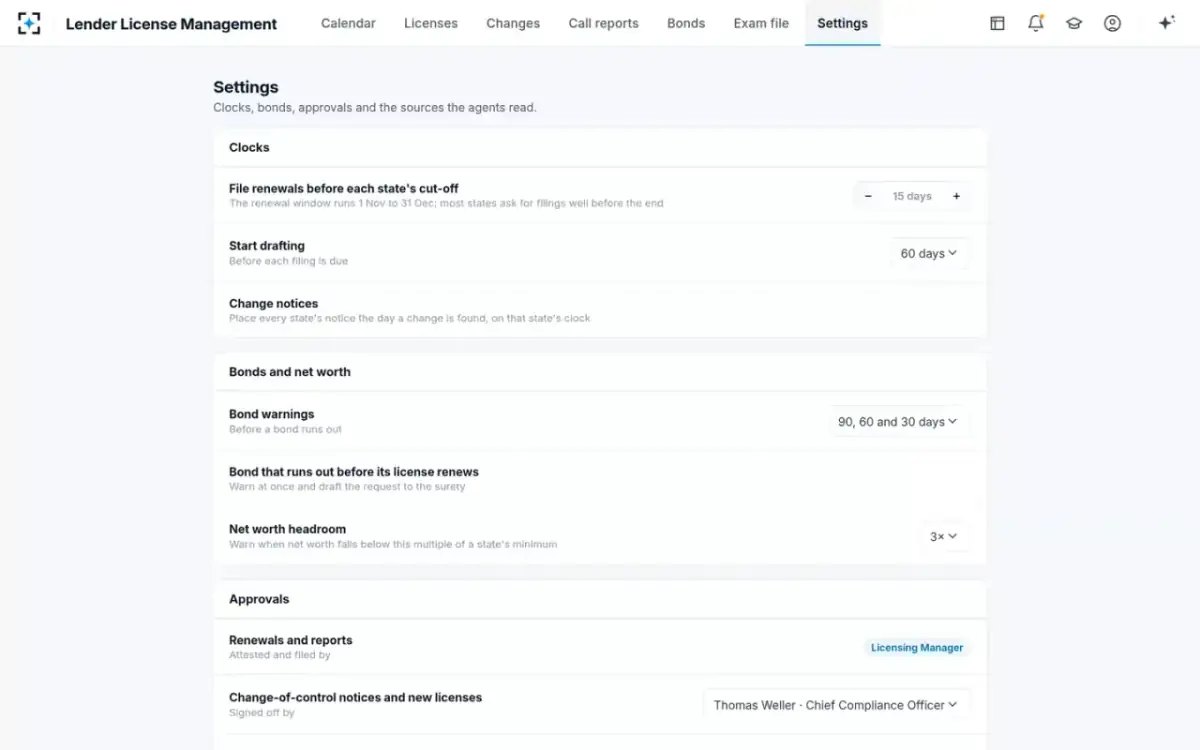
A handful of choices shape how the calendar behaves, and they are settings, not a project. The defaults are deliberate starting points; each lender should set them against its own states and risk appetite.
Lender License Management settings, with their defaults
| Setting | Default | Options | Why it matters |
|---|---|---|---|
| File renewals before each state’s cut-off | 15 days | 5 to 30 days, in steps of 5 | Some states let a lender keep closing loans only if the renewal was filed early enough; Maryland’s line is two calendar weeks. |
| Start drafting before each filing is due | 60 days | 45, 60 or 90 days | Earlier drafts find bond gaps and stale records while there is time to fix them. |
| Change notices | Placed the day a change is found | On or off | Some states count back from the change; a late find misses them. |
| Bond warnings | 90, 60 and 30 days | 60/30, 90/60/30 or 120/90/60/30 | Continuations need the surety and the premium approval. |
| Bond that runs out before its license renews | Warn at once and draft the request | On or off | The single most avoidable cause of a blocked renewal. |
| Net worth headroom | 3× a state’s minimum | 2×, 3× or 5× | An early signal before a state’s minimum is touched; some states require notice when net worth falls below it. |
| Who signs change-of-control notices and new licenses | Chief Compliance Officer | CCO or Licensing Manager | A change of control can open a regulator’s review. |
| Who approves bond premiums | Finance | A named person in Finance | Spending stays with its owner. |
Clocks, bonds and approvals, set in one place
How long does a license management software implementation take?
The calendar exists the first morning the minimum set is connected; the time goes into resolving the differences it reports, which depends on the state of a lender's records rather than on the software. The records are not equally urgent. A sensible order starts with what protects the next renewal and ends with what protects the next exam. The sequence below is our suggestion, not a fixed plan.
A suggested order for gathering the records
A person decides
Licensing ManagerExports the license list and grants read access to NMLS; names the owner of each other record.
A person decides
ControllerSupplies the bond schedule and the latest audited financial statements.
Agent
Record keeper, rule reader, bond watcherRead NMLS and report every difference from the license list with both values; read each state’s rules for the licenses held; set every bond against its renewal.
Never: resolve a difference alone
A person decides
Corporate Secretary and HRShare the officer list, ownership record and the last year of minutes.
Agent
Business change watcher and call report preparerRead the minutes and leases for open changes; build the next call report from the loan system extract.
A person decides
Licensing ManagerReviews the first drafts against what the team would have filed, and sets the clocks and approvers.
One responsibility does not move with any of this. Using software to prepare filings leaves the lender accountable for them: as the Federal Reserve's Consumer Compliance Outlook put it, "the institution remains responsible for ensuring that the output from vendor-provided systems and services meets regulatory requirements" (Consumer Compliance Outlook, 2019). That is why the first drafts should be checked against what the team would have filed, and why every answer carries its source. Who attests and files covers the line in full.
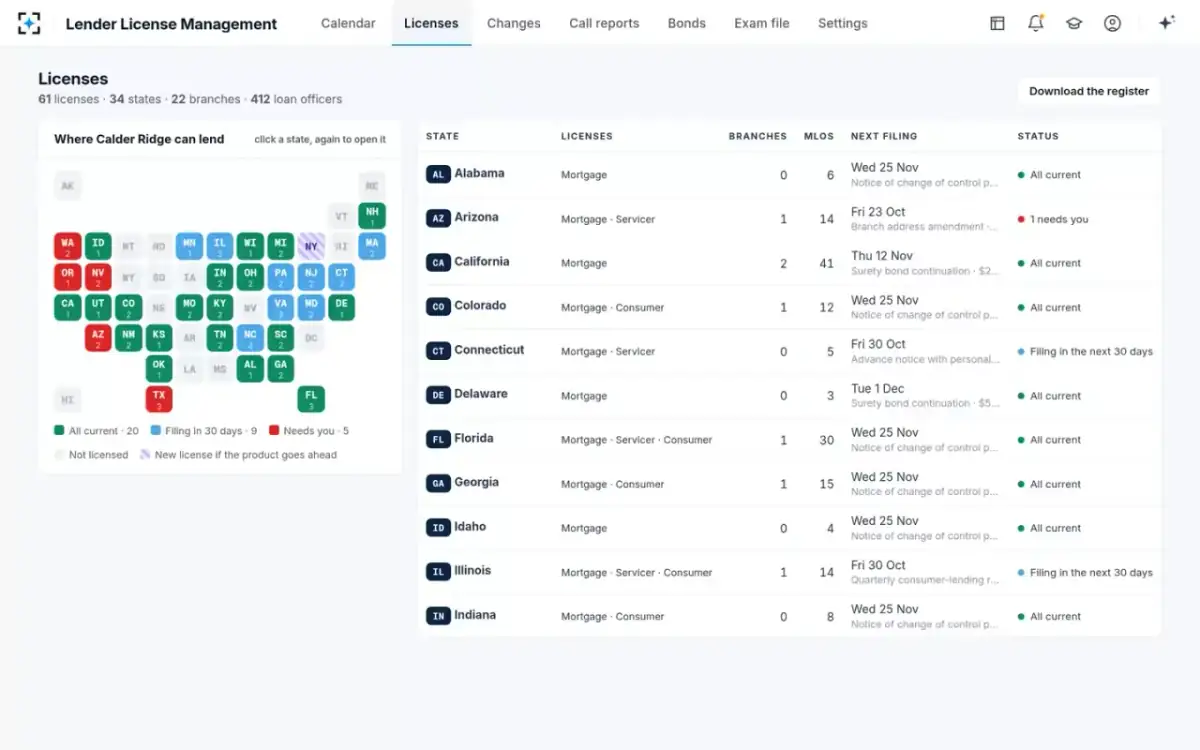
The register the calendar is built on
Who owns each record once the calendar is running
After the start, the calendar stays current only if each record stays current at its source, so ownership matters more than format. The licensing manager owns the license list and resolves differences. Finance owns the bond schedule and the financial statements, and approves premiums. HR owns the officer list and loan originator hires and departures. The corporate secretary owns the minutes. Operations owns the loan system's data quality, which the call report tests every quarter. The agents read each source on a schedule, NMLS every morning and the state rules every Monday, and report what changed; they do not own any of it.
That division is also what an examiner will ask about. A licensing file is defensible when each fact in it can be traced to a source and a person, and the ownership list is the map. The exam-ready licensing file shows the same records from the examiner's side, and the cost of a license shows where the setup time sits in the return.
Questions people ask
Do we need a licensing compliance calendar template first?
No. The calendar is built from the records and each state's rules, so a template is not needed. An existing tracker is still useful as a cross-check against what NMLS shows.
Does it need write access to NMLS?
No. It reads NMLS records every morning, read-only, and a person files every renewal, report and notice.
Does license management software replace NMLS?
No. NMLS remains the system of record and the place every filing is made; regulators read it, not the software. The software prepares what goes into NMLS and watches the records NMLS never sees.
Can it track loan originators' continuing education?
It should. NMLS shows each originator's education compliance by year, and a renewal is blocked until the year's hours are complete and reported; on a fictional sample lender, the register flags the six of 58 Texas loan officers still short of their hours on the December calendar.
What if our states' financial condition reporting dates differ?
They often do by license type and state; the loan activity report is due 45 days after each quarter, while financial condition timing should be checked state by state (Washington DFI shows one state's rule). The rule reader writes each state's obligation with its own date and source.