SAFE Act compliance for mortgage lenders starts from one rule. The Secure and Fair Enforcement for Mortgage Licensing Act of 2008, the SAFE Act, says that an individual may not act as a mortgage loan originator without first "obtaining, and maintaining annually" either a federal registration or a state license, and a unique identifier from the Nationwide Multistate Licensing System and Registry (12 U.S.C. 5103). Bank and credit union employees register; everyone else is licensed by each state in which they originate. For a non-bank lender that sponsors hundreds of loan originators across dozens of states, the Act turns into a standing calendar of education hours, renewals and reports. Botminds' Lender License Management keeps that calendar. This guide explains the rule itself: who it covers, what it asks at the start, what it asks every year, and what it asks of the company.
The SAFE Act's education floor: 20 hours to get a license, 8 hours a year to keep it
Pre-licensing education · at least 20 hours
- Federal law · 3 · 15%
- Ethics · 3 · 15%
- Nontraditional · 2 · 10%
- Other approved courses · 12 · 60%
Continuing education · at least 8 hours a year
- Federal law · 3 · 37.5%
- Ethics · 2 · 25%
- Nontraditional · 2 · 25%
- Elective · 1 · 12.5%
What is the SAFE Act in mortgage lending, and what does it require?
It is the federal law that makes every residential mortgage loan originator hold a license or a registration, and it requires four things of each one: a license or registration before originating, a unique NMLS identifier, a set of entry standards, and an annual renewal with continuing education. The Act sets federal minimums and the states write their own licensing laws on top of them; the CFPB's Regulation H, 12 CFR part 1008, spells out what a state system must contain to count as compliant (Regulation H). A state may ask for more than the floor. It may not ask for less.
The scale is large. NMLS "maintained the licenses or registrations of the more than 549,294 mortgage loan originators operating in the United States" in 2025 (CSBS Annual Report 2025). On the federal side alone, the CFPB estimates 261,638 respondents and 249,628 burden hours a year for Regulation G registration (Federal Register, February 2026).
What is the SAFE Act's mortgage loan originator definition?
A loan originator is an individual who takes a residential mortgage loan application and offers or negotiates its terms for compensation or gain (12 U.S.C. 5102). The definition is about the individual, not the company: a lender holds its own company license under state law, but the SAFE Act's duties attach to each person who does the work. Three groups are carved out by the statute itself: people who do purely administrative or clerical tasks under the supervision of a licensed or registered originator, licensed real estate agents paid only by their clients, and people who deal only in timeshare plans.
"Compensation or gain" is read widely. A salary counts, not only a commission, and so does anything of value whether or not the loan closes (Regulation H, Appendix A). And the clerical carve-out has a limit that Regulation H states outright: an independent contractor processor or underwriter needs a license even for clerical work (§1008.103(d)). Where the line falls between support work and origination, task by task, is the subject of the guide to unlicensed loan originators; this page stays with what the Act requires of those on the licensed side of it.
What is the difference between Regulation G and Regulation H?
Regulation G governs federal registration and Regulation H governs state licensing, and which one applies depends on the employer, not the job. Regulation G (12 CFR part 1007) covers employees of banks, savings associations, Farm Credit System institutions and federally insured credit unions. They register with NMLS, obtain the same unique identifier, submit fingerprints and their employment and disciplinary history, and renew the registration in an "annual renewal period" the regulation defines as 1 November to 31 December (Regulation G). They take no test and no pre-licensing or continuing education; NMLS confirms that state-licensed originators "are the only individuals who have a requirement to take a test, complete pre-licensure education, or satisfy an annual continuing education requirement" (NMLS).
Regulation H (12 CFR part 1008) does not license anyone itself. It sets the minimum a state's licensing system must contain to satisfy the SAFE Act, and every state's mortgage licensing law sits on top of it. Two details from Regulation G matter to non-bank lenders that hire from banks. A bank employee who originated five or fewer loans in the past twelve months need not register at all, so a "banker" may arrive with no NMLS history. And a registered originator must update the registration within 30 days of leaving the bank, which is the date a hiring lender can check against the move.
Registered or licensed: the two tracks of the SAFE Act
| Federally registered (Regulation G) | State-licensed (Regulation H) | |
|---|---|---|
| Who | Employees of banks, savings associations, credit unions and Farm Credit institutions | Everyone else who originates, including employees of non-bank lenders and brokers |
| Granted by | Registration in NMLS; no state approval | Each state in which the originator works |
| Education | None required | 20 hours before licensing, 8 hours every year |
| Test | None | National test, 75% to pass |
| Background | Fingerprints and history submitted through NMLS | Fingerprints, credit report and a state finding of fitness |
| Renewal | 1 November to 31 December, confirming the record | Annual, on each state’s terms, after the year’s education |
Getting the license: 20 hours, a score of 75 and a clean history
Before a state may issue a license, the applicant must clear six minimum standards (12 U.S.C. 5104). They must never have had a loan originator license revoked. They must have no felony conviction in the seven years before applying, and none ever if it involved fraud, dishonesty, breach of trust or money laundering. They must show "financial responsibility, character, and general fitness", for which NMLS collects fingerprints for an FBI check and an independent credit report. They must complete the 20 hours of pre-licensing education, pass the written test, and be covered by a net worth or surety bond requirement, or a state recovery fund.
The test is a real hurdle: in 2025 about half of first attempts failed. A pass needs "not less than 75 percent correct answers". A candidate may retake it three times, each at least 30 days after the last; after three failures in a row, the wait is six months. A licensee who lets their license lapse for five years or more must sit the test again.
Pre-licensing education also has a shelf life. Under an NMLS policy adopted in 2016, the 20 hours must be taken again if the person does not obtain a license or registration within three years of completing them, or returns more than three years after their last license or registration ended (NMLS). For a lender recruiting people who left the industry during a downturn, both clocks matter: five years for the test, three for the education.
The National Test in 2025: about half pass first time
75%
the minimum passing score the SAFE Act sets
52%
of first attempts passed in 2025 (13,237 of 25,159)
37%
of later attempts passed (5,264 of 13,930)
6months
wait after three failures in a row
Keeping the license: eight hours a year, taken in that year
Renewal under the SAFE Act needs two things: the originator "continues to meet the minimum standards for license issuance", and has completed the year's continuing education (12 U.S.C. 5105). The education is at least eight hours of NMLS-approved courses: three of federal law, two of ethics, two on nontraditional lending, and the rest elective. Three rules make it a calendar problem rather than a paperwork one. Credit counts only "in the year in which the course is taken", so hours cannot be banked. The same course cannot be repeated "in the same or successive years". An approved instructor earns two hours of credit for each hour taught.
NMLS applies those words strictly. It reads "successive years" as two years in a row, and treats courses that share licensed content as the same course even under different titles, so a loan officer who picks a familiar course in December can find the hours not applied and the renewal blocked (NMLS). The one exemption runs the other way: an originator who completed pre-licensing education in the same year the license was approved owes no continuing education that year (NMLS).
Because renewals run from 1 November to 31 December in most states, the practical deadline for the year's hours sits in December, and a loan officer who leaves them to the last fortnight puts the renewal itself at risk. Renewal season covers the window and what a missed renewal costs.
Continuing education counts only in the year it is taken. Hours cannot be banked, and the same course cannot count twice in a row.
Is a loan originator ready to renew? Five checks against the Act
- Eight approved hours this calendar year
At least three federal law, two ethics, two nontraditional. Courses taken last year do not count.
- No repeated course
A course taken last year cannot satisfy this year’s requirement.
- Disclosure answers still true
Renewal re-affirms the entry standards, including the criminal, civil and regulatory history in the individual’s NMLS record.
- Record current in NMLS
Employment, address and other personal history changes filed. California, for one, will not renew a loan originator until open changes to the individual form are filed.
- Sponsorship recorded
The employing company’s sponsorship of the individual must be current in NMLS; Virginia, for one, requires sponsorship changes within five days.
What is temporary authority under the SAFE Act?
Temporary authority lets an eligible loan originator keep originating for up to 120 days while a new state license application is pending.
Since 2019, a loan originator who moves to a state-licensed mortgage company can keep originating while a new state license is pending, under conditions. The Economic Growth, Regulatory Relief, and Consumer Protection Act of 2018 added section 5117 to the SAFE Act (12 U.S.C. 5117). It covers two moves: a registered originator leaving a bank or credit union for a state-licensed mortgage company, and a state-licensed originator taking a job with a licensed company in a new state.
The conditions are specific. The originator must never have had a license application denied or a license revoked or suspended, must not be subject to a cease and desist order, must have no conviction that would bar licensing in the new state, and must have applied for the license there. The bank originator must have been registered in NMLS within the past year; the interstate originator must have been licensed in another state within the past 30 days. The authority ends at the earliest of four dates: the application is withdrawn, the state denies it or gives notice of intent to deny, the state grants the license, or 120 days pass with the application still listed as incomplete.
Two details matter for a licensing team. The employer is held to the Act and to state law "to the same extent as if that individual was a State-licensed loan originator licensed by the application State", so temporary authority is not a lighter regime. And the 120-day clock runs only while the application is incomplete, which turns a missing document into a deadline. A lender hiring a team from a bank should know, for each person, the date their temporary authority would end and what is still missing from each application.
NMLS's own questions and answers add three practical points (NMLS). Nobody applies for temporary authority as such: the originator applies for the license, and the authority follows if they are eligible. It starts only on the day the application is submitted with the background check material, the fingerprints, personal history and credit authorization, so work done before that day is not covered. And a gap between jobs is allowed but may not exceed fourteen calendar days, counted from the day the old registration or license ends to the day the new employer requests sponsorship.
Sponsorship: the company's part in each individual license
A state license belongs to the individual, but it works only through the company that employs them. In NMLS the employing company sponsors each originator's license in each state, and the states put duties on the company that follow from that relationship. Virginia requires a licensee to update its sponsorship information "within five days" after an originator joins or leaves (10VAC5-160-90). California requires a licensed lender to notify the Commissioner when it employs a new originator in California or ends one's employment, and, if a sponsored originator has not amended their own record "within five (5) days from the demand", to inform the Commissioner in writing (Cal. Code Regs. tit. 10, §1409.1).
For a lender with hundreds of originators, sponsorship is therefore a stream of small filings: every hire, every departure, every originator who moves branch or adds a state. Each one is also a fact that later filings depend on, because the call report's originator IDs, the branch's licensed staff and each renewal's list of sponsored individuals all read from it.
What the SAFE Act asks of the company
The Act is written about individuals, but three of its duties land on the company that employs them. Each mortgage licensee "shall submit to the Nationwide Mortgage Licensing System and Registry reports of condition", the mortgage call report (12 U.S.C. 5104(e)). A state's system must include "minimum net worth or surety bonding requirements that reflect the dollar amount of loans originated", or a recovery fund. And every state must have "a mechanism to assess civil money penalties for individuals acting as mortgage originators in their State without a valid license" (12 U.S.C. 5107). California's 2025 order against one lender priced that duty at $500 for each unlicensed employee an audit finds, on top of the penalty itself.
The SAFE Act on one page: each duty, who carries it and when
| Duty | Who | When | Where it is written |
|---|---|---|---|
| License or registration and a unique identifier | Each loan originator | Before taking any application | 12 U.S.C. 5103 |
| 20 hours of pre-licensing education | Each new state-licensed originator | Before the license is issued | 12 U.S.C. 5104(c) |
| Written test, 75% to pass | Each new state-licensed originator; again after 5 years without a license | Before the license is issued | 12 U.S.C. 5104(d) |
| Background, credit and fitness review | Each originator | At application; re-affirmed at renewal | 12 U.S.C. 5104(a)–(b) |
| 8 hours of continuing education | Each state-licensed originator | Every calendar year, before renewal | 12 U.S.C. 5105 |
| Mortgage call report | Each mortgage licensee (the company) | Through NMLS; quarterly in states such as Virginia | 12 U.S.C. 5104(e) |
| Net worth, surety bond or recovery fund | Set by each state; carried by the company or originator | Kept in force while licensed | 12 U.S.C. 5107(d)(6) |
Where Lender License Management tracks the SAFE Act's dates
The solution reads the individual records for every sponsored loan originator from NMLS each morning, read-only, alongside the company and branch records, and holds them on one register with each state's license, branch and next filing. On a fictional sample lender with 412 sponsored loan originators in 34 states, that register flags the Texas loan originator renewals in December because six of the 58 have not finished their 2026 education. The flag sits on the renewal calendar, weeks before the window closes.
The unique identifier matters beyond licensing. When the sample lender's third-quarter call report was built from its loan system, three Nevada loans were missing the loan originator's NMLS ID, and the report would not validate until each was filled in from the closing disclosure. The SAFE Act's identifiers are what tie a loan to a licensed person, and a call report that cannot make that link fails before any examiner reads it.
One register for every state's licenses, branches and loan originators
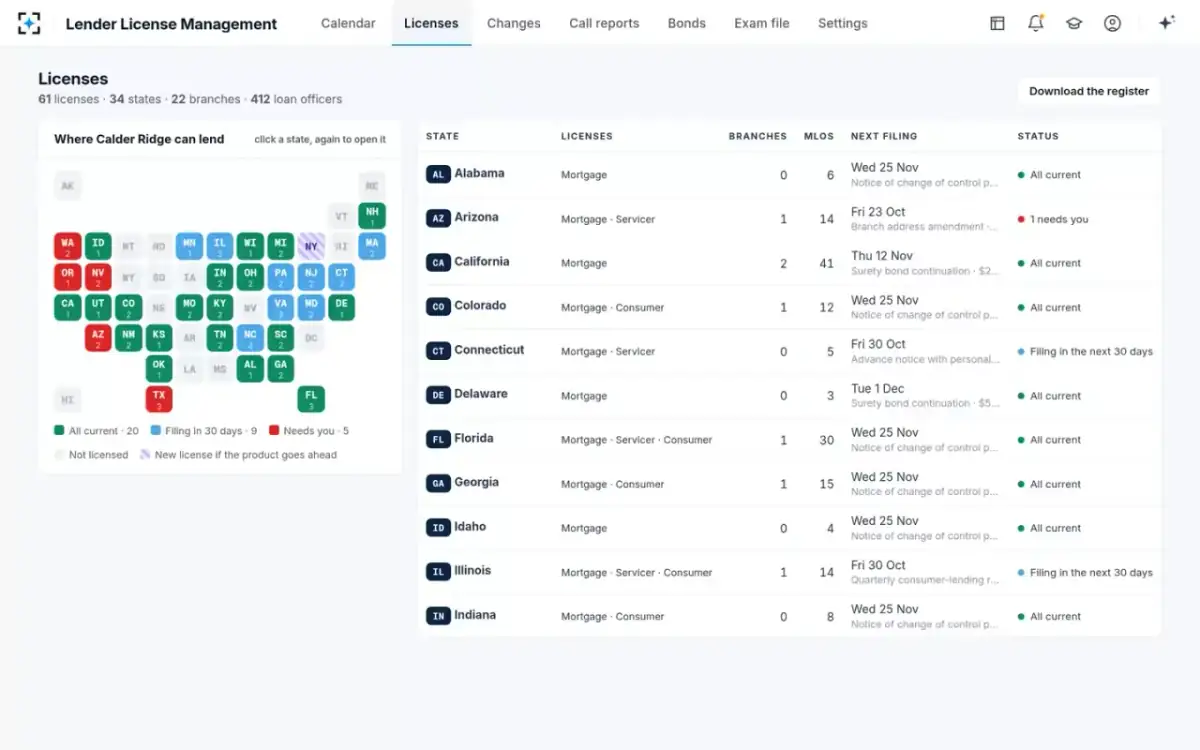
Loan officer counts by state are read from NMLS sponsorship records, not typed in.
Questions people ask
Do bank loan officers need a state license?
No. Employees of banks, credit unions and their regulated subsidiaries register through the NMLS Federal Registry under Regulation G instead. They still need a unique identifier and must renew their registration by 31 December. If they move to a state-licensed mortgage company, they need a state license, and may qualify for up to 120 days of temporary authority while it is pending.
Does the SAFE Act cover consumer loans that are not mortgages?
No. The Act covers residential mortgage loan originators. Consumer finance, servicing and other non-bank activities are licensed under each state's own laws, many of them also through NMLS, which now handles 98 state-licensed activities for 67 regulators.
What happens if a loan originator's license lapses?
They may not originate in that state until it is reinstated or reissued. If it stays lapsed for five years or more, they must pass the test again before a new license can be issued, and after three years without a license or registration NMLS policy also requires the 20 hours of pre-licensing education again.
Do loan originators need a separate license in every state?
Yes. Each state licenses originators who take applications for property in that state, so an originator who works in five states holds five licenses, each renewed on that state's terms. The NMLS unique identifier stays the same across all of them and across employers.
How many times may a loan originator retake the NMLS test?
Three times in a row, with at least 30 days between attempts; after a third failure in a row the wait is six months. In 2025, 52% of first attempts passed and 37% of later attempts did.