Integrated disability and absence management (IDAM) is the practice of handling every program a single employee absence can touch, the Family and Medical Leave Act (FMLA), state paid family and medical leave or disability insurance, short-term disability (STD), long-term disability (LTD), accommodation under the Americans with Disabilities Act (ADA) and the Pregnant Workers Fairness Act (PWFA), and the employer's own sick, parental and PTO pay, through one intake and one case, so that eligibility, clocks and offsets are worked out once and agree with each other. It exists because those programs are run by different parties under different laws, and an absence handled program by program produces call-backs, late notices and weeks paid twice. Botminds' Integrated Disability & Absence Management is a solution for group carriers and the teams that run leave for employers: one conversation captures the leave, agents work out every program that applies and who pays each week, and a case manager signs the plan.
The examples come from a fictional sample book in the solution, and from illustrative arithmetic using 2026 state figures read on the agencies' own pages. The definitions rest on the Department of Labor's FMLA regulations and the EEOC's guidance.
One disability week in New Jersey, split across the programs that pay it
Coordinated, no top-up · $1,500 of $3,000
- State TDI $1,119 · 37.3%
- STD after offset $381 · 12.7%
- Unpaid; FMLA protects the job · 50%
With a PTO top-up the employee chose · $3,000 of $3,000
- State TDI $1,119 · 37.3%
- STD after offset $381 · 12.7%
- Employer PTO $1,500 · 50%
What is integrated disability and absence management?
IDAM is a way of running absences, not a single program: the employee calls once, one person or team owns the case, and every program is applied to the same facts and laid out on the same weeks. In a non-integrated model the FMLA leave is run by HR, the STD claim by the carrier, the state claim by the employee and the pay by payroll, and each learns what the others decided by email, if at all.
The FMLA regulations themselves link the pieces. "Leave taken pursuant to a disability leave plan would be considered FMLA leave for a serious health condition and counted in the leave entitlement permitted under FMLA if it meets the criteria set forth above in §§ 825.112 through 825.115," and the employer "may designate the leave as FMLA leave and count the leave against the employee's FMLA leave entitlement" (29 CFR 825.207(d)). A disability claim and an FMLA leave are often the same weeks seen from two sides; IDAM is the decision to see them from one.
The same absence, handled program by program and handled as one case
Program by program: The employee tells HR, the carrier and the state the same story three times.
Integrated disability and absence management: One intake captures every fact any program needs, once.
Program by program: Each program decided separately, sometimes on different dates of first absence.
Integrated disability and absence management: Each program’s test applied to the same facts, with its rule.
Program by program: FMLA notices with HR, the disability decision with the carrier, cut-offs with payroll.
Integrated disability and absence management: Every date on one plan, from the morning of the call.
Program by program: The policy pays in full until the state’s amount is known; payroll defaults PTO.
Integrated disability and absence management: Each week’s state benefit, offset and employer pay worked out before it is paid.
Program by program: Leave ends at twelve weeks because the FMLA does.
Integrated disability and absence management: A request for more time is routed as an ADA or PWFA accommodation question.
Program by program: Payroll learns the return date from the employee.
Integrated disability and absence management: The return date is on the plan payroll receives.
What is the difference between absence management and disability management?
Absence management is the broader term: it covers every reason an employee is away, including job-protected leave, state leave, accommodations and attendance, and its central question is whether the absence is protected and how it is counted. Disability management is narrower: it covers absences caused by the employee's own illness or injury, the disability benefits that pay for them and the return to work, and its central question is whether the employee can work and what the plan pays. Integrated disability management, a term some employers use, joins disability claims with workers' compensation and return-to-work programs.
IDAM joins both sides. The reason is arithmetic as much as administration: of employees who took leave in the Department of Labor's 2018 survey, "Forty-two percent received full pay, 24 percent received partial pay, and 34 percent received no pay while on leave" (DOL, FMLA 2018 surveys, summary). The partial-pay group is where disability benefits, state programs and employer pay meet, and where most coordination errors are made.
The programs one absence can touch
Seven programs can apply to a single absence, each with its own test, clock and decision-maker. Not every absence touches all seven; the sample pregnancy leave on this site touches four, and five once the employee asks for an accommodation before the birth.
The parts of integrated disability and absence management, program by program
| Program | What it gives | Its clock | Who decides |
|---|---|---|---|
| FMLA | Up to 12 workweeks of unpaid, job-protected leave | Eligibility and designation notices within five business days | The employer |
| State paid leave or disability insurance | Partial pay; in some states, job protection | Set by each state, with rates reset each January | The state agency or an authorised insurer |
| Short-term disability | A share of pay after an elimination period | Decision within 45 days of the claim under the ERISA claims rule | The insurer or plan |
| Long-term disability | A share of pay after a longer elimination period | The same 45-day rule, with two possible 30-day extensions | The insurer or plan |
| ADA accommodation | Leave beyond 12 weeks, or changes that let the employee work | No fixed clock; an interactive process | The employer |
| PWFA accommodation | Accommodation of pregnancy-related limitations, including leave | No fixed clock; an interactive process | The employer (15 or more employees) |
| Employer pay | Sick pay, PTO, parental pay, salary continuation | Each payroll cut-off | The employer, under its own policy |
Employer pay is the program people forget is a program. Paying an employee's normal compensation out of the employer's general assets while the employee is unable to work is a payroll practice, not an ERISA plan (29 CFR 2510.3-1(b)(2)), so no federal claims rule governs it; but it still counts toward what the employee receives each week, and it is where unchosen PTO turns a coordinated week into an overpaid one.
Why integrate FMLA and short term disability?
Because they usually cover the same weeks, and a disagreement between them lands on the employee. When the STD claim is approved, the employer can designate the same weeks as FMLA leave, and the employee's 12 weeks start running from the first day off, not from whenever HR hears about it. When they are not integrated, three things go wrong in predictable ways: the FMLA designation notice is late because HR did not know about the disability claim; the employee's FMLA balance is wrong because the disability weeks were never counted; and PTO is forced into weeks the disability plan is already paying, which the FMLA forbids.
The integration also runs the other way. A disability denial does not end job protection, and an FMLA leave that ends at twelve weeks does not end the employer's obligations if the employee is still disabled. How a single pregnancy leave runs through both, week by week, is set out in maternity leave rules for employers.
Who has access to the programs IDAM joins, March 2026
59%
of private industry workers had access to life insurance
44%
had access to short-term disability plans
37%
had access to long-term disability plans
49%
had access to paid family and medical leave
What is absence management insurance?
Absence management insurance is group disability insurance sold together with leave administration: an employer buys STD and LTD cover from a carrier, and the carrier, or an administrator it works with, also runs the employer's FMLA and state leave. In some states part of it is required insurance in its own right. New York, for example, requires employers to insure statutory disability and paid family leave, and its Department of Financial Services requires disability insurers to carry paid family leave as a rider on their disability policies (NY DFS, PFL premium rate decision for 2026).
The insurance and the administration are different products with different duties. The carrier decides disability claims as the plan's fiduciary; the employer keeps the FMLA and ADA duties even when the carrier administers them. Who carries a missed notice when a carrier or administrator runs the leave is compared on one case in third party leave administrators.
ADA and PWFA: the parts with no fixed clock
The ADA and the PWFA are the parts of IDAM that the FMLA's twelve weeks do not limit, and the parts easiest to leave out of an absence program because they have no form and no deadline. The FMLA regulations draw the line themselves: the FMLA "entitles eligible employees to 12 weeks of leave in any 12-month period due to their own serious health condition, whereas the ADA allows an indeterminate amount of leave, barring undue hardship, as a reasonable accommodation" (29 CFR 825.702(b)).
The EEOC has said what that means for an employer whose leave policy stops at twelve weeks: "The Commission takes the position that compliance with the FMLA does not necessarily meet an employer's obligation under the ADA, and the fact that any additional leave exceeds what is permitted under the FMLA, by itself, is not sufficient to show undue hardship" (EEOC, Employer-provided leave and the ADA). An integrated program flags the week the FMLA runs out while the employee is still certified as unable to work, and routes the case to the person who decides accommodations.
The PWFA adds a pregnancy-specific duty for employers with 15 or more employees: leave can be an accommodation, but an employer may not push an employee onto leave when another reasonable accommodation would keep her working (EEOC, What You Should Know About the PWFA; maternity leave rules for employers quotes the EEOC's list). An IDAM intake that hears "pregnant" and starts a leave without asking about the job has the order wrong.
Who offers integrated absence management, and how to judge an offer
Integrated absence management is offered by group disability carriers, by third-party administrators, and by software that lets an employer's or carrier's own team run it. This page names no providers; the test is the same for all of them. Judge an offer on four things: whether one intake feeds every program; whether every decision shows its rule and the employee's values; whether pay is coordinated week by week, offsets included, before it is paid; and whether the employer's payroll is checked before each cut-off rather than reconciled after.
The fastest way to check all four is to hand the provider 50 of your closed leaves and score its answers against what the law required, as set out in the pilot on closed leaves. A provider that cannot replay your past leaves cannot show you how it will handle your future ones.
How Botminds' Integrated Disability & Absence Management works
In Botminds' solution, the leave intake specialist takes the call while the intake listener captures each fact with the line it came from and pulls service, hours, pay, headcount, PTO and coverage from the employer's payroll and enrolment feed. With nothing missing, one click starts six agents in turn: the eligibility checker applies the FMLA, the state program, STD, LTD and the employer's policies; the benefit calculator works out each week's amounts and offsets; the leave timeline planner lays the weeks out; the notice drafter dates every notice from the plan; and the payroll reconciler reads the employer's file before the cut-off.
The payer calendar: every program, every week and who pays, on one screen
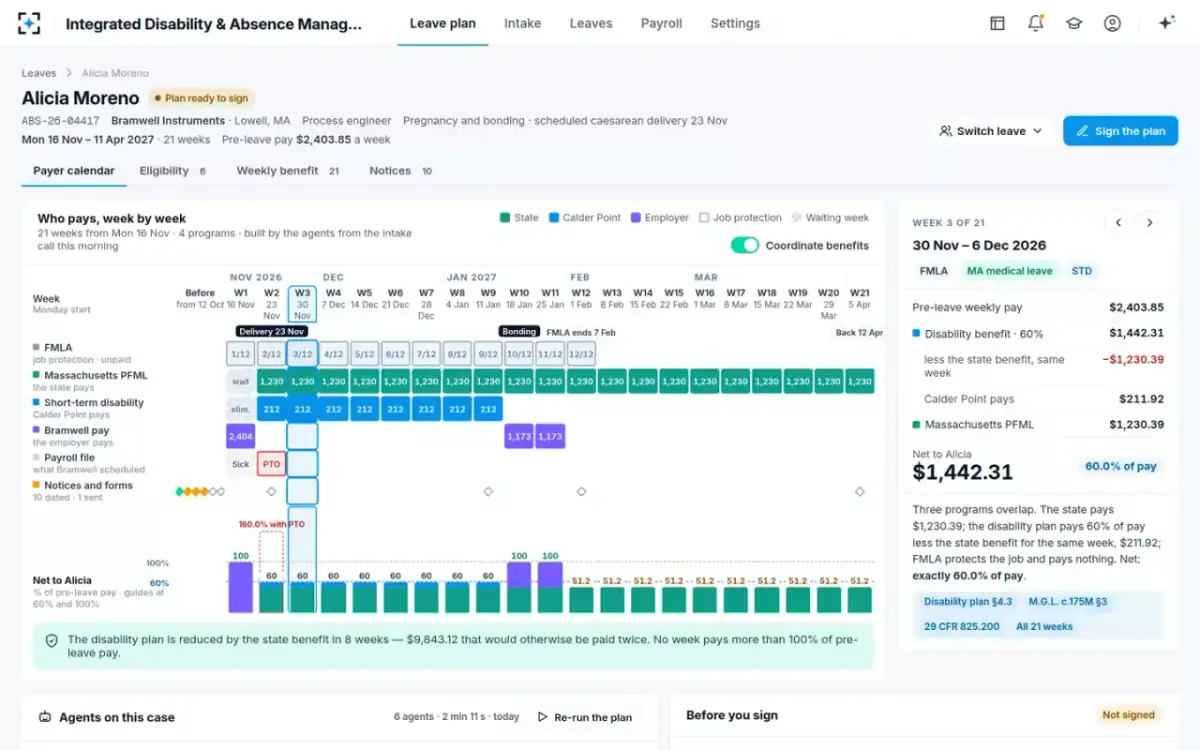
In the sample case, a pregnancy leave at Bramwell Instruments run by Calder Point Group Benefits, 18 of 18 facts were captured on the call, six agents built a 21-week plan in 2 minutes 11 seconds, ten notices were dated, and a payroll entry that would have paid one week at 160 percent of pay was caught before the cut-off. The design target is one day from the intake call to a signed plan.
Each program’s test, the employee’s values and the rule, ready to agree or change
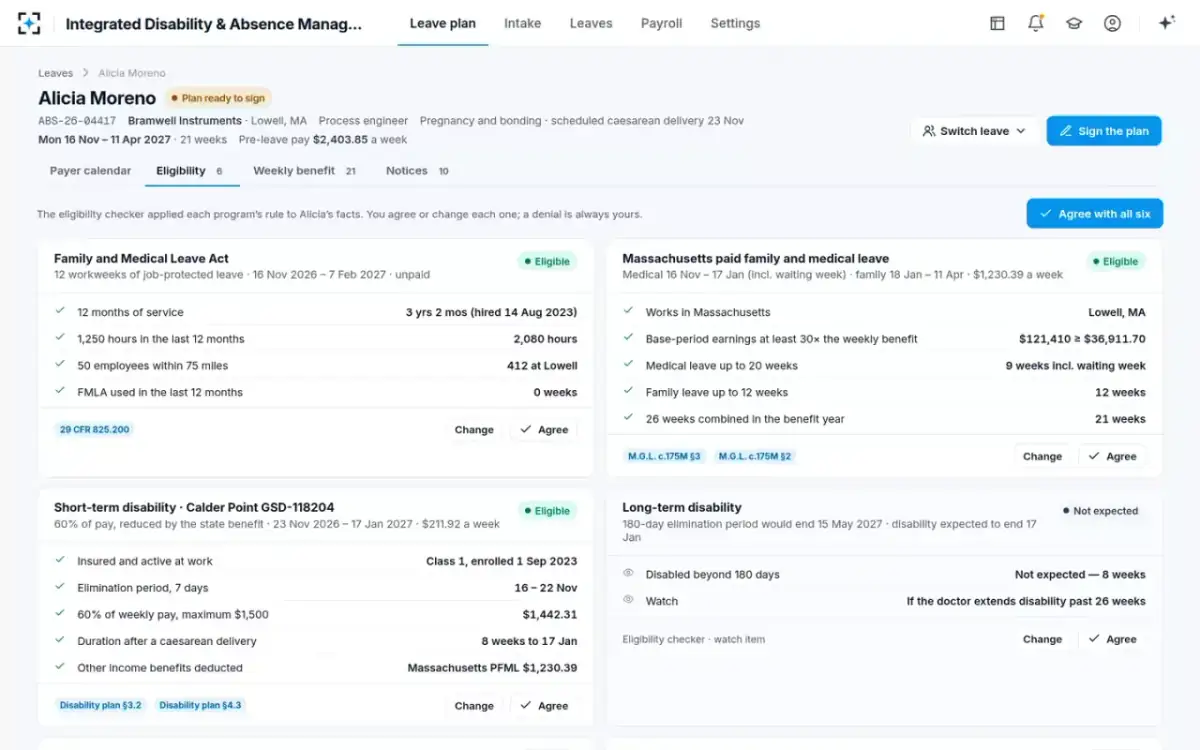
The people stay in charge. The absence case manager agrees each eligibility decision and signs the plan; agents never approve, deny, pay, recover or send; a week above 100 percent of pay or any recovery needs a second signature; employers see only their own employees' plans, and HR sees dates and programs, not medical details. The rest of the series, from the leave specialist's job to New York's two programs, starts from Integrated Disability & Absence Management.
Questions people ask
What is integrated disability management?
Integrated disability management is a narrower practice than IDAM: it coordinates an employer's disability-related programs, typically short- and long-term disability, workers' compensation and return-to-work support, so that one person manages an employee's time away for illness or injury. IDAM adds job-protected leave, state paid leave, accommodations and employer pay to the same case.
Is IDAM only for large employers?
The FMLA applies to employers with 50 or more employees within 75 miles of a worksite, and in the Department of Labor's 2018 survey 56 percent of employees were eligible for it. Smaller employers can still face state leave programs, the ADA (15 or more employees), the PWFA (15 or more) and disability plans, so integration matters wherever two of those overlap.
Does IDAM include workers' compensation?
It can. A work injury that is also a serious health condition can be designated as FMLA leave, and because workers' compensation pays, PTO cannot be forced into those weeks (29 CFR 825.207(e)). A program may also leave the workers' compensation claim with the comp carrier and coordinate only the leave and pay around it.
What is an IDAM program for employees?
For employees it means one place to report an absence, one set of questions, and one letter that says which programs apply, what each pays each week and when each notice or form is due. The employee still has to return the medical certification and apply for any state benefit, but should not have to tell the same story to three parties.
What should an IDAM provider show you before you buy?
One of your own past leaves on one screen, with every program, every clock and every week's pay, each with the rule behind it; then the result of replaying a sample of your closed leaves against what the law required. Ask also who signs each plan, how payroll is told, and how a request for leave beyond twelve weeks reaches the person who decides accommodations.