Third party leave administrators are firms, such as group insurance carriers and claims administrators, that run an employer's leave of absence program for a fee: they take the employee's request, apply the FMLA and state leave rules, send the notices and track the leave to its end, sometimes alongside the short-term disability claim. Employers outsource leave because the rules multiply with every state they operate in and every program a single absence can touch. What they cannot outsource is responsibility: under the FMLA the employer remains answerable for designating the leave and notifying the employee, whoever does the work. Botminds' Integrated Disability & Absence Management is built for the team that does the work, in-house, at an administrator or at a carrier, so that one intake produces one plan a named person signs.
The comparison below uses one fictional sample leave: Alicia Moreno, an engineer at Bramwell Instruments in Lowell, Massachusetts, with a scheduled caesarean and a 21-week leave that touches the FMLA, a state program, short-term disability and employer pay. The rules are quoted from the Department of Labor and the EEOC.
One leave, three operating models: who does each part of the work
| Part of the work | In-house HR team | Third party leave administrator | Agent-assisted desk |
|---|---|---|---|
| Takes the call | HR generalist or leave specialist | Administrator’s intake line | Intake specialist, with facts captured as the call runs |
| Decides FMLA eligibility | HR | Administrator, in the employer’s name | Agent applies the test; case manager agrees or changes it |
| Decides the STD claim | The carrier, separately | The carrier, sometimes the same company | The carrier, from the same intake facts |
| Works out weekly pay and offsets | Payroll, often on a spreadsheet | Outside the service unless the contract adds it | Agent, with the formula shown; case manager signs |
| Dates and sends notices | HR, from templates | Administrator, from its system | Agent dates and drafts; case manager sends |
| Tells payroll | HR email | Report or file feed | Instruction per employee before each cut-off |
| Carries a missed notice | The employer | The employer | The employer |
What does a third party leave administrator do?
A third party leave administrator runs the mechanics of an employer's leave program: intake, eligibility, certification, notices, tracking and return to work, and often the coordination with the employer's disability plan and state programs. It does this under a services contract, in the employer's name, through its own phone line, portal and systems. It does not take over the employer's legal obligations, and it does not decide what the employer's policies are; it applies them.
For an administrator serving many employers, the difficulty is variety rather than any single rule. Every leave arrives through the same intake line, but behind each one sits a different employer's policy, a different set of states, a different disability plan and a different payroll calendar, and each of those decides part of the answer.
Who holds what when a leave is outsourced
Today
Hands the leave to an administrator and assumes the notices are handled; hears about a problem when an employee complains.
With agents
Sees each employee’s dates and programs on the day the plan is signed, and the employer statement it owes.
Still theirs: The legal duty to designate and notify, the job, and every ADA accommodation decision.
Today
Runs the FMLA leave from its own portal, separate from the disability claim and from payroll.
With agents
Works one case that holds the FMLA leave, the state program and the STD claim together.
Still theirs: Eligibility review, notices sent in the employer’s name, the employee’s questions.
Today
Decides the STD claim on the plan’s 45-day clock, with whatever the administrator forwards.
With agents
Starts from the same intake facts and the same week-by-week plan.
Still theirs: The disability decision and any denial.
Today
Gets leave information late, from two directions, in two formats.
With agents
Gets one instruction per employee per pay period, before the cut-off.
Still theirs: The pay run.
Should we outsource FMLA administration?
Outsource when your leave volume, state footprint or program mix has outgrown what an in-house team can run accurately, and when the administrator can show, on your own past leaves, that it gets the answers right. Keep it in-house when leaves are few, in one or two states, and rarely involve disability or state pay. Either way, the decision turns on accuracy and on who talks to payroll, not on who answers the phone.
Three signs point to outsourcing: employees in several states with paid leave programs, each with its own clock and form; a disability plan whose offsets nobody in HR calculates; and notice dates that are worked out by hand. Three signs point the other way: an HR team that already knows each employee's schedule and history; a single state; and a leave volume small enough that a mistake would be noticed the same week. The middle path, an in-house team with agents doing the mechanical work, is what the third column of the table describes.
Who is liable if a TPA makes an FMLA mistake?
The employer. The FMLA makes the employer responsible in all circumstances for designating leave and giving notice of the designation (29 CFR 825.300(d)(1)), and the consequences of failure fall on it: "Failure to follow the notice requirements set forth in this section may constitute an interference with, restraint, or denial of the exercise of an employee's FMLA rights. An employer may be liable for compensation and benefits lost by reason of the violation" (29 CFR 825.300(e)). An administrator's missed notice is the employer's missed notice in front of the Department of Labor and the courts.
The employer's recourse against the administrator is whatever the contract says: service levels, indemnity, insurance, audit rights. That makes the contract, not the sales presentation, the document to read. What the FMLA's notice duties are, clock by clock, is set out in FMLA designation notice requirements.
The ADA is the same, only more so. The EEOC's position is that "When an employee requests leave, or additional leave, for a medical condition, the employer must treat the request as one for a reasonable accommodation under the ADA" (EEOC, Employer-provided leave and the ADA). An administrator that closes a leave at twelve weeks because the FMLA is exhausted, without passing the request for more time back to the employer, has not discharged the employer's ADA duty, and the employer is the one who answers for it.
What is the difference between a TPA and a carrier?
A carrier insures the benefit and bears the risk of paying it; a third-party administrator administers a program for a fee and bears no insurance risk. One company can be both: a group carrier that insures an employer's short-term disability plan may also run the employer's FMLA leave as an administrative service. The difference matters for who decides what, and for tax.
Carrier or administrator: what changes for the employer
Insurance carrier: A premium for an insurance policy.
Third-party administrator: A fee for services, with the employer funding any benefit.
Insurance carrier: Decides as the plan’s claims fiduciary, inside the ERISA clocks.
Third-party administrator: Administers claims on a self-funded plan; the plan decides.
Insurance carrier: May be sold alongside STD as an administrative service.
Third-party administrator: The core service, in the employer’s name.
Insurance carrier: Paid a premium, so not the employer’s agent: it reports, or shifts part of the reporting to the employer, under the third-party sick pay rules.
Third-party administrator: Administrative services only make it the employer’s agent; the employer keeps the tax responsibility.
Insurance carrier: Stays with the employer.
Third-party administrator: Stays with the employer.
The tax line is where year-end surprises come from. Who files the W-2 for disability benefits, and who files the reconciliation form, depends on whether the payer is the employer's agent and on what the contract says. That is worked through in third party sick pay W-2 reporting.
One leave, run three ways
Every model has to meet the same clocks, and the clocks belong to different owners. On the sample leave, three of them start within the first weeks: the employer's FMLA notices, the plan's disability decision, and the employer's payroll cut-off. The question for any operating model is whether one person can see all three at once.
Three clocks on one leave, each with a different owner, from the first call
- Eligibility and rights notice, 5 business daysnotice · 19 Oct
- Certification back, 15 calendar days from requestcert · 27 Oct
- Designation, 5 business days once completedesignation · 3 Nov
- Decision window under the ERISA claims ruleup to 45 days from the claim
- To the first pay period cut-off after leave startscut-off 25 Nov
In-house, the three clocks sit with three people in two departments, and the payroll cut-off is the one with no owner, because payroll hears about a leave only when someone tells it. With an administrator, the FMLA clock is the core service, but the administrator may not see the employer's payroll file at all, and the disability decision may sit in a different system even inside the same company. With an agent-assisted desk, all three dates are on one plan from the morning of the call, and the case manager signs the plan before any of them falls due.
In the sample, that is how the payroll problem in the week of the caesarean was found: the employer's file had 40 hours of PTO defaulted into a week the state and the disability plan were already paying, and the instruction to remove it went to the payroll manager before the 25 November cut-off. Without the payroll file laid on the same weeks as the leave, it would have surfaced after the pay run, as an overpayment.
What are the risks of outsourcing leave?
The main risks are a gap with payroll, a gap with the ADA, and medical information in the wrong hands. The payroll gap: an administrator that sees the leave but not the pay produces leaves that are designated correctly and paid wrongly. The ADA gap: FMLA administration ends at twelve weeks, accommodation does not. The privacy risk is narrower than it looks, because the FMLA already limits who may see what.
Certifications and medical histories must be kept as confidential medical files, separate from personnel files, and where the ADA applies the regulation allows only narrow exceptions, starting with: "Supervisors and managers may be informed regarding necessary restrictions on the work or duties of an employee and necessary accommodations" (29 CFR 825.500(g)(1)). An administrator is well placed to hold that line, and should show HR dates and programs, not diagnoses. The sample solution does exactly that: each employer sees only its own employees' plans, medical details stay with the carrier, and HR sees dates and programs only.
Ten questions to put in any third party leave administrator contract
- Notice service levels
Eligibility, rights and designation notices within five business days, measured and reported per leave.
- Who signs a denial
A named person at the administrator, with the employer’s right to review.
- Payroll instructions
What payroll receives, in what format, and how long before each cut-off.
- Disability and state pay
Who calculates offsets and checks that no week exceeds 100% of pay.
- ADA hand-back
How and when a request for more time or an accommodation reaches the employer.
- Medical confidentiality
What HR and supervisors see; where certifications are kept, separately.
- Records for three years
The FMLA record set, available to the employer and to the Department of Labor.
- Indemnity
Who pays for a mistake the administrator makes, and up to what amount.
- Audit and replay rights
The employer’s right to replay closed leaves and see every answer with its rule.
- Tax reporting for sick pay
Who files the W-2s and the reconciliation form for disability benefits.
How much does a leave administrator cost?
No government or research source publishes what third party leave administration costs, and fees are quoted in different ways, with or without disability insurance in the bundle. The useful comparison is total cost on your own leaves: the fee, plus the HR time still needed to work with the administrator, plus the cost of errors the arrangement still lets through, such as overpayments at payroll and missed accommodations.
The errors are the part buyers most often leave out. They can be measured the same way for each option, by replaying a sample of closed leaves and counting what would have gone wrong; the 50-leave pilot sets out the method. Run it on the administrator you are considering, on your in-house team's past work, and on any tool you are offered.
The agent-assisted model, and its limits
The agent-assisted model keeps the work with a team the employer or carrier controls, and gives that team agents for the mechanical part: intake facts captured with their source, each program's test applied with its rule, weekly pay worked out with the offset, notices dated from the plan, and the payroll file checked before every cut-off. It is the model Integrated Disability & Absence Management is built for, and it can be run by an in-house leave desk, an administrator or a carrier.
Ten notices and forms in date order, each with its clock and its rule
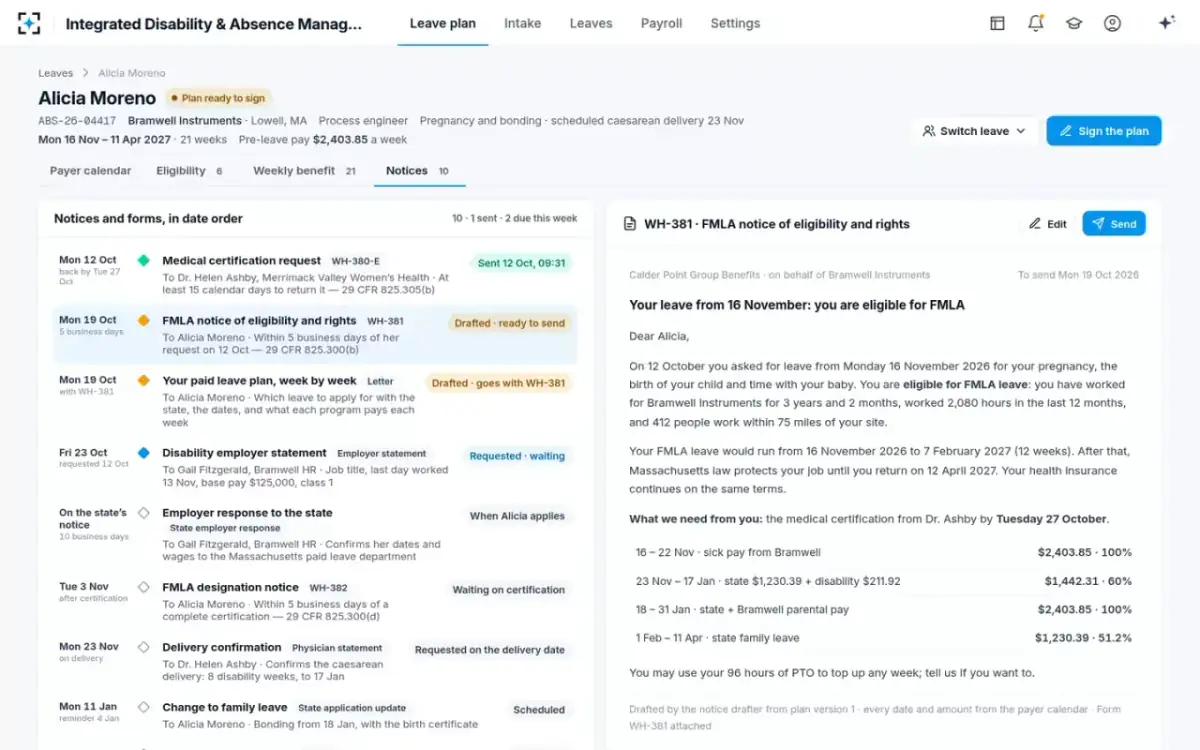
Its limits are deliberate. Agents never approve, deny, pay, recover or send; the case manager agrees every eligibility decision and signs every plan, and a week above 100 percent of pay or any recovery needs a second signature. It does not change who carries the FMLA duty, which stays with the employer in every model. And it is not a payroll system: it sends instructions to the employer's payroll manager, who makes the change.
The payer calendar: every program and every week of one leave on one screen
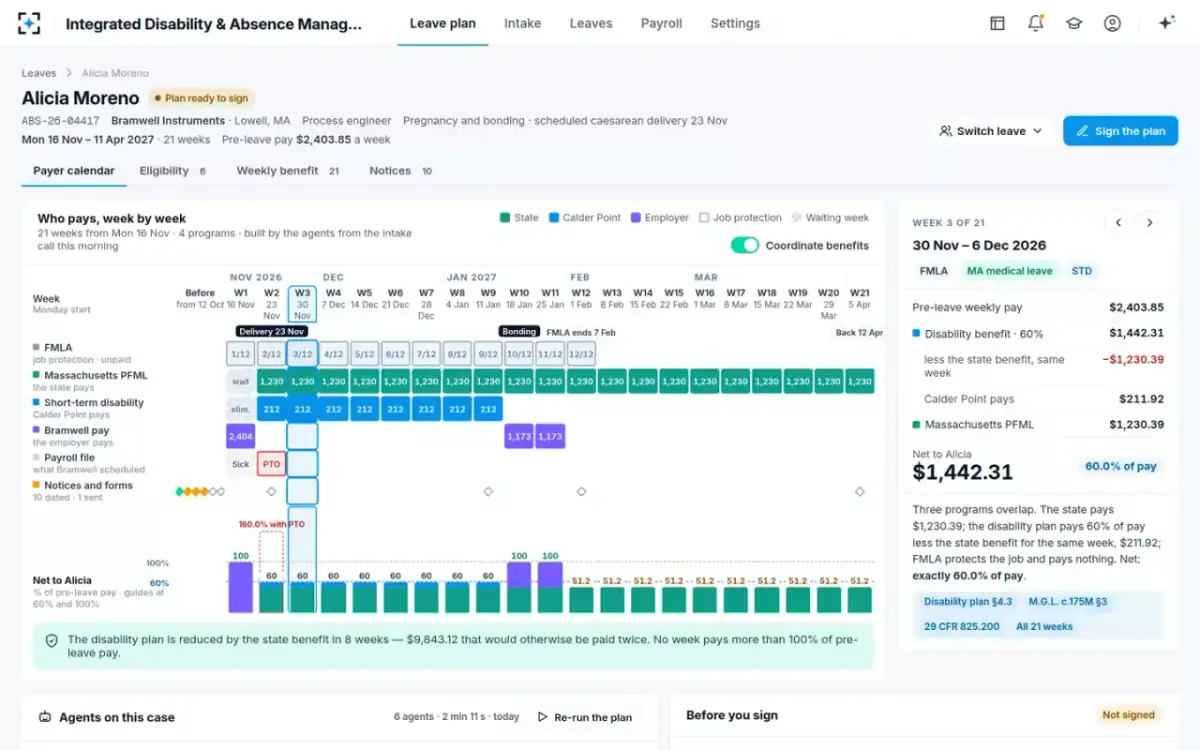
Whichever model you choose, ask to see one leave on one screen, with every clock and every payer, and ask who signs it. The rest of the series starts from Integrated Disability & Absence Management.
Questions people ask
What is leave of absence administration outsourcing?
It is a contract under which a carrier or third-party administrator runs an employer's leave program: intake, eligibility, certifications, notices, tracking and return to work, often together with the disability claim. The employer keeps its legal duties under the FMLA and the ADA and remains liable for a missed notice or a wrongly denied leave.
Can a third party administrator deny FMLA leave?
An administrator can make and communicate the decision in the employer's name if the contract allows it, but the decision is the employer's in law, and any challenge is brought against the employer. An employer can keep the right to review denials in the contract. Where a request might also be an ADA accommodation, the employer must still consider it under the ADA.
Does a leave administrator need a license?
The FMLA regulations set no licence for administering leave. Administering insured disability claims is different: state insurance law may require a third-party administrator or adjuster licence, depending on the state and on whether the administrator adjusts claims on an insured policy. Ask any administrator which licences it holds in your states.
How does a leave administrator coordinate with payroll?
Either by a report or file feed once leaves are designated, which can arrive after the payroll cut-off, or by a tighter arrangement that checks the employer's payroll file against every open leave before each cut-off and sends an instruction per employee, so that PTO nobody chose and return-to-work dates are fixed before the pay run.
What happens to an employee's leave when the employer changes administrator?
The FMLA entitlement belongs to the employee and continues; the new administrator needs the leave history to count the remaining weeks under the employer's 12-month method, plus copies of notices and certifications, which the FMLA requires the employer to keep for three years. Ask for the history in a form the new system can replay, not as scanned letters.