Employee overpayment recovery is the process of getting back pay or benefits an employee received but was not owed, and after a leave of absence it usually means one of three things: a short-term disability (STD) benefit paid in full before the state's benefit was deducted, paid time off that payroll defaulted into a week the state and the disability plan were already paying, or full pay for weeks the employee was still on leave. An employer can generally recover an overpaid wage, but how, how fast and how much the employee repays depend on state wage-payment law, on the FMLA's own limits and, above all, on whether the money comes back in the same calendar year. Botminds' Integrated Disability & Absence Management lays each employer's payroll file over every open leave plan before the cut-off, so the double-paid week is caught as an instruction rather than recovered as a debt.
The worked example on this page is a fictional sample case in the solution: a pregnancy leave at Bramwell Instruments, run by Calder Point Group Benefits, with pre-leave pay of $2,403.85 a week. The tax rules are quoted from the IRS; the leave rules from the Department of Labor and state agencies.
Where the gross of one overpaid week goes before the employee sees it
One week of PTO paid in error · $2,403.85 gross
- Reaches the employee (net) · 70%
- Federal income tax withheld · 22%
- Social security and Medicare · 8%
How do employers recover overpayments from employees?
Employers recover overpayments in one of three ways: a deduction from later pay, a repayment the employee makes by check or payment plan, or, for a benefit plan, a reduction of later benefit payments under the plan's terms. Which one is open depends on what was overpaid and where the employee works. Wages paid in error fall under state wage-payment law, which may limit deductions from pay; a disability benefit overpaid by an insurer falls under the policy's overpayment clause; a state benefit overpaid by the state is the state's to recover under its own procedure.
The leave setting adds a fourth party. The FMLA lets an employer recover its share of health premiums paid during unpaid leave if the employee does not come back, and says how: the employer "may recover the costs through deduction from any sums due to the employee (e.g., unpaid wages, vacation pay, profit sharing, etc.), provided such deductions do not otherwise violate applicable Federal or State wage payment or other laws. Alternatively, the employer may initiate legal action against the employee to recover such costs" (29 CFR 825.213(f)). The same deference to state wage law applies to any other overpayment taken back through payroll.
"Because paid leave provided under a plan covering temporary disabilities (including workers' compensation) is not unpaid, recovery of health insurance premiums does not apply to such paid leave."
29 CFR 825.213(d), Department of Labor FMLA regulations
That sentence matters for every maternity or surgery leave paid partly by STD: the weeks the disability plan paid are not weeks for which the employer can claw back health premiums, even if the employee never returns. The rights and responsibilities notice the employer sends at the start of the leave must already have warned of "The employee's potential liability for payment of health insurance premiums paid by the employer during the employee's unpaid FMLA leave if the employee fails to return to work" (29 CFR 825.300(c)(1)(vii)); an employer that did not send it is in a weak position to collect.
Can an employer take back an overpayment?
Yes, an overpaid wage is generally recoverable, but the method is regulated and varies by state. Some states allow a payroll deduction only for particular kinds of error and only on a procedure set by the state's labor department. New York's Labor Law § 193, for example, permits deductions that "are related to recovery of an overpayment of wages where such overpayment is due to a mathematical or other clerical error," and requires the employer to follow the commissioner's regulations on "the timing, frequency, duration, and method of such recovery" (NY Labor Law § 193, as in force October 2026). Rules differ from state to state, so the state's wage-payment law has to be read before anything is deducted. The safe default is a written repayment agreement the employee signs, with an instalment schedule.
A state can also take back its own benefit, and its process runs on its own clock. California's Employment Development Department sends a Notice of Potential Overpayment where it needs more information; for disability or paid family leave the claimant "must respond within 14 days." If the overpayment was not the claimant's fault, a waiver may be granted where repayment "would cause you extraordinary hardship," and an overpayment determination may be appealed "within 30 days of the mailed date" (California EDD, Benefit Overpayments and Penalties). An employer that lets sick pay or PTO run alongside the state benefit without combining it can trigger that process for its own employee: the EDD "may reduce your employees' benefits" by sick leave pay unless the employer allows combining (California EDD, employer FAQs).
Gross or net: what does the employee repay?
If the overpayment is recovered in the same calendar year, the employee normally repays the net and the employer recovers the withheld taxes itself; after 31 December, the employer can no longer get the income tax back through payroll, and the employee's relief, if any, comes on her own return. The calendar, not the amount, decides which. The IRS rule for employers is short: "If an employee repays you for wages received in error, don't offset the repayments against current year wages unless the repayments are for amounts received in error in the current year" (IRS Publication 15, Wage Repayments).
Within the year, repayments of wages from an earlier quarter are corrected on Form 941-X "to recover income tax withholding and social security and Medicare taxes for the repaid wages." For a prior year, the employer can recover only the social security and Medicare taxes; "You can't make an adjustment for income tax withholding because the wages were income to the employee for the prior year." It files Forms W-2c and W-3c, and does not correct box 1.
For the employee, the prior-year wages "remain taxable to the employee for that year," and she cannot amend that year's return to undo them; she "may be entitled to a deduction or credit for the repaid wages on their income tax return for the year of repayment." Publication 525 sets the threshold that makes that relief real or not: if the amount repaid "was more than $3,000," it can be deducted or taken as a credit under the claim-of-right rule; for repayments of $3,000 or less, "you aren't able to deduct it from your income in the year you repaid it" (IRS Publication 525 (2025), Repayments).
The sample week shows why that matters. A defaulted 40 hours of PTO in the week of 23 November would have overpaid $2,403.85. The leave runs to 12 April 2027, so a recovery letter sent after her return lands in the next tax year. Recovered in 2027, it is a prior-year repayment of less than $3,000: the employer cannot reclaim the $528.85 of income tax it withheld, and the employee cannot deduct the repayment. Whoever bears it, about a fifth of the week is lost to tax.
What is a short term disability overpayment?
A short-term disability overpayment is a benefit the insurer paid that the policy did not owe, most often because the policy paid its full percentage before deducting a state disability or paid leave benefit for the same week, or kept paying after the employee went back to work. The policy's overpayment clause sets how it is recovered, for example by reducing later benefit payments or by asking for repayment. The arithmetic of the state offset, and how often it goes wrong on closed claims, is worked through in STD state disability offset.
STD overpayments and payroll overpayments often happen together, because they come from the same missing fact: nobody has laid the state's payments, the policy's payments and the employer's payroll on the same weeks. The Department of Labor's 2018 survey shows how often leave pay has more than one source.
Pay on leave usually comes from more than one source
Do I have to repay STD if I got state disability?
If the policy deducts state benefits and paid you in full while the state claim was pending, usually yes: the state's award shows that part of what the policy paid was not owed. The amount to repay is the policy payment minus what the policy should have paid after the deduction, week by week. Whether the insurer takes it from later payments or asks for a check is set by the policy, and an employee who disagrees with the amount can ask for the calculation behind it.
The reverse can happen too. In California, where the state program can pay more than a 60 percent policy, a carrier that deducts an estimated state benefit before the state's own figure arrives can underpay, and owe the difference. Neither the carrier nor the employee knows the right answer until the state's notice exists, which is why the offset belongs in the intake, not in the recovery letter.
How long does an employer have to recover an overpayment?
No federal rule sets a single deadline for recovering wages paid in error. Recovery by payroll deduction is governed by state wage-payment law, which in some states fixes how soon and how fast it may happen; recovery by lawsuit is subject to the state's limitation period for the claim. The FMLA's health-premium rule has its own step: if the employer asks for medical certification of why the employee did not return, the employee must provide it "within 30 days from the date of the employer's request," and if she does not, "the employer may recover 100 percent of the health benefit premiums it paid during the period of unpaid FMLA leave" (29 CFR 825.213(a)(3)).
The tax calendar is the deadline that bites first. Every overpayment recovered after 31 December of the year it was paid becomes a prior-year repayment, with the costs set out above. For a leave that starts in the autumn, that point arrives while the employee is still away.
What one double-paid week costs
One double-paid week costs much more than the week. In the sample pay period of 16 to 29 November, Bramwell's payroll file had seven employees on leave. Five matched their leave plans. Two did not, and they show both directions an error can run.
One pay period, two payroll differences: one employee overpaid, one about to be paid nothing
The overpayment's cost has four parts, and only the first is the money. The recovery work: someone drafts the letter, agrees a repayment plan and tracks it. The tax correction: a W-2c, and a 941-X if the money comes back in another quarter or year. The tax that cannot be recovered, if it crosses the year end. And the employee's goodwill, on a letter that arrives after a birth or an operation. No government or research source publishes the cost of recovering a wage overpayment, so the method below uses your own numbers.
The yearly cost of leave overpayments across a book, term by term
Money not recovered
Overpaid dollars × share never collected
Write-offs, waivers and balances owed by employees who left.
Finance
Recovery work
Overpayments × hours per recovery × loaded hourly rate
Letter, agreement, instalments, follow-up and disputes.
Payroll and absence team
Tax corrections
Overpayments needing W-2c or 941-X × hours each × rate
Any overpayment recovered in a later quarter or year.
Payroll tax
Tax lost at the year end
Prior-year recoveries × income tax withheld that cannot be adjusted
About 22% of each gross week at the supplemental rate.
Employer or employee
Prevent it before the cut-off
The cheapest overpayment is the one that never reaches a payslip. That means checking each employer's payroll file against every open leave plan before the cut-off, not reconciling after the pay run. In the solution the payroll reconciler reads each employer's file at 06:00, two days before the cut-off, compares every employee on leave with the week the plan says, and drafts an instruction for each difference. It flags PTO the employee did not choose; it never edits payroll.
The employer's payroll file against every leave plan, two differences to fix before the cut-off
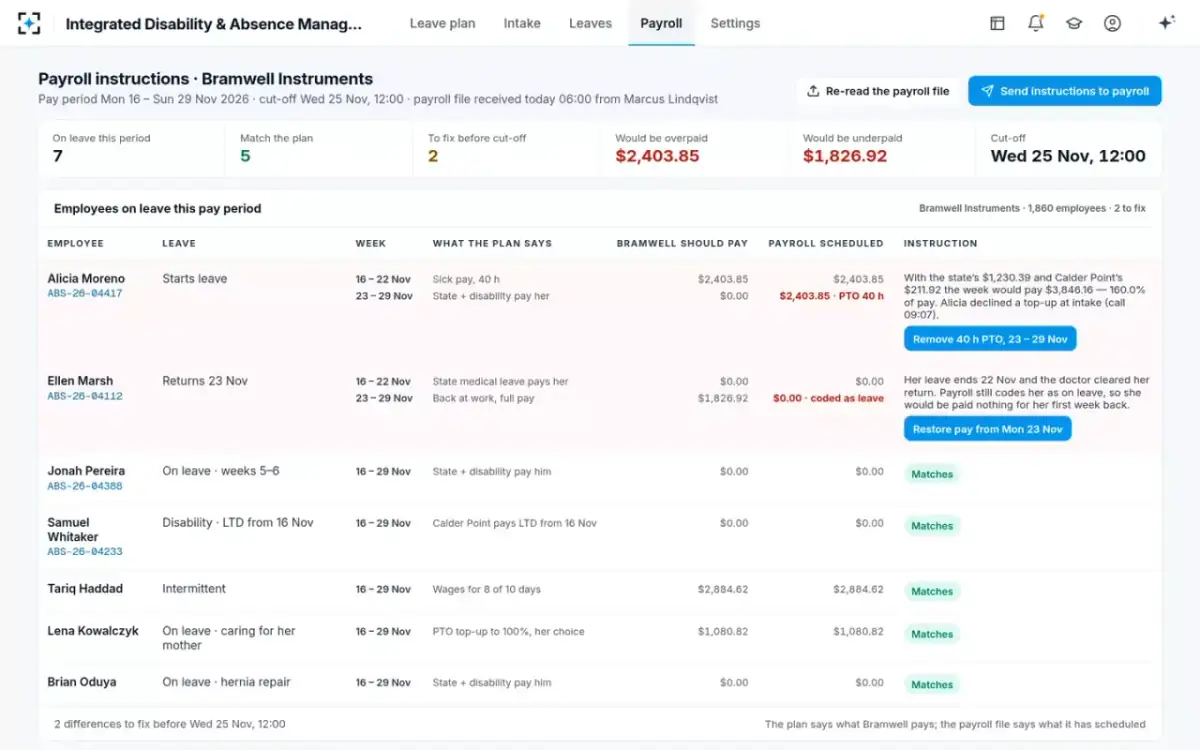
Two governance rules sit behind it. No week may pay above 100 percent of pre-leave pay without stopping the plan for review, and any recovery, like any week above 100 percent, needs a second signature from the team lead. The agents never approve, pay, recover or send. The PTO top-up itself is not forbidden: the FMLA lets an employer and employee agree to supplement a disability benefit with paid leave where state law permits. What the check prevents is a top-up nobody chose, which is how the sample case handles it in the maternity leave rules for employers.
Before the plan is signed: the 100% test, the PTO conflict and the notice clock
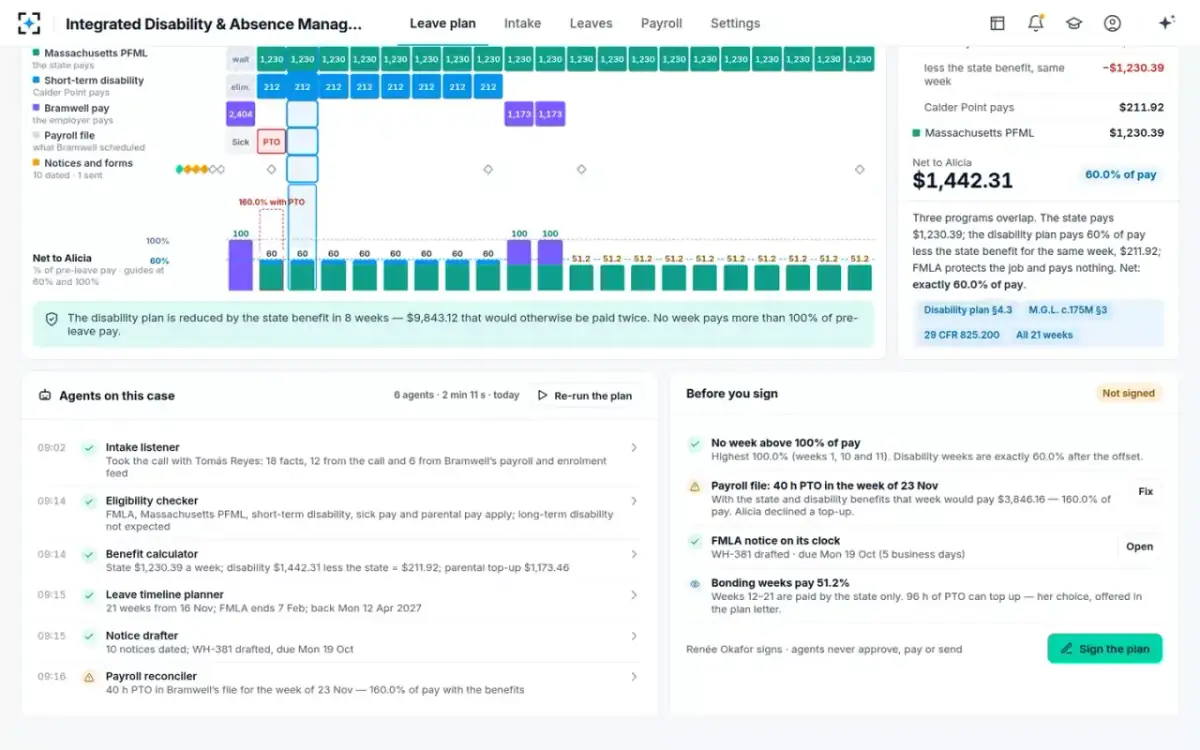
Every number on the payroll screen traces back to the plan, and every plan is signed by a named case manager. To see the rest of the system, start from Integrated Disability & Absence Management.
Questions people ask
Can an employer deduct an overpayment from my final paycheck?
It depends on the state. The FMLA's own recovery rule allows deductions from "any sums due to the employee," including final wages and vacation pay, only where they do not violate federal or state wage-payment law, and state rules on final-pay deductions differ. A written, signed repayment agreement is the safer route for both sides.
Do I have to pay back an overpayment my employer made by mistake?
Generally yes, because wages paid in error were not earned, but the employer must recover them lawfully. In New York, for instance, a payroll deduction for a clerical overpayment must follow the labor commissioner's rules on timing, frequency, duration and method. Ask for the calculation and for an instalment plan if the amount is large.
Is an overpayment repaid in a later year tax deductible?
Only above $3,000. IRS Publication 525 lets a taxpayer who repays more than $3,000 of income included in an earlier year under a claim of right take a deduction or a credit for the year of repayment; for $3,000 or less, no deduction is available for tax years after 2017. The employer can still recover the social security and Medicare taxes on Form 941-X.
What is an employee overpayment repayment agreement?
It is a written agreement in which the employee acknowledges the overpaid amount and agrees how it will be repaid: a lump sum, instalments, or deductions from later pay. Where state law requires written authorisation for a deduction, the agreement is that authorisation. It should state the gross and net figures and the tax year, so both sides know how the repayment will be reported.
Can an employer recover health insurance premiums after FMLA leave?
Only if the employee fails to return after the FMLA entitlement ends or expires, and not when the reason is a continuing serious health condition or another circumstance beyond the employee's control (29 CFR 825.213). Premiums for weeks paid by a disability plan or workers' compensation cannot be recovered, and an employee who returns for 30 calendar days has returned.