The maternity leave rules for employers in the United States come from four places at once. The FMLA gives an eligible employee of a covered employer 12 workweeks of job-protected leave, with group health coverage kept on the same terms; the Pregnancy Discrimination Act requires any short-term disability benefit the employer offers to cover pregnancy like any other condition; the Pregnant Workers Fairness Act bars employers with 15 or more employees from forcing leave when another accommodation would keep the employee working; and a growing number of states add a paid leave program whose benefit the disability policy usually deducts. No federal rule requires the employer to pay, but every one of these rules runs on the same weeks, which is why coordination, not any single rule, is where employers and their carriers go wrong. Botminds' Integrated Disability & Absence Management takes one intake call and lays every program out as a single week-by-week plan that the carrier's case manager checks and signs.
This guide is for the employer's benefits and HR leaders and for the group carriers and administrators who run leave on their behalf. The worked example is a fictional sample case: a process engineer at Bramwell Instruments in Lowell, Massachusetts, with a scheduled caesarean on 23 November, whose leave is run by Calder Point Group Benefits. The employer, carrier and employee are invented; the rules are quoted from the regulators.
The federal maternity leave rules an employer must apply, and to whom they apply
| Rule | Applies to | What it requires of the employer |
|---|---|---|
| FMLA leave (29 CFR 825.120) | Employers with 50 or more employees; eligible employees | Leave for incapacity due to pregnancy, prenatal care and recovery, and bonding leave for both parents within 12 months of the birth: 12 workweeks in total. |
| Health coverage (825.209) | The same | Keep group health coverage on the same conditions as if the employee had worked throughout the leave. |
| Reinstatement (825.214) | The same | Return to the same position or an equivalent one, with equivalent pay, benefits and terms. |
| Notices (825.300) | The same | Eligibility notice within five business days of the request; designation notice, with the amount counted, within five business days of enough information. |
| Pregnancy and disability benefits (Pregnancy Discrimination Act, as 825.702(f) notes) | Employers covered by Title VII (15 or more employees) | The same short-term disability benefits for pregnancy as for any other condition. |
| Pregnant Workers Fairness Act | Employers with 15 or more employees | Reasonable accommodation of known limitations; no forced leave if another accommodation would let her keep working. |
What are the federal maternity leave rules for employers?
The federal rules protect the job and the benefits, not the pay. Under the FMLA, "the expectant mother is entitled to FMLA leave for incapacity due to pregnancy, for prenatal care, or for her own serious health condition following the birth of the child," and "both parents are entitled to FMLA leave for the birth of their child" and to bond with a healthy newborn during the 12 months after the birth (29 CFR 825.120). The entitlement to bonding leave expires at the end of that 12-month period unless state law or the employer allows more.
During the leave, "an employer must maintain the employee's coverage under any group health plan ... on the same conditions as coverage would have been provided if the employee had been continuously employed during the entire leave period" (29 CFR 825.209(a)). On return, the employee "is entitled to be returned to the same position the employee held when leave commenced, or to an equivalent position with equivalent benefits, pay, and other terms and conditions of employment," even if she has been replaced in the meantime (29 CFR 825.214).
One rule surprises employers who think of pregnancy leave as starting at the birth. The expectant mother "is entitled to leave for incapacity due to pregnancy even though she does not receive treatment from a health care provider during the absence, and even if the absence does not last for more than three consecutive calendar days" (29 CFR 825.120). A morning off for severe nausea is protected leave, and so is a week off on the doctor's order before a scheduled caesarean. The disability policy may still require a doctor's certification before it pays for those days, so the job can be protected while the pay waits.
Who pays which week of a maternity leave
On a typical insured maternity leave, the employer's own sick pay or the policy's waiting week covers the first days, short-term disability and any state medical benefit pay the weeks the mother cannot work, and state family leave or the employer's parental pay covers bonding afterwards. The FMLA protects the job across all of it, up to 12 workweeks, and pays nothing.
One maternity leave, 21 weeks: who protects the job and who pays each week
- FMLA, 12 workweeksFMLA · 12 wk
- After FMLA: state law and employer policystate law · 9 wk
- Wait
- STD, 8 weeks after the caesareanSTD · 8 wk
- No STD: she is not disablednone · 12 wk
- Sick pay
- State medical leave + STD after offsetstate + STD · 8 wk
- State + parental top-up2 wk
- State family leave onlystate · 10 wk
The order is not fixed by any one rule; it falls out of how each program is written. The disability policy pays only while the mother is unable to work, so its weeks end when her doctor says she has recovered, six weeks after a vaginal delivery or eight after a caesarean in the sample policy unless the doctor certifies longer. Bonding pay starts when disability ends. Moving the delivery method moves both dates by two weeks, which is why the delivery method is a fact the carrier must have at intake, not when the doctor's form arrives.
Bonding leave is also the longest kind of FMLA leave employers see. In the Department of Labor's 2018 survey, the most recent leave for a new child averaged 36 business days, against 28 across all reasons (DOL 2018 surveys), so maternity leaves are the ones most likely to run past the end of the FMLA's 12 weeks into territory governed only by state law and the employer's own policy.
Leave for a new child runs longer than any other FMLA reason
Can an employer run FMLA concurrently with short term disability?
Yes. Weeks paid by a disability plan are FMLA leave when the condition qualifies, and the employer may count them against the 12 weeks, provided its designation notice says so and states the amount counted (29 CFR 825.300(d)). An employer that fails to designate the disability weeks has not run the two concurrently, whatever its policy says, and may find the employee entitled to 12 further weeks after the disability ends.
The same regulation limits what the employer may do with paid time off during those weeks. "Because leave pursuant to a disability benefit plan is not unpaid, the provision for substitution of the employee's accrued paid leave is inapplicable, and neither the employee nor the employer may require the substitution of paid leave. However, employers and employees may agree, where state law permits, to have paid leave supplement the disability plan benefits" (29 CFR 825.207(d)). An employer policy that says "PTO is used first" cannot be applied to a week the disability plan pays; a top-up is the employee's choice, agreed, not the payroll system's default.
The practical consequence for the plan is that the FMLA clock usually starts on the first day off, not on the day of the birth, and runs out twelve workweeks later. In the sample case it ends on 7 February, while the state's family leave has ten weeks still to run. What the designation notice must say, and how late designation works, is set out separately.
State paid leave: the second set of maternity leave rules
State programs add rules the federal ones do not have, and they differ in what they pay for and whether they may overlap with private disability benefits. New York requires employers to carry disability benefits, and its Workers' Compensation Board tells employees they are "eligible for disability benefits for four weeks before your due date and six weeks after giving birth (eight weeks if you delivered by Caesarian section)," with the statutory benefit capped at "$170 per week" (NY Workers' Compensation Board, Disability Benefits). It also says plainly that disability benefits and Paid Family Leave cannot be collected at the same time, and the two together "may not exceed 26 weeks" in any 52.
Short-term disability and state paid family leave pay for different weeks
Short-term disability (group policy): Weeks the mother is unable to work because of pregnancy, delivery or recovery, as her doctor certifies.
State paid family leave (bonding): Time with a new child, for either parent, once any disability period ends; no medical incapacity needed.
Short-term disability (group policy): The insurer or plan, under the policy and, for an employer plan governed by ERISA, the federal claims rule.
State paid family leave (bonding): The state agency, or a private insurer where the state lets employers insure it.
Short-term disability (group policy): After the policy’s elimination period, such as 7 days.
State paid family leave (bonding): By the state’s own rule, which differs by state.
Short-term disability (group policy): A share of pre-leave pay, such as 60%, up to the policy maximum.
State paid family leave (bonding): A share of pay set by state law, up to a state maximum that resets each January.
Short-term disability (group policy): A policy that offsets state benefits pays only the difference.
State paid family leave (bonding): In New York, never at the same time as disability benefits.
States that pay medical leave as well as family leave create the overlap New York forbids: the state's medical benefit and the private STD policy can cover the same week, and then the policy's offset decides who pays what. States also limit the employer's top-up. California's Employment Development Department tells employers that an employee's wages plus the state's disability or family leave benefit "can't be more than their normal wages before the start of the benefit period," and that a combined amount above regular pay may reduce the state's payment (California EDD, integration and coordination). A multi-state employer is therefore applying a different ceiling in each state, on the same kind of leave. New York's two programs are compared line by line in NY DBL and PFL.
The disability offset: who pays which dollar in a maternity week
Where the STD policy deducts the state benefit, the carrier pays only the difference between the policy's benefit and what the state pays for the same week. In the sample case the employee's weekly pay is $2,403.85 and the policy pays 60%, or $1,442.31. The state pays $1,230.39 for the same week, so the carrier pays $211.92, and the employee receives exactly 60.0% of pay in each of the eight disability weeks.
Integrated Disability & Absence Management's weekly benefit view: the offset in one line, every week shown
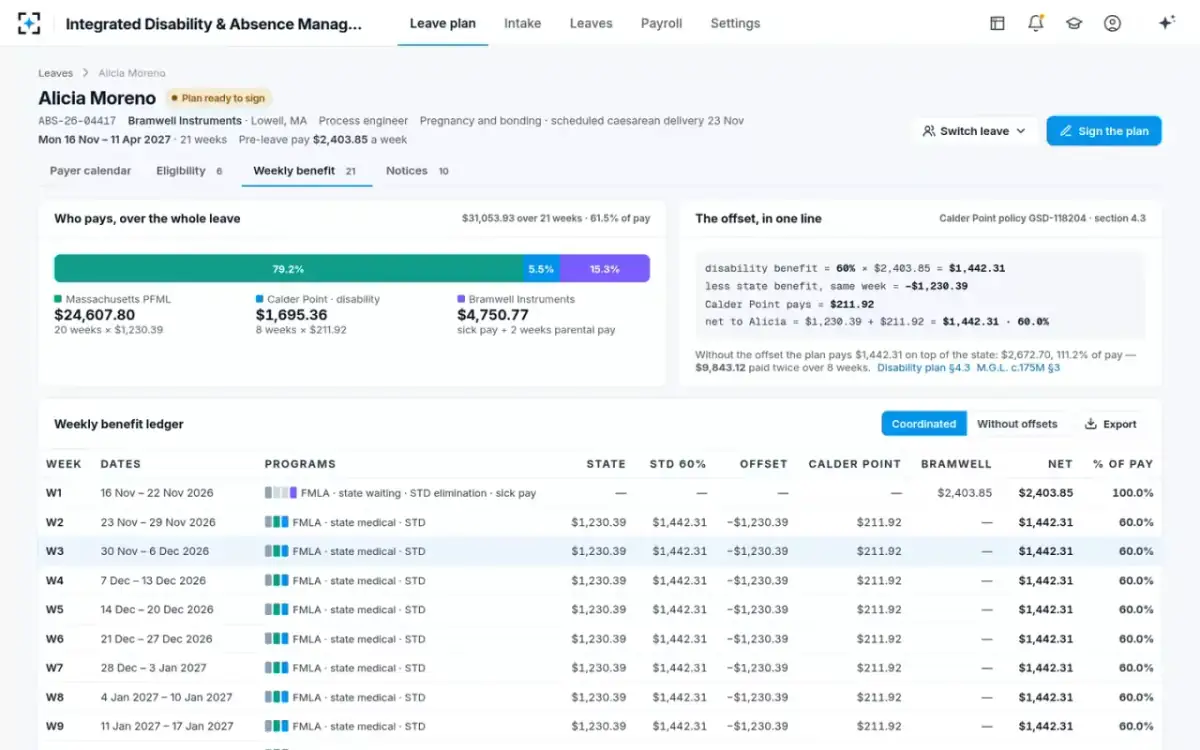
The failure is easy to describe and expensive to unwind. If the carrier pays its full 60% before the state's benefit is known, the employee is paid twice for the same weeks. With coordination switched off in the sample, the eight disability weeks pay 111.2% of pay and $9,843.12 is paid twice, money the carrier must then ask a new mother to return. The state-by-state arithmetic, and a test that replays closed claims to find the errors, are in the guide to STD state disability offsets.
Payroll is where an employer's maternity leave goes wrong
Most errors on a well-decided maternity leave are made in the employer's payroll file, not in the leave decisions. Payroll systems default to paying scheduled hours, and an employer policy that applies PTO automatically will put it into weeks the state and the disability plan are already paying, which is exactly what 29 CFR 825.207(d) forbids the employer to require.
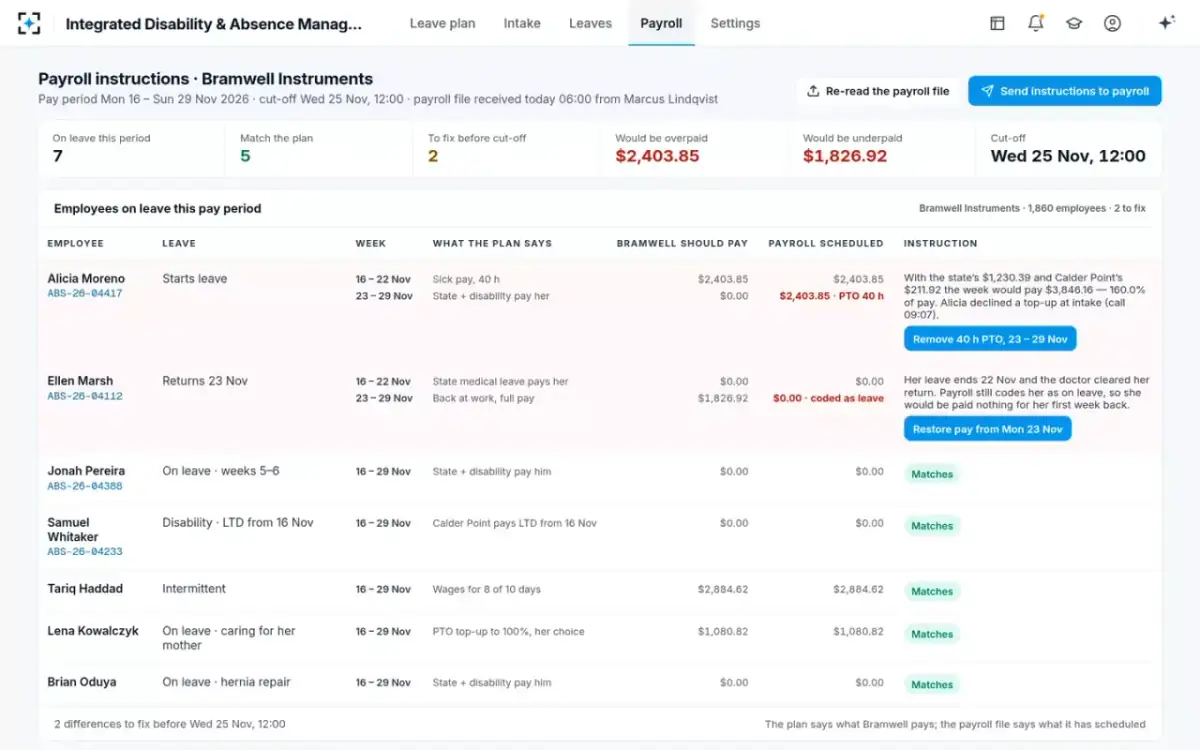
In the sample, Bramwell's payroll file for the pay period of 16 to 29 November had 40 hours of PTO defaulted into the week of 23 November, the week of the caesarean. With the state and the disability plan already paying 60%, the PTO would have paid her 160.0% of pre-leave pay, and she had declined a top-up on the intake call. The payroll reconciler flagged it before the cut-off and drafted the instruction to remove it; the employer's payroll manager made the change. The same check catches the opposite error, an employee back at work and still coded as on leave, who is paid nothing that week.
The employer's payroll file read against every open leave before the cut-off
The notices an employer owes on a maternity leave, in date order
A maternity leave generates a sequence of notices with their own clocks, and on a planned birth most of them can be dated the day the employee first calls. The sample plan dates ten notices from one call on Monday 12 October.
The first notices on one maternity leave, dated from the plan
| Notice | When | Rule or source |
|---|---|---|
| FMLA eligibility and rights notice (WH-381) | Monday 19 October: five business days after the call | 29 CFR 825.300(b), (c) |
| Request for the doctor’s certification (WH-380-E) | With the eligibility notice; due back Tuesday 3 November, 15 calendar days after the request | 825.305(b) |
| State paid leave employer statement | On the state’s own clock once the employee files | The state program |
| Disability claim acknowledgement and decision | Decision within 45 days of the claim, extendable | 29 CFR 2560.503-1(f)(3) |
| FMLA designation notice (WH-382), with the weeks counted | Five business days after a complete certification | 825.300(d) |
| The plan letter in plain words | With the signed plan | The employer’s and carrier’s own practice |
The designation notice is the one employers most often treat as a formality, and it is the one that decides whether the disability weeks count. It must state "the amount of leave counted against the employee's FMLA leave entitlement" (29 CFR 825.300(d)(6)). In the Department of Labor's survey only 51% of covered worksites said they give written notice of how much leave counted as FMLA leave (DOL 2018 surveys).
Before the birth: when the PWFA comes before leave
The PWFA changes the first question an employer asks of a pregnant employee who needs something: not "how much leave?" but "what would let her keep working?" The EEOC lists among the things a covered employer must not do: "Require an employee to take leave if another reasonable accommodation can be provided that would let the employee keep working" (EEOC, What You Should Know About the PWFA).
Leave remains an accommodation when it is what the employee needs; the EEOC's examples include "Leave for health care appointments" and "Leave to recover from childbirth or other medical conditions related to pregnancy or childbirth." For the leave team, a request for a stool, lighter duties or time for appointments is a case to work, and an FMLA designation for prenatal care does not settle whether an accommodation is owed. The two run on different tests and different clocks, and an employer's process should route the request to both.
A maternity leave coordination checklist for employers and carriers
The rules above meet at a small number of points, and a checklist built around those points prevents most of the errors employers and carriers see. Each item is one an employer can audit on last year's closed maternity leaves.
Ten checks on every maternity leave, before anything is paid or sent
- Delivery method asked at intake
It sets the disability weeks after delivery, and with them the start of bonding pay.
- Every program tested
FMLA, the state program, STD, LTD and the employer’s sick and parental pay, each with its test and the employee’s values.
- Disability weeks designated as FMLA leave
In writing, with the weeks counted, so the 12 weeks run concurrently (825.300(d)).
- No PTO forced into a paid disability week
A top-up only by agreement, where state law permits (825.207(d)).
- State ceiling applied
Wages plus the state benefit no higher than the state allows, state by state.
- Offset worked before the first STD payment
The carrier pays the difference, not the full benefit, once the state benefit is known.
- No week above 100% of pre-leave pay
Any exception has a second signature and a reason.
- Health coverage kept on the same terms
Including how the employee’s share of premium is collected while she is unpaid (825.209).
- Payroll file checked before each cut-off
Defaulted PTO and leave codes that outlast the leave.
- Return date in payroll and the job held
Same or equivalent position on return (825.214); the return date reaches payroll before the pay period.
What Integrated Disability & Absence Management does at each step, and who signs
Six agents carry the mechanical work of a maternity leave in order, and none of them decides anything the rules give to a person. The carrier's case manager agrees or changes each eligibility test, signs the plan and is the only one who can send a notice; any week above 100% of pay, or any recovery, needs a second signature from a team lead.
One maternity leave in Integrated Disability & Absence Management, step by step
Agent
Intake listenerCaptures the delivery date and method, first day off, doctor, bonding plan and PTO choice from the call, and service, hours, headcount and coverage from the employer feed, each with its line.
Never: telling the employee she is approved or denied
Agent
Eligibility checkerApplies the FMLA test, the state program, the STD policy and the employer’s pay policies, each with her values and the rule.
Never: denying a program
Agent
Benefit calculatorWorks out each week’s state benefit, STD benefit, offset and employer pay, with the net and the share of pay.
Never: a week above 100% of pre-leave pay
Agent
Timeline planner and notice drafterLays out the 21 weeks, then dates the eligibility notice, the certification request and the designation notice from the plan.
Never: sending a notice
Agent
Payroll reconcilerReads the employer’s payroll file before the cut-off and drafts instructions where it disagrees with the plan.
Never: editing payroll
A person decides
Absence case managerAgrees each eligibility decision, checks the warnings before signing, and signs version 1; the plan letter and the FMLA notice go out.
The design target is one day from the intake call to a signed plan, against Botminds' estimate of three to five days of call-backs and spreadsheets by hand. How an absence team that runs many such leaves sizes its caseload and measures itself is covered in leave management best practices. The whole series starts from Integrated Disability & Absence Management.
Questions people ask
Are employers required to pay maternity leave?
Not under federal law: FMLA leave is unpaid. Pay comes from short-term disability, where the employer offers it or a state requires it, from a state paid family and medical leave program, and from the employer's own sick or parental pay. In the Department of Labor's 2018 survey, 34% of employees who took leave received no pay at all.
Does short term disability have to cover pregnancy?
If the employer offers short-term disability, it must treat pregnancy like other conditions. As the FMLA regulations note in describing the Pregnancy Discrimination Act, "an employer should provide the same benefits for women who are pregnant as the employer provides to other employees with short-term disabilities" (29 CFR 825.702(f)). Some states, such as New York, also require disability coverage by law.
Can an employer require PTO during maternity leave?
Not for weeks a disability plan or workers' compensation already pays: 29 CFR 825.207 makes substitution inapplicable, though the employer and employee may agree to a top-up where state law permits. For unpaid FMLA weeks, such as bonding with no state benefit, the employer may generally require accrued paid leave to run concurrently under its own policy.
When does FMLA start for a pregnant employee?
On the first day of qualifying leave, which may be before the birth. Absence for incapacity due to pregnancy or prenatal care is FMLA leave, even without treatment and even for a single day (29 CFR 825.120). Bonding leave must be taken within 12 months of the birth.
Is health insurance continued during maternity leave?
During FMLA leave, yes: the employer must keep group health coverage on the same conditions as if the employee had worked throughout (29 CFR 825.209). After the 12 FMLA weeks end, continuation depends on state law, the employer's own policy and the plan's terms.
Can state paid family leave and short term disability be paid for the same week?
It depends on the state. New York says disability benefits and Paid Family Leave cannot be collected at the same time, and caps the two at 26 weeks in 52. Where a state pays medical leave that overlaps the STD weeks, a policy that offsets state benefits pays only the difference.