Leave management best practices are the operating rules that keep an absence team inside the law and off the payroll error report: size the caseload by the dated obligations each leave generates, not by the number of open files; take the employee's facts once; date every notice from a single plan; keep medical certifications in separate confidential files; check the employer's payroll file against every open leave before each cut-off; and require a second signature on any week above full pay and on every recovery. The work is hard because one absence can touch the FMLA, a state paid leave program, short-term and long-term disability and the employer's own pay, each with its own test and clock. Botminds' Integrated Disability & Absence Management exists to carry the mechanical half of that work for group carriers, administrators and the employers they serve, so the case manager's week goes on decisions.
This guide is written for the people who run absence programs: the head of a carrier's leave and disability operation, an administrator's service leader, an employer's benefits director. The examples come from a fictional sample, Calder Point Group Benefits, a group carrier, and Bramwell Instruments, one of its employer clients. The research figures come from the Department of Labor and the rules themselves, linked where they appear.
The load an absence team carries, as the Department of Labor measured it
15%
of US employees took leave for an FMLA-qualifying reason in the past 12 months
31%
of those leave-takers took it in separate occasions for the same reason: intermittent leave
32%
took more than one leave for different qualifying reasons in the same 12 months
28days
average length of a leave for a qualifying reason, in business days
What are leave management best practices?
Leave management best practices are the ten habits below, each tied to the rule that makes it necessary rather than merely tidy. A program that follows the FMLA notice rules and ignores the disability plan's offset, or that dates every notice correctly and lets payroll default PTO into a paid disability week, fails in the gaps between programs, which is where most complaints and recoveries start.
Ten leave management best practices, and the rule each one rests on
- Take the facts once, at intake
Delivery method, first day off, doctor, hours and headcount at the first call, so no program needs a call-back. Missing facts are what push the eligibility notice past five business days (29 CFR 825.300(b)).
- Test every program, every time
FMLA, the state program, STD, LTD and employer pay, each with its own test written down beside the employee’s values.
- Date every notice from one plan
Eligibility within five business days of the request; designation within five business days of enough information (825.300(b), (d)).
- Track the certification clock
At least 15 calendar days to return it, seven to cure a deficiency, both on the calendar from the day they start (825.305).
- Count intermittent leave in hours
Against the employee’s actual workweek, in the smallest increment the employer uses for other leave.
- Keep medical files apart
Certifications and medical histories in separate confidential files, not the personnel file (825.500(g)).
- Coordinate pay before it is paid
The state benefit, the STD offset and any top-up worked out per week, with no week above 100% of pay.
- Check payroll before every cut-off
Defaulted PTO and return dates still coded as leave are the two commonest causes of a paid-twice week.
- Two signatures on the costly decisions
A second person signs any week above full pay and any recovery; a denial is always a person’s.
- Keep the evidence three years
Dates, hours, notices, policies and disputes, ready for the Department of Labor to inspect (825.500(b)–(c)).
The list is short because the hard part is not knowing it but doing all ten on every leave, at volume, across employers with different policies and states with different programs. The rest of this guide takes them in the order a leader meets them: the caseload, the clocks, the rules that bind the seat, the money, the evidence and the measures.
Size the absence team's caseload by obligations, not open files
A count of open leaves is the number most absence teams report and the one least useful for staffing. A case manager with 120 continuous leaves that run quietly for twelve weeks has an easier month than one with 60 intermittent leaves, each throwing up a new absence to count in hours, a recertification and a payroll question. The unit that predicts the work is the dated obligation: a notice due, a certification returning, a disability decision, a return to work, a payroll cut-off.
The Department of Labor's figures show why the two counts drift apart. Almost a third of leave-takers took leave intermittently, and almost a third took more than one leave for different reasons in the same year (DOL 2018 surveys). Each extra leave restarts some clocks and not others, and an intermittent leave generates obligations every time the employee is absent, not once at the start.
In the fictional sample, Renée Okafor, an absence case manager at Calder Point, carries 118 open leaves across 14 employers in nine states. On a Monday in October, ten of them change during the month: a return to work that payroll has not recorded, a long-term disability decision due in four weeks, a new pregnancy leave starting in November. Those ten, not the 118, are her month, and a team leader who staffs by the 118 will misjudge both her and the colleague beside her.
Integrated Disability & Absence Management counts a caseload by what changes this month
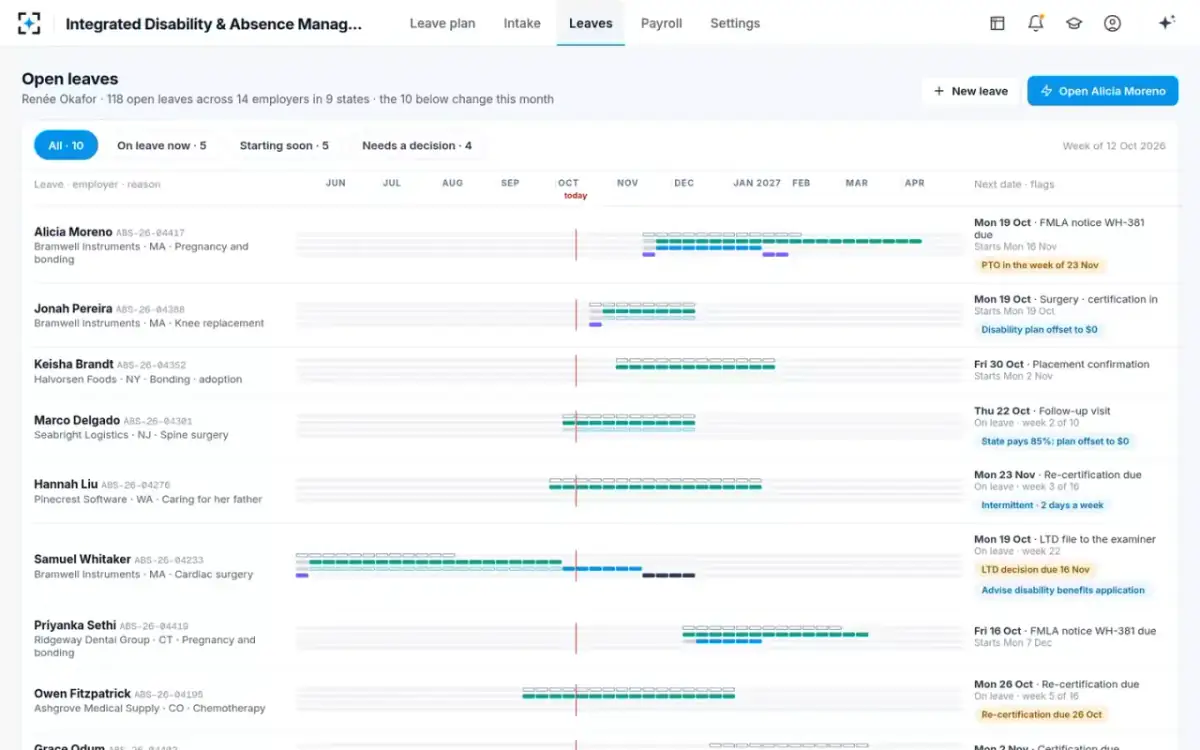
How many leaves can one case manager carry?
No government or research body publishes a standard caseload for leave or absence case managers, so the answer is a method rather than a number. Count the dated obligations each kind of leave generates in a typical month, weight them by the time each takes, and staff to the total, then check the result against the notices that went out late last quarter.
A caseload method: count the month's obligations by kind of leave
| Kind of leave | Obligations it typically generates in a month | Why it weighs more or less |
|---|---|---|
| Continuous, one program (FMLA only) | Designation; return to work; one payroll check | Few dates once designated, and no pay to coordinate. |
| Continuous, several programs (pregnancy, surgery) | Eligibility and designation; state claim; STD decision; weekly offset; payroll check at each cut-off; return | Every payer has its own clock, and the offset changes when the state benefit is known. |
| Intermittent | Each absence counted in hours; balance updates; recertification; payroll check at each cut-off | Generates work every time the employee is out, for as long as the leave lasts. |
| Disability claim moving to LTD | Claim file to the examiner; the 45-day decision clock; benefit change; notices | An ERISA deadline on top of the leave’s own. |
| Returning this month | Fitness-for-duty step; return date to payroll; close of the leave | The commonest source of a week paid wrongly in either direction. |
Run the method on last quarter's closed leaves before using it to hire. If the obligation count says a case manager had capacity and her notices still went late, the weights are wrong; if it says she was over capacity and nothing went late, something is being skipped, and the place to look is the payroll check, because it is the obligation nobody else notices until the pay stub.
The clocks an absence team must never miss
The FMLA and the disability claims rule set deadlines that run whether or not the case manager has the facts. Most are short, and several run at once on a single leave, which is why a team that tracks them in a spreadsheet per case manager tends to find out about a missed one from the employee.
The federal clocks on one leave, and where each starts
| Obligation | Deadline | Starts when | Rule |
|---|---|---|---|
| Eligibility and rights notice | 5 business days | The employee asks, or the employer learns the leave may qualify | 29 CFR 825.300(b), (c) |
| Certification returned | At least 15 calendar days | The employer asks for it | 825.305(b) |
| Deficiency cured | 7 calendar days | The employer says in writing what is missing | 825.305(c) |
| Designation notice, with the amount counted | 5 business days | The employer has enough information, usually the certification | 825.300(d) |
| STD claim decision | 45 days, extendable twice by 30 | The plan receives the claim | 29 CFR 2560.503-1(f)(3) |
| Leave records kept | At least 3 years | The records are made | 825.500(b) |
The cost of a miss is written into the rule. "Failure to follow the notice requirements set forth in this section may constitute an interference with, restraint, or denial of the exercise of an employee's FMLA rights," the regulation says, and the employer "may be liable for compensation and benefits lost by reason of the violation" and for other losses and relief (29 CFR 825.300(e)). For a carrier or an administrator running leaves for an employer, the designation stays the employer's duty "in all circumstances," so a late notice from the administrator is the client's exposure first and the administrator's relationship problem second. What the designation notice must say, and how late designation works, is set out separately.
The rules that bind the absence team's seat
Three rules shape who may do what in an absence team, and each one is a control a leader can test. They concern the doctor, the medical file and the people who decide disability claims.
"To make such contact, the employer must use a health care provider, a human resources professional, a leave administrator, or a management official. Under no circumstances, however, may the employee's direct supervisor contact the employee's health care provider."
29 CFR 825.307(a), Department of Labor FMLA regulations
The first is contact with the doctor. Once the employee has had the chance to cure an incomplete certification, the employer may contact the health care provider to authenticate or clarify it, but only through the roles above, and "no additional medical information may be requested" (29 CFR 825.307(a)). A program that lets supervisors chase doctors' offices for a return date is out of line with the rule, however helpful the supervisor meant to be.
The second is the medical file. Certifications, recertifications and medical histories created for FMLA purposes "shall be maintained as confidential medical records in separate files/records from the usual personnel files" (29 CFR 825.500(g)). In practice that means the employer's HR team sees the leave's dates, programs and return date, and not the diagnosis; a system that shows everyone the whole file breaks the rule by design.
The third applies where the same team decides short-term or long-term disability claims. The Department of Labor's claims rule requires that disability claims be "adjudicated in a manner designed to ensure the independence and impartiality of the persons involved in making the decision," and that decisions on hiring, pay, promotion or dismissal of an adjudicator or a medical or vocational expert "must not be made based upon the likelihood that the individual will support the denial of benefits" (29 CFR 2560.503-1(b)(7)). A scorecard that rewards a disability examiner for denials, under whatever name, is the measure this rule forbids.
Where absence programs lose money: payroll, offsets and the return date
Most money lost on a leave is lost after the decisions are right, in the hand-off to payroll. Payroll systems default to paying scheduled hours. When an employee is on leave, a defaulted 40 hours of PTO in a week the state and the disability plan are already paying can take her well above full pay, and an employee cleared to return on a Monday who is still coded as on leave is paid nothing that week.
In the sample pay period, Bramwell's payroll file shows both. One employee on maternity leave has 40 hours of PTO defaulted into her delivery week, which would pay her 160.0% of pay; she had declined a top-up on the intake call. Another, back at work on 23 November, is still coded as on leave. Neither error is a leave decision, and both would have reached the employee's bank account without a check against the leave plan before the cut-off.
The disability offset is the other leak. Where the STD policy deducts the state benefit for the same week, a carrier that pays its full benefit before the state's figure is known has paid twice, and the recovery letter goes to someone who has just had a baby. How the offset is worked out state by state, and how to test it on closed claims, and what one double-paid week costs the employer and the employee, are each covered in their own guides. The best practice they share is simple to state: work out each week's pay from every program before any of it is paid, and put a second signature on any week that comes out above 100%.
Where the days go between the intake call and a signed leave plan
By hand · about 4.5 days (estimate)
- Intake and call-backs · 33%
- Eligibility, program by program · 22%
- Weekly benefits and offsets · 22%
- Dating notices · 11%
- Telling payroll · 11%
With the agents · about 0.6 days (estimate)
- Intake · 17%
- Eligibility review · 33%
- Benefits · 17%
- Notices · 17%
- Payroll · 17%
What evidence should a leave program keep for an audit?
A leave program should be able to show, for any leave in the last three years, what the employee asked for, what each program decided and why, what notices went out and when, and what was paid. The FMLA sets the floor: employers must keep its records "for no less than three years and make them available for inspection, copying, and transcription by representatives of the Department of Labor upon request" (29 CFR 825.500(b)).
The evidence the FMLA requires, and what a well-run program adds
| The rule requires | A well-run program also keeps |
|---|---|
| Payroll and identifying data: pay, hours worked, deductions, total compensation (825.500(c)(1)) | The payroll instruction sent for each leave week, and the employer’s confirmation |
| Dates of FMLA leave, designated as FMLA leave in the records (c)(2) | The plan version that produced each date, and the reason for every change |
| Hours of leave taken in increments of less than a day (c)(3) | The running balance after each intermittent absence |
| Copies of the employee’s written notices and of every notice given to the employee (c)(4) | The date each notice was due against the date it was sent |
| The employer’s leave and benefit policies (c)(5) | The policy version in force on the day each decision was made |
| Records of disputes over designation, with the reasons (c)(7) | Who decided each program, with the test, the employee’s values and the rule cited |
The Department of Labor's survey shows how far practice sits from the rule. The designation notice must tell the employee how much leave will be counted against the entitlement, yet only about half of covered worksites said they give written notice of how much leave counted as FMLA leave (DOL 2018 surveys). The survey asks about practice, not compliance, but the gap is the first place an auditor would look.
How often covered worksites put leave rules in writing
The weekly measures an absence leader should read
Five numbers tell a leader whether the practices above are happening, and none of them is the count of open leaves. Each can be computed from the plan and the notices without asking the team to report anything new.
Notices sent on time, as a share of notices due: the FMLA clocks are the program's legal exposure, so this is the first line of the report, split by employer. Days from intake call to signed plan: the design target in the solution is one day, and a team that runs at four or five is spending its week on call-backs. Call-backs per leave for missing facts: the measure of intake quality, and the one that moves first when a new kind of leave arrives. Payroll differences found before the cut-off, and the number found after: the second figure should be close to zero. Weeks above 100% of pay and recoveries opened: each one should have a second signature, and a rising count is a coordination problem, not a collections one.
A sixth number belongs on the disability side only, and it is the one the ERISA rule constrains: decisions made inside the 45-day clock. It is a timeliness measure. Approval and denial rates may be watched for drift across the book, but under the claims rule they cannot be a target for any individual adjudicator.
Where agents fit in leave management, and what stays with the case manager
The mechanical half of these practices is what agents carry well: capturing the facts with the line they came from, applying each program's test, working out weekly amounts and offsets, dating every notice from the plan and reading the payroll file before the cut-off. The judgement half stays where the rules put it, with named people, and Integrated Disability & Absence Management is built around that line.
One leave through Integrated Disability & Absence Management: who does each step
A person decides
Leave intake specialistTakes the call and keeps the conversation; answers the prompt for any fact that would change the plan.
Agent
Intake listenerCaptures each fact beside the line it came from and pulls service, hours, pay, headcount and PTO from the employer feed.
Never: telling the employee they are approved or denied
Agent
Eligibility checker and benefit calculatorApplies each program’s test with the employee’s values and the rule; works out each week’s state benefit, STD offset and net pay.
Never: denying a program, or paying a week above 100% of pay
Agent
Notice drafter and payroll reconcilerDrafts and dates every notice from the plan; reads the employer’s payroll file against the plan before the cut-off.
Never: sending a notice or editing payroll
A person decides
Absence case managerAgrees or changes each eligibility test, signs the plan and sends the notices.
A person decides
Team leadSecond signature on any week above full pay and on any recovery.
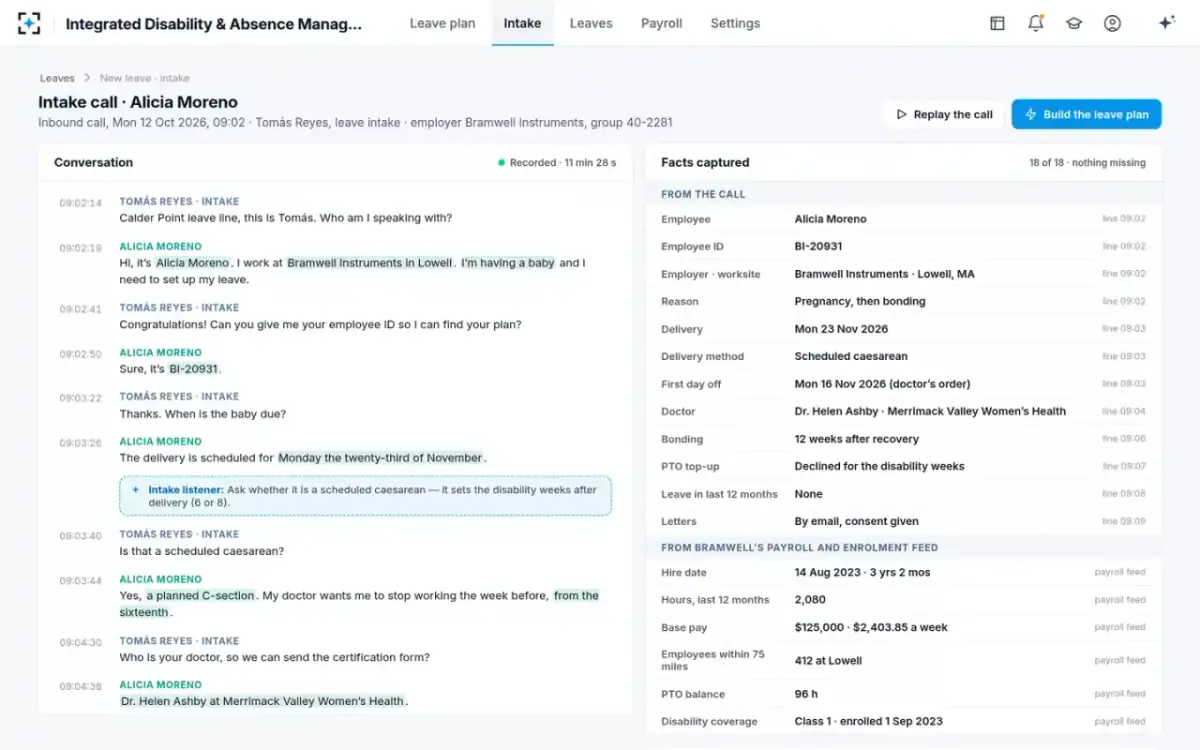
In the sample, Tomás Reyes, a leave intake specialist at Calder Point, takes an employee's call on Monday 12 October. Beside the transcript, 18 facts fill in, 12 from the call and six from Bramwell's payroll and enrolment feed, and when the delivery date comes up the intake listener prompts him to ask whether it is a scheduled caesarean, which sets the disability weeks after delivery. That one question is the difference between a plan that is right on day one and a call-back a fortnight later.
The intake call, with each fact captured beside the line it came from
Whether a carrier, an administrator or the employer itself should run the leave at all is a separate decision; one leave run three ways compares them. The whole series starts from Integrated Disability & Absence Management.
Questions people ask
What is the most common leave management mistake?
Treating each program on its own. A leave that is right under the FMLA can still be paid wrongly if the disability plan pays before the state benefit is known, or if payroll defaults PTO into a paid week. The FMLA regulations require a designation notice within five business days of enough information, but nothing in them checks the pay; that check is the program's own.
How long must leave records be kept?
At least three years under the FMLA, which requires employers to keep payroll data, leave dates, hours of partial-day leave, copies of notices, leave and benefit policies and records of designation disputes, and to make them available to the Department of Labor (29 CFR 825.500). State programs and the disability plan's own claim files may set longer periods.
Who may contact an employee's doctor about a leave?
Under 29 CFR 825.307, after the employee has had a chance to cure an incomplete certification, a health care provider, an HR professional, a leave administrator or a management official may contact the doctor to authenticate or clarify it. The employee's direct supervisor may never make that call, and no additional medical information may be requested.
Can an absence team be measured on disability denials?
Not individually. The ERISA claims rule for disability benefits forbids decisions on hiring, pay, promotion or dismissal of an adjudicator or medical expert based on the likelihood that the person will support a denial (29 CFR 2560.503-1(b)(7)). Timeliness inside the 45-day clock is a fair measure; denial rates are for watching the book, not for scoring people.
Should leave management be centralised for a multi-state employer?
Usually, yes, because the hard part is coordination: the FMLA, each state's program and the disability plan run on the same weeks. In the Department of Labor's survey, 59 percent of covered worksites gave employees guidance on how the FMLA fits other leave and benefits, which suggests four in ten leave that coordination to the employee.
What should a leave management dashboard show?
Notices sent on time against notices due, days from intake to a signed plan, call-backs per leave, payroll differences caught before and after the cut-off, and weeks above full pay. Open-leave counts belong underneath, because a caseload of intermittent leaves generates far more dated obligations per file than a caseload of continuous ones.