The FMLA designation notice requirements are set by the Department of Labor in 29 CFR 825.300(d): once an employer has enough information to decide whether a leave is for an FMLA-qualifying reason, usually after receiving the medical certification, it must tell the employee in writing, within five business days, whether the leave will be designated and counted as FMLA leave, and, where it is known, how many hours, days or weeks will be counted. Where they apply, the notice must also say that paid leave will be required to run alongside it and that a fitness-for-duty certificate will be needed to return. The Department's optional Form WH-382 covers all of it. The rule is simple; the hard part is the clock, which starts on a date nobody writes down and runs alongside an eligibility notice, a certification deadline and, often, a disability claim. Botminds' Integrated Disability & Absence Management dates every notice from the leave plan and drafts it in plain words, and the case manager sends it.
The rules below are quoted from the FMLA regulations, the Department of Labor's forms page and the Supreme Court. The worked dates come from a fictional sample case in the solution: a leave request taken by phone on Monday 12 October 2026.
The FMLA notice clocks from the first call, for one leave
- Eligibility and rights notice, five business daysby Mon 19 Oct
- Waiting on the certificationcert due Tue 27 Oct
- Designation notice, five business days once completeby Tue 3 Nov
- Return the certification15 calendar days
- Cure an incomplete one, if asked+7 calendar days
What is an FMLA designation notice?
An FMLA designation notice is the employer's written decision on a leave: it says whether the leave is FMLA leave, and if it is, how much of the employee's entitlement it uses and on what conditions. It is the second of the FMLA's three individual notices. The first, the eligibility notice, says whether the employee is eligible at all; the rights and responsibilities notice, sent with it, sets out what the employee must do; the designation notice closes the loop once the employer knows enough to decide.
"The employer is responsible in all circumstances for designating leave as FMLA-qualifying, and for giving notice of the designation to the employee as provided in this section."
29 CFR 825.300(d)(1), Department of Labor FMLA regulations
"In all circumstances" is meant literally. The employee "does not need to expressly assert rights under the Act or even mention the FMLA" to put the employer on notice; it is enough to give a qualifying reason (29 CFR 825.301(b)). An employer that waits for the words "FMLA leave" before designating has already started late.
When must an employer send the designation notice?
Within five business days of having enough information to decide, absent extenuating circumstances. The regulation's own example of "enough information" is "after receiving a certification." If the employer already has enough when the employee first asks, it may send the designation notice then, together with the eligibility notice.
The days before the designation have their own clocks. The eligibility notice is due within five business days of the employee's request "or when the employer acquires knowledge that an employee's leave may be for an FMLA-qualifying reason," with the rights and responsibilities notice each time. The employer should ask for certification at the same time or within five business days, and the employee "must provide the requested certification to the employer within 15 calendar days after the employer's request," unless that is not practicable despite diligent, good-faith efforts (29 CFR 825.305(b)). An incomplete certification gets a written list of what is missing and "seven calendar days" to cure it.
Only one designation is needed per reason per 12-month period: "Only one notice of designation is required for each FMLA-qualifying reason per applicable 12-month period, regardless of whether the leave taken due to the qualifying reason will be a continuous block of leave or intermittent or reduced schedule leave." A new reason, or a change in what the notice said, needs a new notice, the latter "within five business days of receipt of the employee's first notice of need for leave subsequent to any change."
What is form WH-382?
Form WH-382 is the Department of Labor's optional Designation Notice. The Department describes it as the form that "informs the employee whether the FMLA leave request is approved; also informs the employee of the amount of leave that is designated and counted against the employee’s FMLA entitlement," and adds that "An employer may also use this form to inform the employee that the certification is incomplete or insufficient and additional information is needed" (DOL Wage and Hour Division, FMLA forms). It is published in English and Spanish.
Its companions are Form WH-381, the combined Notice of Eligibility and Rights and Responsibilities, and the certification forms WH-380-E for the employee's own condition and WH-380-F for a family member's. None is mandatory. "Employers may use their own forms, if they provide the same basic notice information and require only the same basic certification information," and an employer "cannot reject a certification that contains all the information needed" just because it is not on the company's form.
What must the designation notice say?
The designation notice must be in writing and must cover up to five things, depending on the leave. Leave that is not designated "may be in the form of a simple written statement," but it must still be given; an employer that decides a leave is not FMLA leave "must notify the employee of that determination."
What an FMLA designation notice must contain, and when
- Whether the leave is designated
Yes or no, for this qualifying reason, in writing (825.300(d)(1), (d)(4)).
- The amount counted
Hours, days or weeks, if known; for unforeseeable intermittent leave, on request, no more than once in 30 days (825.300(d)(6)).
- Paid leave running alongside
If the employer requires paid leave to be substituted, or counts leave under an existing leave plan as FMLA leave, it must say so now (825.300(d)(1)).
- A fitness-for-duty requirement
If one will be needed to return, said here; with the list of essential functions if the certificate must address them (825.300(d)(3)).
- What is missing from a certification
If incomplete or insufficient, the additional information needed, in writing, with seven days to cure (825.305(c)).
- Any change, within five business days
A written update after the next request for leave if anything in the notice changes, such as an exhausted entitlement (825.300(d)(5)).
The paid-leave line trips up leaves that involve a disability plan. Weeks paid by a disability plan can be designated as FMLA leave, but the employer cannot require PTO to be substituted into them, because they are not unpaid. A designation notice that tells an employee on short-term disability that her PTO "will run concurrently" has misstated the rule. How the disability, state and FMLA weeks fit together on one pregnancy leave is set out in maternity leave rules for employers.
What happens if the employer does not designate FMLA?
A late or missing designation is not automatically a violation with a fixed penalty; it is a violation if it harms the employee. Under 29 CFR 825.300(e), a failure to follow the notice rules can amount to interference with the employee's FMLA rights, and the employee can recover the wages, benefits and other losses it caused. The Supreme Court settled the limit in 2002, when it struck down an earlier rule that gave employees an extra 12 weeks whenever the employer failed to designate in time.
In Ragsdale v. Wolverine World Wide, the Court held that the old rule's "categorical penalty for its breach is contrary to the Act," because it punished "an employer’s failure to provide timely notice of the FMLA designation by denying the employer any credit for leave granted before the notice," a penalty "unconnected to any prejudice the employee might have suffered from the employer’s lapse" (Ragsdale v. Wolverine World Wide, Inc., 535 U.S. 81 (2002), syllabus). The current rule follows it: the employee has to show harm.
Harm is easy enough to show. The regulation's own example is an employee who cared for a sick child believing the time would not count, planned to use FMLA leave later for a spouse's surgery, and "would have arranged for an alternative caregiver for the seriously ill son or daughter if the leave had been designated timely" (29 CFR 825.301(e)). In the Wage and Hour Division's own enforcement in fiscal year 2025, denial of leave was the most common violation it found.
Denied leave tops the FMLA violations the Department of Labor found in FY 2025
Can FMLA be designated retroactively?
Yes, with notice, provided the delay did not harm the employee, or at any time if the employee agrees. The rule: "If an employer does not designate leave as required by § 825.300, the employer may retroactively designate leave as FMLA leave with appropriate notice to the employee as required by § 825.300 provided that the employer's failure to timely designate leave does not cause harm or injury to the employee. In all cases where leave would qualify for FMLA protections, an employer and an employee can mutually agree that leave be retroactively designated as FMLA leave" (29 CFR 825.301(d)).
The common case is a disability claim that HR learns about late. The weeks the disability plan paid can still be counted as FMLA leave, with a designation notice that says so, as long as the employee was not prejudiced, for example by being unable to plan around a shorter remaining entitlement. The cleanest fix is not to need one: in an integrated case, the disability claim and the FMLA designation come from the same intake.
Are expired DOL FMLA forms still valid?
Yes. The Department's forms page answers the question directly: "Yes. The content of the information contained within the optional-use DOL form is still applicable, regardless of the expiration date. The expiration date on the DOL forms is related to the collection of information as required by the Office of Management and Budget (OMB), and not relevant to the content of the required information" (DOL, FMLA forms).
The more important question is whether the form, expired or not, matches the leave. A certification request that asks for more than the regulations allow is the more common problem: an employer "may request only information that relates to the serious health condition for which the current need for leave exists, and no information may be required beyond that specified in the FMLA regulations." The Department's 2018 worksite survey found half of FMLA-covered worksites require medical certification for all FMLA-designated leave, and three-fifths of those that ever request one require recertification (DOL 2018 surveys), so the certification step, and the clock it starts, is in most leaves.
Who sends the notice when a carrier runs the leave?
The carrier or administrator may send it, in the employer's name, but the duty stays with the employer, and so does the liability for a notice that is late or wrong. The practical question is who owns each date. In the sample, the employer's absence program is run by a group carrier: its intake specialist takes the call, its case manager signs the plan and sends the notices, and the employer's HR partner sees the dates and programs, not the medical details. The designation notice waits, flagged, until the certification is complete. Which operating model carries which clock, on one leave, is compared in third party leave administrators.
Ten notices and forms in date order, the designation notice waiting on the certification
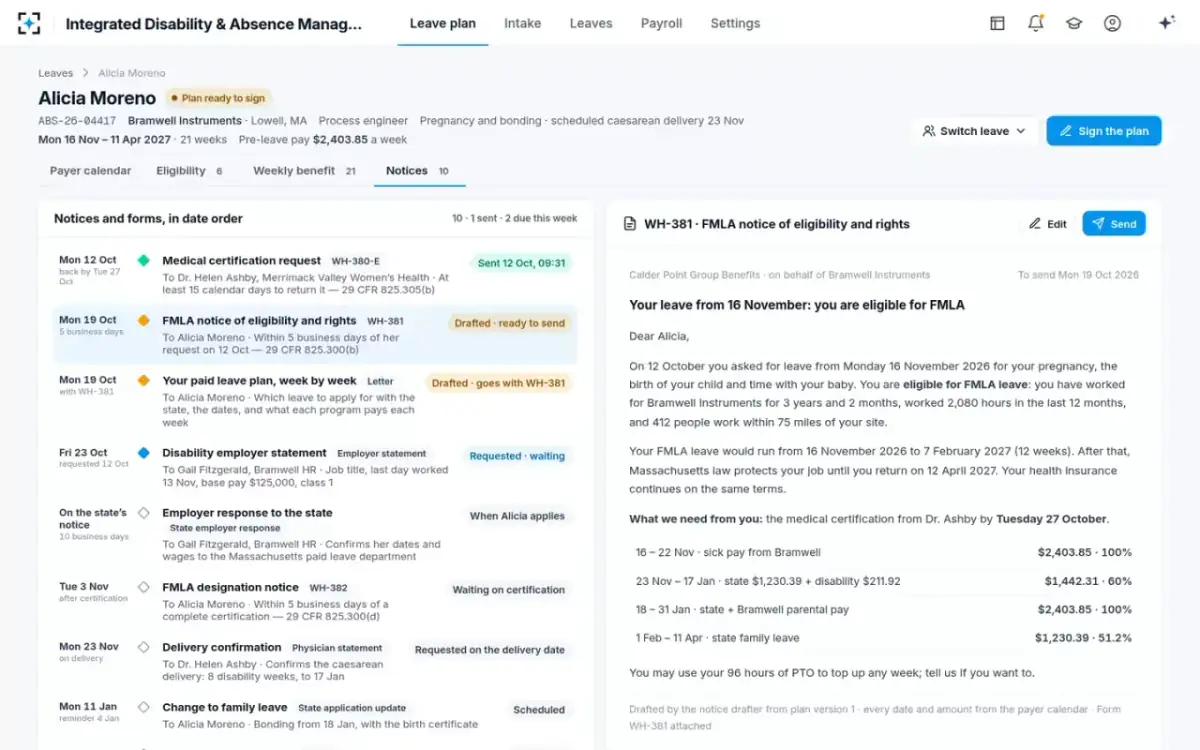
The notice drafter dates every notice from the plan, so a change to the leave dates moves the notices with it, and it drafts each one in plain words, with what each program pays each week. It never sends. The case manager reviews and sends, and any change after the plan is signed becomes a new version with its reason.
The plan is built in minutes, and the notice dates come with it
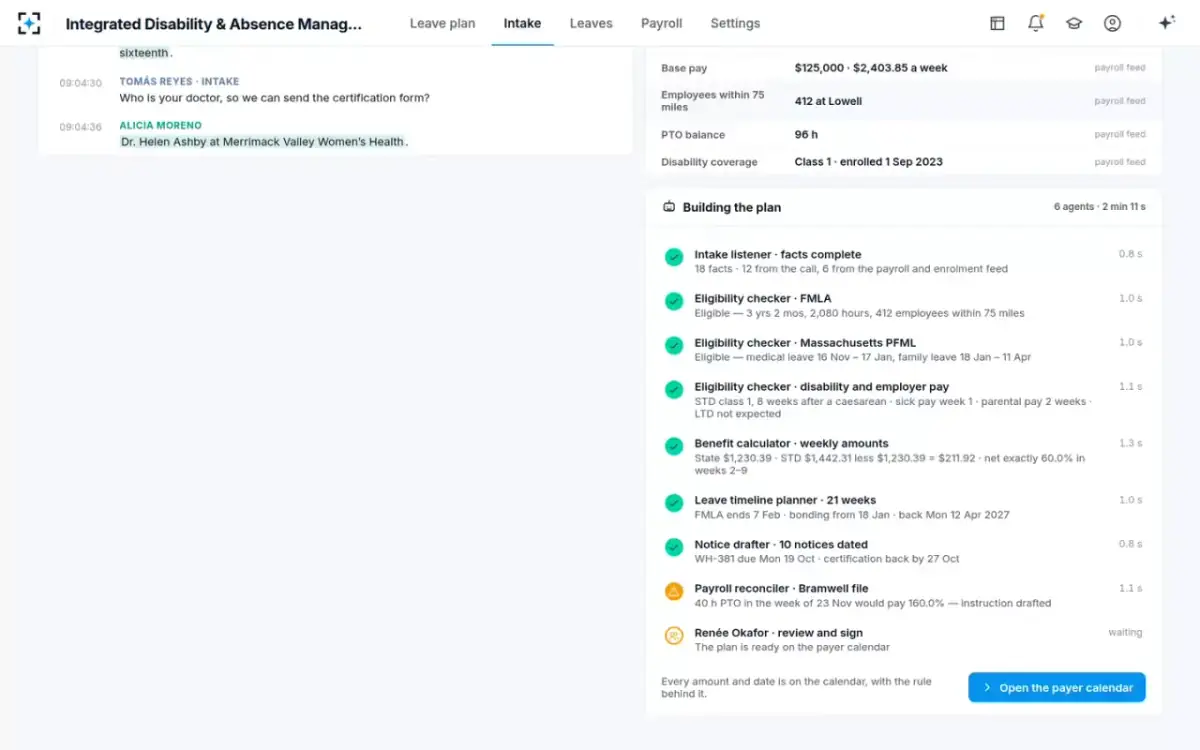
The design target is one day from the intake call to a signed plan, which puts the eligibility notice inside its five business days with time to spare. The rest of the series, from the leave specialist's job to New York's two programs, starts from Integrated Disability & Absence Management.
Questions people ask
Is there an FMLA designation notice in Spanish?
Yes. The Department of Labor publishes Form WH-382, and Form WH-381, in Spanish on its FMLA forms page. Where a significant portion of an employer's workforce is not literate in English, the regulations require the employer to provide FMLA notices in a language the employees can read (29 CFR 825.300(a)(4), (b)(2), (c)(1)).
Does intermittent leave need a new designation notice each time?
No. One designation notice covers each qualifying reason for the 12-month period, whether the leave is continuous, intermittent or on a reduced schedule. Where the amount cannot be known in advance, the employer must tell the employee how much has been counted on request, no more than once in 30 days and only if leave was taken in that period; an oral answer must be confirmed in writing by the next payday.
Can an employer deny FMLA leave if the certification is late?
For foreseeable leave, the employer may deny FMLA protection until the certification arrives; the regulation's example is a certification 30 days late, which allows denial for those 30 days. For unforeseeable leave, protection may be denied from the end of the 15-day period until a sufficient certification is provided, unless extenuating circumstances made it impracticable (29 CFR 825.313).
Can the eligibility and designation notices be sent together?
Yes, if the employer already has enough information to designate when the employee first asks; the regulation allows the designation notice to be given then. Otherwise the eligibility and rights notice goes first, with the certification request, and the designation follows once the certification is back.
Does the FMLA designation notice have to be in writing?
Yes. The eligibility notice may be oral or written, but the designation notice "must be in writing," and a notice that leave is not designated may be a simple written statement. Copies of written notices are part of the FMLA records an employer must keep for at least three years (29 CFR 825.500).