An STD state disability offset is the clause in a short-term disability policy that reduces the policy's weekly benefit by whatever a state disability or paid medical leave program pays the same employee for the same week of the same condition. In California, New Jersey, New York and Hawaii, where the state program pays for an employee's own non-work illness or injury, the policy pays only the difference, so the employee receives the policy's percentage of pay rather than the policy's percentage plus the state's. The offset goes wrong when the policy pays before the state's amount is known, uses last year's maximum, or deducts the wrong week, and each mistake becomes an overpayment to recover from someone on leave. Botminds' Integrated Disability & Absence Management works out the state benefit, the policy benefit and the offset for every week of a leave before it is paid, and the method below lets a claims team measure how often its own closed claims got it wrong.
The examples use 2026 state figures read on each agency's own pages and a fictional sample policy from the solution: 60 percent of weekly pay up to $1,500, a 7-day elimination period, and a rule that reduces STD by state paid leave and disability benefits for the same week and the same condition.
For a high earner, a missed offset overpays a whole STD week in California and $170 in New York
What is a state disability offset?
A state disability offset is a reduction the private policy makes, not something the state does. The state program pays what its own statute says, whether or not the employee also has private cover; the group policy then counts the state benefit as "other income" and pays only the balance up to its own percentage. That is why a claimant can see one check from the state and a much smaller one from the carrier for the same week.
The point of the clause is to stop two programs from replacing more of a week's pay than either was designed to. A policy written to pay 60 percent and a state program that pays 70 to 90 percent, as California's does, can together pay more than the employee earned if nobody offsets. California's Employment Development Department, which counts "Employer-provided short-term or long-term disability plans" among the leave credits an employer may combine with state benefits, puts the ceiling plainly: "You and your employer both need to make sure your combined wages are not more than your regular pay" (California EDD, Combined Wages With Benefits).
The data show the offset states in the coverage itself. In March 2026, short-term disability plans were available to 66 percent of civilian workers in the Northeast, which includes New York and New Jersey, against 36 percent in the South, according to the Bureau of Labor Statistics (BLS, Employee Benefits in the United States, March 2026). Where the state requires the coverage, more people have it, and more claims carry an offset.
Which states have state disability insurance?
Four states run programs that pay for an employee's own non-work disability and so meet a private STD policy week for week: California, New Jersey, New York and Hawaii. Puerto Rico has its own; the Department of Labor's Women's Bureau describes "paid temporary disability and maternity leave" there (DOL Women's Bureau, paid leave page, captured October 2026). The newer paid family and medical leave states also pay medical leave for an employee's own condition (Washington's 2026 paycheck insert offers "Up to 12 weeks of medical or family leave", and Delaware's statute sets a separate contribution for "medical leave benefits": Washington ESD, 19 Del. C. ch. 37), and a policy written to offset "state disability and paid leave benefits" will reach those too.
The four older programs are built differently, and the differences decide where the offset comes from and who knows the state's amount first.
How each state's program meets a private STD policy
Who pays the state benefit: The state, through State Disability Insurance funded by a 1.3% employee withholding in 2026, unless the employer has an EDD-approved Voluntary Plan. Benefit "estimated as 70–90% (depending on income)" of base-period wages, up to $1,765 a week in 2026.
What it means for the offset: The state can pay more than a 60% policy, so the offset can take the policy to zero. The EDD sends the employee a Notice of Computation (DE 429DF) with the weekly amount; that notice is the offset’s source.
Who pays the state benefit: The state plan pays Temporary Disability Insurance up to $1,119 a week in 2026, up from $1,081 in 2025.
What it means for the offset: The maximum moved $38 on 1 January; a claim that runs across the new year must use the amount the state actually paid for each week.
Who pays the state benefit: The employer must insure Disability Benefits Law cover with an authorised carrier or the State Insurance Fund, or self-insure (WCL § 211). Half of pay up to $170 a week.
What it means for the offset: Where one carrier writes both the statutory cover and an enhanced STD policy on top, the offset is internal, and at $170 a week it is small.
Who pays the state benefit: The employer provides Temporary Disability Insurance by buying an insured plan, by approved self-insurance or under a collective bargaining agreement; statutory benefit 58% of average weekly wages from the eighth day, up to $871 in 2026, for up to 26 weeks.
What it means for the offset: The STD policy may itself be the TDI plan. Only a policy layered on top of a separate TDI plan has a state benefit to offset.
New York is unusual enough to need its own page: the $170 cap has not moved since 1989, while the state's paid family leave pays up to $1,228.53 a week in 2026, and NY DBL and PFL sets the two side by side.
How is the offset calculated?
The offset is calculated week by week: the policy's gross benefit, minus the state benefit paid for the same week of the same condition, never below zero, and then checked against 100 percent of pre-leave pay. The order matters. The policy maximum applies to the gross benefit before the offset, so a high earner capped at $1,500 has the state benefit deducted from $1,500, not from 60 percent of full pay.
The STD state disability offset, term by term
Policy benefit
Benefit % × pre-disability weekly earnings, capped at the policy maximum
The sample policy: 60% of weekly pay, maximum $1,500.
The policy
State benefit, same week
The amount the state program paid for that week of the same condition
Taken from the state’s own notice, not estimated, once it exists.
The state program
Policy pays
Policy benefit − state benefit, never below $0
The carrier’s check for the week.
The carrier
100% test
State + policy + any employer pay ≤ pre-leave weekly pay
A week above it stops for review in the solution, and any recovery needs a second signature.
The case manager
The same $3,000-a-week employee, four states, with and without the offset
| State, 2026 | State benefit | Policy pays after offset | Net to employee | Without the offset |
|---|---|---|---|---|
| California | $1,765 | $0 (state exceeds $1,500) | $1,765 · 58.8% of pay | $3,265 · 108.8% of pay |
| New Jersey | $1,119 | $381 | $1,500 · 50.0% | $2,619 · 87.3% |
| Hawaii (separate TDI plan) | $871 | $629 | $1,500 · 50.0% | $2,371 · 79.0% |
| New York | $170 | $1,330 | $1,500 · 50.0% | $1,670 · 55.7% |
The California row is the one that surprises people. A state benefit above the policy's maximum leaves the policy owing nothing at all, so a carrier that pays first and waits for the state's notice has paid a full week it did not owe. For an average claimant the exposure is smaller but still real: the EDD's forecast puts California's average weekly benefit at $983 in 2025, against the maximum of $1,681 that year (California EDD, DI Fund Forecast, May 2026).
Do I have to apply for state disability if I have STD?
The state benefit is the employee's to claim, and in California, New Jersey and New York the statutory benefit is payable whether or not the employee also has private cover, so the usual answer is yes: a policy with an offset clause expects the claim and deducts the benefit either way. Whether the policy may deduct an estimate before the award arrives, and what happens if the employee never applies, is a policy term, so the answer for any one claim is in the policy's other-income section.
The administrator's practical question is where the state's actual amount will come from. California sends the employee two documents: a Notice of Computation (DE 429DF) with the estimated weekly amount, and, once the claim is approved, an Electronic Benefit Payment Notification (DE 2500E). The EDD tells employers that employees "should share this information with you to prevent any benefit overpayment" (California EDD). The same notices are what a carrier needs to true up an offset, so asking for them belongs in the intake, not in a recovery letter.
California also reduces its own benefit in one case that matters to administrators: it treats paid sick leave as wages, and "may reduce your employees' benefits" by that pay unless the employer lets employees combine it with SDI (California EDD, employer FAQs). A week where sick pay, the state and the policy all pay is a week where two parties may claw back.
How much a missed offset costs, state by state
A missed offset costs the smaller of the policy's benefit and the state's benefit for every week it is missed, and it is recovered from the claimant, usually after the leave. The bars at the top of this page show the weekly figure for one high earner; the table shows what eight weeks become. The cost is not the same everywhere. In New York a missed offset is a $170 nuisance. In California, for a high earner, it is the entire policy benefit.
Two further costs follow every overpayment. The carrier pays people to find and recover it, and the employee, who may have spent the money, has to repay it. The recovery side, including whether the employee repays gross or net and what the tax calendar does to the answer, is worked through in employee overpayment recovery. The sample case in the solution shows the other side of the same coin: with the offset switched off, every one of eight disability weeks pays above 100 percent of pre-leave pay, and the calendar turns those weeks red.
Replaying closed claims: the method
The quickest way to know your offset error rate is to replay last year's closed STD claims in offset states against each state's own award, week by week, and count where the policy paid something other than the difference. It needs no new system, only the claim files, the state notices and the policy's offset clause. Five steps.
Choose the sample. Take every closed STD claim from the last twelve months in California, New Jersey, New York and Hawaii, or a random 50 per state if volumes are large. Include claims that crossed 1 January, claims with partial weeks, claims where the employee also received employer sick pay, and pregnancy claims, because each tends to carry its own kind of error.
Rebuild each week. For every paid week, put the policy's gross benefit, the state benefit the state actually paid for that week (from the state's notice, not from the estimate on file), any employer pay, and what the policy actually paid. Compute what the policy should have paid.
Classify each difference. An estimate never trued up; the wrong year's maximum; a waiting-week mismatch, where the policy's elimination period and the state's waiting week fall on different days; an offset taken for a different condition; a partial week prorated differently by the two payers; a week above 100 percent with employer pay.
Measure three numbers. The share of claims with at least one wrong week; the dollars over and under, net and gross; and the days from the state's award to the carrier's correction. The third is the one that predicts recovery letters.
Repeat after any change. Run the same replay after a new state maximum takes effect each January, and after any change to the offset clause or the claims system.
Eight checks to run on every replayed STD claim in an offset state
- State award on file
The state’s own notice of the weekly amount (in California, the DE 429DF or DE 2500E), not an estimate.
- Same week
Each policy week matched to the state week it overlaps, day for day.
- Same condition
The state benefit deducted is for the condition the policy is paying for.
- Maximum in force
The state maximum for the week in question: New Jersey moved from $1,081 to $1,119 and California from $1,681 to $1,765 on 1 January 2026.
- Waiting weeks aligned
California and New York pay nothing for the first seven days, Hawaii pays from the eighth day; the policy’s elimination period may not line up.
- Estimate trued up
Any estimated offset replaced by the actual amount, with the difference paid or recovered.
- Partial weeks prorated alike
Both payers use the same daily rate for the first and last week.
- No week above 100%
State, policy and employer pay together within pre-leave pay.
Where offset errors hide
Most offset errors come from timing, not arithmetic. The policy pays weekly from the end of its elimination period; the state decides on its own schedule and may pay retroactively. A carrier that waits for the state's award delays the employee's money; one that pays first must estimate, and an estimate is an error until it is trued up.
The new-year reset is the second hiding place. Every state maximum on this page except New York's $170 changed for 2026. Whether a claim that began in December keeps the old weekly amount or moves to the new one is the state's rule, not the policy's: New York's paid family leave, for instance, says "You get the benefit rate in effect on the first day of your leave" (New York State Paid Family Leave, 2026). An offset built on the calendar year rather than the state's rule will be wrong by the difference for every week after 1 January.
The third is employer pay. Sick pay in the elimination week is usually fine; PTO defaulted by a payroll system into a week the state and the policy are already paying is not. In the solution's sample book, a payroll file defaulted 40 hours of PTO into the week of a caesarean, which with the state and the policy would have paid 160.0 percent of pre-leave pay. That is not an offset error in the policy's terms, but it is the same overpayment to the employee, and it lands on the same recovery desk.
What the solution checks before a week is paid
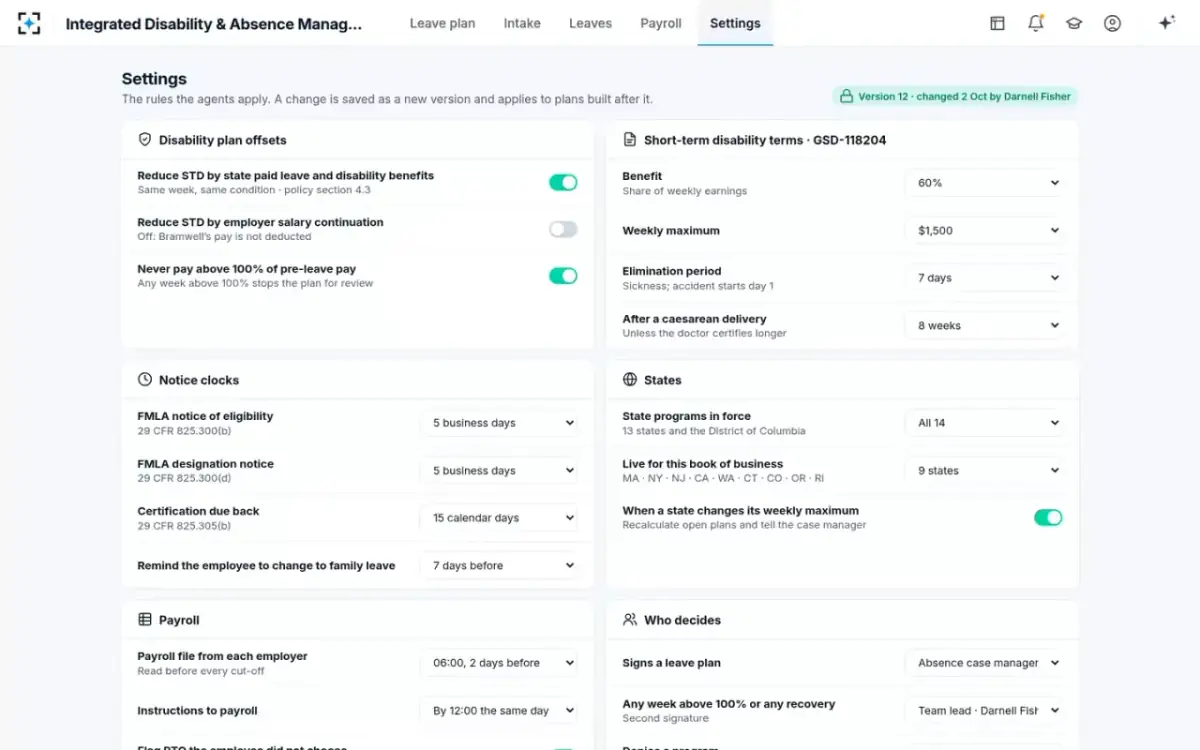
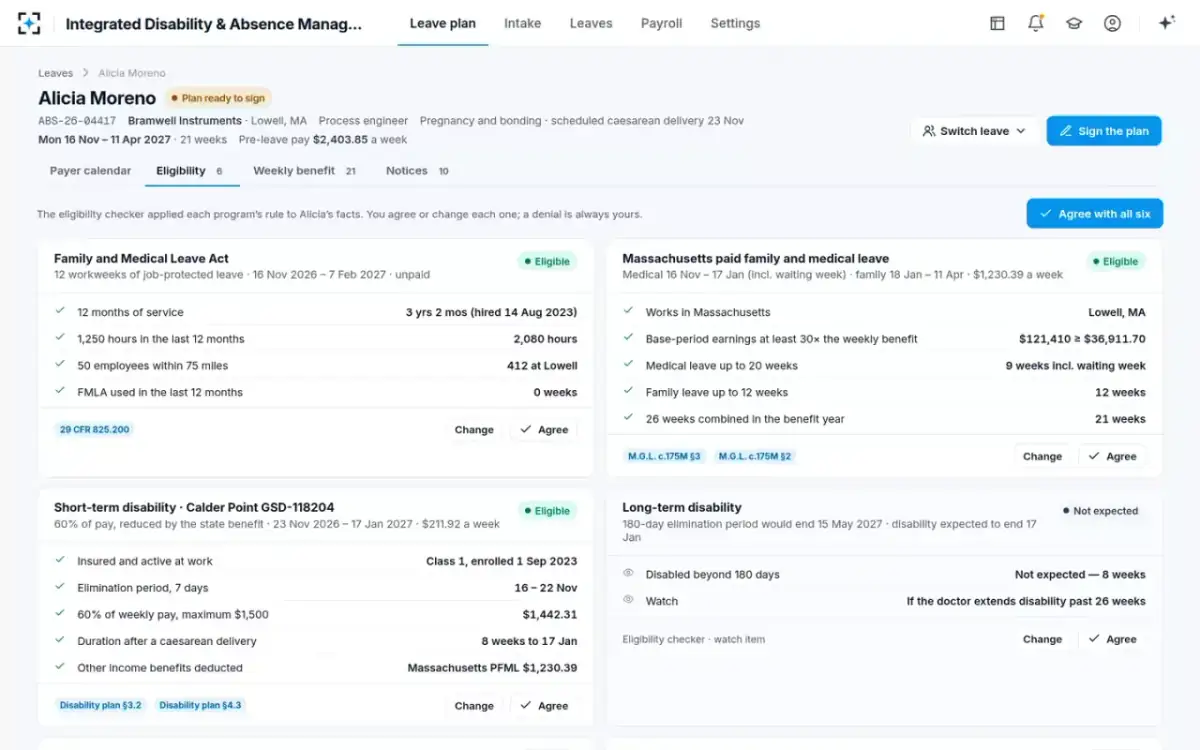
In Integrated Disability & Absence Management the offset is a setting, not a spreadsheet formula. The benefit calculator applies it to every week of the plan with the formula shown, the case manager agrees each eligibility test, and any week above 100 percent of pre-leave pay stops the plan for review with a second signature from the team lead. When a state changes its weekly maximum, open plans are recalculated and the case manager is told.
The offset rule and the policy terms, as versioned settings
Each program's test, with the offset the policy applies shown on the STD card
The replay method above is also how to test this or any other tool before trusting it: give it last year's closed claims and count where it disagrees with what the state actually paid. The pilot on closed leaves sets out the same approach for the leave side. The full set of guides starts from Integrated Disability & Absence Management.
Questions people ask
What is an STD offset?
An STD offset is any reduction a short-term disability policy makes for other income the employee receives for the same disability, most often a state disability or paid medical leave benefit, sometimes workers' compensation or employer salary continuation. The policy pays its percentage of pay minus the other income, never below zero. Which incomes count is set by the policy's own wording.
Why did my short term disability payment go down after state disability was approved?
Because the policy deducts the state benefit for the same weeks. If the carrier paid in full while the state claim was pending, the state's approval reveals an overpayment, and the carrier may recover it by reducing later payments or asking for repayment, as the policy allows. California's EDD sends a Notice of Computation and a payment notification that show the state's weekly amount.
Does New York DBL offset short term disability?
It works the other way round: where an employer buys an enhanced STD policy on top of the statutory Disability Benefits Law cover, the enhanced policy deducts the DBL benefit, which is half of pay up to $170 a week. Because the cap is so low, the offset is small, and a missed one costs at most $170 a week.
Is the offset based on the gross or net state benefit?
That depends on the policy's wording. A clause that deducts the amount the employee is entitled to receive from the state deducts the gross weekly benefit; one that deducts only the amount actually received after any withholding leaves a slightly larger carrier payment. Read the other-income definition before replaying claims, and apply the same basis to every week.
Does Hawaii TDI offset private short term disability?
Only if they are separate plans. Hawaii requires employers to provide Temporary Disability Insurance, by an insured plan, approved self-insurance or a collective bargaining agreement, and an insured plan may be the employer's STD policy itself. Where an employer has a statutory TDI plan and a separate STD policy on top, the second policy can offset the first, with the statutory benefit capped at $871 a week in 2026.