Third party sick pay W-2 reporting is how short-term disability (STD) benefits paid by an insurance carrier, rather than by the employer, end up on the employee's Form W-2. If the carrier is not the employer's agent, it withholds the employee's social security and Medicare tax and can shift the employer's share, and with it the W-2, to the employer by notifying it of each payment; the employer then reports the sick pay on its Form 941 and on a W-2 with the "Third-party sick pay" box 13 checked, and the carrier files Form 8922 to reconcile the two by the last day of February. If the carrier keeps the liability, it files the W-2 under its own name and EIN, and the employer files the 8922. Getting it right is hard because two parties report one payment, under rules that turn on insurance risk, contracts, contributions and timing. Botminds' Integrated Disability & Absence Management keeps, for every leave, which weeks the carrier paid and which the employer paid, which is the data the year-end file has to agree with.
The rules on this page are quoted from IRS Publication 15-A (2026) and the General Instructions for Forms W-2 and W-3 (2026). Sample screens are from the solution's fictional book at Calder Point Group Benefits.
One STD payment from the carrier to the employee's W-2, when liability is shifted to the employer
| Step | Who | What happens | By when |
|---|---|---|---|
| 1. Benefit paid | Carrier | Pays the weekly STD benefit; withholds the employee’s social security and Medicare tax, and federal income tax only if the employee filed Form W-4S | Each payment |
| 2. Deposit and notice | Carrier | Deposits the withheld taxes under its own EIN and notifies the employer of the payments | Its own deposit due date, such as the 15th of the next month for a monthly depositor |
| 3. Employer’s share | Employer | Deposits the employer’s social security and Medicare tax and FUTA under its own EIN | Liability begins when it receives the carrier’s notice |
| 4. Form 941 | Employer | Includes the sick pay on lines 2, 5a, 5c and 5d; on line 8 subtracts the employee tax the carrier withheld and deposited | Each quarter |
| 5. Sick pay statement | Carrier | Each employee’s sick pay, federal income tax withheld, and employee social security and Medicare tax withheld | 15 January |
| 6. W-2 and Form 8922 | Employer; carrier | W-2 with box 13 checked from the employer; Form 8922 from the carrier to reconcile the two returns | 31 January; last day of February |
What is third party sick pay?
Third party sick pay is sick pay paid by someone other than the employer, most often an insurance company paying short-term or long-term disability benefits under a group policy. The IRS defines sick pay broadly: it "generally means any amount paid under a plan because of an employee’s temporary absence from work due to injury, sickness, or disability. It may be paid by either the employer or a third party, such as an insurance company. Sick pay includes both short- and long-term benefits" (IRS Publication 15-A, section 6).
Some payments that look similar are not sick pay. Workers' compensation is not, and is not subject to employment taxes; neither are payments determined by the type of injury rather than by absence from work, or disability retirement payments, which follow the pension rules. State disability benefits paid by a state are handled by the state: California's EDD tells employers that its disability benefits "are not reportable for tax purposes," except when they replace unemployment benefits (California EDD, employer FAQs). New York's statutory disability benefits are different again, because private carriers pay them, and the Workers' Compensation Board notes that "Disability benefits paid by the employer or insurance carrier are subject to Social Security and Medicare taxes" (NY Workers' Compensation Board).
The employer's own salary continuation is not third-party sick pay at all; it is wages, reported like wages. For benefits purposes it is not even a plan: paying "an employee's normal compensation, out of the employer's general assets, on account of periods of time during which the employee is physically or mentally unable to perform his or her duties" is a payroll practice, not an ERISA welfare plan (29 CFR 2510.3-1(b)(2)).
Agent or not: the test that decides who reports
Whether the carrier is the employer's agent decides almost everything else, and the test is insurance risk. "An employer’s agent is a third party that bears no insurance risk and is reimbursed on a cost-plus-fee basis for payment of sick pay and similar amounts," and "if a third party provides administrative services only, the third party is your agent. If the third party is paid an insurance premium and isn’t reimbursed on a cost-plus-fee basis, the third party isn’t your agent" (IRS Publication 15-A).
Fully insured carrier or administrative-services payer: who carries the sick pay taxes
Carrier paid a premium (not the employer’s agent): The carrier withholds and deposits it under its own EIN.
Administrator paid cost-plus-fee (the employer’s agent): The responsibility stays with the employer, unless an agreement makes the agent responsible.
Carrier paid a premium (not the employer’s agent): The carrier’s, unless it transfers them by withholding, depositing and notifying the employer in time.
Administrator paid cost-plus-fee (the employer’s agent): The employer’s.
Carrier paid a premium (not the employer’s agent): Not mandatory; withheld only if the employee files Form W-4S.
Administrator paid cost-plus-fee (the employer’s agent): Mandatory, as for wages; an agent may use the 22% supplemental rate if it pays no regular wages.
Carrier paid a premium (not the employer’s agent): The employer’s, if liability was transferred; otherwise the carrier’s, under its own name and EIN.
Administrator paid cost-plus-fee (the employer’s agent): The employer’s, as for wages, or the agent’s under an agreement.
Carrier paid a premium (not the employer’s agent): Filed by whichever party is not filing the W-2s.
Administrator paid cost-plus-fee (the employer’s agent): Only where the agency agreement splits the reporting as Publication 15-A describes.
For a fully insured STD policy, the carrier is not the agent, and the default is that it owes both halves of social security and Medicare tax and the FUTA tax. It can hand the employer's share back by meeting three conditions: it withholds the employee's share, deposits it on time, and "Notifies the employer for whom the employee normally works of the payments on which employee taxes were withheld and deposited" within the time allowed for its own deposit. When it does, the employer's liability for its share "begins when you receive the third party’s notice of sick pay payments." A late notice moves the whole problem back to the carrier.
Who reports third party sick pay on the W-2?
The employer, when an insured carrier has transferred liability, and the carrier in the other cases. If the carrier transfers liability, the employer reports the sick pay on Forms W-2 and W-3 and on Form 941, under its own name and EIN, using the carrier's notices and its year-end statement. If the carrier does not transfer liability, "the employer has no tax responsibilities for sick pay," and the carrier "must give each employee to whom it paid sick pay a Form W-2 by January 31 of the following year" under "the third party’s name, address, and EIN instead of the employer information." A third route is the optional rule: the employer and the carrier sign "a legally binding agreement designating the third party to be your agent for purposes of preparing Forms W-2 reporting sick pay," and the carrier prepares the W-2s while the employer files Form 8922.
The W-2 instructions add a backstop: if the carrier "did not notify you in a timely manner about the sick pay payments, it must prepare Forms W-2 and W-3 for your employees showing the sick pay" (IRS General Instructions for Forms W-2 and W-3, 2026). The employer may also combine the sick pay with other wages on one W-2 or issue a separate W-2 for it, and "A Form W-2 must be prepared even if all of the sick pay is nontaxable."
What does box 13 third party sick pay mean?
Box 13's "Third-party sick pay" checkbox tells the IRS and the Social Security Administration that some or all of the wages on that W-2 were sick pay paid by a third party, so the employee tax on them was withheld by someone other than the filer. It is checked by a carrier filing a W-2 for an insured's employee, or by an employer reporting sick pay a third party paid. It does not change the amounts in the other boxes.
Where third-party sick pay lands on Forms W-2 and W-3
| Box | What goes in it for third-party sick pay |
|---|---|
| W-2 box 1 | The sick pay the employee must include in income: the part due to the employer’s contributions |
| W-2 box 2 | Federal income tax withheld from the sick pay, if the employee asked for it on Form W-4S |
| W-2 boxes 3 and 5 | Sick pay subject to social security and Medicare tax, after the six-month and wage-base exceptions |
| W-2 boxes 4 and 6 | Employee social security and Medicare tax the carrier withheld |
| W-2 box 12, code J | Sick pay paid by a third party that was not includible in income because the employee contributed to the plan |
| W-2 box 13 | The “Third-party sick pay” checkbox, only if the amounts were paid by a third party |
| W-3 box 14 | Total federal income tax withheld by third-party payers, shown separately though included in box 2 |
Is short term disability taxable?
It depends on who paid the premiums and how. Benefits from a plan the employer paid for are taxable income; benefits from a plan the employee paid for with after-tax money are not; and where both paid, only the part due to the employer's contributions is taxable. IRS Publication 525 puts the employee's side plainly: "If you pay the entire cost of an accident or health plan, don’t include any amounts you receive from the plan for personal injury or sickness as income on your tax return," but premiums paid through a cafeteria plan that were not included in income count as paid by the employer, and "you must include any benefits you receive in your income" (IRS Publication 525 (2025)).
For a group policy where both paid, the split is set by history, not by the year of the claim. Publication 15-A tells the payer to "figure the taxable sick pay by multiplying total sick pay by the percentage of the policy’s cost that was contributed by the employer for the 3 policy years before the calendar year in which the sick pay is paid." In its example, an employer paid 70 percent of the cost over the three prior years, so $1,400 of each $2,000 monthly payment was taxable sick pay and $600 was not.
When third-party sick pay escapes social security and Medicare
Two exceptions beyond employee contributions move amounts out of boxes 3 and 5. Social security, Medicare and FUTA taxes "don’t apply to sick pay paid more than 6 calendar months after the last calendar month in which the employee worked," and social security and FUTA taxes stop when sick pay plus wages for the year pass the wage base, $184,500 for social security in 2026; Medicare has no limit. A carrier can rely on the employer for three facts it needs here: total wages for the year, the last month the employee worked, and the employee's after-tax contributions. "The third party shouldn’t rely on statements regarding these items made by the employee."
What is Form 8922?
Form 8922, Third-Party Sick Pay Recap, reconciles the employment tax returns with the W-2s when one party paid the sick pay and the other reports it. In the IRS's words, it "is filed to reconcile employment tax returns (for example, Form 941) with Forms W-2 when third-party sick pay is paid," and it is filed by "The employer, if sick pay is reported on Forms W-2 under the name and employer identification number (EIN) of the insurer or agent; or The insurer or agent, if sick pay is reported on Forms W-2 under the name and EIN of the employer" (IRS Form 8922 and instructions, Rev. October 2024).
It shows totals, not people: Publication 15-A says it "doesn’t show the names of individuals who received the third-party sick pay but the total amounts paid in the calendar year." The instructions set the date: "File Form 8922 by the last day of February." If the carrier pays all the employment taxes itself and files the W-2s under its own name, neither party files a Form 8922. An employer with contracts with more than one insurer files a separate 8922 for each contract.
The sick pay year end, from the last payment to Form 8922
- Year-end sick pay statement to the employerstatement · 15 Jan
- Form 8922, when the employer files the W-2sForm 8922 · last day of Feb
- Reconcile the statement with payrollreconcile
- W-2s to employees, box 13 checkedW-2 · 31 Jan
The year-end file the carrier and employer must agree
Every number on the W-2, the 941s and the 8922 has to come from one agreed file: for each employee, what the carrier paid, which part was taxable, which part fell outside the six-month window or the wage base, what was withheld, and when the employer was notified. The carrier's statement is due by 15 January and the W-2s by 31 January, so the two parties have about two weeks to agree it. The hardest differences to fix in January trace back to the leave itself: a week the carrier paid that payroll also paid, a return to work the carrier did not know about, a contribution percentage nobody updated.
Nine checks before the sick pay statement becomes a W-2
- Every paid week matches a leave week
Each carrier payment falls inside a leave the employer knows about, with the same dates.
- No week paid by both
Where payroll paid sick pay or PTO for a week the carrier also paid, the employee’s choice of a top-up is on file.
- Last month worked agreed
Both parties use the same month, so the six-month exemption starts at the same point.
- Year-to-date wages supplied
The employer has given the carrier total wages, so social security stops at the 2026 wage base of $184,500.
- Contribution split current
The employer’s share of premium for the three prior policy years, applied to every payment.
- After-tax contributions in code J
The non-taxable part shown in box 12, code J, not in boxes 1, 3 and 5.
- Notices received on time
Each carrier notice arrived within its deposit deadline, so liability transferred as the 941s assume.
- Withholding totals agree
Employee social security, Medicare and income tax withheld match the carrier’s deposits.
- One 8922 per contract
A separate Form 8922 for each insurer or agent the employer used.
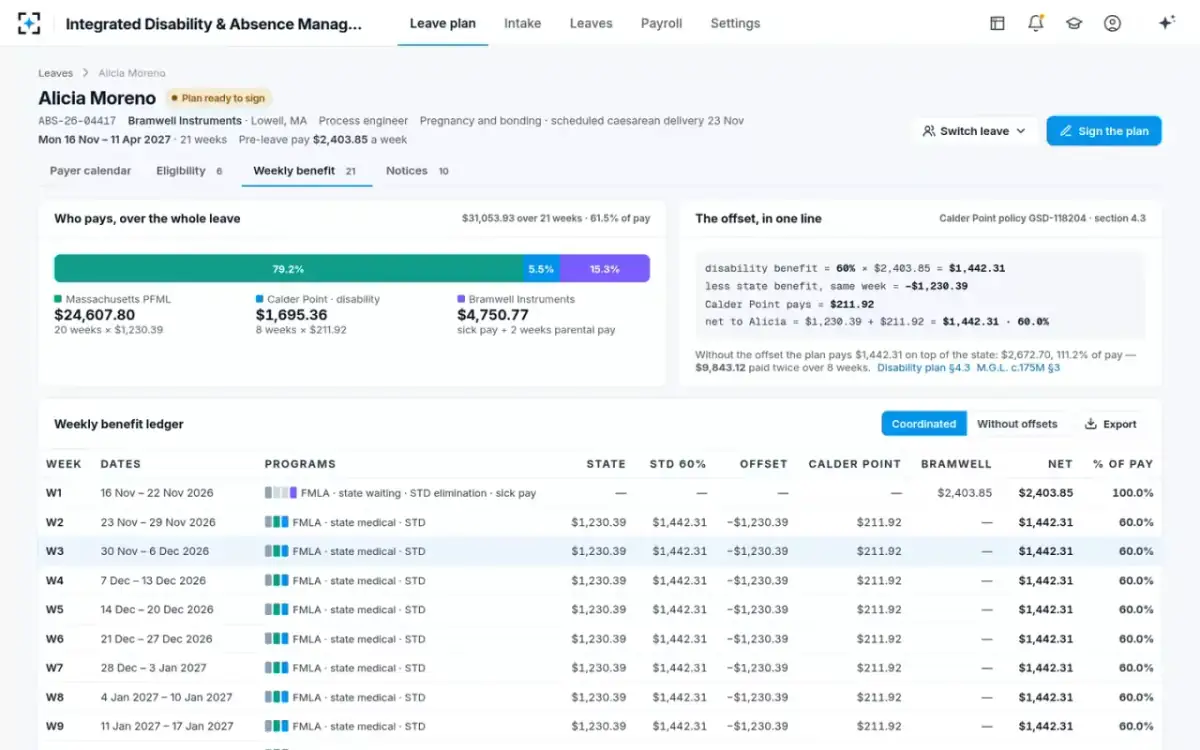
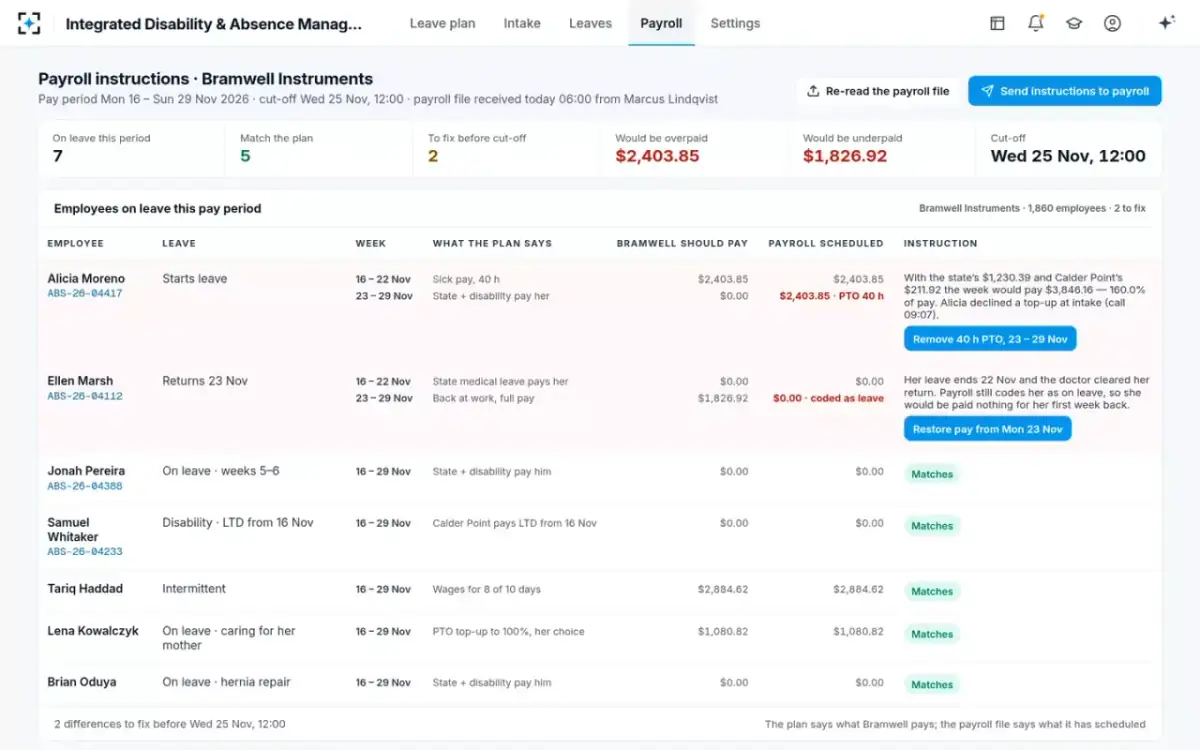
The first two checks are not tax checks at all. They depend on whether anyone laid the carrier's payments and the payroll file on the same weeks while the leave was running. In Integrated Disability & Absence Management that happens before every payroll cut-off: the payroll reconciler compares each employer's file with every open plan and drafts an instruction where they disagree, and each plan shows, week by week, whether the state, the carrier or the employer paid.
Who paid each week of a leave: the state, the carrier and the employer, side by side
The payroll file checked against every leave before the cut-off, not after the year end
The solution does not file Forms 941, W-2 or 8922, and does not decide whether a carrier is an agent; those stay with the payroll and tax teams. What it supplies is the weekly fact base those forms rest on. How a double-paid week is unwound once it has reached a payslip is covered in employee overpayment recovery, and the whole series starts from Integrated Disability & Absence Management.
Questions people ask
Does the employer or the insurer issue the W-2 for short term disability?
Either, depending on whether the insurer transferred liability. If it withheld and deposited the employee taxes and notified the employer in time, the employer issues the W-2 with box 13 checked and the insurer files Form 8922. If it did not, the insurer issues the W-2 under its own name and EIN. Under the optional rule the insurer prepares the W-2s as the employer's agent and the employer files the 8922.
Why did I get two W-2s from my employer?
Publication 15-A lets an employer either combine sick pay with regular wages on one W-2 or prepare separate W-2s, one for sick pay and one for wages. A separate W-2 for third-party sick pay has box 13 checked. If the insurer kept the tax liability, the second W-2 may come from the insurer instead, under its own name.
Is third party sick pay subject to FICA?
In general, yes: social security and Medicare tax apply, with three exceptions. Amounts due to the employee's after-tax contributions are exempt; sick pay paid more than six calendar months after the last month the employee worked is exempt; and social security stops at the wage base, $184,500 in 2026, though Medicare has no limit.
Do I have to withhold federal income tax from third party sick pay?
Not if the payer is a third party that is not the employer's agent: withholding is voluntary, and applies only if the employee files Form W-4S, starting with payments made eight or more days after the form is received. Sick pay paid by the employer or its agent is subject to mandatory withholding, like wages.
When is Form 8922 due?
By the last day of February for the previous calendar year, or the next business day if that falls on a weekend or holiday. It is filed with the IRS only, by the employer or the insurer depending on whose name is on the W-2s, with a separate form for each insurer or agent contract.