NY DBL and PFL are New York's two statutory, employer-insured wage replacement programs. DBL, the Disability Benefits Law, pays an employee who is unable to work because of an illness or injury that did not happen on the job, including pregnancy: half of average weekly wage, capped at $170 a week, from the eighth day of disability. PFL, Paid Family Leave, pays an employee to bond with a new child, care for a seriously ill family member or handle a military exigency: 67 percent of average weekly wage, up to $1,228.53 a week in 2026, for up to 12 weeks. Employers must insure both, and the two together cannot exceed 26 weeks in any 52. Running them is harder than it looks because one policy carries two formulas, two waiting rules and one shared clock, and any private short-term disability plan on top has to coordinate with both. Botminds' Integrated Disability & Absence Management applies each program's test and formula to the same leave and lays them on the same weeks, so the case manager signs one plan.
The rules and 2026 figures here are quoted from New York's Workers' Compensation Law, the Workers' Compensation Board, the state's Paid Family Leave site and the Department of Financial Services. The screens show a fictional sample book in the solution.
New York's DBL and PFL, line by line, for 2026
Disability benefits (DBL): The employee’s own off-the-job illness or injury, including pregnancy and recovery from birth.
Paid Family Leave (PFL): Bonding with a new child, caring for a family member with a serious health condition, a military exigency.
Disability benefits (DBL): 50% of average weekly wage over the last eight weeks worked.
Paid Family Leave (PFL): 67% of average weekly wage.
Disability benefits (DBL): $170, unchanged since disabilities beginning 1 May 1989.
Paid Family Leave (PFL): $1,228.53 in 2026: 67% of the state average weekly wage of $1,833.63.
Disability benefits (DBL): The eighth consecutive day of disability; seven-day waiting period unpaid.
Paid Family Leave (PFL): The first full day of leave; no waiting period.
Disability benefits (DBL): Up to 26 weeks in any 52 consecutive weeks.
Paid Family Leave (PFL): Up to 12 weeks in any 52, all at once or in full days.
Disability benefits (DBL): The employer; it may collect 0.5% of wages from the employee, up to 60 cents a week.
Paid Family Leave (PFL): Employees, through payroll deductions: 0.432% of gross wages in 2026, up to $411.91 a year.
Disability benefits (DBL): Not paid for the same days as PFL; combined with PFL, no more than 26 weeks in 52.
Paid Family Leave (PFL): Not paid for the same days as DBL; may be required to run with FMLA leave.
What is NY DBL?
NY DBL is the statutory short-term disability insurance every covered New York employer must carry. In the Workers' Compensation Board's words, the Disability Benefits Law "provides weekly cash benefits to replace, in part, wages lost due to injuries or illnesses that do not arise out of or in the course of employment," and "New York is one of a handful of states that require employers to provide disability benefits coverage to employees for an off-the-job injury or illness" (NY Workers' Compensation Board). Work injuries are workers' compensation; DBL covers everything else, from surgery to pregnancy.
The benefit is half of the employee's average weekly wage for the last eight weeks worked, capped at $170. Benefits start on the eighth consecutive day of disability, last up to 26 weeks in any 52, and require the employee to be under the care of a physician, chiropractor, podiatrist, psychologist, dentist or certified nurse midwife. Once an employee has been disabled more than seven days, the employer must give a Statement of Rights under the Disability Benefits Law (Form DB-271S) "within five days of learning that you are disabled," and the employee must file the claim within 30 days of becoming disabled.
What is the difference between DBL and PFL?
DBL pays when the employee is too ill or injured to work; PFL pays when the employee is well enough to work but needs time for someone else. Both sit in Article 9 of the Workers' Compensation Law, both are insured together, PFL as a rider on the disability policy, and both are claimed through the employer's carrier or self-insurer, but their formulas, waiting rules and funding are different. PFL was added in 2018 and has risen each year since; DBL's formula has not changed in more than three decades.
The pregnancy case shows the line between them. The Board puts it simply: "Only the birth mother is eligible for disability benefits for the period immediately after the birth of a child," while Paid Family Leave "begins after the birth and is not available for prenatal conditions" (NY Workers' Compensation Board). The disability weeks belong to the mother's recovery; bonding weeks belong to either parent. How the same split works under a private STD policy and the FMLA elsewhere is set out in maternity leave rules for employers.
What is the maximum NY disability benefit?
The maximum NY disability benefit is $170 a week. The statute reads: "The weekly benefit which the disabled employee is entitled to receive for disability commencing on or after May first, nineteen hundred eighty-nine shall be one-half of the employee's weekly wage, but in no case shall such benefit exceed one hundred seventy dollars" (NY Workers' Compensation Law § 204(2)(b)). The Board's 2026 pages give the same figure: "a maximum benefit of $170 per week."
The DBL cap rose four times between 1970 and 1989, then stopped; PFL's 2026 maximum is seven times higher
The $170 that never moved
The DBL cap is a fixed dollar figure in the statute, while the PFL maximum is a percentage of the state average weekly wage that moves every January. That difference in drafting, not any annual decision, is why the two have drifted so far apart. For 2026 the PFL page reports a state average weekly wage of $1,833.63, so the DBL cap is about 9 percent of the average week, while PFL's maximum is 67 percent of it.
For anyone earning more than $340 a week, the DBL benefit is the $170 cap, whatever their pay. An employer that wants employees to receive more than that while disabled has to buy enhanced disability cover on top of the statutory policy, and then the coordination between the two matters: an enhanced policy that deducts DBL deducts at most $170 a week. The general offset arithmetic, and what a missed offset costs in New York compared with California or New Jersey, is set out in STD state disability offset.
Is NY paid family leave insurance required?
Yes, for covered private employers. The statute requires a covered employer to "provide disability and after January first, two thousand eighteen, family leave benefits to his or her employees" by insuring with the State Insurance Fund, by insuring with a carrier "authorized to transact the business of accident and health insurance in this state," or by proving it can pay the benefits itself (NY Workers' Compensation Law § 211). In practice the two are sold together: the Department of Financial Services notes that "disability insurers are required to include Paid Family Leave benefits coverage as a rider to their disability policies" (NY DFS, 2026 PFL rate decision).
PFL is also community rated, so every employer pays the same rate. The Superintendent decided in 2017 that PFL coverage "shall be community rated," which "ensures that all employees are similarly treated and are not subject to cost variations based upon age, gender, geographic location, or any other demographic factor." For 2026 the rate rose 11.31 percent, to 0.432 percent of wages, and DFS noted that insurers' reports show "total expenses as a percentage of earned premiums amount to about 20%."
Who pays for NY DBL?
The employer pays for DBL, and may recover a small part from employees: "Your contribution is calculated at the rate of one half of one percent of your wages, but no more than 60 cents a week," and an employer "is allowed, but not required" to take it (NY Workers' Compensation Board). PFL is the opposite: the Board tells employers that "Paid Family Leave is fully-funded through employee contributions," at the rate DFS sets each year (WCB, PFL questions from employers, April 2024).
So an employee earning $1,000 a week contributes at most 60 cents a week toward a disability benefit of up to $170, and $4.32 a week toward a family leave benefit of $670, using the PFL page's own 2026 example. The employer carries the rest of the DBL premium.
Can you take NY PFL and DBL at the same time?
No. The Board is explicit: "You cannot collect disability benefits and Paid Family Leave benefits at the same time. The total combined disability leave and Paid Family Leave in any 52-week period may not exceed 26 weeks" (NY Workers' Compensation Board, What are disability benefits). After a birth, the mother can take her disability weeks first and PFL at any time within the first 12 months, or take PFL immediately without claiming disability; the Board notes that each requires "a separate request" with separate documentation.
PFL and the FMLA can run together. The Board's employer guidance says that where an event qualifies under both, "an employer may require the employee to take the leaves concurrently," and if the employer tells the employee that a period of FMLA leave also qualifies for PFL and the employee does not apply, the employer and carrier "may count the FMLA time against the employee's maximum Paid Family Leave." It also notes that the law "does not allow employers to force employees to use accruals (such as vacation or PTO) during Paid Family Leave," and recommends against requiring accruals even when FMLA runs alongside (WCB, April 2024).
A New York birth, week by week
A planned caesarean in New York shows how the two programs and the FMLA fit together. The Board's schedule for pregnancy is four weeks of disability before the due date and six after the birth, or eight after a caesarean, with more if a doctor certifies complications.
A New York caesarean birth: DBL, then PFL, inside the 26-week limit
- Wait
- Before the due date3 wk
- After the caesarean8 wk
- No PFL while on DBLnot payable
- Bonding12 wk
- FMLA during the disability weeks, if designatedFMLA · 12 wk
- PFL’s own job protectionPFL
Take an employee earning $2,000 a week. Her DBL is $170 a week for 11 paid weeks, $1,870 in all; her PFL is $1,228.53 a week for 12 weeks, because 67 percent of her pay is above the cap. If her employer carries enhanced STD, that policy pays during the 11 disability weeks and deducts the $170. If the employer designates the disability weeks as FMLA leave, her FMLA entitlement is used up by the time bonding starts, and PFL provides the job protection for the bonding weeks; the PFL page describes it as "job protected, paid time off" (New York State Paid Family Leave, 2026).
What a carrier's case must hold for both
Because one carrier usually insures both programs on one policy, its case for one employee has to carry two formulas and one shared limit, and keep them straight across a calendar year. The table lists the fields that decide every week's payment.
What one New York case has to hold to pay DBL and PFL correctly
| Field | Why it matters |
|---|---|
| Average weekly wage, last eight weeks | DBL is half of it, capped at $170; a final partial week that lowers the rate is left out |
| First day of disability and the seven-day wait | DBL pays from the eighth consecutive day |
| Date of the birth or other qualifying event | PFL for bonding begins after the birth and must be used within 12 months |
| Weeks of DBL and PFL used in the last 52 | Together no more than 26; PFL no more than 12 |
| The PFL rate in force on the first day of leave | New York pays the rate in effect on the first day of a leave that crosses into a new year |
| Days of intermittent PFL | PFL can be taken in full days, each paid at one-fifth of the weekly benefit |
| FMLA designation and notice | Whether FMLA time can be counted against PFL depends on the employer’s notice |
| Any enhanced STD on top | Its benefit, maximum and DBL offset, week by week |
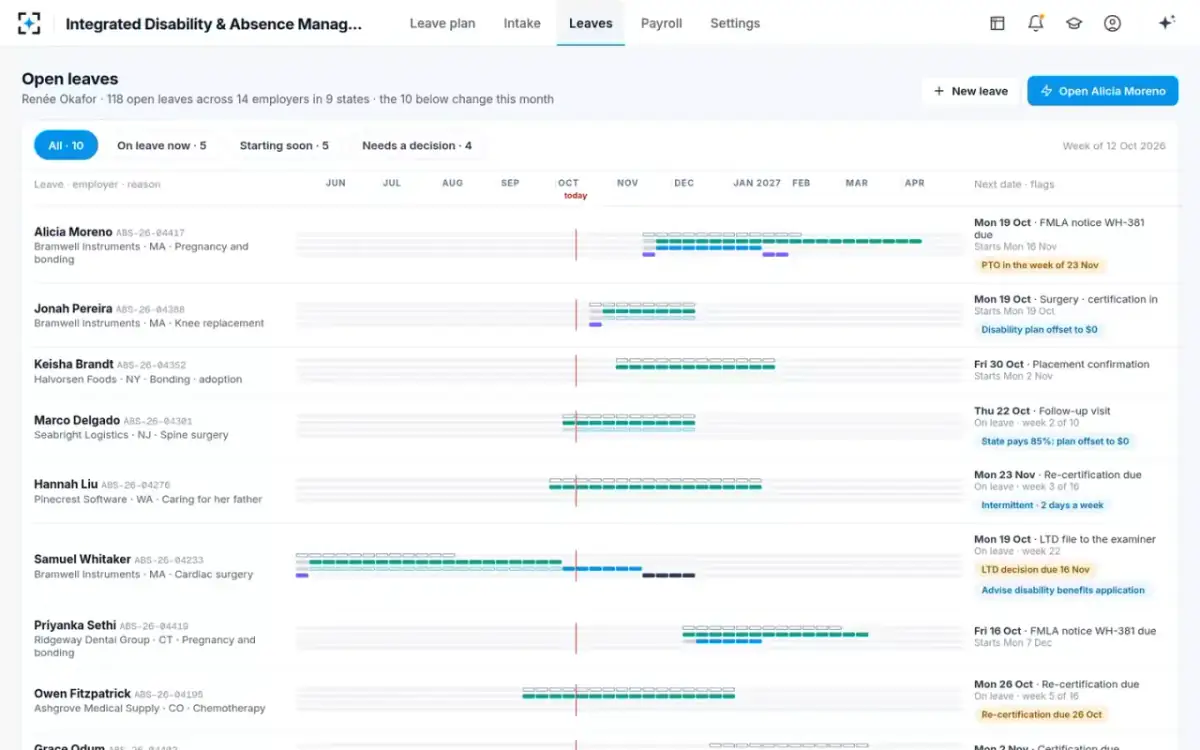
In Integrated Disability & Absence Management, New York is one of the states the eligibility checker and benefit calculator apply, with each program's test and formula shown and the state's maximum versioned so a change is recalculated on open plans. In the sample book, a New York bonding leave for an adoption sits on the same time axis as Massachusetts and New Jersey leaves, each with its own payer strip.
New York, New Jersey and Massachusetts leaves on one time axis, each with its own programs
States, maximums and notice clocks are settings, versioned when they change
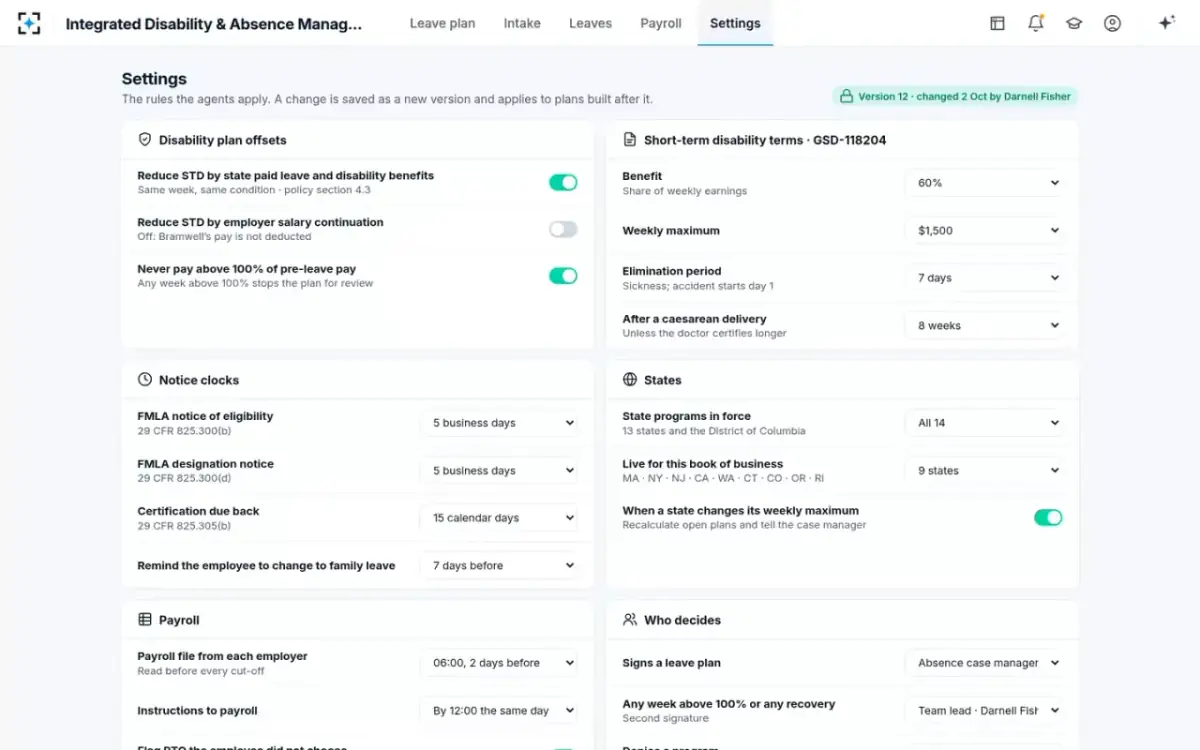
The case manager still decides. Agents never approve, deny, pay or send; the case manager agrees each program's eligibility and signs the plan, and a week above 100 percent of pay needs a second signature. The rest of the series starts from Integrated Disability & Absence Management.
Questions people ask
Is there a waiting period for NY DBL?
Yes: seven days. Benefits begin on the eighth consecutive day of disability (WCL § 208), and no benefit is paid for the waiting week. PFL has no waiting period and is payable from the first full day of leave (WCL § 204(1)).
How do I file a NY disability claim?
Through the employer's disability carrier, within 30 days of becoming disabled. The employer must give the employee Form DB-271S, the Statement of Rights under the Disability Benefits Law, within five days of learning the employee has been disabled more than seven days. The employee must be under the care of a physician, chiropractor, podiatrist, psychologist, dentist or certified nurse midwife.
Can NY employers make employees use PTO during PFL?
No. The Workers' Compensation Board's guidance is that the law "does not allow employers to force employees to use accruals (such as vacation or PTO) during Paid Family Leave." The PFL regulations let an employer charge accruals in line with the FMLA when the two run concurrently, but the Board recommends against it.
How much is the NY PFL deduction in 2026?
0.432 percent of gross wages per pay period, up to an annual maximum of $411.91, as set by the Department of Financial Services. An employee earning $1,000 a week contributes about $4.32 a week; one earning the state average weekly wage of $1,833.63 or more reaches the cap.
Does NY DBL cover pregnancy?
Yes. The Board's schedule is four weeks before the due date and six weeks after the birth, or eight after a caesarean, with more weeks payable with medical documentation, up to the 26-week limit. The medical report must say the disability is due to pregnancy or recovery from delivery, and only the birth mother is eligible for the weeks right after the birth.