The Safer from Wildfires regulations are the California Department of Insurance's rules, adopted in 2023 as 10 CCR §2644.9, for insurers that use a wildfire risk model or rating factor to segment, create a rate differential or surcharge a premium. Such an insurer must give each policyholder the wildfire score in writing, within 15 days of a completed application, at least 45 days before each renewal and at least 75 before any nonrenewal; explain the range of possible scores, where the policyholder sits and the property features that drove it; list the mitigation measures that would lower it with the premium saving for each; and hear an appeal, acknowledging it within 10 calendar days and deciding within 30. Its rating plan must carry a separate discount for each mandatory mitigation factor. The hard part is that wildfire scores move for three different reasons, the property, the land around it and the model, and the disclosure has to say which. Botminds' Homeowners Renewal Underwriting re-scores every renewal 90 days out and splits each score change by factor, with the model version and the capture date beside each.
This guide is for the underwriting, product and compliance leaders of carriers writing property business in California. It reads the regulation as the Department publishes it; it is not legal advice. The sample renewal is from a fictional insurer, Larkmoor Mutual, whose sample book is in Colorado and Texas.
Four clocks every California insurer rating on wildfire risk runs
45days
before each renewal: the wildfire score in writing, at the latest
75days
before any nonrenewal: the score in writing, at the latest
10days
to acknowledge an appeal of the score, in writing
30days
to decide the appeal with a written reconsideration
What do the Safer from Wildfires regulations require of insurers?
Three things: disclose the score, price mitigation, and hear appeals. The Department's insurer FAQ describes the regulation as "a new insurance pricing and transparency regulation in 2023" that "required insurance companies to submit new rate filings incorporating wildfire safety standards created by the Department, and established a process for releasing wildfire risk determinations to residents and businesses" (CDI, insurer FAQ, revised 4 September 2026). The disclosure duty attaches to any insurer "utilizing a Wildfire Risk Model, or rating factor, to segment, create a rate differential, or surcharge the premium based upon the policyholder or applicant's wildfire risk", which must have "a written procedure to provide, in writing" the score (10 CCR §2644.9(h)).
The reach is wider than homeowners. The regulation applies to "any line of insurance, personal or commercial" where the rate relies on a plan that segments by wildfire risk, and "territorial rate segmentation that recognizes varying levels of wildfire risk, whether explicit or not, will be considered to be subject to the regulation". Tenant policies are in scope when the tenant's premium is based on wildfire risk, and surplus lines insurers, though not mandated, are "expected" to offer similar mitigation discounts. An insurer that says it is outside the rule carries the burden: "it is the insurance company's responsibility to demonstrate that its rating plan is in compliance with the regulation and/or that is it not subject to the regulation."
When must the wildfire score be disclosed?
At four points, each with its own clock. The score must reach the applicant "No later than fifteen (15) days following the submission to the insurer of the applicant's completed application"; the policyholder "At least forty-five (45) days prior to each renewal" and "At least seventy-five (75) days prior to any nonrenewal"; and, after the policyholder completes a mitigation measure and asks, a revised score "no later than thirty (30) days following the submission" of the request (§2644.9(h)). Every disclosure must also tell the policyholder of the right to appeal.
California's wildfire score clocks, in calendar days
For a renewal calendar, the 75-day score clock sits on top of California's 75-day nonrenewal notice: a carrier that decides to non-renew must have both the notice and the score out by the same date, and the score must reflect the decision's actual inputs. The 45-day renewal clock means every California renewal rated on wildfire risk produces a disclosure, not only the adverse ones. How the whole renewal block runs to its dates is set out in the property insurance renewal process.
What must the disclosure explain?
The scale, the position, the reason and the remedy. With the score, the insurer must give "The range of such scores or classifications that could possibly be assigned to any policyholder or applicant", "The relative position of the score or classification assigned … within that range … and the impact of the score or classification on the rate or premium", and "A detailed written explanation of why the policyholder or applicant received the assigned score or classification", which "shall make specific reference to the features of the property in question that influenced the assignment" (§2644.9(k)). It must add "Which mitigation measure or measures can be taken … to lower the wildfire risk score" and "The amount of premium reduction the policyholder or applicant would realize as a result of performing each such measure under the insurer's rating plan that is in effect at the time."
What each wildfire score disclosure must carry, and where it comes from
| Element | What the regulation asks | Where the insurer gets it |
|---|---|---|
| The score | The score or classification used to segment, differentiate or surcharge | The model run on the address, with its version |
| The range | Every score that could be assigned to anyone | The model’s scale, as filed |
| The position and effect | Where this score sits, and its effect on rate or premium | The rating plan in effect |
| The reason | Specific reference to the property features that drove it | The model’s inputs for this parcel: vegetation, slope, structure |
| The remedy | Mitigation measures that would lower it, and the saving for each | The filed discount for each mitigation factor |
| The right to appeal | Notice of the appeal right, every time the score is given | A fixed paragraph in the disclosure template |
Mitigation discounts in the rating plan
The rating plan has to price each mandatory mitigation factor on its own. "An insurance company's rating plan must contain a separate, individual discount or credit for each mandatory mitigation factor identified in the regulation", optional factors used must also carry their own discount, and "The Department expects that consumers will receive at least $1 in premium reduction for each mandatory factor" (CDI insurer FAQ). The Department also separates the two levers: "Premium discounts or credits rather than the use of models and wildfire risk scores must be used to address the mandatory factors", while the score itself may need to be adjusted when an appeal shows it is wrong.
The Department's consumer guidance lists the measures policyholders will ask about: a Class A fire-rated roof, a five-foot ember-resistant zone around the structure, noncombustible material on the bottom six inches of walls, ember- and fire-resistant vents, double-pane windows or shutters, enclosed eaves, and vegetation cleared from under decks, along with community measures such as a Firewise USA neighbourhood (CDI, Safer from Wildfires FAQ). Each measure the plan credits is a field the carrier has to capture, verify and carry into the next disclosure's premium-saving line.
Verifying mitigation: inspections, CAL FIRE and Firewise
An insurer may verify mitigation, but the regulation fixes the terms. It can follow its filed underwriting process or accept the policyholder's answers; if it requires inspections, "the insurer must provide, in addition to any paid inspection option, a free inspection option", and it "shall accept inspections by CAL FIRE or a local fire department as proof or verification of completed mitigation actions", without limiting verification to a fire department certificate alone (CDI insurer FAQ). Community credits carry their own duty: "Verification of participation in the Firewise USA program is the responsibility of the insurer, not the policyholder" (CDI consumer FAQ).
Eight controls for a California wildfire score program
- Decide, in writing, whether the rating plan is in scope
Territorial segmentation that reflects wildfire risk counts, explicit or not.
- Run each disclosure clock from the right event
Completed application, renewal date, nonrenewal date, mitigation request.
- Keep the model version and input dates with every score
So a changed score can be explained by property, land or model.
- Explain with property features, not the number alone
Specific reference to what on this parcel drove the score.
- Price each mandatory mitigation factor separately
With the saving for each named in the disclosure.
- Offer a free inspection option if inspections are required
And accept CAL FIRE or local fire department inspections.
- Verify Firewise USA participation yourself
Through data providers; not by asking the policyholder.
- Log every appeal with its two dates
Acknowledged within 10 days (5 via an agent), decided within 30; denials available to the Department.
Why a wildfire score moves when nothing at the house did
Because the model or its data changed, and the disclosure has to say so. Scores are produced by versioned models re-run on vegetation maps, weather and fire history with their own vintages. Public models show how large such changes can be: the USDA Forest Service says of its Wildfire Risk to Communities maps that "Direct comparisons between the 2020 and 2024 versions are impossible due to fundamental methodological changes", and that its data are "not designed for insurance companies" and "not designed for considering risk at the individual home scale" (Wildfire Risk to Communities FAQ).
For an insurer, a model version change can move scores across a region overnight, and every policy in that region then gets a renewal disclosure with a new number. A disclosure that reports a higher score without saying whether the house, the vegetation or the model moved fails the regulation's "specific reference to the features of the property" test in practice, because the policyholder cannot tell what to fix. The appeal volume that follows lands on the same team, with a 10-day acknowledgement clock.
One home's wildfire inputs at last renewal and at this one
Last renewal: 3
This renewal: 5
Last renewal: Version 2026.1
This renewal: Version 2026.2, dated 30 Sep 2026
Last renewal: No finding listed
This renewal: Juniper and brush about 25 ft from the north-east corner, from the 27 Aug 2026 aerial capture
Last renewal: —
This renewal: +3: two steps at 1.5 points each, as filed
Last renewal: Hail 4, wind 3, flood zone X
This renewal: Unchanged
Last renewal: —
This renewal: “Juniper and brush are now about 25 feet from the north-east corner of the house, and our wildfire score for the address rose from 3 to 5.”
Appeals: the volume a score change creates
An appeal can come orally or in writing, directly or through an agent or broker, and each route has a clock. Directly, the insurer "shall acknowledge receipt of the appeal in writing within ten (10) calendar days" and "respond to the appeal in writing with a reconsideration and decision within thirty (30) calendar days"; through an agent or broker, the intermediary forwards within five calendar days and the insurer acknowledges within five of receipt, then decides within 30 (§2644.9(i)–(j)). A denial must be available to the Department on request, and the response must tell the policyholder that the Department can help, with its hotline and complaint center address.
The operational answer is evidence held in advance. An appeal citing defensible-space work since the last capture is decided fastest when the file already shows the capture date the score relied on; one disputing a model change needs the model version and what it changed. A team that has to reconstruct those facts per appeal will spend its 30 days doing it. The Department's consumer guidance tells policyholders they can appeal "if you believe it is inaccurate —for instance, if you have done wildfire safety work since your last renewal" (CDI consumer FAQ).
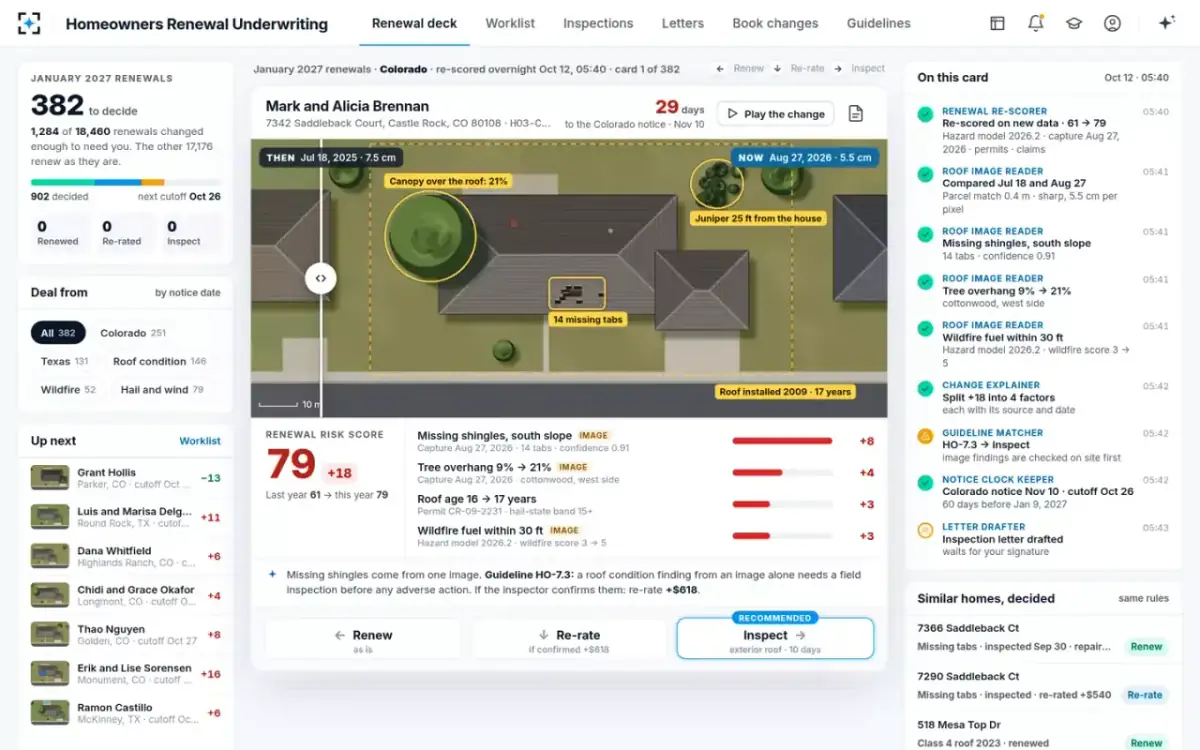
Then and now under one slider: the change that moved the score
Wildfire moratoria and the score
After a declared wildfire emergency, a separate rule applies to nonrenewals near the fire. An insurer "shall not cancel or refuse to renew a policy of residential property insurance for a property located in any ZIP Code within or adjacent to the fire perimeter, for one year after the declaration of a state of emergency … based solely on the fact that the insured structure is located in an area in which a wildfire has occurred" (CDI 2026 Annual Notice, Insurance Code §675.1(b)(1)). The score disclosure continues inside a moratorium; the nonrenewal it might support does not, if location is the only reason. Tracking which ZIP codes are under which order is the work of Botminds' Binding Restriction Management, set out in its wildfire binding restrictions map.
Where Homeowners Renewal Underwriting fits on wildfire disclosures
The solution produces the evidence a California disclosure rests on. The renewal re-scorer refreshes any hazard score older than 12 months before scoring; the change explainer splits each score change into filed factors, so wildfire appears as its own line with the model version and the capture behind it; the guideline matcher applies the carrier's wildfire rule, which in the sample setup re-rates and offers the mitigation credit and applies brush and fuel rules the same way to every home; and the letter drafter writes the reason in plain words. A named underwriter decides and signs. The sample book is in Colorado and Texas; a California book would add the §2644.9 clocks and disclosure fields as rules of its own.
It does not build the wildfire model, set the mitigation discounts or decide appeals. The model and its scale come from the carrier's vendor or its own filing, the discounts from its filed rating plan, and appeal decisions from its staff. How renewal underwriting tools compare on the same changed home is set out in homeowners underwriting software comparison.
Questions people ask
What is the Safer from Wildfires regulation?
California's 2023 regulation, 10 CCR §2644.9, titled Mitigation in Rating Plans and Wildfire Risk Models. It requires insurers that rate on wildfire risk to disclose the score with its range and reasons, credit each mandatory mitigation measure in the rating plan, and hear appeals on set clocks.
Does the regulation apply to commercial property and surplus lines?
It applies to any licensed insurer's line, personal or commercial, whose rate relies on a plan that segments by wildfire risk, including territorial rating that reflects wildfire risk. Surplus lines insurers are not mandated but are expected to offer similar mitigation discounts.
How long does a California insurer have to decide a wildfire score appeal?
Thirty calendar days after receiving it, with a written acknowledgement within 10 calendar days, or within five when the appeal comes through an agent or broker, who must forward it within five.
What mitigation discounts must a California rating plan include?
A separate discount or credit for each mandatory mitigation factor in the regulation, and for each optional factor the insurer uses. The Department expects at least $1 of premium reduction for each mandatory factor.
Must an insurer accept a CAL FIRE inspection as proof of mitigation?
Yes. If the insurer requires inspections it must offer a free option alongside any paid one, and it must accept inspections by CAL FIRE or a local fire department, without limiting verification to a fire department certificate alone.
Can an insurer use the Forest Service wildfire map to score a home?
The Forest Service says its Wildfire Risk to Communities data are not designed for insurance companies or for risk at the individual home scale. Insurers generally score parcels with their own or a vendor's model, and California requires them to explain that score.