The property insurance renewal process at a homeowners carrier has six steps: pull each block of renewals ahead of its effective date, 90 days out at the sample insurer below; re-score every home against new hazard scores, aerial captures, permits and claims; send the homes whose risk moved past a threshold to an underwriter; inspect where the evidence disagrees; decide renew, re-rate or non-renew; and mail any adverse notice before the state's deadline, which is 60 days before expiry in Texas and Colorado, 75 in California and 120 in Florida. The opening of that window is the carrier's choice; the end is the law's, and a decision that misses it leaves the home on last year's terms. The hard part is that the whole book has to be re-read to find the few homes that changed. Botminds' Homeowners Renewal Underwriting re-scores every renewal 90 days out and brings the underwriter only the homes that changed, ranked by the day each decision is due.
This guide is for the personal lines underwriting leader and the operations manager who run renewal season. The examples follow a fictional insurer, Larkmoor Mutual, through its January 2027 Colorado and Texas renewals as they run through the solution; every person and address is invented.
One month of renewals, sorted the night the review opened
18,460
January 2027 renewals re-scored overnight on 12 October 2026
1,284
moved 8 points or more, or picked up a new condition finding
7.0%
of the block that needs an underwriter’s decision
17,176
renew as they are, on guideline
What is the property insurance renewal process?
It is the carrier's routine for deciding, before each policy expires, whether to renew it on the same terms, renew it on changed terms, or not renew it, and for telling the insured in time. Most renewals roll forward on the filed rating plan with no person involved. The process exists for the exceptions: a roof that has aged into a surcharge band, a hazard score that crossed a line, a claim, an inspection finding, a permit for a new roof that should lower the premium.
Renewals differ from new business in one way that shapes the whole process. A new application can wait a day for a missing document. A renewal has a statutory clock running from the moment its block is pulled, and the law's answer to a missed date is mechanical. In Texas, unless the insurer has mailed notice of nonrenewal or of a change in coverage "not later than the 60th day before the date on which the insurance policy expires", it "must renew an insurance policy, at the request of the insured, on the expiration of the policy" (Tex. Ins. Code §551.105).
The homeowners renewal process, from pull to mailing
Agent
Pull and re-scoreRe-scores every renewal in the block 90 days out against new captures, hazard scores, permits and claims.
Never: Uses a hazard score older than 12 months without refreshing it.
Agent
Apply the thresholdSends homes that moved 8 points or more, or have a new condition finding, to an underwriter; the rest renew on guideline.
Never: Hides a new condition finding below the threshold.
Agent
Rank by cutoffOrders the worklist by the day each decision is due under the state’s notice date.
A person decides
Underwriter decidesRenew, re-rate or inspect each changed home; reads the inspection when it returns.
A person decides
Manager approvesEvery nonrenewal and exception, and every re-rate over $1,000.
Agent
Draft the letterWrites each reason in the state’s wording with its source and date; nothing is sent until the underwriter signs.
The renewal calendar: from 90 days out to the notice date
The calendar has three segments: the carrier's decision window, the buffer it needs to draft, sign and mail, and the notice period the state requires. Larkmoor pulls each renewal 90 days before its effective date. For the Brennan home in Castle Rock, Colorado, renewing on 9 January 2027, the review opened on 12 October, the carrier's own decision cutoff fell on 26 October, and the Colorado notice date was 10 November, 60 days before renewal.
One Colorado renewal's 89 days: two weeks to decide, then the law's 60
- Decision window14 d
- Cutoff to notice date15 d
- Notice period Colorado requires60 d
The notice period at the end is the part a carrier cannot move, and it varies more than most underwriting calendars allow for. Colorado's 2023 act "increases the notice requirement to 60 days in advance of the action" (HB23-1174). Florida requires notice "at least 120 days before the effective date of the nonrenewal, cancellation, or termination", with the reason in the notice (Fla. Stat. §627.4133(2)(b)). California requires 75 days before a nonrenewal (California Department of Insurance, 2026 notice). A carrier writing in Florida with a 90-day pull has no window at all; its Florida blocks must be pulled earlier. The state-by-state rules and what makes a notice hold are set out in homeowners non renewal notice requirements.
What a late notice costs, in four states
| State | Notice before nonrenewal | If the notice is late |
|---|---|---|
| Texas | 60 days before expiry, mailed | The insurer must renew at the insured’s request |
| Colorado | 60 days before the action | Not stated in the act’s summary; check the statute |
| California | 75 days before expiry | The existing policy, terms unchanged, stays in effect for 75 days |
| Florida | 120 days before the effective date, with the reason | Coverage continues until replacement coverage starts or a full notice period passes, whichever is first |
Which renewals need an underwriter? The change threshold
Only the ones whose risk moved, and the threshold decides how many that is. A carrier that sends every renewal to a person will not reach the end of the list before its notice dates; one that sends none misses the roof that failed. The sample insurer's rule sends a renewal to an underwriter if its score moved 8 points or more or it picked up any new condition finding, whatever the score. On the January 2027 block that was 1,284 of 18,460 renewals, 7.0%, and the other 17,176 renewed as they were.
The threshold is a book-level decision with a cost on both sides, and it belongs to the underwriting manager. Lower it and more underwriter hours go to homes that will renew anyway; raise it and slower changes slip through, a roof aging a year at a time or a tree line closing in. Two safeguards keep a threshold honest: a new condition finding always reaches a person, and score falls get the same review as rises, so a homeowner who replaced a roof gets the credit. Grant Hollis in Parker, whose new Class 4 roof on permit dropped his score from 64 to 51, renewed with a $402 credit. What a whole-book re-read costs, and what the threshold saves, is worked in reunderwriting homeowners insurance.
Working the list by cutoff, not by policy number
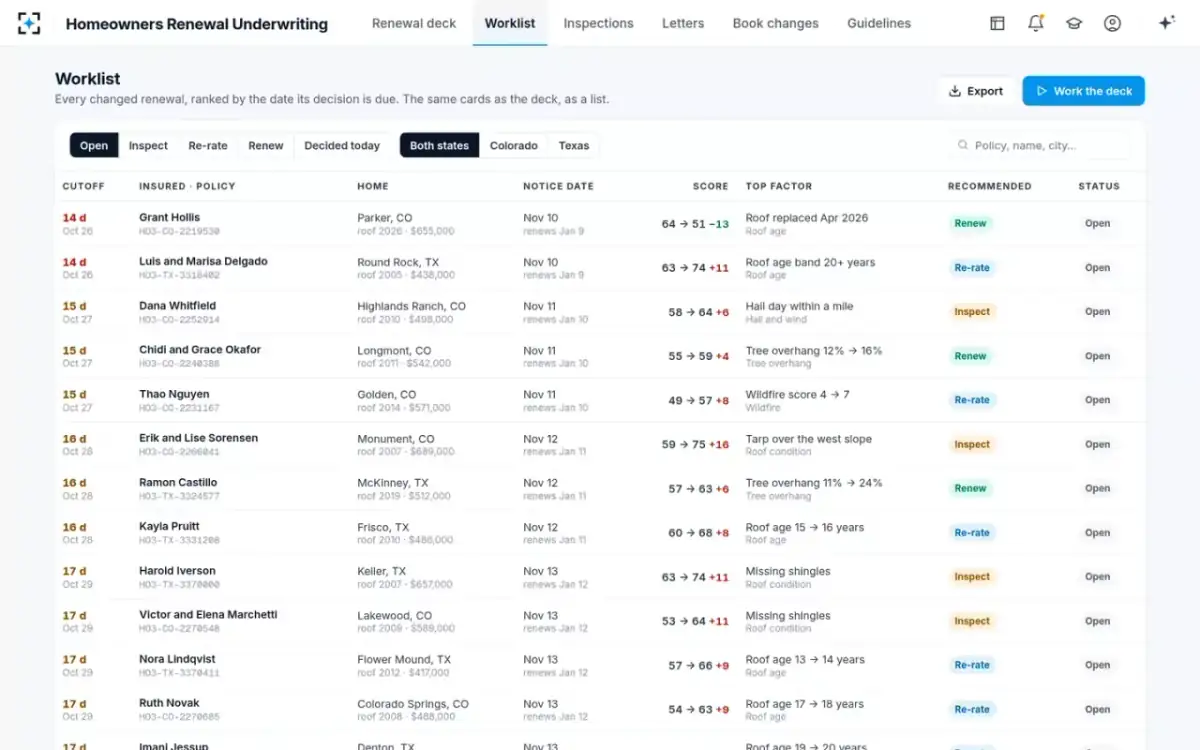
A changed renewal's place in the queue should follow its notice date. A list worked in policy-number or effective-date order leaves the home at position 900 waiting while homes with more time are decided first, and the waiting is where most of a renewal's days go. The sample worklist ranks every changed renewal by its decision cutoff, carries the state notice date and the factor that moved the score most beside it, and warns the manager ten days before any cutoff with a renewal still open.
The worklist: every changed renewal, ranked by the day its decision is due
Where the days go on one changed renewal
On a renewal that needs a roof inspection, the inspection is the only step that genuinely takes days. On Botminds' estimate for one such renewal handled by hand, it waits 6 days for its turn on the list, takes 2 days to pull captures, hazard scores, permits and claims, a day to read the roof and work out what moved, 8 days to order and receive the inspection, and 2 days to decide and write the letter: 19 days, against a 14-day window to the carrier's cutoff.
By hand, most of a changed renewal's 19 days is waiting and inspecting
Worked by hand · 19 days
- Waiting on the list · 31.6%
- Pulling data, reading the roof · 15.8%
- Inspection · 42.1%
- Decide, write · 10.5%
With the agents · 7.1 days
- Waiting, reading · 8.5%
- Inspection · 84.5%
- Decide, write · 7%
The inspection line is partly a scheduling problem. An inspection ordered on day 10 of a 14-day window cannot be waited for, so a late order turns into either a decision without it or a missed cutoff. Ordering on the day the review opens, as the Brennan file did, leaves the four days that matter. When to order an inspection at renewal, and what to ask the inspector, is set out in homeowners renewal inspection requirements.
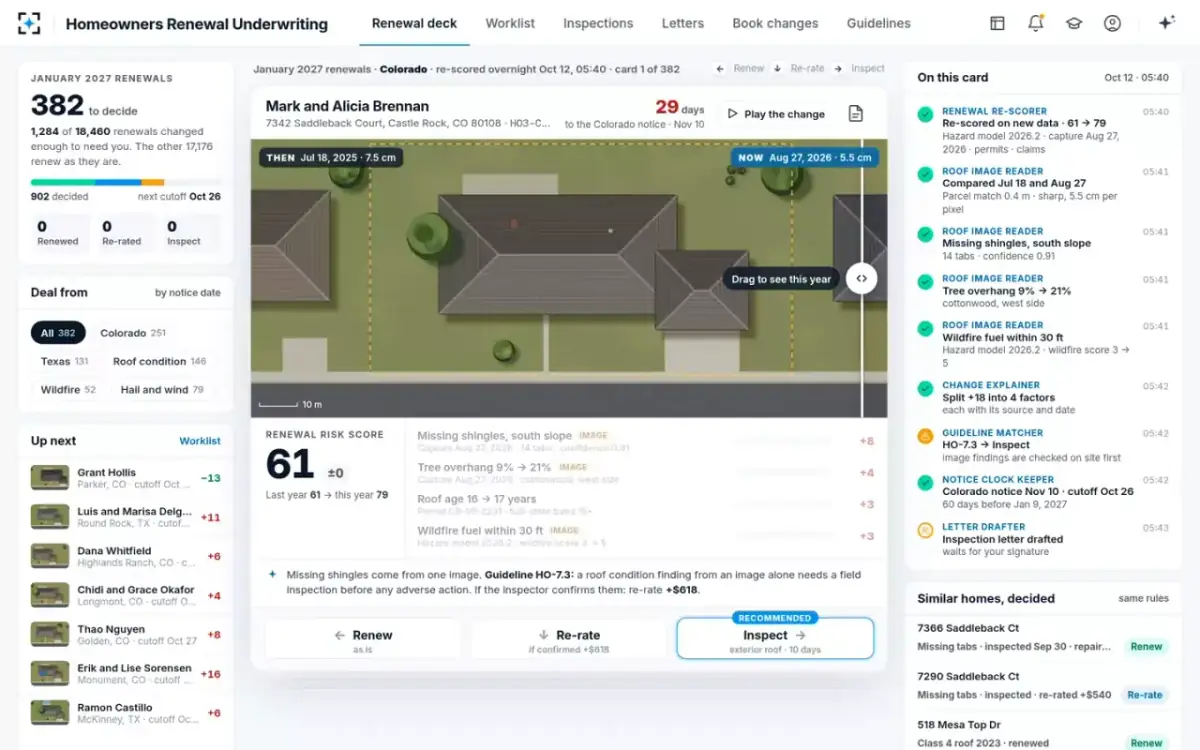
The underwriter's first screen: the home that changed most, nearest its date
What must a renewal letter say, and who signs it?
Each reason, with its source, and the underwriter's signature. Texas now writes the source into statute: the written statement for a declination, cancellation or nonrenewal must "state the precise incident, circumstance, or risk factors applicable to the applicant for insurance or the policyholder that violates any applicable guidelines" and "state the source of information on which the insurer relied" (Tex. Ins. Code §551.002(c), as amended in 2025), and insurers must report their reasons to the department every quarter, organised by ZIP code (§551.006). Florida requires the reason in the notice itself.
For the process, that turns a habit into a step: every reason on a letter carries its source and date as the letter is drafted, not reconstructed when a complaint arrives. In the solution, letters are drafted in each state's wording with each reason tied in the margin to its factor, source and date, and nothing is sent until the underwriter signs. A capture that does not sit on the insured's parcel, such as one 14 metres off the line in the sample book, is set aside under the carrier's guideline and its findings are marked not used.
Consistency across the book: the check a list cannot make
Two similar homes on one street should get the same answer, and a list worked by several underwriters over several weeks cannot guarantee it. The sample insurer runs a nightly check that pairs similar homes decided differently and sends each pair to the manager or reopens one decision. In the sample season it found 14 such pairs; 12 were resolved and two remained open, one with the manager and one flagged to reopen.
The check matters beyond fairness. A carrier that cannot show why two near-identical homes were treated differently has a problem in any complaint and in any market conduct review of its underwriting, and the explanation has to exist before the question is asked. Underwriting guidelines, factor points as filed and the threshold are settings in the solution, each change versioned and approved by the underwriting manager, so the rule applied to any decision can be shown for the date it was made.
Five roles in one January renewal block: what each owns
Today
Works the renewal list policy by policy, pulling captures, permits and hazard scores for each.
With agents
Sees only the renewals that changed, each with the roof then and now and the score split by factor.
Still theirs: every Renew, Re-rate and Inspect decision, and the signature on every letter
Today
Approves nonrenewals and exceptions and owns consistency across the book.
With agents
Gets a nightly list of similar homes that got different answers, each ready to send back or reopen.
Still theirs: nonrenewals, exceptions, re-rates over $1,000 and every guideline change
Today
Owns the rating plan, the roof condition factor and the state filings.
With agents
Sets the factor points as filed, so every surcharge traces to one of them.
Still theirs: the filed rating plan
Today
Chases the renewal calendar, the inspection vendor and the notice mailing by hand.
With agents
Works from a list ranked by cutoff, with inspection orders due back 10 days after they go out.
Still theirs: vendor management and the mailing
Today
Hears from the insured first, often before knowing why.
With agents
Gets a copy of every letter, with each reason, the photo dates and how the insured can send their own roofer’s report.
Still theirs: the conversation with the client
Where Homeowners Renewal Underwriting fits in the renewal process
The solution covers the gathering and first-pass reading that make up most of a renewal's elapsed time. Agents re-score every renewal 90 days out, read the roof in last year's and this year's captures, split each score change by factor with its source, match the carrier's guideline rules, keep the clock against each state's notice date and draft the letter. The underwriter decides every changed renewal, the manager approves nonrenewals, exceptions and large re-rates, and nothing reaches an insured without a signature. How each task divides between agents and named people is set out in the AI homeowners underwriting process.
It does not set the threshold, write the rating plan or choose which states to write; those are the manager's and the product manager's decisions. And it does not shorten the inspection itself: on Botminds' estimate, six of the 7.1 remaining days on an inspected renewal are the inspection. What it changes is where those days fall, early in the window rather than at its end.
Questions people ask
How far in advance do insurers review homeowners renewals?
It is the carrier's choice, and it must leave time to decide and mail before the state's notice date. The sample insurer pulls each renewal 90 days out; a Florida block needs more, because Florida requires nonrenewal notice at least 120 days before the effective date.
What are the steps in the insurance renewal process?
Pull the block, re-score each policy, send the changed ones to an underwriter, inspect where the evidence disagrees, decide renew, re-rate or non-renew, approve the adverse decisions, and mail each notice before the state's date with the reasons it requires.
What happens if an insurer misses the nonrenewal notice date?
The policy generally continues. In Texas the insurer must renew at the insured's request; in California the existing policy stays in effect on unchanged terms for 75 days; in Florida coverage continues until replacement coverage starts or a full notice period passes.
How many homeowners renewals need an underwriter's review?
It depends on the carrier's change threshold. With an 8-point threshold plus any new condition finding, 1,284 of 18,460 renewals in the sample book, 7.0%, went to an underwriter; the rest renewed on guideline.
What must a Texas nonrenewal notice include?
A written statement of the precise incident, circumstance or risk factors that violate the insurer's guidelines and the source of the information relied on, under Insurance Code §551.002(c) as amended in 2025. Insurers also report their reasons to the department quarterly by ZIP code.
Who approves a homeowners nonrenewal?
The carrier decides, usually an underwriting manager above the underwriter. In the sample setup the manager approves every nonrenewal and exception and every re-rate over $1,000, and the underwriter signs each letter.