HELOC turn time, from application to approval, averages about five to six weeks: the MBA's 2025 Home Equity Lending Study found home equity "turn times are averaging 39 days," and that "just 50 percent of home equity applications are closing." Very little of that time is required by law. The fixed clocks are short: a three-business-day rescission period after the line is opened, during which no money can be disbursed, and Regulation B's outer limit of 30 days from a completed application to a notice of action. The rest is waiting on valuations, title reports, documents and an underwriter's queue. Botminds' HELOC Origination Automation checks value, title and income side by side as soon as a file is complete, with a design target of a signed decision two days after the application.
For a lender, the wait has a price: applicants who leave. This guide is for heads of home equity and finance leads deciding whether turn time is worth fixing. It uses MBA and New York Fed figures for the market, Regulation Z and Regulation B for the clocks, and one fictional sample file, Daniel and Renee Whitaker's $185,000 line at Brookmere Bank, to show where the days go.
The average home equity turn time against the clocks the law actually sets
How long does a HELOC take from application to funding?
The MBA's figure of 39 days is the best published average for the industry, from the lenders in its 2025 study covering 2024 lending (MBA, July 2025). It is an average across HELOCs and closed-end home equity loans at participating lenders, so individual lenders sit well above and below it. For comparison, a Federal Reserve working paper using mortgage application data finds "it takes lenders, on average, 50.8 days to reach a decision" on first-lien mortgages (FEDS 2026-017). The two figures measure different things, but they sit closer together than the difference in loan size would suggest.
What the 39 days does not tell a borrower is how much of it is approval and how much is closing. On the sample file, everything after the decision followed fixed steps: conditions due a week later, closing at home with a mobile notary the next day, rescission ending at midnight three business days after that, and funds on the following Monday. Application to funds was 18 calendar days, of which the decision took the first four.
One sample HELOC from application to funds, against the 39-day average
- Application to documents complete4 days
- Checks and decisionMon
- Conditions and closing8 days
- Rescission3 days
- Funding3 days
- Average home equity turn time, 202439 days
Why do HELOCs take so long?
Because a small loan needs the same proof as a large one, and each proof waits on someone outside the bank. Before deciding, a lender has to establish the home's value, every lien ahead of it, the borrower's income and debts, and whether the combined loan-to-value and debt-to-income fit its policy. Those facts come from a valuation provider, a title agency, the borrower's employer and tax returns, and the credit bureaus, and by hand they are worked one after another.
Capacity makes it worse. Research on first mortgages found that "a doubling of the application volume raises the loan processing time by 13.5 days (or 26%) for traditional lenders, compared to only 7.5 days for FinTech lenders" (NBER Working Paper 24500). Home equity demand has been rising steadily: HELOC balances rose for a 17th straight quarter to $459 billion in mid-2026, and limits rose another $19 billion in the quarter (New York Fed). A desk staffed for 2021 volumes is a queue in 2026.
The order of work adds days that no one decides to spend. A file that waits for the title report before anyone reads the returns, then waits for a second request for a missing tax year, then waits in the underwriter's queue, loses a week to sequence alone. That is the time checking side by side removes.
What is HELOC pull-through, and what does the wait cost?
Pull-through is the share of applications that close. The MBA reported average closings-to-applications pull-through of 49% for HELOC accounts in 2024, "relatively flat" from 48% in 2023, and half of all home equity applications closing (MBA, July 2025). Some of the other half are declined or withdrawn for reasons speed cannot change. Some leave because another lender answered first.
Half of HELOC applications never close
HELOC applications, 2024
- Closed · 49%
- Did not close · 51%
No regulator or independent study measures how many applicants a slow HELOC loses, so the cost is best stated as arithmetic a lender can run on its own numbers. The table below uses MBA and New York Fed figures where they exist and labels everything else as an assumption.
What one point of pull-through is worth, per 1,000 applications: our illustration
| Input | Value | Basis |
|---|---|---|
| Applications | 1,000 | Assumption, for scale |
| Pull-through | 49% → 490 lines | MBA, HELOC accounts, 2024 |
| One more point of pull-through | 10 more lines | Arithmetic |
| Average line | $100,000 | Assumption; 57% of new lines are $100,000 or less (New York Fed) |
| New commitments per point | $1,000,000 | Arithmetic |
| Utilization at nine months | 42% | MBA, 2024 vintage |
| Balances per point, at nine months | $420,000 | Arithmetic |
On those assumptions, each point of pull-through a lender recovers per 1,000 applications is about $1 million of new lines and $420,000 of balances nine months later. Multiply by the lender's margin over its cost of funds to get the income at stake, then compare it with the cost of the change. The arithmetic is simple; the uncertain input is how many points speed is worth, and a lender learns that from its own withdrawn-application data, not from a published average.
How long is the HELOC rescission period?
Three business days after the line is opened, and longer if the lender gets the paperwork wrong. The borrower "may exercise the right to rescind until midnight of the third business day following" the opening, the delivery of the rescission notice, or delivery of all material disclosures, "whichever occurs last" (12 CFR 1026.15(a)(3)). If the notice and material disclosures are never delivered, the right lasts three years. During the period, "no money shall be disbursed other than in escrow."
For rescission, a business day means "all calendar days except Sundays and the legal public holidays" (12 CFR 1026.2(a)(6)), so Saturdays count and federal holidays do not. On the sample file the line was opened at a Tuesday evening closing, so the period ran Wednesday, Thursday and Friday and ended at midnight on Friday. A Thursday closing would end at midnight on Monday. Draws within the approved limit do not restart the period; a limit increase does.
The clocks on a HELOC: which are fixed by law and which a lender controls
| Clock | Length | Set by | Can a lender shorten it? |
|---|---|---|---|
| Disclosures and brochure | At application; up to 3 business days if by phone, mail or broker | Reg Z 1026.40(b) | Deliver at application |
| No nonrefundable fee | Until 3 business days after the borrower receives the disclosures | Reg Z 1026.40(h) | No; it limits fees, not the decision |
| Valuation, title, flood, documents | Days to weeks | Vendors, the borrower, the lender's order of work | Yes: order at once, read side by side |
| Decision and notice | Up to 30 days after a completed application | Reg B 1002.9 | Yes; 30 days is a ceiling |
| Conditions and closing | Days | Lienholders, insurers, the borrower's calendar | Partly: name an owner and a due date for each |
| Rescission | 3 business days after opening | Reg Z 1026.15 | No, except a borrower's written waiver for a bona fide emergency |
| Flood insurance, if newly required | Usually 30 days for a new NFIP policy | National Flood Insurance Program | Order the determination first |
How should a lender measure its own HELOC turn time?
By stage, from timestamps, with the clock started where the regulation starts it. An average from application to funding hides the two numbers that matter: how long a file waits before it is complete, and how long a complete file waits for a decision. Regulation B already draws that line, since its 30 days run from "receiving a completed application," and a lender that records when each file became complete can see which half of its turn time is the borrower's paperwork and which half is its own queue (12 CFR 1002.9).
Four timestamps are enough to start: application received, file complete, decision signed, line opened. Median and spread tell more than a mean, because a few files stuck on a lien release can drag an average for months. Withdrawn applications need their own count, with the stage they were in when the borrower left; that is the closest a lender can get to measuring how many applicants a slow answer costs. The sample bank's pipeline screen shows days since application on every file and median days to a decision for the desk, which is sample data on fictional files, not a reported result.
Does a faster HELOC decision mean a riskier one?
Not if the speed comes from doing the checks sooner rather than from doing fewer of them. The risk in a fast HELOC program is the one the 2005 interagency guidance warned about: decisions resting on "limited or no documentation," "higher loan-to-value (LTV) and debt-to-income (DTI) ratios" and a credit score standing in for capacity. A program that gets faster by dropping the title search or taking stated income has bought speed with risk.
The days that can be removed safely are the sequential ones: waiting for one report before reading the next, asking twice for the same return, and holding a complete file in a queue. On the sample file nothing was skipped. The title report, the returns, the AVM and the flood determination were all read, the unreleased lien and the falling income were both found, and a person still decided. What changed was that the reading happened in seconds, side by side, the morning the file was complete.
What is the fastest HELOC process?
One where every check starts the day the file is complete and the only waits left are the ones the law sets. That means ordering the valuation, the title report and the flood determination at application, reading income documents as they arrive rather than at the end, running the checks side by side, and giving the underwriter a file with its questions already listed. It also means naming who clears each condition, because a release from an old lienholder or an insurance declaration page can add more days than all the internal steps together.
On the sample file, the application was taken at a branch on a Thursday morning, the disclosures and brochure e-signed two minutes later, the AVM, title report and flood determination back on Friday, and all 14 documents in by 07:30 on Monday. The six agents then ran: 9 seconds for the property value checker, 16 for the title and lien examiner, 24 for the income and debt analyst, and 15 for the policy check and memo. The underwriter decided that day, business day two, within her authority.
The decision timeline: application to funds on one line
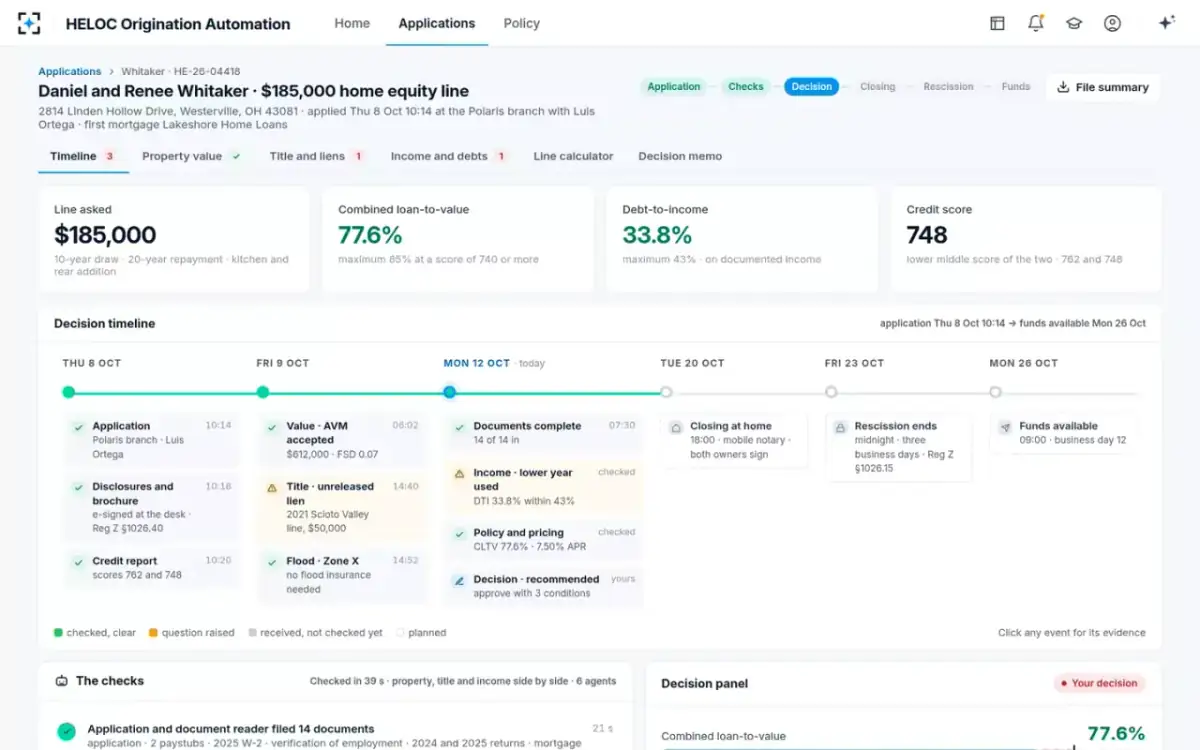
The decision sets the rest of the clocks
Once the underwriter signs, the remaining dates follow from rules rather than from anyone's calendar. Conditions are due before closing; rescission runs three business days from the closing; funds go out once the period ends and the lender is satisfied the borrower has not rescinded; and Regulation B's latest notice date is 30 days from the complete application. On the sample file that last date was Wednesday 11 November, met the day the underwriter signed.
The sample file's clocks, set the day it was decided
2days
business days to the signed decision, on the Monday
8days
from decision to closing, for three conditions
3days
rescission, Wednesday to Friday midnight
18days
application to funds available
The design targets for the solution are a signed decision within two days of the application and every lien, income figure and limit tied to a document before the decision. Who carries the file in those two days, and what each person stops doing, is the subject of the home equity underwriter's desk; how a lender gets there is a ten-week go-live plan.
Approved on business day two, with every later date on the record
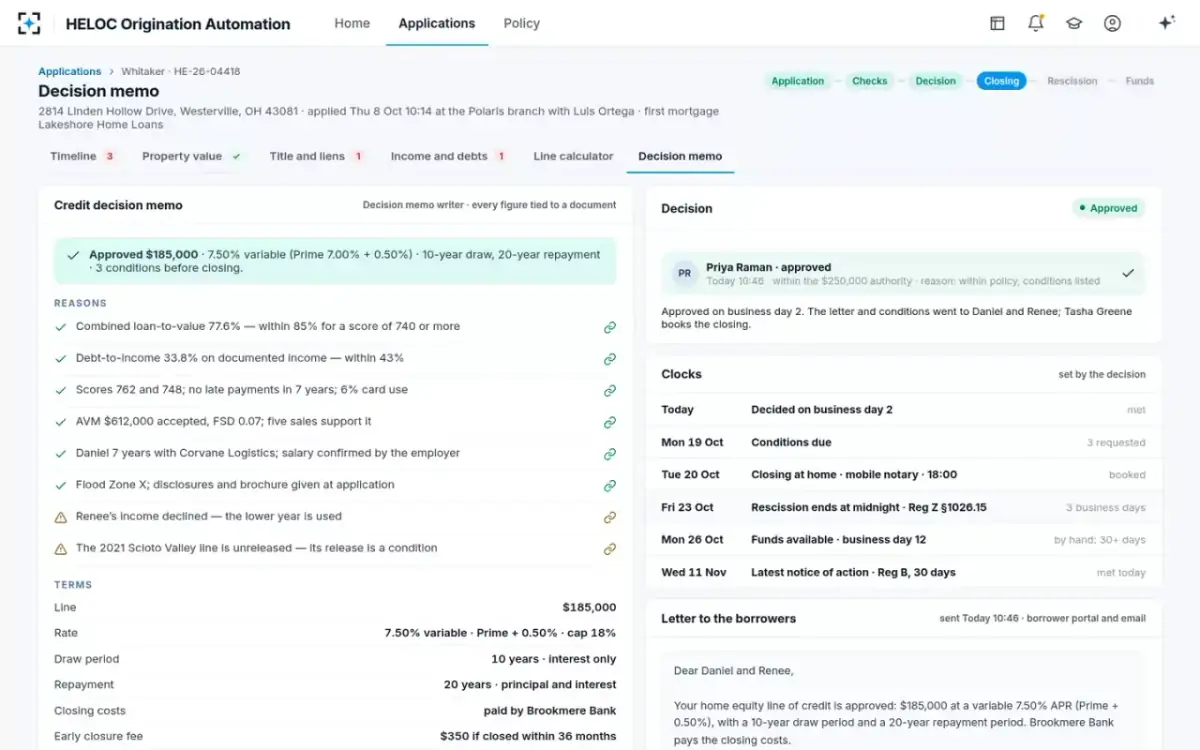
To time the clocks on your own files, start from HELOC Origination Automation.
Questions people ask
How long does it take to get a HELOC funded after closing?
At least until the rescission period ends: three business days after the line is opened, counting Saturdays but not Sundays or federal holidays. Regulation Z bars disbursement other than into escrow until then. On a principal dwelling a borrower can waive rescission only in writing for a bona fide personal financial emergency.
What is the average HELOC closing time?
The MBA reported average home equity turn times of 39 days in its 2025 study of 2024 lending. Lenders vary widely around that figure, and the study covers participating lenders, not the whole market.
How long does a HELOC appraisal take?
It depends on the valuation route. An AVM returns in seconds, and most home equity lines below the $400,000 threshold need only an evaluation, which an AVM can support. A desktop or exterior-inspection evaluation takes days, and a full appraisal longer, depending on appraiser availability in the area.
Does a HELOC application have a deadline for a decision?
Yes. Regulation B requires a lender to notify the applicant of approval, a counter-offer or adverse action within 30 days after receiving a completed application. For an incomplete application, the lender must decide or send a written notice of incompleteness within 30 days.
Why does a HELOC approval take longer than a mortgage pre-approval?
A pre-approval rests on a credit report and stated information. A HELOC approval is a final credit decision, so the lender has to establish the home's value, every lien ahead of it and the income behind the payment, each from a separate document, before it can decide.