The AVM quality control standards final rule requires mortgage originators and secondary market issuers that use automated valuation models (AVMs) in credit decisions to "adopt and maintain policies, practices, procedures, and control systems" so that those models meet quality control standards designed to ensure a high level of confidence in the estimates, protect against the manipulation of data, seek to avoid conflicts of interest, require random sample testing and reviews, and comply with nondiscrimination laws. Six agencies issued it in August 2024 and it took effect on October 1, 2025. It covers HELOCs: the rule defines a credit decision to include a decision "to extend new or additional credit or change the credit limit on a line of credit," and the agencies kept HELOC reductions and suspensions in scope. Botminds' HELOC Origination Automation runs the lender's AVM order and limits on every home equity file and records the evidence each factor needs.
For a home equity lender the rule lands on the most common valuation route: in the MBA's 2024 data, 47% of home equity originations used an AVM. This guide reads the rule from the second line's side: what it covers, what it asks for, what it leaves to the lender, and what evidence an examiner can expect. Examples use a fictional sample bank's policy and one sample file valued by AVM at $612,000.
The five factors every AVM used in a HELOC credit decision must be controlled for
- Ensure a high level of confidence in the estimates produced
Confidence minimums for each model, set by the lender, and a route to another method when a value falls short.
- Protect against the manipulation of data
Inputs the loan team cannot edit, and no expected value passed to the model or to whoever reviews it.
- Seek to avoid conflicts of interest
Model choice, order and review kept away from the people paid on the loan.
- Require random sample testing and reviews
A random sample of AVM values tested against later sales or appraisals, by people independent of the vendor and of production.
- Comply with applicable nondiscrimination laws
Testing whether the model's accuracy or errors differ across neighbourhoods or groups; added by the agencies as a fifth factor.
What is the AVM quality control rule?
It is the regulation implementing section 1125 of FIRREA, added by the Dodd-Frank Act in 2010, which told the agencies to set quality control standards for AVMs used by "mortgage originators and secondary market issuers to determine the collateral worth of a mortgage secured by a consumer's principal dwelling." The OCC, Federal Reserve, FDIC, NCUA, CFPB and FHFA published the final rule on August 7, 2024 (89 FR 64538).
The rule is short and deliberately unprescriptive. It requires policies, practices, procedures and control systems built around the five factors, and stops there. The agencies wrote that "institutions will have the flexibility to adopt approaches to implement the fifth factor in ways that reflect the risks and complexities of institutions' business models," and the same flexibility runs through the rest. There is no required confidence level, no testing frequency and no named method.
When did the AVM rule take effect, and who does it cover?
The rule took effect on October 1, 2025. It applies to "mortgage originators and secondary market issuers that engage in credit decisions or covered securitization determinations themselves, or through or in cooperation with a third-party or affiliate" (12 CFR 34.222). A lender that buys AVM values from a vendor, or uses a vendor's cascade, is covered for those models: using a third party does not move the obligation.
The definitions do the scoping. An AVM is "any computerized model used by mortgage originators and secondary market issuers to determine the value of a consumer's principal dwelling collateralizing a mortgage," and a mortgage is a security interest "in a consumer's principal dwelling" (12 CFR 34.221). A HELOC on a second home or an investment property is outside the rule, though not outside the 2010 guidelines' expectations for any AVM used to support an evaluation.
Where the AVM rule applies on a home equity line, and where it does not
| Use of an AVM | In scope? | Why |
|---|---|---|
| Valuing the home for a new HELOC on a principal dwelling | Yes | A credit decision "whether and under what terms to originate" |
| Deciding a limit increase | Yes | "a decision whether to extend new or additional credit or change the credit limit on a line of credit" |
| Deciding to freeze or reduce a line | Yes | The agencies kept "HELOC reductions and suspensions" in the final rule as proposed |
| Portfolio monitoring of values | No | Excluded: "monitoring of the quality or performance of mortgages" |
| Checking a valuation already made | No | Excluded: "reviews of the quality of already completed determinations of the value of collateral" |
| An appraiser using a model inside an appraisal | No | Excluded: "the development of an appraisal by a certified or licensed appraiser" |
| A HELOC on a second home or rental | No | Not a "principal dwelling"; the 2010 guidelines still apply to any AVM-based evaluation |
Does the AVM rule apply to HELOCs?
Yes, at origination and afterwards. The proposal listed "renewing, increasing, or terminating a home equity line of credit (HELOC)" among the decisions in scope, and two commenters argued that applying it to line reductions and suspensions would cost more than it was worth. The agencies disagreed and adopted the rule as proposed, finding that "AVMs used to make credit decisions relating to HELOC reductions and suspensions are important both to safety and soundness and to consumer protection" (89 FR 64538).
That reach matters for a home equity program because Regulation Z lets a lender freeze or reduce a line when the home's value "declines significantly below the dwelling's appraised value for purposes of the plan" (12 CFR 1026.40(f)(3)(vi)(A)). An AVM run across a portfolio to find those homes is monitoring and outside the rule; an AVM relied on to decide a particular line's freeze is a credit decision and inside it. The controls have to follow the model into account management, not stop at origination.
The agencies have determined that AVMs used to make credit decisions relating to HELOC reductions and suspensions are important both to safety and soundness and to consumer protection.
Quality Control Standards for Automated Valuation Models, final rule, 2024
What evidence does each factor call for?
The rule names the factors; the lender's controls have to show them working. Much of what an examiner will look for was already in the 2010 Interagency Appraisal and Evaluation Guidelines; the agencies said that "existing standards and guidance on model risk management and on testing of AVMs remain applicable, and can be used by institutions to assist with compliance." Reading the two together gives a practical list of evidence for each factor.
From factor to evidence: what a home equity lender can show
What the rule or guidelines say: "Establish internal confidence score minimums, or similar criteria, for when each model can be used" (2010 guidelines).
Evidence on a HELOC program: A written limit per model, such as a forecast standard deviation ceiling, and the files that fell back to inspection or appraisal.
What the rule or guidelines say: Lenders should "ensure that an expected or estimated value of the property is not communicated" (2005 guidance).
Evidence on a HELOC program: Model inputs taken from the application and public records, not editable by the loan team; an audit of any change.
What the rule or guidelines say: Validation "conducted by qualified individuals that are independent of the model development or sales functions."
Evidence on a HELOC program: Who chose the cascade, who reviews AVM performance, and how both are separated from production pay.
What the rule or guidelines say: Back-test "a representative sample of the valuations against market data on actual sales" (2005 guidance).
Evidence on a HELOC program: A random sample of AVM values compared with later sales or appraisals, by model, area and price tier, with results reported.
What the rule or guidelines say: Agencies added the factor so that controls "comply with applicable nondiscrimination laws."
Evidence on a HELOC program: Error rates compared across neighbourhoods; a plan for areas where the model under- or over-values.
How do you test an AVM?
Against what happened next, on a sample the lender did not pick, by people who did not build or sell the model. The 2010 guidelines expect "standards and procedures for independent and ongoing monitoring and model validation, including the testing of multiple AVMs," and say a lender "should not rely solely on validation representations provided by an AVM vendor" (Interagency Appraisal and Evaluation Guidelines). The 2005 home equity guidance describes the core method: "back-testing a representative sample of the valuations against market data on actual sales," covering "properties representative of the geographic area and property type for which the tool is used."
The guidelines also say when to stop trusting a model, which is the other half of testing. A lender should identify circumstances in which an AVM may not be used, including "the aftermath of a natural disaster or a major economic event," when "a model's performance is outside of specified tolerances for a particular geographic market or property price-tier range," and when "a property is non-homogeneous." A test result that shows a model drifting in one county should change the cascade for that county.
Confidence scores need testing too. The guidelines warn that "the scale and components of a confidence score are not standardized," so a lender must understand "the extent to which a confidence score correlates to model accuracy," and, where it runs several models, "how the combination of models affects overall accuracy."
What is AVM value shopping?
Value shopping is running more than one valuation and keeping the one that makes the loan work. The 2005 guidance explains why it is banned: different tools "may return different values for the same property," and "these differences can result in systematic overvaluation of properties if the valuation choice becomes driven by the highest property value." Where several AVMs are used, "the institution should adhere to a policy for selecting the most reliable method, rather than the highest value" (2005 home equity guidance).
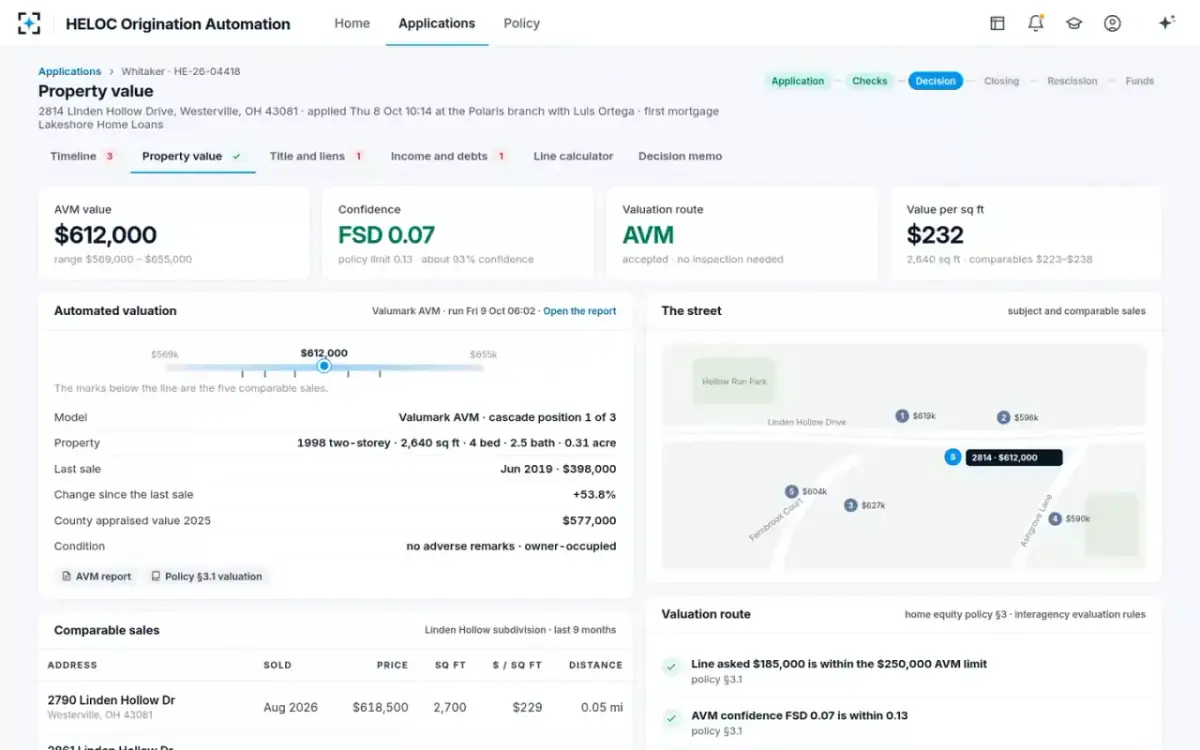
The usual control is a cascade fixed in advance: models tried in a set order, each accepted only if its confidence clears the lender's limit, with the first acceptable value used. In HELOC Origination Automation the property value checker runs the lender's cascade, and its limit is written as a rule it cannot cross: it never orders a second AVM to replace a lower value. The file records which model ran, its position in the order and its forecast standard deviation, which is the evidence the data-manipulation and conflict factors need.
Which model, which position in the order, what confidence: on the file
What does the AVM rule not require?
It does not set a confidence threshold, a testing frequency, a sample size or a model. It does not make a lender validate a vendor's code, which commenters said many smaller lenders cannot see. It does not apply to monitoring or to reviews of completed valuations. And it does not replace the appraisal rules: below $400,000 a bank still needs an evaluation that meets the 2010 guidelines' content expectations, whether or not an AVM supports it, as whether a HELOC requires an appraisal sets out.
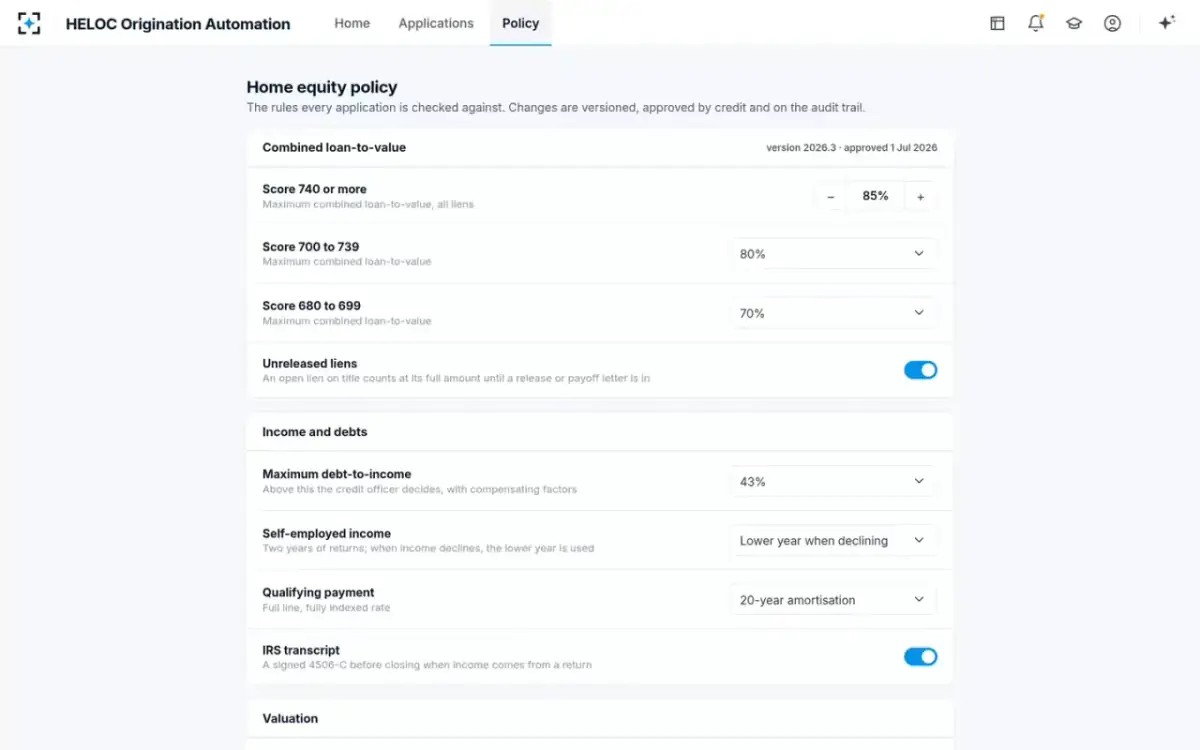
What it leaves to the lender is the hard part: choosing the numbers and proving they work. The sample bank's settings show the kind of choices involved: AVMs allowed for lines up to $250,000 (options $150,000, $250,000 or $400,000), a forecast standard deviation of 0.13 or lower (options 0.10, 0.13 or 0.15), an exterior-inspection evaluation up to $400,000, and an appraisal above it. Each is a policy setting, versioned and approved by credit, so a change in model performance can become a change in policy with a date on it.
Valuation limits as policy settings, changed only with credit's approval
How much work does compliance take?
Estimates in the rulemaking ranged widely. One commenter said "a statistically-based, rigorous analytical approach would require between 100 and 400 hours a year," most of it for fair lending testing; another gave "a rough estimate of 320 to 480 hours." The CFPB's small-entity analysis estimated 194 hours in the first year: "69 hours for verifying compliance, 65 hours for drafting and developing policies, practices, procedures, and control systems, and 60 hours for training" (89 FR 64538).
First-year and annual effort estimates for AVM quality control, from the rulemaking
The fair lending factor drives most of the spread. Commenters said community banks "lack in-house expertise needed to test for disparate impact and will lack the volume to yield the number of observations required for testing." The agencies' answer was flexibility and existing guidance, not an exemption, and the CFPB expected that "most third parties would be able to provide institution-specific ... service that accompanies an AVM." In practice that puts the vendor's testing, and the lender's review of it, inside third-party risk management.
Is an AVM a model under the 2026 model risk guidance?
Usually yes: a statistical valuation model produces quantitative estimates from data and theory, which is what the revised guidance means by a model, unlike "deterministic rule-based processes" it excludes. But the April 2026 guidance "does not set forth enforceable standards" and "is expected to be most relevant to banking organizations with over $30 billion in total assets" (SR 26-2). For most HELOC lenders the AVM rule is the binding text and the model risk guidance a useful frame.
The agents that read documents and apply the lender's policy sit differently. The same guidance places generative and agentic AI outside its scope, and the policy tests they run are rules. AI HELOC underwriting covers how their limits are set and tested. To see the valuation checks on your own files, start from HELOC Origination Automation.
Questions people ask
Who issued the AVM quality control rule?
Six agencies jointly: the OCC, Federal Reserve, FDIC, NCUA, CFPB and FHFA. It was published in the Federal Register on August 7, 2024, implementing section 1125 of FIRREA, and took effect on October 1, 2025. Each agency codified it in its own regulations; the OCC's is 12 CFR 34.220 to 34.222.
Does the AVM rule apply to credit unions and nonbank lenders?
Yes. NCUA adopted it for federally insured credit unions, and the CFPB adopted it for mortgage originators it oversees, including nonbanks. Coverage turns on being a mortgage originator or secondary market issuer making a credit decision on a principal dwelling, not on charter type.
Does the rule apply when an appraiser uses an AVM?
No. It excludes "the development of an appraisal by a certified or licensed appraiser." It also excludes portfolio monitoring and reviews of valuations already completed; it reaches models used to make the credit decision itself.
Can a lender rely on its AVM vendor's testing?
Not alone. The rule covers models used "through or in cooperation with a third-party," and the 2010 guidelines say a lender "should not rely solely on validation representations provided by an AVM vendor." Vendor testing can be part of the evidence, reviewed by people independent of the vendor and of production.
Does the AVM rule set a confidence score or FSD limit?
No. It requires controls that ensure "a high level of confidence in the estimates produced," and the 2010 guidelines ask each lender to set its own confidence minimums per model. Because vendors' confidence measures are not standardized, a lender has to test what its chosen measure means for accuracy.