The home equity underwriting workflow at a community bank runs through one desk. A home equity underwriter reviews a HELOC or home equity loan application and decides, within delegated authority, whether to approve it, counter or decline: confirming the property's value, the liens ahead of the bank, the borrower's income and debts, and that combined loan-to-value and debt-to-income fit the lender's policy. At a large lender those checks are split across a valuation desk, a title team, processors and underwriters. At a community bank or credit union one person often does all of them, then writes the conditions and the letter. Botminds' HELOC Origination Automation is built for that desk: six agents check value, title and income side by side, and the underwriter decides and signs.
This guide is for the people in that seat and the managers who staff it. It sets each task against the rule behind it and follows one fictional sample bank, Brookmere Bank, and its five people through a week of home equity files.
Five people carry one home equity file; at a small lender, one desk carries most of it
Today
Orders the AVM, reads the title report, keys two years of returns into a worksheet, computes CLTV and DTI, then decides and drafts the letter.
With agents
Opens each file with value, liens and income already checked against the policy and every figure linked to its document; decides and signs within authority.
Still theirs: The decision, the conditions, the signature
Today
Chases documents, asks for the same tax return twice, orders title and flood, keeps the closing calendar in a spreadsheet.
With agents
Works a conditions list where each item names who clears it; books closing once the decision is signed.
Still theirs: The borrower relationship and the closing
Today
Takes the application, hands over the disclosures and brochure, then waits weeks to tell the customer anything.
With agents
Takes the application at the desk; the customer hears within days, with the reasons and the conditions in plain words.
Still theirs: The application and the customer
Today
Sees exceptions late and without the numbers; signs declines without the reasons laid out.
With agents
Receives each exception and each line above the underwriter's authority with the limit it breaks and the compensating factors.
Still theirs: Exceptions, larger lines, declines
Today
Knows half the applicants give up, but not where the days go.
With agents
Sees days to decision by file and by stage, and which checks hold files.
Still theirs: The program, pricing and policy changes
What does a home equity underwriter do?
A home equity underwriter decides home equity applications within an approval authority set by the lender's board, and documents why. The decision itself is short; the work before it is long. The 2005 interagency guidance lists what the decision must weigh: "a borrower's income and debt levels, credit score (if obtained), and credit history, as well as the loan size, collateral value (including valuation methodology), lien position, and property type and location" (2005 home equity guidance). Each item on that list is a separate piece of evidence, from a separate source.
The underwriter's output is more than a yes. It is an approval with conditions, a counter-offer at an amount the policy allows, or a decline with specific reasons that Regulation B will accept, and in every case a file an examiner can follow. Priya Raman, the fictional underwriter at the sample bank, puts the imbalance in one line: "The decision takes me ten minutes. Finding out what's true takes three weeks."
The five jobs on one desk, and the rule behind each
At a small lender the underwriter's day breaks into five jobs, each answering to a different rule. Splitting them out shows why the desk is slow even when the files are simple: every job waits on a different outside party, and each one can stop the file on its own.
Five jobs, five sources of evidence, five rules
| Job | Evidence | The rule it answers to | Where it goes wrong |
|---|---|---|---|
| Valuation desk | AVM, desktop or exterior inspection, or an appraisal | Appraisal threshold ($400,000 at banks); 2010 evaluation guidelines; AVM quality control rule | A second model run for a better number; a value the model cannot support |
| Title reader | Owner and encumbrance report, releases, payoff letters | 2005 guidance: verify "the amount and priority of any senior liens prior to closing" | A paid-off line never released; a judgment or tax lien missed |
| Income analyst | Paystubs, W-2s, returns, verification of employment | 2005 guidance: income and debt "and not just a credit score" | Stated income used; a declining business averaged up |
| Policy and decision | The credit report, the policy grid, the authority table | The lender's board-approved policy; exception tracking | A limit missed; an exception granted without the right signature |
| Letters and clocks | Disclosures, the decision letter, the closing calendar | Reg Z 1026.40 and 1026.15; Reg B 1002.9 | A notice late; reasons Regulation B calls insufficient |
The valuation desk is where speed and independence pull against each other, and where a small lender's structure matters most; the next section takes it on. The title reader's job is the least visible and the most expensive to get wrong, because a lien missed at origination changes the lender's position for the life of the line; the lien a credit report doesn't show walks one through.
The letters and clocks job is all deadlines. Regulation B requires notice of action "within 30 days after receiving a completed application" (12 CFR 1002.9), and an incomplete application needs either a decision or a written notice of incompleteness within 30 days. After closing, the borrower may rescind "until midnight of the third business day" (12 CFR 1026.15). A desk working 20 files at different stages is tracking dozens of dates, usually in a spreadsheet.
How do small banks underwrite HELOCs?
Mostly with the same rules as large banks and fewer people to divide them among. Community banks are the norm, not the exception: the FDIC counted 4,238 insured institutions in mid-2026, and community banks "represent 90 percent of insured institutions" (FDIC Quarterly Banking Profile). NCUA counted 4,214 federally insured credit unions with 146.1 million members (NCUA).
The agencies wrote the small lender into the valuation rules. The 2010 guidelines accept that "for a small or rural institution or branch, it may not always be possible or practical to separate the collateral valuation program from the loan production process." In that case, "another loan officer, other officer, or director of the institution may be the only person qualified to analyze the real estate collateral," and to keep independence "such lending officials, officers, or directors must abstain from any vote or approval involving loans on which they ordered, performed, or reviewed the appraisal or evaluation" (Interagency Appraisal and Evaluation Guidelines).
If absolute lines of independence cannot be achieved, an institution should be able to demonstrate clearly that it has prudent safeguards to isolate its collateral valuation program from influence or interference from the loan production process.
Interagency Appraisal and Evaluation Guidelines, 2010
That is the one-person desk's central constraint. The underwriter who orders and reviews the evaluation should not be the one who approves the line, unless the lender can show safeguards that isolate the valuation. For credit unions, NCUA's own rule says a written estimate of market value must be prepared by someone "independent of the loan production and collection processes," with the same fallback to demonstrated safeguards (12 CFR 722.103).
Safeguards that let one desk keep valuation independent
- Choose the valuation route by written policy
Line amount, model confidence and CLTV decide AVM, inspection or appraisal, so no one picks the method after seeing the file.
- Fix the order of models before any value is seen
The 2005 guidance requires controls that "preclude 'value shopping'"; a fixed cascade is the simplest.
- Keep the estimated value off the order
The guidance says an expected value should not be "communicated to an appraiser or individual performing an evaluation."
- Separate the valuation reviewer from the approver
Where one person must review the evaluation, a second signs the credit decision, as the 2010 guidelines expect.
- Record who did what
Who ordered, prepared, reviewed and approved, on the file, so the independence can be demonstrated rather than asserted.
Where the home equity desk's cost sits: time, not headcount
Most of the desk's cost is time. A file that sits three weeks waiting for a title report and a second request for a tax return costs underwriter hours and, often, the applicant. The MBA's 2025 study found "just 50 percent of home equity applications are closing, and turn times are averaging 39 days" (MBA, July 2025). How long a HELOC takes to approve follows where those days go.
What does a HELOC processor do?
A HELOC processor gathers what the underwriter needs and clears what the underwriter asks for. BLS's description of the occupation that includes processors captures the job: they "verify references; prepare loan request papers; and forward findings, reports, and documents to appraisal department," then "review loan papers to ensure completeness, and complete transactions between loan establishment, borrowers, and sellers upon approval of loan" (BLS 43-4131).
On a home equity file that means ordering the valuation, the title report and the flood determination, chasing paystubs, W-2s, returns and a mortgage statement, requesting releases and payoff letters, and booking the closing once the line is approved. At a small lender the processor and the underwriter may share a desk or be the same person, which is why a conditions list that names who clears each item is worth more there than anywhere: it is how one person hands work to their future self.
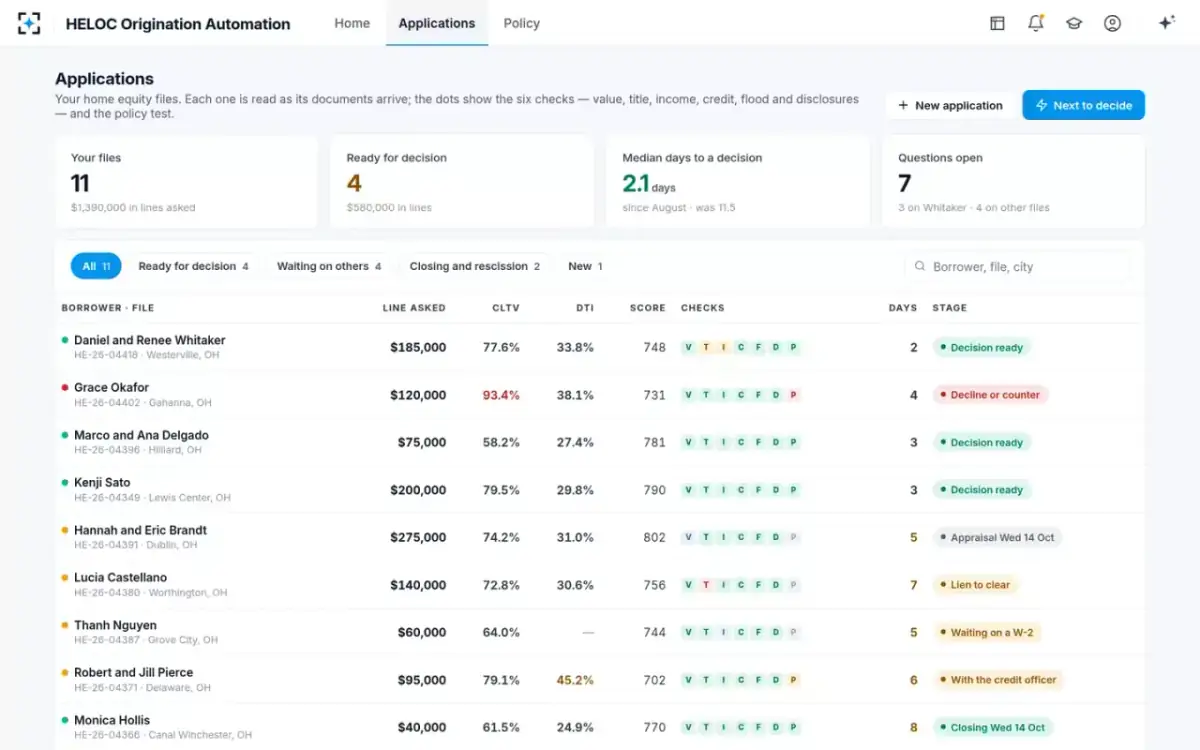
Eleven files on one desk, each read as it arrived
Who decides a HELOC at a credit union or community bank?
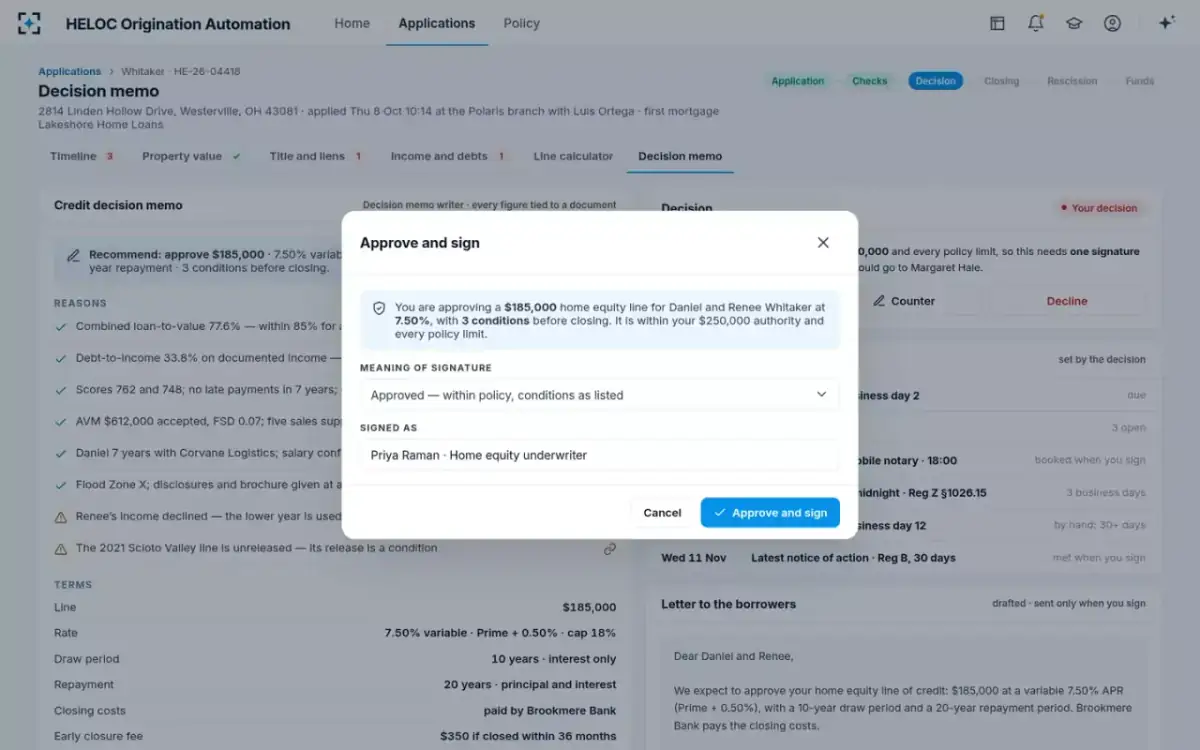
Whoever the board has given the authority, within limits the board sets. At the sample bank the home equity underwriter signs lines up to $250,000 that meet every policy limit; anything larger, and any exception, goes to the senior credit officer. A credit union may add a credit committee or name loan officers in its lending policy, and NCUA has long recognised that officials may need to take part in valuation "although it may be sound business practice to ensure no single person has the sole authority to make credit decisions involving loans on which the person ordered or reviewed the appraisal or evaluation" (2010 guidelines, citing NCUA).
Two practices make that authority defensible. The first is recording what a signature means: an approval within policy is a different act from an approval of an exception, and the file should say which. The second is tracking exceptions as the 2005 guidance asks, by "identifying, approving, tracking, and analyzing underwriting exceptions," so the board can see whether the policy it approved is the one being applied.
One signature, within authority, with its meaning recorded
What an examiner reads on a home equity underwriter's files
The evidence behind each decision, and whether the policy was followed. The 2005 guidance sets out what examiners expect a home equity program to show: underwriting that weighs income and debt rather than score alone, valuations chosen by written criteria with controls to "preclude 'value shopping'," senior liens verified before closing, high-LTV loans "identified in the institution's records" and reported to the board, and a process for "identifying, approving, tracking, and analyzing underwriting exceptions" (2005 home equity guidance).
For a one-person desk that list is the job description's hidden half. Each file needs to show not only the decision but the route to it: which valuation method and why, which liens were counted and from which document, which income and from which return, which limits were tested and which version of the policy applied, and, for a decline, reasons specific enough for Regulation B. A desk that keeps those in a worksheet and an email thread can pass an exam; a desk whose files carry them as linked evidence passes it without the week of reconstruction before the examiners arrive.
What changes on the desk when the checks run first
The order of work changes before the amount does. In the sample, the Whitakers' documents were complete at 07:30 on a Monday; the application and document reader filed all 14 to the checks that need them, and the property value checker, the title and lien examiner and the income and debt analyst ran side by side, finishing in 9, 16 and 24 seconds, with the policy check and memo taking 15 more. The underwriter opened a file whose questions were already listed: an unreleased 2021 line on title, a self-employed income that fell 21.6%, and a tax transcript to match.
What stays with the underwriter is everything that is a judgement. The agents never approve, decline or grant an exception, never drop a lien without a recorded release or payoff letter, and never use stated income when a document says otherwise. The design targets are a signed decision within two days of a complete application and every lien, income figure and limit tied to a document before the decision; they are targets, not results. What each agent may check and never decide sets the limits out one by one.
For a small lender the gain is less about speed than about splitting one job into reviewable parts. When each check leaves its evidence in the file, the person who reviews the valuation and the person who approves the line can be different people, even on a two-person team. To see that on your own files, start from HELOC Origination Automation.
Questions people ask
Is a home equity underwriter the same as a mortgage underwriter?
The skills overlap, but the rules differ. A home equity line is underwritten to the lender's own policy and the 2005 interagency guidance rather than to the ability-to-repay rule or an agency guide, and it adds open-end tasks: qualifying on the fully drawn line, counting every senior lien, and the HELOC disclosure and rescission rules.
Which tasks sit on a small lender's home equity underwriting desk?
Reviewing applications for credit, capacity and collateral; ordering or reviewing valuations; reading title reports; calculating income, CLTV and DTI; setting conditions; deciding within authority; and preparing approval, counter-offer or adverse action letters. At small lenders it often adds processing and closing tasks.
Can a loan officer review the valuation at a small bank?
The 2010 guidelines allow it when absolute independence is not practical, but the officer "must abstain from any vote or approval involving loans on which they ordered, performed, or reviewed the appraisal or evaluation." The lender should be able to show the safeguards that isolate valuation from loan production.
How many HELOCs does a lender originate a year?
Nationally, about 1.3 million HELOCs were opened in 2023, according to the New York Fed, and balances have risen every quarter since 2022. Per lender it varies widely; the MBA's 2025 study reported average HELOC commitment volume of $1.7 billion per company in 2024 among the lenders it surveyed.
How long should a home equity underwriter take per file?
No federal source measures it. The clock that binds is Regulation B's 30 days from a completed application to notice of action. The MBA reports average home equity turn times of 39 days from application, most of it spent waiting on valuation, title and documents rather than on the decision.