HELOC software covers several kinds of system: the point-of-sale application, the loan origination system that holds the file and produces documents, valuation and title services, and decision software that checks the file against the lender's credit policy. Implementing the decision layer, the part that determines how fast and how safely a line is approved, takes about ten weeks when the lender's policy, vendors and sample files are ready, most of it spent on writing the policy as settings and proving the checks on the lender's own files. Botminds' HELOC Origination Automation is that decision layer: six agents check value, title and income side by side against the lender's policy and draft the memo, conditions and letter, and the home equity underwriter decides. It works alongside the systems the lender already runs, which is why the plan below starts with policy rather than with integration.
This guide is for the operations, IT and credit leads who will own the project. It sets out what to look for when choosing HELOC software, what a lender has to bring, a week-by-week plan, how to run a parallel test, and the tests to pass before go-live. The examples use a fictional sample bank, Brookmere Bank, and its home equity policy.
Ten weeks from policy to production
- Policy as settingsweeks 1–2
- Valuation routeweek 3
- Title, credit, flood feedsweek 4
- Letters and clocksweek 5
- Closed-file replayweeks 6–7
- Live parallel runweeks 8–9
- Go-liveweek 10
What is HELOC software, and what does it replace?
"HELOC software" is used for at least four different products, and buying the wrong one is the commonest mistake. A point-of-sale system takes the application and documents. A loan origination system holds the file, produces disclosures and closing documents and hands the account to servicing. Valuation and title services return values and reports. Decision software turns those inputs into a decision against the lender's policy. It is the layer the MBA's survey respondents named, with automated valuations, as a way to cut home equity turn times that average 39 days (MBA, July 2025).
HELOC Origination Automation is decision software built around agents. It reads the application and documents, runs the lender's valuation route, matches liens to the credit report, computes qualifying income, CLTV and DTI, tests the policy, and drafts the memo, conditions and borrower letter. It does not replace the loan origination system, the core banking system, the closing and e-signature process, or servicing and account management. It connects to the portal, valuation providers, the title agency, the credit bureaus, flood and OFAC checks, and the lender's policy and pricing grid.
Does HELOC software replace a loan origination system? What each does
Loan origination system: The application record, pricing, documents and the file's workflow from intake to closing.
HELOC Origination Automation: The checks: value, liens, income and debts, policy, each linked to its document.
Loan origination system: Disclosures, closing documents, the account set-up for servicing.
HELOC Origination Automation: The decision memo, conditions with owners, the borrower letter or specific adverse action reasons.
Loan origination system: Records the decision and who made it.
HELOC Origination Automation: Recommends; the underwriter decides and signs within authority.
Loan origination system: Pricing tables and product set-up.
HELOC Origination Automation: The home equity credit policy as versioned settings: CLTV grid, DTI, income, qualifying payment, valuation routes, authority.
Loan origination system: Hands off to servicing.
HELOC Origination Automation: Out of scope: account management, freezes and line reviews stay in the lender's servicing process.
What should you look for in HELOC software?
Evidence, control and fit with the rules the lender already follows. The 2005 interagency guidance sets the bar any HELOC program is examined against: repayment capacity on income and debt "and not just a credit score," qualification on "the fully drawn line," valuation chosen by policy with no "value shopping," and senior liens verified "prior to closing the loan" (2005 home equity guidance). Software that cannot show each of those on a file will not help with an exam, however fast it is.
Six questions to ask any HELOC software vendor
- Does it read the documents, or only the data?
An unreleased lien is in the title report and a falling income in the returns; a system that reads only the credit report and the application will miss both.
- Is the policy yours, as settings?
CLTV by score band, DTI, income rules, qualifying payment, valuation routes and authority should be the lender's choices, versioned and approved by credit.
- Who signs?
Software that approves on its own needs governance the lender must write; software that recommends leaves the decision where the authority table already puts it.
- Can every figure be traced?
Each CLTV, income and debt number should open the page and line it came from, for the underwriter and for an examiner.
- How does it handle valuation models?
A fixed order, confidence limits per model and the records the AVM quality control rule needs.
- What does the vendor disclose and test?
Models used, limits, testing results and change control, in a form third-party risk management can review.
What do you need to launch an automated HELOC program?
A written policy, the vendors that supply the evidence, and a set of past files with known answers. The software is the shortest part of the list. Most delays in a go-live come from a policy that exists only as practice ("we usually allow 85% for good scores") or from a vendor contract that does not yet allow the data to flow.
What the lender brings, who owns it, and when it is needed
| Item | Owner | Needed by | Why |
|---|---|---|---|
| Home equity credit policy and authority table | Chief credit officer | Week 1 | Every check tests against it; the board approves it at least annually under the 2005 guidance |
| Pricing grid and margins | Home equity product lead | Week 1 | CLTV and score tiers set the rate and the qualifying payment |
| Valuation vendors and model order | Collateral or valuation manager | Week 3 | The AVM cascade, confidence limits and inspection and appraisal routes |
| Title agency and report type | Operations | Week 4 | Owner and encumbrance or full title reports, and how releases are requested |
| Credit, flood and OFAC access | Operations and IT | Week 4 | The tri-merge, the flood determination and the OFAC screen on every file |
| Disclosure, letter and notice templates | Compliance | Week 5 | Approval, counter-offer and adverse action letters with specific reasons |
| 50 to 100 closed files with known outcomes | Credit administration | Week 6 | The closed-file replay, including files with known problems |
How long does it take to implement HELOC software?
For the decision layer, about ten weeks with the inputs above ready; longer if the policy has to be written first or a vendor contract renegotiated. The plan below is the one we recommend for HELOC Origination Automation, and the order matters more than the dates.
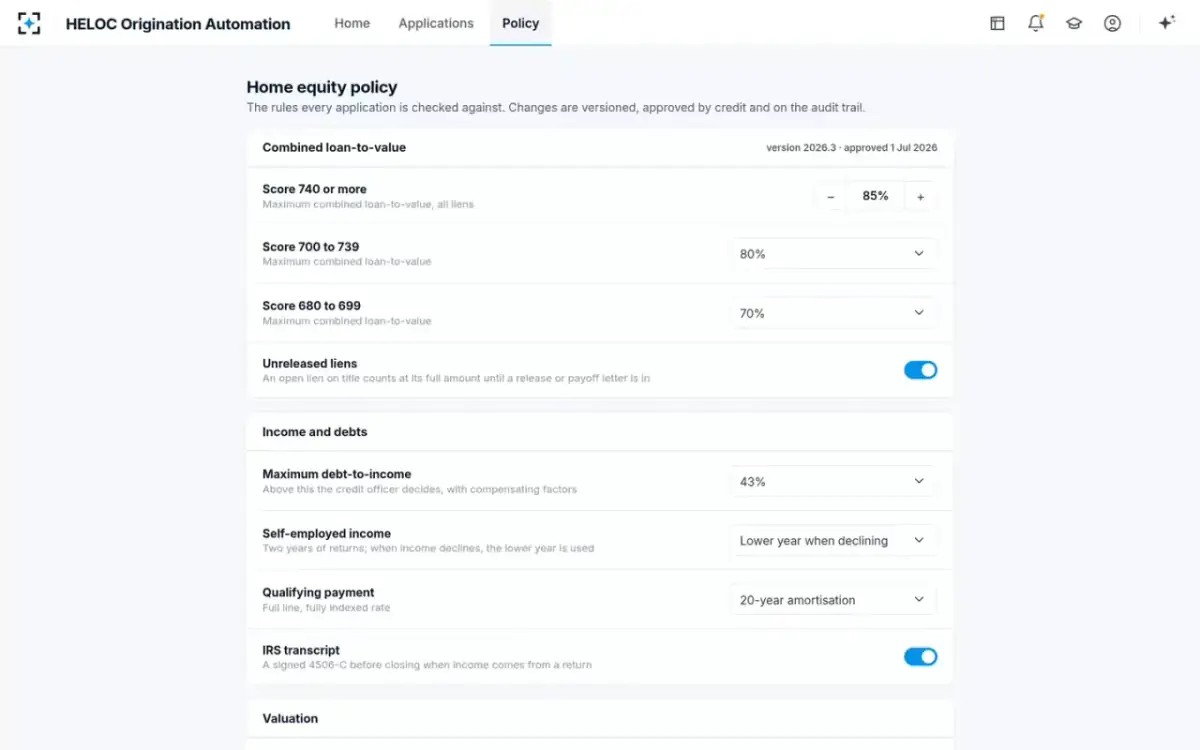
Weeks 1–2: the policy as settings. Credit writes each rule as a setting with an owner: maximum CLTV by score band (the sample bank uses 85% at 740 and above, 80% at 700 to 739, 70% at 680 to 699), the treatment of unreleased liens, maximum DTI, self-employed income, the qualifying payment and approval authority. The guidance's expectation that lenders track "underwriting exceptions" becomes an exception route that names the limit broken. Credit approves version 1.
Week 3: the valuation route. The collateral manager sets the model order, the confidence limit per model, the line amount up to which an AVM may support an evaluation, and the routes to inspection and appraisal. The 2010 guidelines expect "internal confidence score minimums ... for when each model can be used" (Interagency guidelines), and the AVM quality control standards final rule expects testing evidence; both are written down here.
Week 4: title, credit and flood. The feeds are connected and tested on real reports: the title agency's owner and encumbrance report, the tri-merge credit report, the flood determination and the OFAC screen. Flood needs a policy choice as well as a feed: whether to size cover to the full line at opening or track balances, which the agencies allow either way (Interagency flood Q&A); flood insurance on a HELOC explains the trade-off.
Week 5: letters and clocks. Compliance approves the decision letter, the counter-offer and the adverse action templates, with reasons drawn from the file rather than from a score, as Regulation B requires (12 CFR 1002.9). The clocks are set: disclosures at application, the 30-day notice limit, closing, rescission and funding.
How do you run a parallel test?
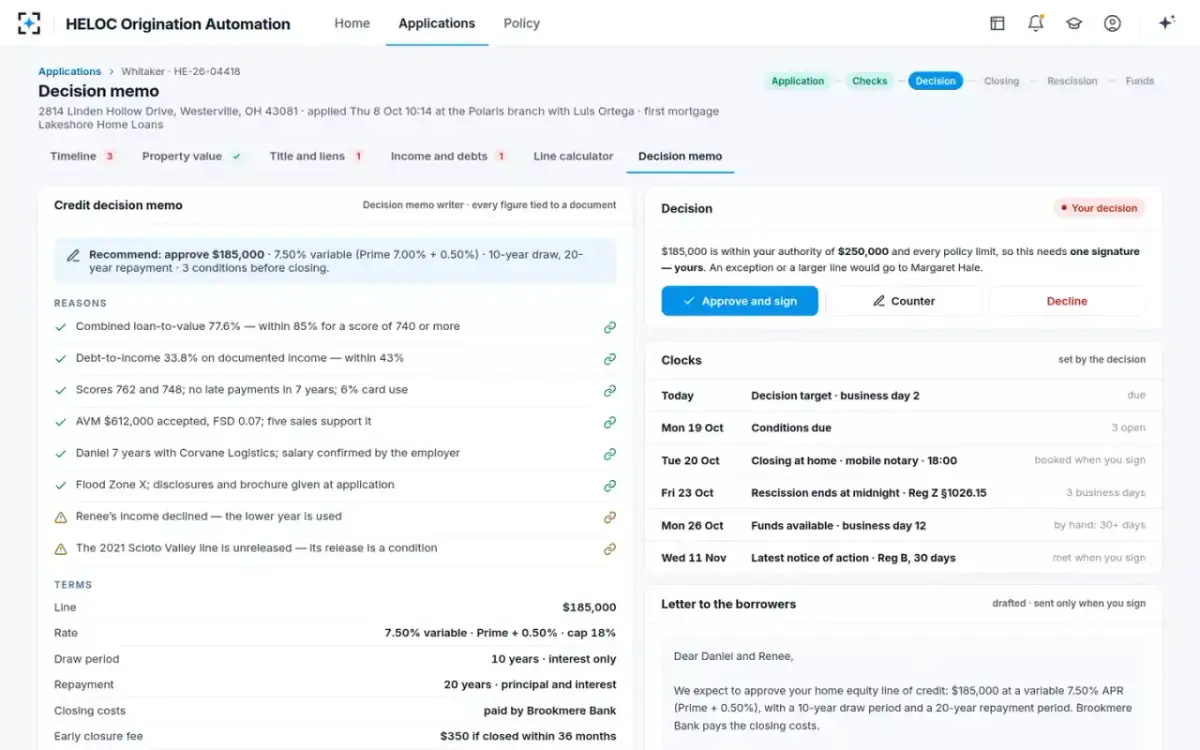
In two stages: replay closed files whose answers are known, then run live applications through both processes side by side. The replay, in weeks six and seven, uses 50 to 100 closed home equity files, deliberately including the problem cases the lender remembers: a lien found late, a self-employed borrower whose income fell, a valuation that was challenged, a decline. For each file the solution's CLTV, DTI, conditions and recommendation are compared with what the lender decided, and every difference is explained as a policy setting to fix, a document the agents could not read, or a finding the original underwriter missed.
The live parallel run, in weeks eight and nine, puts new applications through both the current process and the solution, with the current process still deciding. It measures what the replay cannot: time from complete application to a ready file, how often the underwriter changes a recommendation and why, and whether conditions are clearer for processors and borrowers. The agents' limits are tested here too, with seeded files that try to break them, such as a second AVM ordered for a better value or stated income above the returns; what each agent may check and never decide lists the limits to test.
The decision memo the parallel run compares, reason by reason
Who should own HELOC credit policy settings?
Credit, with the board's approval, not IT or the vendor. The 2005 guidance reminds lenders that the real estate lending standards require "an institution's board of directors review and approve these policies at least annually," and that management assess "the potential effect on the institution's overall risk profile" before changing them. Settings that encode the policy are the policy; whoever can change them is changing it.
In HELOC Origination Automation every setting change is versioned, approved by credit and on the audit trail; the sample bank's policy is version 2026.3, approved 1 July 2026. That gives the board report a simple answer to which policy applied to a file: the version in force on the day it was checked. It also makes exception reporting a by-product, since every file that broke a setting is recorded with the setting and the person who approved the exception.
The policy, versioned: the settings credit owns
Vendor due diligence for HELOC software
A decision vendor is a third party in the full supervisory sense, and the lender keeps responsibility for what its tools produce. The interagency third-party risk management guidance of 2023 remains in force; on September 11, 2026 the banking agencies and NCUA proposed replacing it with principles-based guidance meant to help institutions "better align and tailor their third-party risk management practices to the risks of individual third-party relationships" (joint press release). The AVM rule applies whether the lender uses a model itself "or through or in cooperation with a third-party."
For AI specifically there is less to lean on. The April 2026 model risk guidance places "generative AI and agentic AI models" outside its scope and says it "does not set forth enforceable standards" (SR 26-2). A lender that sells first mortgages to Fannie Mae also meets Lender Letter LL-2026-04, which requires policies for AI/ML used in originating loans sold to Fannie Mae, an owner who reviews them "at least annually," and governance of "subcontractor and vendor use of AI/ML." In practice the due diligence file for HELOC software should show what the software does and refuses to do, how it is tested, and how changes reach production.
Go-live: the tests to pass, and where the solution fits
Go-live in week ten should follow evidence, not the calendar. The tests below are the ones we use; a lender may add its own, and a test that fails moves the date.
Before the first live decision: tests to pass
- Replay agreement explained
Every difference between the solution and the lender's closed-file decisions is traced to a setting, a document or a missed finding, and the settings are fixed.
- Limits held under seeded files
A second AVM, stated income above the returns and an unreleased lien each produce the expected condition or refusal.
- Policy version approved
Credit has signed the settings in force on day one, with the exception route and authority table.
- Letters approved
Compliance has approved the decision, counter-offer and adverse action templates and the reasons they draw from the file.
- Feeds proven on live reports
Title, credit, flood and OFAC returned on parallel-run files without manual fixes.
- Owners named
Who reviews valuation model performance, who maintains the policy settings, and who watches the first month's files.
Where it fits: a bank or credit union that originates home equity lines for its own portfolio, with an underwriting desk that spends its days collecting and reconciling evidence, and a written policy it is willing to make explicit. Where it fits less well: a lender whose bottleneck is closing logistics rather than the decision, or one that wants software to approve without a person, which this solution will not do. To run the closed-file replay on your own home equity applications, start from HELOC Origination Automation.
Questions people ask
What is the difference between HELOC software and a loan origination system?
A loan origination system is the system of record for the file: application data, documents, disclosures and closing. HELOC decision software checks the file against the credit policy before the decision. A lender needs a system of record either way; decision software sits beside it.
Can HELOC software work with our existing core and LOS?
HELOC Origination Automation is built to: it takes the application and documents in from the lender's portal or origination system and sends conditions, letters and the signed decision back. It does not replace the core, the origination system, closing or servicing.
How many closed files do we need for a parallel test?
Enough to include the cases that matter: our suggestion is 50 to 100 closed home equity files, chosen to include known problems such as late-found liens, declining self-employed income, valuation disputes and declines. A smaller lender can use fewer if the problem cases are in the set.
What happens to the credit policy when the software changes?
Nothing, if the policy is held as the lender's settings: a software update changes how checks run, not what they check against. Policy changes are separate, versioned and approved by credit, so each file can be read against the version in force when it was checked.
Does automated HELOC software need regulator approval?
No federal approval is needed to use decision software. The lender remains responsible for compliance and for its vendors under third-party risk management guidance; the 2010 appraisal guidelines mention prior regulator approval for automated pre-funding reviews of appraisals, which is a different use.