Does a HELOC require flood insurance? Yes, if the home securing it is in a special flood hazard area (SFHA) in a community where federal flood insurance is available. The interagency flood Q&A is direct: "A home equity loan is a designated loan, regardless of the lien priority," and the regulation forbids a lender to "make, increase, extend, or renew any designated loan" without flood coverage for the term of the loan. A line needs a flood determination before it is opened, but not one per draw; a limit increase may need a new one. The trap is the amount: a second-lien lender must make sure coverage reaches the first and second loans combined, not just its own line. Botminds' HELOC Origination Automation orders and reads the flood determination on every home equity file and tests coverage before the underwriter decides.
Flood is a small share of home equity files and a large share of compliance findings, which is why it rewards a fixed procedure. The rules below are the FDIC's Part 339 and the 2022 interagency Q&A, issued jointly by the OCC, Federal Reserve, FDIC, Farm Credit Administration and NCUA, whose own flood rules follow the same statute. A fictional sample file shows the check: Daniel and Renee Whitaker's $185,000 line at Brookmere Bank, on a house in Zone X a street away from a mapped flood zone.
Where flood rules bite in the life of a home equity line
- Before opening: determination, notice, coverageweeks
- Draw period: draws need no new determination10 years
- Repayment period20 years
- Before openingweeks
- Draws4 years
- Increase: determination may be needed; coverage re-testedyear 5
- Draws5 years
- Repayment period20 years
Is a second lien a designated loan?
Yes. A designated loan is one secured by a building or mobile home in an SFHA in a community where flood insurance is available under the National Flood Insurance Program, and lien position does not change that. The agencies' answer to "Is a home equity loan considered a designated loan that requires flood insurance?" is "Yes. A home equity loan is a designated loan, regardless of the lien priority, if the loan is secured by a building or a mobile home located in an SFHA in which flood insurance is available under the act" (Interagency Q&A, XIII Q1).
The purchase rule then applies in full: an institution "shall not make, increase, extend, or renew any designated loan unless the building or mobile home and any personal property securing the loan is covered by flood insurance for the term of the loan" (12 CFR 339.3(a)). The four verbs matter on a line of credit, because a HELOC can be increased and extended long after it is made. Outside an SFHA there is no federal purchase requirement, though a lender may require cover by its own policy.
Does each HELOC draw need a flood determination?
No. The determination is made once, before the line is opened: "While a line of credit secured by a building or mobile home located in an SFHA in which flood insurance is available under the act is a designated loan and, therefore, requires a flood determination before the loan is made, draws against an approved line do not require further determinations" (Interagency Q&A, XIII Q2). A draw is credit extended within a limit already approved, which is also why a draw does not restart the borrower's right of rescission (12 CFR 1026.15).
Draws still matter for the amount of cover if the lender sizes it to the balance rather than to the line, which the next section takes up. And the determination has to come early enough to act on: if it shows an SFHA, the lender must deliver a written notice to the borrower "within a reasonable time before the completion of the transaction" (12 CFR 339.9(c)), and the policy must be in force at opening. A new NFIP policy usually carries a 30-day waiting period, which the agencies mention in the line-of-credit answer below.
Does a HELOC line increase need a new flood determination?
It may. The Q&A says "a request made for an increase in an approved line of credit may require a new determination, depending upon whether a previous determination was done." The flood statute lets a lender rely on a previous determination "when it increases, extends, renews, or purchases a loan," if the original "was made not more than seven years before the date of the transaction, the basis for the determination was set forth on the SFHDF, and there were no map revisions or updates affecting the security property since" (Interagency Q&A, determinations Q4).
Two details trip lenders up. Making a new loan is not on the statute's list, so a new HELOC from a lender that did not make the first mortgage needs its own determination; if the same lender made the first mortgage, the Q&A allows reliance on a determination up to seven years old under the same conditions. And reliance on the determination does not carry over to the notice: for a later transaction on the same property, "the lender must still provide a new Notice of Special Flood Hazards to the borrower." An increase also requires coverage to be re-tested against the larger line, and it reopens the right of rescission.
Five events on a home equity line, and what the flood rules ask at each
| Event | Flood determination | Coverage | Notice to borrower |
|---|---|---|---|
| New line, lender did not make the first mortgage | New determination required | In place at opening, in the required amount | Required if in an SFHA |
| New line, same lender holds the first mortgage | May rely on one up to 7 years old, no map change, on the standard form | In place at opening, re-sized for both loans | A new notice is still required |
| Draw within the approved limit | None | Re-check only if cover is sized to the balance | None |
| Limit increase | May need a new one, depending on the previous determination | Re-tested for the larger line | Required if in an SFHA |
| Extension or renewal of the draw period | May rely on the previous one under the 7-year conditions | Must cover the extended term | Required if in an SFHA |
How much flood insurance is required on a HELOC?
Enough to cover both loans, up to the program's caps. For a second mortgage, the lender "must ensure that adequate flood insurance is in place or require that additional flood insurance coverage be added ... in the amount of the lesser of either the combined total outstanding principal balance of the first and second loan, the maximum amount available under the act (currently $250,000 for most residential buildings and $500,000 for other buildings), or the insurable value of the building" (Interagency Q&A, XIII Q4).
That is the second-lien trap. A lender that requires cover only for its own line leaves itself exposed, because the first lienholder is paid first from any claim. The agencies' first worked example shows it: a $100,000 first mortgage insured for only $75,000, a $50,000 second, and a building with an insurable value of $200,000. "Lender B must ensure that flood insurance in the amount of $150,000 is purchased and maintained"; if it required only $50,000, "Lender B would receive only $25,000 of the loss payment toward its principal balance of $50,000."
On the agencies' own example, a second lien insured for its own balance recovers half
For a line of credit the agencies allow two ways to size cover. "For administrative convenience," a lender "may require the purchase of flood insurance for the total amount of all loans or the maximum amount of flood insurance coverage available, whichever is less," at opening; or it may "actively review its records throughout the year," adjusting for draws and repayments, in which case, if there is no policy at origination, "the borrower must, at a minimum, obtain a policy as a requirement for drawing on the line" (Interagency Q&A, XIII Q3). The agencies warn that the second route carries more risk, including "inadequate flood insurance coverage during the 30-day waiting period for an NFIP flood policy to become effective."
Finding the first loan's balance is a practical problem the Q&A also addresses. A junior lienholder should get the borrower's consent to obtain balance and coverage information from the senior lienholder, and "junior lienholders also have the option of pulling a borrower's credit report and using the information from that document to establish how much flood insurance is necessary." The lender must also accept a private flood policy that meets the regulation's definition (12 CFR 339.3(c)).
Do HELOCs need flood escrow?
No. The escrow requirement for flood premiums has exceptions, and one of them is a loan that "is a home equity line of credit" (12 CFR 339.5(a)(2)(iv)); another covers a loan "in a subordinate position to a senior lien" where the borrower has adequate coverage. The exception has a condition attached: if a lender later "determines at any time during the term of a designated loan ... that an exception ... does not apply," it must start escrowing "as soon as reasonably practicable."
For a HELOC the line-of-credit exception stays in place for the life of the line, but the coverage requirement does not go away. If the lender learns the property is uninsured or underinsured at any time, it must notify the borrower, and "if the borrower fails to obtain flood insurance within 45 days of the lender's notification to the borrower, the lender must purchase flood insurance on the borrower's behalf."
When must the flood notice be given on a HELOC?
Before closing, with enough time to act on it. When a lender "makes, increases, extends, or renews a loan secured by a building or a mobile home located or to be located in a special flood hazard area," it must "mail or deliver a written notice to the borrower and to the servicer in all cases whether or not flood insurance is available" (12 CFR 339.9(a)). The notice goes to the borrower "within a reasonable time before the completion of the transaction."
The notice has fixed contents: a warning that the building is in an SFHA, the purchase requirement, where cover is available, and that private flood insurance may also be available. For a home equity line the timing question is practical. A determination ordered after the decision, or a notice handed over at the closing table, leaves the borrower no time to buy a policy that, from the NFIP, usually takes 30 days to take effect. Ordering the determination with the valuation, at application, is what makes "a reasonable time" achievable. And because a new notice is needed for each transaction even when the determination can be reused, a limit increase on a line in an SFHA always carries a notice.
Why flood is one of the most cited lending violations
Flood rules are mechanical, and mechanical rules applied by hand across many files fail at a steady rate. The FDIC cited 131 violations of the Flood Disaster Protection Act and Part 339 in 2025, the third most of any consumer law, behind TILA and Regulation E; the most cited flood provision was the failure to have insurance when a loan was made, increased, extended or renewed, at "41 percent of the total FDPA violations cited in 2025" (FDIC Consumer Compliance Supervisory Highlights, 2026).
Flood keeps appearing near the top of examiners' lists
131
flood violations cited by the FDIC in 2025, third among consumer laws
41%
of them: no flood insurance when a loan was made, increased, extended or renewed
3
flood provisions among the Federal Reserve's most-cited violations in 2025: notice, force placement, purchase
The Federal Reserve's 2025 list tells the same story from the other side: its most-cited flood provisions were the notice to the borrower, the 45-day force-placement rule and the purchase requirement itself (Consumer Compliance Outlook). None of those is a judgement call. Each is a date, a document or an amount that a procedure can check on every file.
What an automated flood check does on a home equity file
It treats flood as a check with evidence, like value or income, rather than a box on a closing checklist. In HELOC Origination Automation the flood determination arrives with the AVM and the title report, and the credit policy checker tests flood with the rest of the policy: the zone, whether coverage is required and, where it is, the evidence of insurance and the timing of the notice. An open flood question shows on the file's flood dot and becomes a condition the decision memo names.
A flood check for every home equity file
- Order the determination before the decision
On the standard form, for every line, including lines from the lender that holds the first mortgage unless the 7-year reliance conditions are met.
- If the home is in an SFHA, send the notice early
Within a reasonable time before closing, whether or not insurance is available; a new notice for each transaction.
- Size cover to both loans
The lesser of the combined first and second balances (or the full line, if sized at opening), the program maximum, and insurable value.
- Get the bank named on the policy
The Q&A says the junior lienholder should have the borrower add it as mortgagee or loss payee on the existing policy.
- Mark the line for re-tests
A limit increase, extension or renewal re-opens the determination question and the amount; draws do not.
- Keep the force-placement clock ready
If cover lapses or falls short, notify the borrower; after 45 days the lender must buy it.
On the sample file the determination came back on the Friday after the application: Zone X, outside the SFHA, so no flood insurance is required and no notice is due. The property map shows why the check is still worth running: the Spring Run flood zone, Zone AE, sits a few streets south of the parcel. The insurance condition on the Whitaker approval is the ordinary hazard policy, which must name Brookmere Bank as second mortgagee.
The parcel in Zone X, with an AE zone a few streets away
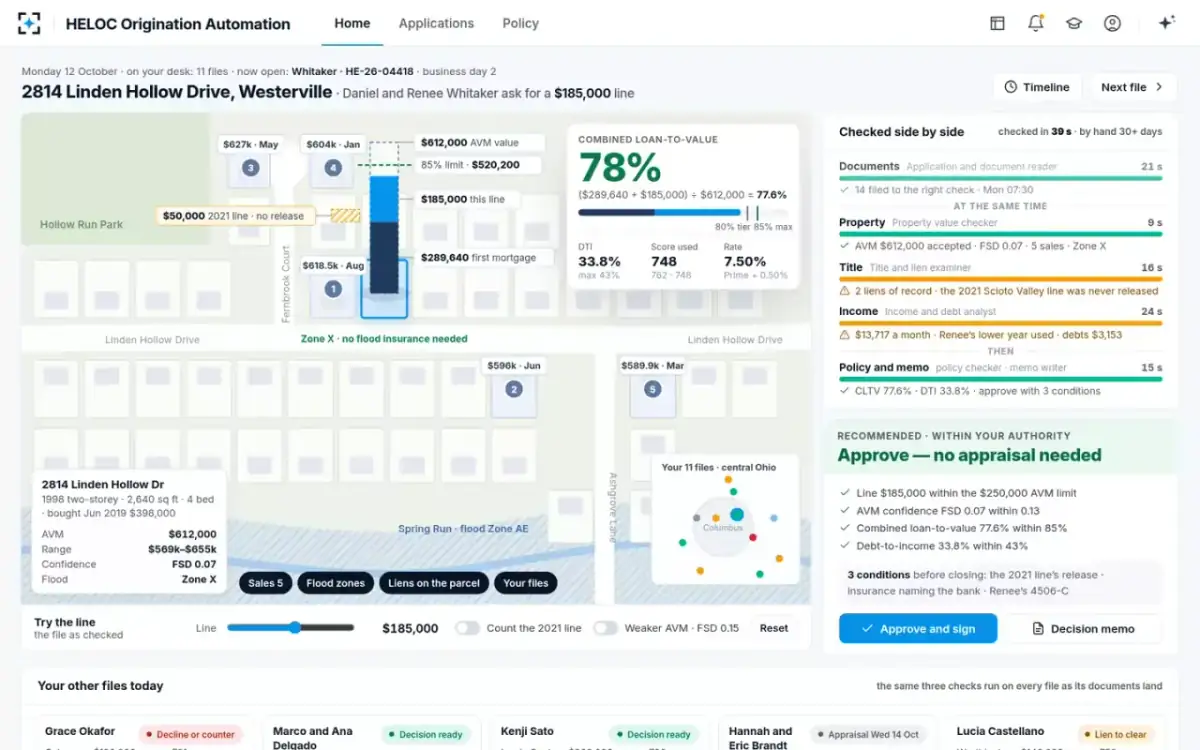
Flood also belongs in the go-live plan, because it depends on a vendor feed and on the lender's choice between sizing cover at opening and tracking balances; a ten-week plan for HELOC software places it in week three. The other lien-position question a second lien raises is covered in the lien the credit report doesn't show. To see the flood check on your own files, start from HELOC Origination Automation.
Questions people ask
Do HELOCs require flood insurance outside a flood zone?
Not under federal law. The purchase requirement applies only to designated loans, secured by buildings in a special flood hazard area in a participating community. A lender may still require cover by its own policy, and it must still make and keep the determination that shows the home is outside the SFHA.
Does a junior lienholder have to escrow for flood insurance?
No. The escrow rule exempts a home equity line of credit, and also a subordinate loan where the borrower has adequate coverage. The lender must begin escrowing as soon as reasonably practicable if it learns an exception no longer applies, and it must still make sure adequate coverage exists.
Who pays if the flood insurance on the first mortgage is too low?
The second-lien lender must make sure total coverage is adequate for both loans, so it may require the borrower to add cover. If the borrower does not obtain it within 45 days of the lender's notice, the lender must force-place the shortfall and may charge the borrower for it.
Does a HELOC need flood insurance for the full credit line?
Not necessarily. The agencies allow a lender to require cover for the total of all loans, including the full line, at opening, or to track balances through the year and adjust cover as the borrower draws. The first is simpler; the second risks gaps, including the 30-day waiting period on a new NFIP policy.
Can the lender rely on the flood determination from the first mortgage?
Only if it made the first mortgage, the determination is no more than seven years old, its basis is on the standard flood hazard determination form, and the maps have not changed. A different lender making a new HELOC needs its own determination.