AI HELOC underwriting is the use of AI agents to do the reading and checking that comes before a decision on a home equity line of credit: extracting figures from the application, returns, title report and AVM, testing them against the lender's policy, and drafting the memo, conditions and letter. It is different from an automated decision engine that approves on a score. In Botminds' HELOC Origination Automation, six specialist agents check property, title and income side by side, each with written limits, and none of them approves, declines or grants an exception: the home equity underwriter decides and signs. The limits are not a product preference. Most of them restate a rule the lender already has to follow.
For a technical evaluator or a chief credit officer, the useful question is not whether AI can underwrite a HELOC but which steps it should take and which it must never take. This page answers that agent by agent, using one fictional sample file: Daniel and Renee Whitaker's $185,000 line at Brookmere Bank.
Six agents, what each checks, and what each may never do
Application and document reader
What it checksReads the application and every document as it arrives (paystubs, W-2s, returns, the mortgage statement, the insurance page) and files each to the check that needs it.
What it may never doNever infers a missing figure; it asks for the document. Cites page and line for every value.
Property value checker
What it checksRuns the lender's AVM cascade and tests the result against the valuation policy: line amount, forecast standard deviation, CLTV; then chooses AVM, inspection or appraisal.
What it may never doNever shops several AVMs for the highest value. Never overrides an appraiser.
Title and lien examiner
What it checksReads vesting, every recorded lien, taxes and judgments, and matches each lien to a tradeline on the credit report.
What it may never doNever drops a lien without a recorded release or payoff letter. Flags judgments, tax liens and mechanic's liens.
Income and debt analyst
What it checksComputes qualifying income by the bank's rules and monthly debts from the credit report, with the qualifying payment on the full line at the fully indexed rate.
What it may never doNever uses stated income when a document says otherwise. Takes the lower year when self-employed income declines.
Credit policy checker
What it checksTests CLTV by score, DTI, pricing tier, flood, insurance, OFAC and disclosure timing against the home equity policy.
What it may never doNever grants an exception. An exception always routes to the credit officer.
Decision memo writer
What it checksDrafts the memo, the conditions, the pricing and the borrower letter, or the specific adverse action reasons when the answer is no.
What it may never doNever approves or declines; the underwriter decides and signs. Every condition names who clears it.
What is AI HELOC underwriting?
AI HELOC underwriting is reading, matching and calculating at the speed of software, applied to a home equity file, with a person deciding at the end. A home equity decision rests on a short list of facts: what the house is worth, every lien ahead of the bank, what the borrowers earn and owe, and whether combined loan-to-value and debt-to-income fit the policy. Each fact sits in a different document from a different source, which is why the work is slow by hand and suits agents that read documents.
The term covers two quite different designs. One is a decision engine: a model or rule set that outputs approve or decline, usually from a credit score, an AVM and a few application fields. The other is the design described here: agents that assemble and test the evidence and draft the decision for a person to make. Score-only, rules and agents on one file runs the same file through each design to show what they catch.
Can AI approve a HELOC?
No federal rule forbids a lender to automate a HELOC approval, but every rule that governs the decision assumes someone can explain it. The 2005 interagency guidance expects repayment capacity to be judged on income and debt "and not just a credit score," and expects lenders to track and approve exceptions (2005 home equity guidance). Regulation B requires specific reasons for any adverse action. A lender's board sets approval authority, and a signature means something only when a person makes it.
HELOC Origination Automation is built so that the agents never approve or decline. They recommend, with each reason linked to its document; the underwriter signs within an authority the bank sets, with the meaning of the signature recorded, and exceptions or larger lines go to the senior credit officer. The design target is a signed decision within two days of a complete application, which the checks make possible without taking the decision away from a person.
Why each limit exists: the rule behind it
Most of the agents' limits are a sentence from a rule or a guidance document, turned into a constraint the software cannot cross. That matters to a second-line reviewer, because a limit that restates a rule can be tested against the rule, while a limit that is only a vendor's promise cannot.
Five agent limits, and the rule each one restates
| The limit | The rule behind it | What would go wrong without it |
|---|---|---|
| Never shops several AVMs for the highest value | 2005 guidance: "preclude 'value shopping'"; 2010 guidelines: controls when "more than one AVM is used" | A higher value than the policy allows, a line too large, and an inflated baseline for any later freeze |
| Never drops a lien without a recorded release or payoff letter | 2005 guidance: "verify the amount and priority of any senior liens prior to closing" | An unreleased lien left out of CLTV, and the bank in a lien position it did not price |
| Never uses stated income when a document says otherwise | 2005 guidance: income and debt "and not just a credit score"; risk factor: "limited or no documentation" | DTI computed on income the borrower does not have |
| Qualifying payment on the full line at the fully indexed rate | 2005 guidance: "ability to amortize the fully drawn line" and "absorb potential increases in interest rates" | A borrower qualified on an interest-only payment on a small draw |
| Never declines; reasons drafted for a person to send | Regulation B 1002.9: reasons "must be specific"; a failed score "insufficient" | A notice that says "did not meet our criteria", or one sent without anyone deciding |
The same logic applies to valuation. Since October 1, 2025, a lender that uses an AVM in a credit decision on a mortgage secured by the borrower's principal dwelling, home equity lines included, must have quality controls designed to "ensure a high level of confidence in the estimates produced," "protect against the manipulation of data," "seek to avoid conflicts of interest," "require random sample testing and reviews," and "comply with applicable nondiscrimination laws" (AVM quality control rule). A fixed model order chosen before any value is seen is the agent-level version of the second factor.
How do you explain an AI HELOC denial?
The same way as any other denial: with the principal reasons, specifically. Regulation B says the statement of reasons "must be specific and indicate the principal reason(s) for the adverse action," and that saying the applicant failed the lender's internal standards or "failed to achieve a qualifying score on the creditor's credit scoring system" is "insufficient" (12 CFR 1002.9(b)(2)). The CFPB withdrew its 2022 and 2023 circulars on adverse action and complex algorithms in May 2025, but the regulation they interpreted did not change.
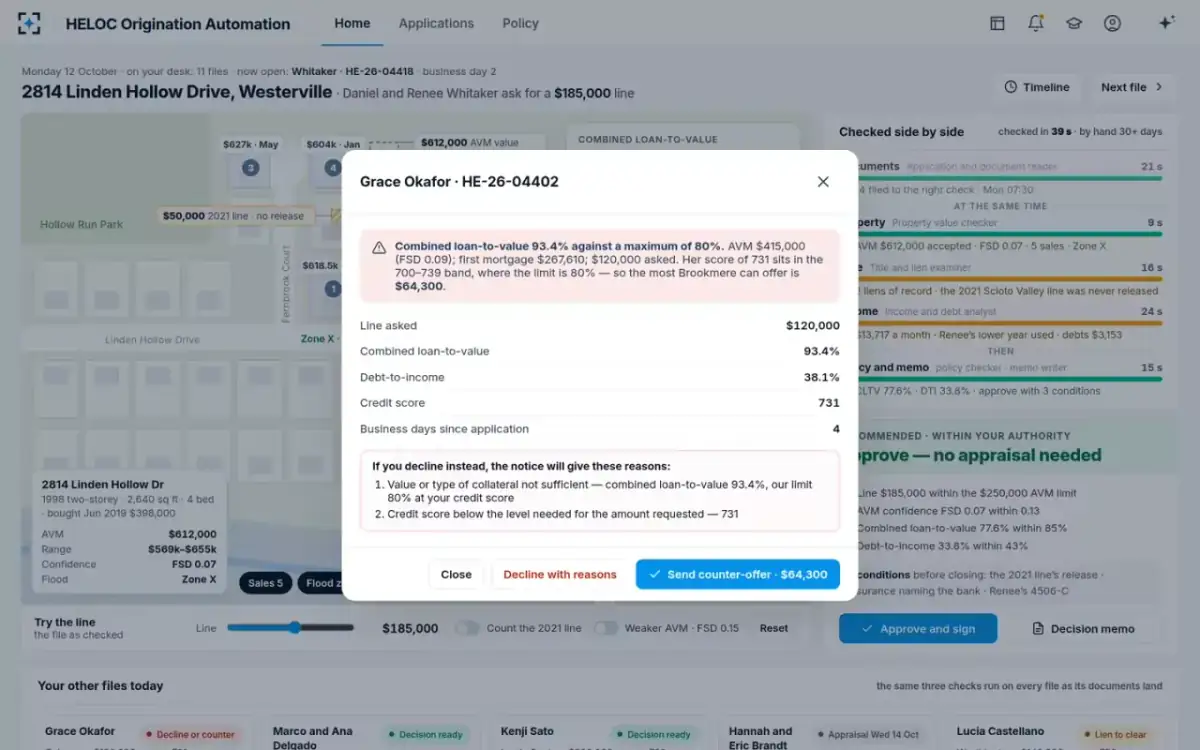
Agents that read documents make this easier, not harder, because each reason is a fact with a source rather than a model weight. In the sample bank's pipeline, Grace Okafor asked for $120,000 on a house valued at $415,000 with a $267,610 first mortgage: CLTV 93.4% against an 80% maximum at her score of 731. The decision memo writer drafts a counter-offer at $64,300, the most the policy allows, and the reasons a decline would carry: "Value or type of collateral not sufficient — combined loan-to-value 93.4%, our limit 80% at your credit score," and "Credit score below the level needed for the amount requested — 731." A person chooses which to send.
A file over the limit: the counter-offer, and the reasons a decline would give
What do regulators say about AI in lending?
No regulator has issued a rule specific to AI in home equity underwriting, and we found no statement endorsing or forbidding it. What exists is a set of general positions that an evaluator should know. The federal banking agencies' revised model risk guidance of April 2026, which replaced SR 11-7, says "Generative AI and agentic AI models are novel and rapidly evolving. As such, they are not within the scope of this guidance," and that it "does not set forth enforceable standards" (SR 26-2). It also excludes "deterministic rule-based processes" from its definition of a model.
What the main federal and agency documents say, and what they leave to the lender
What it says: Generative and agentic AI "are not within the scope of this guidance"; most relevant to banks over $30 billion; not enforceable standards.
What it means for a HELOC agent: No model-risk rulebook for agents yet; the bank's own governance applies, and an RFI on AI is planned.
What it says: Reasons for adverse action "must be specific"; a failed score is "insufficient."
What it means for a HELOC agent: Every decline needs reasons a person can state from the file, however the work was done.
What it says: Five quality-control factors for AVMs used in credit decisions, including line limit changes.
What it means for a HELOC agent: The valuation agent's model order, confidence limits and testing are in scope.
What it says: Sellers using AI/ML in originating loans sold to Fannie Mae need policies with an owner, reviewed "at least annually," and must govern vendor AI.
What it means for a HELOC agent: Applies to loans sold to Fannie Mae; a portfolio HELOC lender that also sells first mortgages will meet it there.
What it says: Interagency guidance of 2023 in force; a replacement proposed September 11, 2026.
What it means for a HELOC agent: An AI vendor is a third party; the bank keeps responsibility for its output.
Regulators' own use of AI points the same way. The GAO found that the financial regulators using AI on data institutions submit "said they were not using AI to make decisions autonomously or relying on it as a sole source of input" (GAO-25-107197). That is not a rule for banks, but it is a fair description of what an examiner will expect to see: AI that prepares, a person who decides, and a record of both.
What happens when the documents disagree?
The agents show the disagreement and apply the lender's rule for it; they do not pick the convenient answer. Most of the useful findings on a home equity file are conflicts between two sources: the application says one income and the returns another, the credit report shows a line closed and the title report shows it open, the AVM says $612,000 and the county's 2025 assessed value says $577,000. A system that silently resolves those conflicts is making credit decisions without saying so.
On the sample file each conflict is handled by a written rule. Stated income of $5,000 a month for Renee Whitaker gives way to her returns, because the policy says documents win and declining self-employed income uses the lower year. The closed tradeline does not remove the recorded lien, because the policy counts an open lien until a release or payoff letter is in. The assessed value is shown next to the AVM but not used, because the valuation route is the AVM when its confidence clears the limit, and the 2010 guidelines expect a lender relying on tax assessments to "demonstrate that a valid correlation exists between the tax assessment data and the market value." Where no rule covers a conflict, it becomes a question for the underwriter, listed on the file.
What the agents leave to people
Everything that is a judgement, an exception or a message to the borrower. In the sample design, the underwriter decides within a $250,000 authority and every policy limit; the senior credit officer takes exceptions, lines above that authority and declines before the notice goes; the processor sends conditions and requests; and what-ifs, such as counting an unreleased lien or trying a weaker AVM, are never saved to the file.
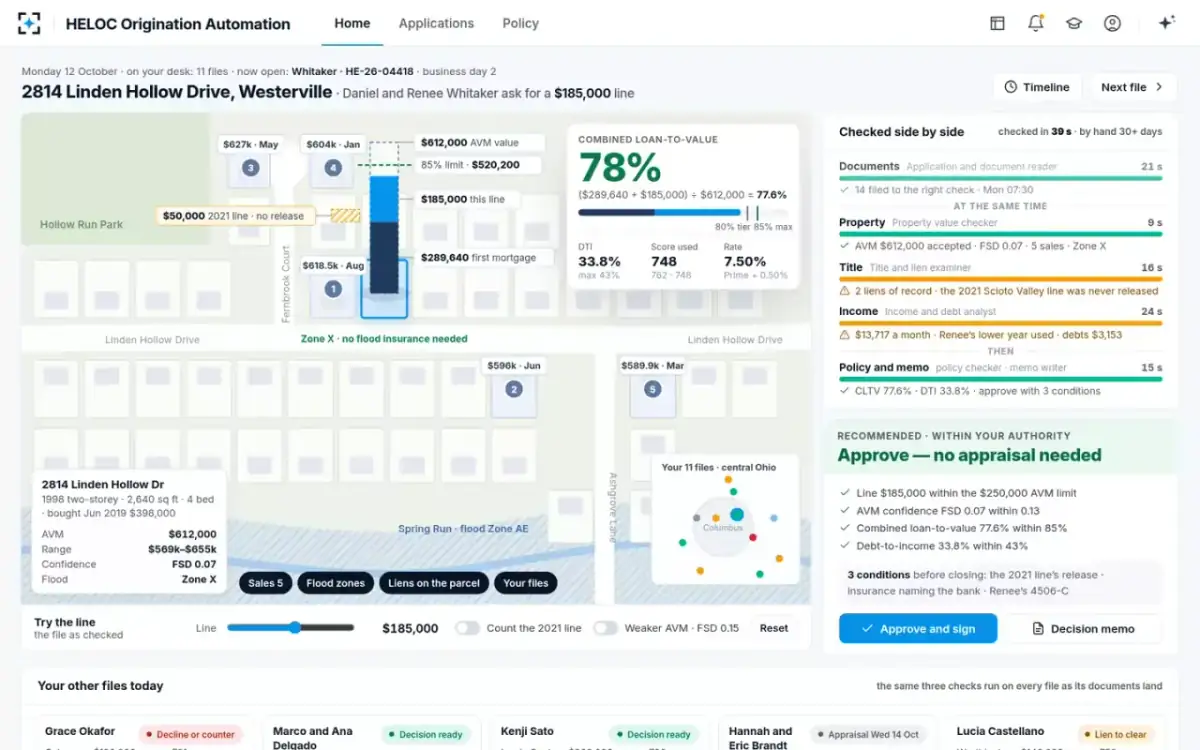
The split shows on the sample file. The agents found the three questions in 39 seconds of checking: the property value checker in 9, the title and lien examiner in 16, the income and debt analyst in 24, then the policy check and memo in 15. They did not decide whether to approve with the 2021 line's release as a condition or counter at $180,500; that was the underwriter's call, made with both numbers in front of her.
The checks, side by side; the recommendation, waiting for a person
What should you ask an AI HELOC solutions vendor?
Ask for the limits in writing and a way to test them. A vendor of AI HELOC solutions should be able to show which steps its software takes, which it never takes, and what happens when the evidence conflicts. The questions below are the ones a credit officer and a second-line reviewer can answer from a demonstration on the lender's own files.
Questions for an evaluation of AI HELOC underwriting
- Who decides?
Can any component approve, decline or grant an exception without a person? Where is the signature, and what does it record?
- What does each agent refuse to do?
Ask for the limits as a list and for a test file that tries to break each one: a second AVM, an unreleased lien, stated income above the return.
- Can every figure be traced?
Each CLTV, income and debt number should open the page and line it came from.
- Whose policy is it?
Are CLTV, DTI, qualifying payment, valuation routes and authority the lender's settings, versioned and approved by credit?
- How are decline reasons written?
Specific principal reasons from the file, drafted for a person to send, never a score or "internal criteria".
- What does the vendor disclose?
Models used, purpose, safeguards and testing, in a form the lender can show an examiner or, for loans it sells, Fannie Mae.
The testing does not need to wait for production. Before go-live, a lender can run a set of its own closed files with known answers through the agents and compare the findings, then run new applications in parallel with its current process; the ten-week go-live plan lays out both steps. For the valuation agent, the AVM quality control standards final rule adds its own testing expectations. To see the agents on your own files, start from HELOC Origination Automation.
Questions people ask
Is AI HELOC underwriting legal?
Yes. No federal rule forbids using AI to prepare or make a credit decision, but the same rules apply as to any decision: Regulation B's specific reasons and fair lending law, Regulation Z's open-end rules, the appraisal and AVM rules, and the 2005 guidance's expectations on income, valuation and exceptions.
Does model risk management guidance cover AI agents?
Not the April 2026 revision. It states that generative and agentic AI "are not within the scope of this guidance" and excludes deterministic rule-based processes from its definition of a model. The agencies plan a request for information on AI; until then, a bank's own governance and third-party risk management apply.
Can an AI agent send an adverse action notice?
Software can deliver a notice, but in this design it never does on its own: the decision memo writer drafts the reasons and a person decides and sends. Regulation B requires notice within 30 days of a completed application, with specific principal reasons, whoever prepares it.
Does Fannie Mae's AI lender letter apply to HELOCs?
LL-2026-04 applies to AI/ML used "in connection with the origination of loans sold to or guaranteed by Fannie Mae." A HELOC held in portfolio is generally outside it, but a lender that sells first mortgages to Fannie Mae and uses the same AI across both will need the policies, owner and vendor governance the letter requires.
What data does an AI HELOC underwriter need?
The same file an underwriter reads: the application, paystubs, W-2s and returns, the first-mortgage statement, the insurance declarations page, the title report, the credit report, the valuation and the flood determination, plus the lender's policy and pricing grid.