An automated HELOC is a home equity line whose decision is produced, wholly or partly, by software rather than by an underwriter working the file by hand. Lenders build it in three ways: score-only automation, which approves on a credit score, an AVM and the application; a rules engine, which applies the credit policy to structured data; and document-reading agents, which assemble and test the evidence and draft a decision for a person to sign. The three are not equally safe. The 2005 interagency guidance says repayment capacity should rest on income and debt "and not just a credit score," and the risks that sink home equity files sit in documents a score never reads. Botminds' HELOC Origination Automation takes the third approach: six agents check value, title and income side by side, and the home equity underwriter decides.
The fairest comparison is one file run three ways. The file below is fictional, from a sample bank, Brookmere Bank: Daniel and Renee Whitaker ask for a $185,000 line on a house in Westerville, Ohio. It is an ordinary file with three ordinary problems, which is the point.
Three of the file's problems, and how many each design finds
What is an automated HELOC?
It is a home equity line decided with software doing some or all of the work between a complete application and a signed decision. The MBA's 2025 study names it as the industry's plan: with "just 50 percent of home equity applications ... closing, and turn times ... averaging 39 days," lenders said "automated valuations and decisioning, integrations with mortgage platforms, and accessible self-service options are a few ways lenders intend to increase efficiency and reduce costs" (MBA, July 2025).
What gets automated varies more than the label suggests. Valuation is the most automated step already, with 47% of 2024 home equity originations in the MBA study using an AVM. Decisioning ranges from a score cut-off to a full policy test. The differences that matter are what evidence the software reads and who signs.
The sample file: what each source says
| Question | What the application or credit report says | What the documents say |
|---|---|---|
| Value | AVM $612,000, confidence FSD 0.07 | Same; five sales in the subdivision support it |
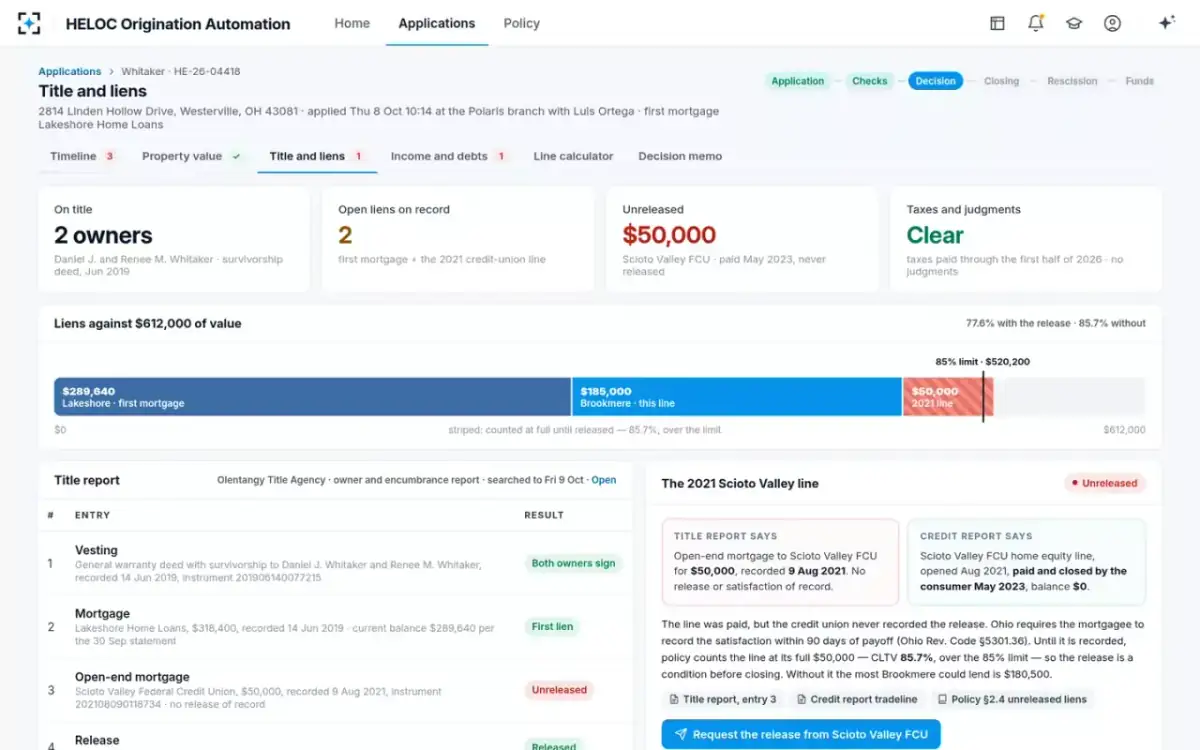
| Liens | First mortgage $289,640; 2021 credit-union line paid and closed, $0 | Title shows the 2021 $50,000 open-end mortgage with no release of record |
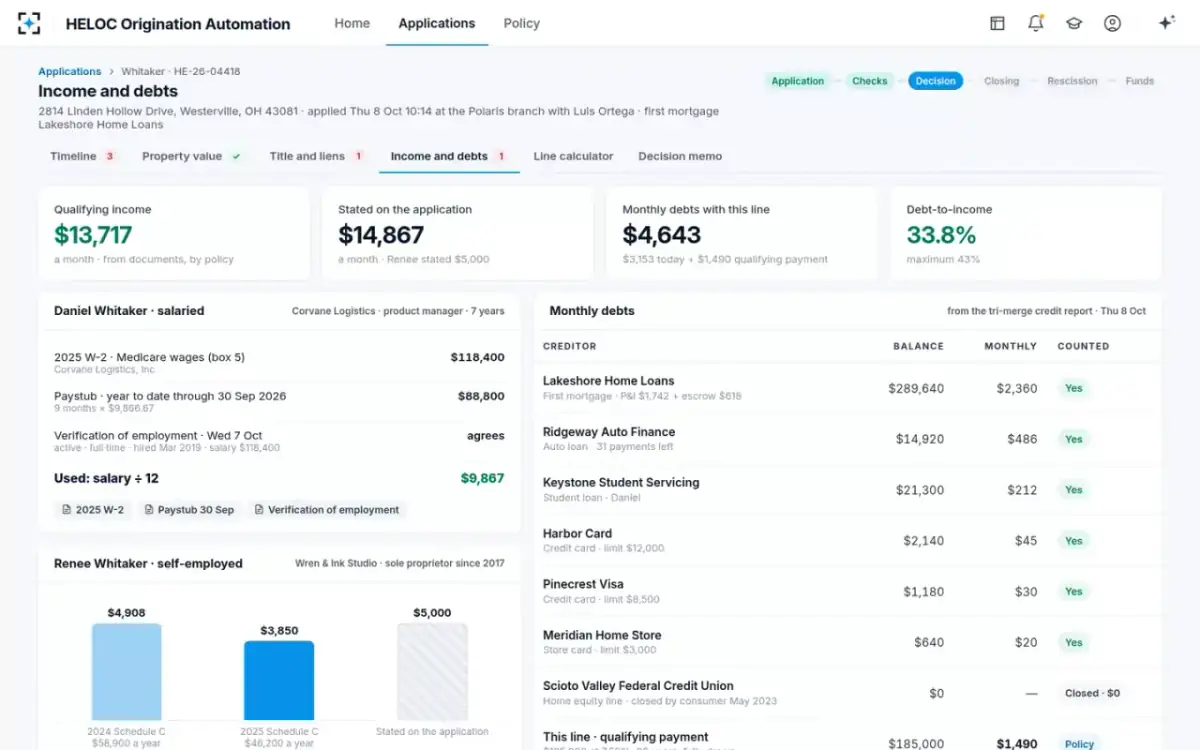
| Income | Stated $14,867 a month, of which Renee $5,000 | Renee's Schedule C: $58,900 in 2024, $46,200 in 2025; policy uses $3,850 a month; total $13,717 |
| Score | 762 and 748 | Same; the policy uses the lower middle score, 748 |
| Flood | Not on the credit report | Determination: Zone X, no insurance required |
| CLTV | 77.6% from credit-report liens | 77.6% if released; 85.7% if the 2021 line is counted, over the 85% limit |
Is score-only HELOC approval allowed?
No rule bans it by name, but it fails the standard the agencies set. The 2005 guidance says that "given the home-equity products' long-term nature and the large credit amount typically extended to a consumer, an evaluation of repayment capacity should consider a borrower's income and debt levels and not just a credit score," because "a significant change in a borrower's income or debt levels can adversely alter the borrower's ability to pay" (2005 home equity guidance). It also lists "limited or no documentation" and "lower credit-risk scores" among the practices that drew scrutiny.
On the sample file, score-only automation approves $185,000 and finds nothing. The score is 748, above any cut-off a HELOC program would set. The AVM is solid. The credit report shows the 2021 line closed with a $0 balance, so the computed CLTV is 77.6%. Income is the stated figure. Every input is true; the decision rests on two of them that are incomplete.
Score-only automation also struggles at the other end. When it declines, Regulation B says reasons that the applicant "failed to achieve a qualifying score on the creditor's credit scoring system are insufficient" (12 CFR 1002.9(b)(2)); the reasons must name what in the file drove the outcome. The market has meanwhile moved to borrowers for whom a score says little: since 2010, the New York Fed found, HELOC originations have been "overwhelmingly skewed toward high-score borrowers," with few lines going to anyone below 760 (Liberty Street Economics). When almost every applicant scores well, the score stops separating good files from bad.
What does a rules engine miss on a HELOC file?
Whatever is not in its data. A rules engine applies the credit policy precisely to the fields it is given: score bands, CLTV limits, DTI caps, documentation triggers. On the sample file a well-built engine catches the transcript requirement, because the application flags self-employment and the policy requires a signed IRS Form 4506-C when income comes from a return. That is one of three.
It misses the other two for the same reason. The unreleased lien is in the title report, a document, and the credit report it does read shows the account closed; tax liens and judgments are no longer on the nationwide credit reports at all (CFPB, 2019). The income decline is in two years of Schedule C; unless a person has keyed both years into the engine's fields, the engine computes DTI from the stated $5,000. Rules are only as complete as their inputs, and in home equity lending the decisive inputs arrive as PDFs.
Score-only, rules engine, agents: what each design reads and who decides
Score-only or rules engine: Score, AVM value, application fields, credit tradelines; rules add whatever fields someone keys in.
Agents that read the documents: Every document: application, paystubs, W-2s, returns, mortgage statement, title report, credit report, AVM, flood determination.
Score-only or rules engine: Invisible: the credit report shows the line closed at $0.
Agents that read the documents: Found by matching each recorded lien to a tradeline; counted until a release or payoff letter is in.
Score-only or rules engine: Missed unless both years are keyed; stated income used.
Agents that read the documents: Read from both returns; the lower year applied when income declines, as policy says.
Score-only or rules engine: Often the first-month payment, or interest only on the draw.
Agents that read the documents: The full line amortised at the fully indexed rate, per policy.
Score-only or rules engine: Score bands or rule codes, which need translating into specific reasons.
Agents that read the documents: Specific reasons drafted from the file, each linked to its document, for a person to send.
Score-only or rules engine: The software, within its cut-offs; people review exceptions.
Agents that read the documents: The underwriter, within authority; the agents never approve, decline or grant an exception.
What agents add: the documents, read and matched
Agents close the gap between the evidence and the rules by reading the documents the rules need. In HELOC Origination Automation the application and document reader files the 14 documents to the checks that need them; the property value checker, the title and lien examiner and the income and debt analyst then run side by side. On the sample file they finished in 9, 16 and 24 seconds, and the policy check and memo took 15 more.
All three problems surface. The title and lien examiner shows the 2021 open-end mortgage of record next to the credit report's closed line, and counts it until the release is in, which puts CLTV at 85.7% against an 85% limit. The income and debt analyst reads Renee's two returns, takes the lower year, and computes qualifying income of $13,717 a month instead of $14,867. The credit policy checker adds the 4506-C condition. The decision memo writer recommends approval of $185,000 with three conditions, or a counter at $180,500 if the lien cannot be released, and stops there.
The income the application stated, and the income the returns support
Can a HELOC be approved automatically?
Technically yes; the question is whether it should be, and for which files. A program could approve automatically when every check passes with documents behind it and the line is small, and route everything else to a person. HELOC Origination Automation does not do that by design: even a clean file waits for the underwriter's signature, because the lender's authority table, not the software, says who may approve. The design target is a signed decision within two days of a complete application, so the wait for a person is short.
There are reasons beyond caution. The revised model risk guidance of April 2026 places "generative AI and agentic AI models" outside its scope (SR 26-2), so a lender cannot point to it as the framework for an AI that decides; it has its own governance to write. A person who signs within written authority is a control every examiner already knows how to test. What each agent may check and never decide lists the limits that keep the decision there.
What should an automated HELOC decision check?
Everything the 2005 guidance names, from evidence rather than from the application. A useful test of any automated design is to run a file with each of the following problems and see whether the software finds it, and from which document.
Checks an automated HELOC decision should make from documents
- Value, by the lender's route
AVM, inspection or appraisal chosen by line size and model confidence; one model order; no second value replacing a lower one.
- Every senior lien
Recorded liens from the title report matched to tradelines; tax liens, judgments, mechanic's liens and assessments included.
- Income from documents
Salaried income confirmed across W-2, paystub and employer; self-employed income from returns, with declines handled by policy.
- The qualifying payment
The full line, amortised, at the fully indexed rate, as the 2005 guidance expects.
- Policy limits by score band
CLTV over all senior liens, DTI, pricing tier, authority; exceptions routed, not granted.
- Flood and disclosures
The flood determination and any notice; the home equity disclosures and brochure given at application.
- Reasons a person can send
Specific principal reasons for any adverse action, drafted from the file within Regulation B's 30 days.
How do lenders automate HELOC decisions?
Mostly in layers: valuation first, then data pulls, then decision rules, with document work last because it is hardest. The MBA's respondents named automated valuations and decisioning as their main levers. Research on first mortgages suggests the speed is real and need not cost credit quality: FinTech lenders, which take applications end to end online, "reduce processing time by about 10 days, or 20% of the average processing time," and the faster processing did "not result in riskier loans" (Fuster, Plosser, Schnabl and Vickery, NBER Working Paper 24500). That study covered mortgages, not home equity lines, and measured speed, not which checks were made.
The layer that decides whether automation is safe is the one most programs skip: reading the title report and the returns. A program that automates valuation and a score cut-off gets faster at approving the files it would have approved anyway, and no better at finding the ones it should not. The HELOC underwriting guidelines set out each check against its source.
The lien that only the title report shows
Where each approach fits, honestly
Score-only automation has a place before an application: a prequalification or a marketing screen that tells a customer roughly what they might borrow, with the full checks to follow. Rules engines are the right tool for applying a policy precisely once the data is clean, and the agents in HELOC Origination Automation apply the lender's policy as rules once the evidence is assembled. Neither substitutes for reading the file.
Agents are not free of limits either. They depend on the documents being there: a missing return becomes a request, not a guess. They need the lender's policy written as settings, which takes work the first time. And they are no faster than the slowest outside party, which is often the title company or a lienholder's release desk; how long a HELOC takes to approve follows those waits. To run the comparison on your own files, start from HELOC Origination Automation.
Questions people ask
What is automated HELOC underwriting?
Software doing some or all of the checks between a complete application and a decision on a home equity line: valuation, liens, income, debts and the policy test. Designs range from a score and AVM cut-off to agents that read every document and draft a decision for a person to sign.
Are instant HELOC approvals real?
A conditional answer can be fast when the decision rests on a score, an AVM and stated data, but the checks that need documents, such as the title search, income verification and flood determination, still have to happen before closing. Rescission adds three business days after the line is opened, which no automation removes.
Does a HELOC need a manual underwriter?
No federal rule requires a person to approve a HELOC, but the lender must be able to explain each decision, track exceptions and give specific reasons for declines. Most lenders keep approval with people who have written authority; in HELOC Origination Automation, agents prepare and a person decides.
Can automation catch an unreleased lien?
Only if it reads the title report. The credit report shows a paid-off line as closed with a $0 balance even when the lien is still recorded, and tax liens and judgments have been off the nationwide credit reports since 2018. Matching recorded liens to tradelines is a document task.
Do automated valuations count as an automated decision?
No. An AVM supplies a value, which a lender uses in its decision under its valuation policy and the AVM quality control rule. In the MBA's 2024 data, 47% of home equity originations used an AVM; the decision still rests on the lender's policy and whoever applies it.