HELOC underwriting guidelines are the rules a lender uses to decide whether to open a home equity line of credit and for how much. For banks and credit unions the federal anchor is the 2005 interagency Credit Risk Management Guidance for Home Equity Lending, which the OCC says "continues to apply": it expects a lender to weigh income and debt "and not just a credit score", to qualify the borrower on the fully drawn line, and to account for the valuation method and lien position. There is no federal maximum CLTV, minimum score or DTI for a HELOC, so each lender writes its own grid. Botminds' HELOC Origination Automation checks every application against that grid, with value, title and income read side by side, and leaves the decision with the home equity underwriter.
The guidance is short and principle-based, which is why lenders write so much on top of it. What follows reads it line by line, with the Regulation Z rules for open-end plans that sit beside it. Where an example helps, it uses one file from a fictional sample bank as it runs through the solution: Brookmere Bank, and Daniel and Renee Whitaker, who ask for a $185,000 line on a house in Westerville, Ohio.
Six lines of the 2005 guidance, and the HELOC policy setting each one becomes
The guidance says"a borrower’s income and debt levels and not just a credit score"
The setting it becomesQualifying income from documents; every debt from the credit report; a maximum debt-to-income
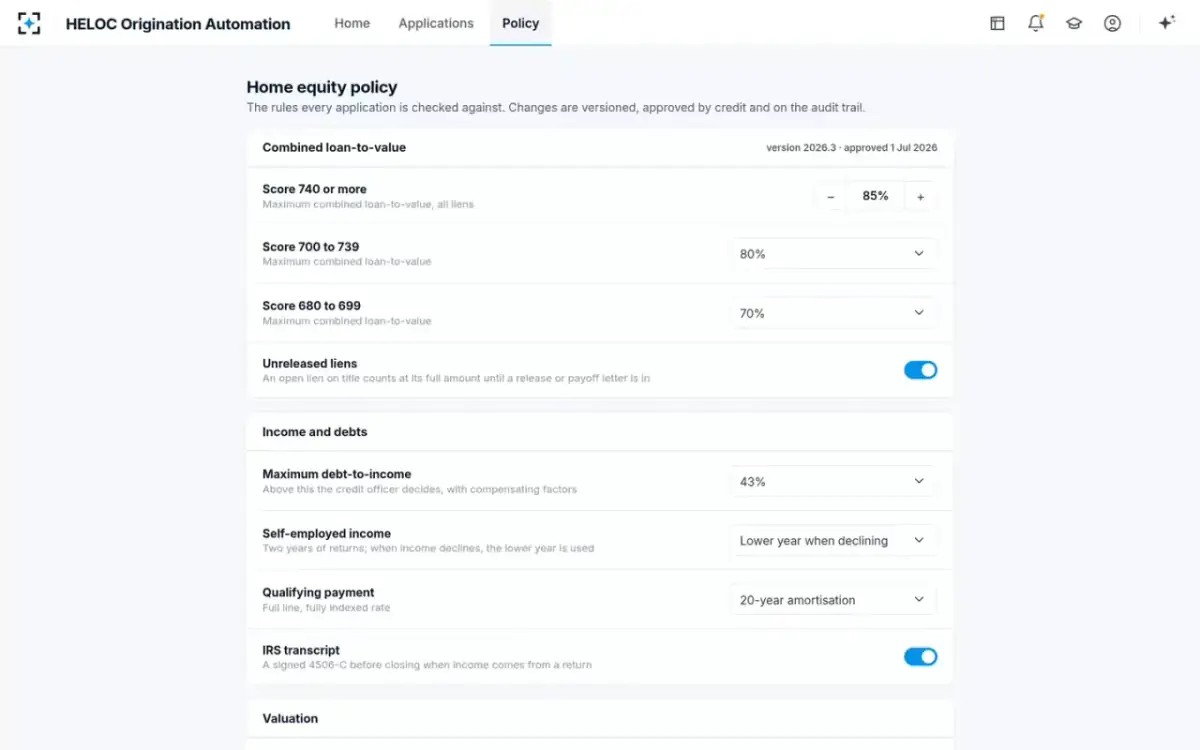
Sample bank's valueDTI ≤ 43%; above it, the credit officer decides with compensating factors
The guidance says"ability to amortize the fully drawn line over the loan term and to absorb potential increases in interest rates"
The setting it becomesQualifying payment on the full line, at the fully indexed rate, amortised
Sample bank's value20-year amortisation; alternatives 15-year, or interest only + 1%
The guidance says"collateral value (including valuation methodology)"
The setting it becomesValuation route by line size and model confidence
Sample bank's valueAVM to $250,000 at FSD ≤ 0.13; exterior inspection to $400,000; appraisal above
The guidance says"lien position"
The setting it becomesCombined loan-to-value over every senior lien, unreleased liens counted in full
Sample bank's valueCLTV 85% at a score of 740+, 80% at 700–739, 70% at 680–699
The guidance says"preclude ‘value shopping’"
The setting it becomesA fixed order of valuation models; a second value may not replace a lower one
Sample bank's valueOne AVM per file, cascade order 1 of 3
The guidance says"identifying, approving, tracking, and analyzing underwriting exceptions"
The setting it becomesApproval authority and an exception route that names the limit broken
Sample bank's valueUnderwriter signs to $250,000 within policy; exceptions to the senior credit officer
What are HELOC underwriting guidelines, and who writes them?
HELOC underwriting guidelines are written by each lender, inside a frame the regulators set. The frame has three parts: the 2005 interagency guidance on home equity lending, the agencies' real estate lending standards, and Regulation Z's rules for home equity plans. None of them sets a number a lender can copy into a policy. Fannie Mae's and Freddie Mac's guides, which supply most of the numbers in first-mortgage lending, deal with a HELOC mainly when it sits behind a first mortgage they buy, so their grids do not decide a portfolio line either.
The guidance was written because the product had outgrown its controls. Issuing it in May 2005, the agencies said that "credit risk management practices have not kept pace with the product's growth and the increased risk due to relaxed structures and liberalized underwriting" (OCC Bulletin 2005-22). The OCC's page for the bulletin still says the guidance "continues to apply". The growth has come back: outstanding HELOC balances rose for a 17th straight quarter to $459 billion in mid-2026, according to the New York Fed.
The practical consequence is that a home equity policy is the lender's own document, approved by its board. The guidance says the agencies' real estate lending standards require that "an institution's board of directors review and approve these policies at least annually", and that management assess "the potential effect on the institution's overall risk profile" before changing them. An examiner reads the lender's grid against the guidance, then reads the files against the grid.
Today's HELOC borrower: high scores, low leverage
771
average FICO score on HELOCs in 2024, up from 760
51%
average combined loan-to-value of funded HELOCs at closing, 2024
80%
the combined cap on first mortgage plus HELOC limit that is "typical", per the New York Fed
$459B
outstanding HELOC balances, second quarter 2026
Income and debt, "and not just a credit score"
The guidance's central underwriting sentence is about capacity, not credit history. "Given the home-equity products' long-term nature and the large credit amount typically extended to a consumer, an evaluation of repayment capacity should consider a borrower's income and debt levels and not just a credit score," it says (2005 guidance). It explains why: credit scores describe the past, and "a significant change in a borrower's income or debt levels can adversely alter the borrower's ability to pay."
That sentence rules out one design choice outright: a HELOC program that decides on score and value alone. It does not say how much verification each file needs. "How much verification these underwriting factors require will depend upon the individual loan's credit risk," the guidance adds, which is the opening most lenders use to tier documentation by line size or CLTV. A $25,000 line at 40% CLTV and a $250,000 line at 85% CLTV can sensibly carry different paperwork.
What the guidance does insist on is that whatever is verified is used. In the sample file, Renee Whitaker stated $5,000 a month of self-employed income. Her Schedule C showed $58,900 in 2024 and $46,200 in 2025, a fall of 21.6%, so the bank's policy takes the lower year, $3,850 a month. Qualifying income drops from $14,867 stated to $13,717 documented, and the debt-to-income ratio is computed on the documented figure.
What DTI is required for a HELOC?
No federal rule sets a maximum debt-to-income ratio for a HELOC; the lender sets it in policy. The Regulation Z ability-to-repay rule, which made DTI part of qualified-mortgage analysis for closed-end loans, does not reach home equity lines: it applies to dwelling-secured credit "other than: (1) A home equity line of credit subject to § 1026.40" (12 CFR 1026.43(a)). A home equity line is underwritten to the lender's policy and the 2005 guidance, not to the QM rule.
There is one exception. A HELOC priced high enough to be a high-cost mortgage under HOEPA must meet a repayment-ability test of its own, with income verified "by the consumer's Internal Revenue Service Form W-2, tax returns, payroll receipts, financial institution records, or other third-party documents" (12 CFR 1026.34(a)(4)). For a subordinate lien the HOEPA rate trigger is an APR more than 8.5 percentage points above the average prime offer rate, a threshold ordinary prime-based lines rarely approach.
Within those bounds, lenders choose. The sample bank's policy caps DTI at 43%, and a file above it goes to the senior credit officer with compensating factors rather than being declined by rule. The number itself matters less than how it is computed, which turns on the payment the HELOC is assumed to carry.
How is a HELOC payment calculated for DTI?
The qualifying payment is the monthly payment the lender assumes for the new line when it computes DTI, and the guidance tells the lender to assume the worst realistic case. For interest-only and variable-rate lines, underwriting "should include an assessment of the borrower's ability to amortize the fully drawn line over the loan term and to absorb potential increases in interest rates." The borrower's first bill, on a small drawn balance during an interest-only draw period, is not the qualifying payment.
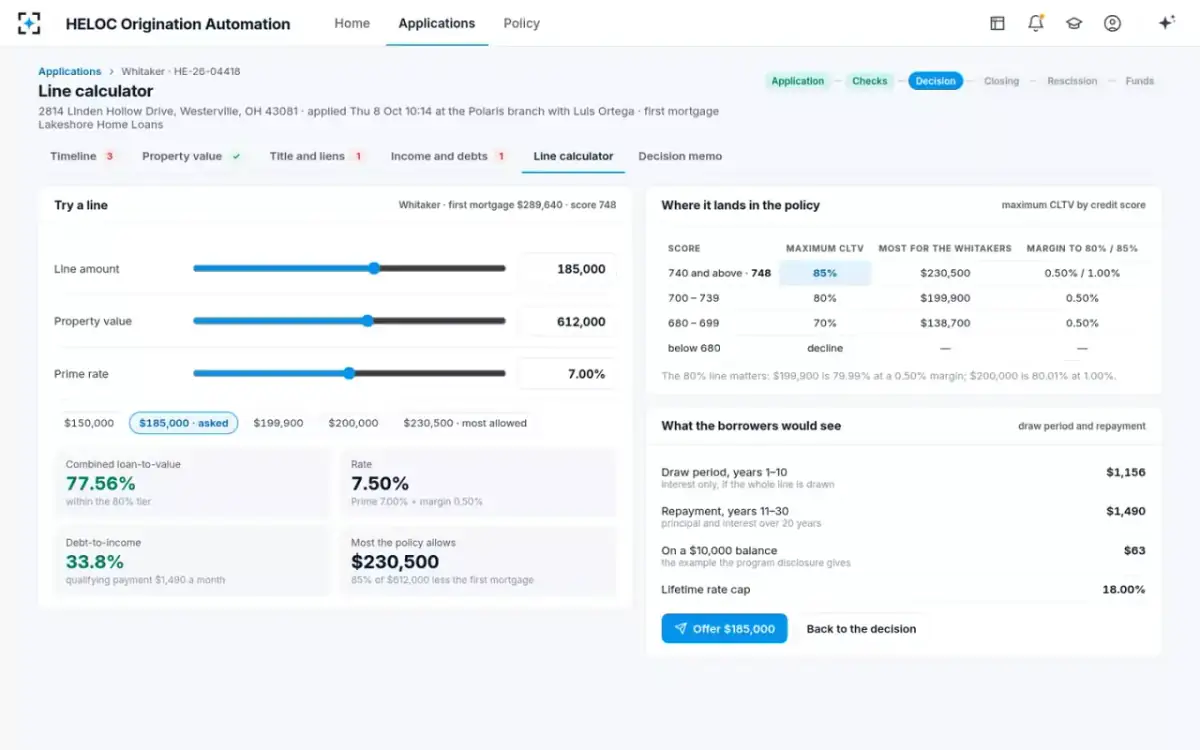
The choice has a large effect. On the sample file the same $185,000 line produces DTIs from 31.4% to 43.8% depending on the assumption, and only the first three methods below pass the sample bank's 43% limit. The HOEPA row shows how far a conservative reading can go: its presumption of compliance for high-cost lines assumes the consumer "borrows the full credit line at account opening" and that the maximum APR in the contract applies.
One $185,000 line, four qualifying payments, four DTIs
| Assumption | Monthly payment | DTI |
|---|---|---|
| Interest only on the full line at 7.50% | $1,156 | 31.4% |
| Full line amortised over 20 years at 7.50% (the sample policy) | $1,490 | 33.8% |
| Full line amortised over 15 years at 7.50% | $1,715 | 35.5% |
| Full line amortised over 20 years at the 18% contract cap (the HOEPA presumption’s assumption) | $2,855 | 43.8% |
Lenders that buy or originate first mortgages meet the same question from the other side. When a first mortgage sold to Fannie Mae sits behind a HELOC "that provides for a monthly payment of principal and interest or interest only, the payment on the HELOC must be considered as part of the borrower's recurring monthly debt obligations" (Selling Guide B3-6-05). That rule is about the first mortgage's DTI, not about approving the line, which is why it is no substitute for a home equity policy.
The qualifying payment and the policy grid, worked live on one file
What is the max CLTV for a HELOC?
There is no regulatory maximum CLTV for a HELOC; the lender sets the limit, often by credit-score band. The New York Fed describes the combined cap as "typically 80 percent" of home value (Liberty Street Economics), and the average funded HELOC in the MBA's 2024 study closed at 51% CLTV. The supervisory line that does exist sits at 90%.
That line comes from the real estate lending standards, restated in the 2005 guidance. A loan on an owner-occupied one-to-four family home is reported as an exception "if the combined LTV of a loan and all senior liens ... equals or exceeds 90 percent and if there is no additional credit enhancement in the form of either mortgage insurance or readily marketable collateral." The aggregate of those high-LTV loans "should not exceed 100 percent of the institution's total capital," and is reported quarterly to the board. Two words in the guidance decide how the ratio is computed: "all senior liens" in the numerator, and a loan amount that is "the legally binding commitment", the whole line, drawn or not.
Fannie Mae's definition reaches the same place for a different purpose. Its home equity combined LTV, used when a first mortgage sits behind a line, counts "the full amount of any HELOCs (whether or not funds have been drawn)" (Selling Guide B2-1.2-03). A HELOC grid computed on the drawn balance understates leverage on exactly the files where the borrower draws the line down later. The lien a credit report does not show is the other way the numerator goes wrong.
What credit score do you need for a HELOC?
No federal rule sets a minimum credit score for a HELOC, and the guidance treats the score as one factor among several, "credit score (if obtained)". In practice the market has moved far above any floor. Since 2010, the New York Fed found, "HELOC originations have been overwhelmingly skewed toward high-score borrowers, with only a small share of newly open credit lines going to borrowers with credit scores below 760." The MBA's study put the average HELOC score at 771 in 2024.
Where a score does enter a policy, it usually sets the CLTV ceiling rather than a yes or no. The sample bank allows 85% at 740 and above, 80% from 700 to 739, 70% from 680 to 699, and declines below 680. Joint applicants raise a second question, which score counts: the sample policy uses the lower of the two borrowers' middle scores, so the Whitakers' 762 and 748 become 748. Whatever the grid, a decline needs reasons that say more than the number. Regulation B states that saying an applicant "failed to achieve a qualifying score on the creditor's credit scoring system" is "insufficient" as a reason (12 CFR 1002.9(b)(2)).
Valuation method and lien position are underwriting factors, not paperwork
The guidance lists "collateral value (including valuation methodology), lien position, and property type and location" among the factors a lender should weigh, alongside income and credit. That puts the choice of an AVM, a desktop or a full appraisal inside underwriting, with rules of its own: lenders should "establish criteria for determining the appropriate valuation methodology for a particular transaction based on the risk in the transaction," and "preclude 'value shopping'". If several AVMs are run on one property, "the institution should adhere to a policy for selecting the most reliable method, rather than the highest value."
Lien position is treated the same way. Under "Lien recording," the guidance tells lenders to "verify the amount and priority of any senior liens prior to closing the loan," and defines senior liens broadly: "first mortgages, outstanding liens for unpaid taxes, outstanding mechanic's liens, and recorded judgments on the borrower." Whether a HELOC needs an appraisal follows the valuation half of this through the federal thresholds.
If several different valuation tools or AVMs are used for the same property, the institution should adhere to a policy for selecting the most reliable method, rather than the highest value.
Interagency Credit Risk Management Guidance for Home Equity Lending, 2005
Does TRID apply to HELOCs? The disclosures that apply instead
No. TRID's Loan Estimate and Closing Disclosure cover closed-end credit: the Loan Estimate rule applies "in a closed-end consumer credit transaction secured by real property" (12 CFR 1026.19(e)(1)(i)). A HELOC follows the home equity plan rules in 12 CFR 1026.40, and the two regimes run on different clocks.
A closed-end home equity loan and a HELOC answer to different disclosure rules
Closed-end home equity loan: Loan Estimate within three business days of application; Closing Disclosure received three business days before consummation (TRID).
Home equity line of credit: Program disclosures and the brochure "What You Should Know About Home Equity Lines of Credit" when the application is provided (1026.40(b), (e)).
Closed-end home equity loan: Same three-business-day Loan Estimate rule.
Home equity line of credit: Disclosures and brochure may be mailed "not later than three business days following receipt" of the application.
Closed-end home equity loan: Only a reasonable credit-report fee before the Loan Estimate.
Home equity line of credit: No nonrefundable fee "until three business days after the consumer receives the disclosures and brochure" (1026.40(h)).
Closed-end home equity loan: Tolerance rules and revised Loan Estimates.
Home equity line of credit: If a disclosed term changes and the consumer does not open the plan, all fees are refunded (1026.40(g)).
Closed-end home equity loan: Regulation Z ability-to-repay and qualified mortgage rules.
Home equity line of credit: Excluded from 1026.43; the 2005 guidance and the lender's policy govern, plus HOEPA if high-cost.
Closed-end home equity loan: Three business days on a principal dwelling, except purchase money.
Home equity line of credit: Three business days at opening and at any limit increase, not on ordinary draws (1026.15).
The 1026.40 rules shape underwriting more than they look. A lender may not, "by contract or otherwise," change the APR except on an index outside its control, and may freeze or reduce the line only in listed cases, such as when "the value of the dwelling that secures the plan declines significantly below the dwelling's appraised value for purposes of the plan." The value set at origination becomes the baseline for every later freeze decision, which is one more reason to choose it by policy rather than by preference.
Exceptions, authority and a policy the file can be tested against
The guidance expects lenders to manage exceptions as data: "a process for identifying, approving, tracking, and analyzing underwriting exceptions," reported "both by transaction and by relevant portfolio segments." It also expects HLTV loans to be "identified in the institution's records" and aggregated for the board. Both are hard to do from a policy written as prose and a decision recorded as a signature.
The fix is to write the policy as settings, each with an owner and a version, and to test every file against the version in force on the day. That is how HELOC Origination Automation works: the bank's credit officers set the CLTV grid, DTI, income rules, qualifying payment, valuation routes and authority, every change is versioned and approved, and the credit policy checker tests each file against them. It never grants an exception; an exception routes to the senior credit officer with the limit it breaks. How the same file fares under score-only automation, rules and agents shows what each design catches.
The home equity policy as settings, versioned and approved by credit
The solution's job ends where judgement begins. The agents read the application, the AVM, the title report, the returns and the credit report, compute CLTV and DTI by the bank's rules, and draft a memo with each reason linked to its document; the underwriter decides and signs within authority. To see it on a sample of your own files, start from HELOC Origination Automation.
Questions people ask
Is the 2005 home equity guidance still in effect?
Yes. The OCC's page for Bulletin 2005-22 says the guidance "continues to apply," and we found no rescission by the other agencies that issued it. It is supervisory guidance rather than a regulation, so it is applied through examinations of a lender's policies and files.
Do Fannie Mae or Freddie Mac set HELOC underwriting guidelines?
Not for a line a bank holds in its own portfolio: its own policy, written within the 2005 guidance, governs. The guides matter when a HELOC sits behind a first mortgage sold to the agencies, where Fannie Mae counts the full credit line in its home equity combined LTV and the HELOC payment in DTI.
Does the ability-to-repay rule apply to a HELOC?
No. Regulation Z's ability-to-repay and qualified mortgage section, 12 CFR 1026.43, excludes "a home equity line of credit subject to § 1026.40." A HELOC that meets HOEPA's high-cost triggers has its own repayment-ability test under 1026.34(a)(4), which assumes the full line is drawn at the contract's maximum rate.
Can a HELOC be approved on stated income?
The guidance does not forbid it outright, but it names "limited or no documentation of a borrower's assets, employment, and income" among the risk factors that "attracted scrutiny" in 2005, and it says verification should rise with each loan's credit risk. A high-cost HELOC under HOEPA must verify relied-on income with third-party records.
Which two HELOC disclosures must be provided at application?
The program disclosures required by 12 CFR 1026.40(d) and the CFPB brochure "What You Should Know About Home Equity Lines of Credit," or a suitable substitute, under 1026.40(e). Both are due when the application is provided, or within three business days when the application is taken by phone, by mail or through a broker.