HELOC valuation requirements for lenders start from one question: does a HELOC require an appraisal? Usually not. For banks and savings institutions, federal rules exempt a residential transaction "that has a transaction value of $400,000 or less" from the appraisal requirement, and require an evaluation instead; credit unions need an appraisal only at $400,000 or more. An evaluation can rest on an automated valuation model (AVM), a desktop review or an exterior inspection, as long as it meets the agencies' content rules and the lender's own valuation policy. Most lines are far below the threshold, which is why fewer than a quarter of home equity originations in the MBA's 2024 study used a full appraisal. Botminds' HELOC Origination Automation applies the lender's valuation policy to every file, choosing AVM, inspection or appraisal by line amount, model confidence and CLTV.
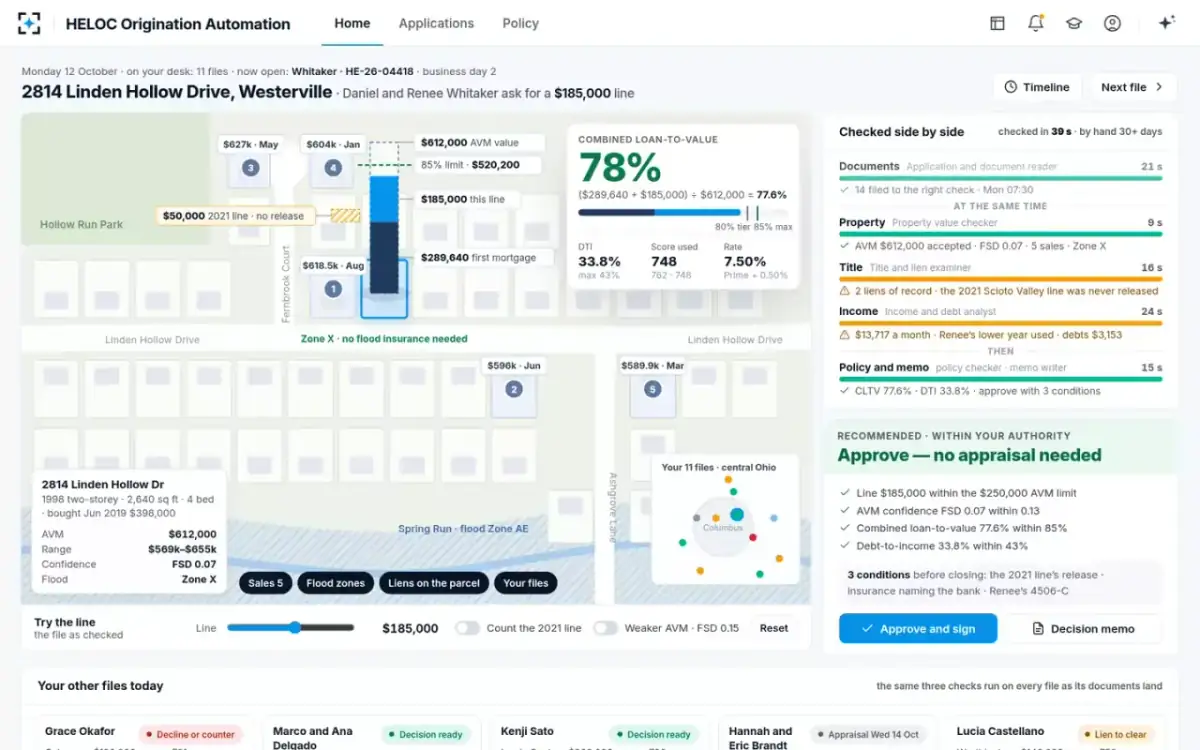
The answer still varies by lender, by line size and by the property. Below, the federal thresholds come first, then what an evaluation is, then when a model cannot carry it. One fictional sample file runs through the examples: Daniel and Renee Whitaker's $185,000 line at Brookmere Bank, valued by AVM at $612,000.
Appraisal, evaluation or AVM: what each is, who prepares it, and when a HELOC can use it
| Appraisal | Evaluation | AVM | |
|---|---|---|---|
| What it is | An opinion of market value by a state certified or licensed appraiser, under USPAP | A lender's estimate of market value that meets the agencies' content rules; not bound by USPAP | A computer model's value, with a confidence score; a tool, not an evaluation by itself |
| Who prepares it | Appraiser engaged by the lender | A competent person independent of loan production, or a tool plus that person's review | A vendor's model, chosen and validated by the lender |
| When a bank's HELOC needs it | Line above $400,000, or when the lender's policy or the risk calls for one | Line of $400,000 or less; line increases on an existing credit | Can support an evaluation below the threshold, inside the lender's AVM policy |
| Inspection | Usually interior and exterior | As the lender's policy sets: none, exterior or desktop | None |
| Share of 2024 home equity originations | 24% | 26% desktop valuations | 47% |
What is the appraisal threshold for a HELOC?
For a bank, $400,000. The OCC's rule lists the exempt cases, the first being "a residential real estate transaction that has a transaction value of $400,000 or less," and then says that for those transactions "the institution shall obtain an appropriate evaluation of real property collateral that is consistent with safe and sound banking practices" (12 CFR 34.43). The FDIC's version in 12 CFR 323.3 is word for word the same, and the Federal Reserve adopted the same threshold in the same 2019 rulemaking.
The threshold was $250,000 until 2019. Raising it, the agencies estimated, would exempt "an additional estimated 14 percent of the dollar volume," bringing the exempt share of regulated residential lending to "approximately 35 percent" (84 FR 53579). The same rule added that appraisals must be "subject to appropriate review for compliance with the Uniform Standards of Professional Appraisal Practice."
For a HELOC, the number to test is the line, not the house. The rule defines transaction value for a loan as "the amount of the loan or extension of credit" (12 CFR 34.42), and the natural reading for a line of credit, the one most home equity policies adopt, is the committed amount rather than today's draw. A $185,000 line on a $612,000 house is a $185,000 transaction.
Do credit unions and nonbank lenders follow the same rule?
Credit unions follow NCUA's Part 722, with a slightly different line. An appraisal by a state certified or licensed appraiser is required for a residential transaction where "$400,000 or more of the transaction value" is not insured or guaranteed; below that, the transaction "must be supported by a written estimate of market value" by someone "independent of the loan production and collection processes" (12 CFR 722.103). A $400,000 line exactly needs an appraisal at a credit union and not at a bank.
Nonbank lenders are outside both rules. Their valuation requirements come from their investors, their warehouse lenders or their own credit policy. One federal appraisal rule that does reach many nonbanks does not reach HELOCs at all: the higher-priced mortgage loan appraisal rule covers "a closed-end consumer credit transaction" (12 CFR 1026.35), so a home equity line, however priced, is outside it.
Which valuation a HELOC needs: five questions, in order
- 1
Is the lender a bank or savings institution, a credit union, or neither?
Banks follow the OCC, Fed and FDIC appraisal rules; credit unions follow NCUA Part 722. A nonbank lender is outside both, and its investor or its own policy decides.
- 2
Is the line amount above $400,000?
Bank: above $400,000 needs an appraisal by a certified or licensed appraiser. Credit union: $400,000 or more does.
- 3
Is it an increase on a line the lender already holds?
With no obvious and material change in the market or the property, an appraisal is not required, but an evaluation still is.
- 4
Below the threshold: can a model support the evaluation?
Only within the lender's AVM policy: a confidence minimum, a fixed order, an area and price tier where the model performs.
- 5
If not: inspect, or appraise anyway
A desktop or exterior-inspection evaluation, or a full appraisal when the property is atypical or the policy says so.
What is an evaluation vs an appraisal?
An appraisal is a regulated product: an opinion of market value by a licensed or certified appraiser, written to USPAP. An evaluation is a lender's estimate of market value that must meet the content rules in the agencies' 2010 guidelines, and it need not be prepared by an appraiser. The guidelines are specific about what it must hold: "An evaluation should contain sufficient information detailing the analysis, assumptions, and conclusions to support the credit decision" (Interagency Appraisal and Evaluation Guidelines).
At a minimum, the guidelines say, an evaluation should identify the property's location, describe the property and its use, estimate "market value in its actual physical condition, use and zoning designation as of the effective date," describe "the method(s) the institution used to confirm the property's actual physical condition and the extent to which an inspection was performed," describe the analysis and the supporting information, and name its data sources. When a person prepares it, it carries that person's name and signature.
That last list is what separates an evaluation from a number on a screen. A model's value with nothing about condition, method or sources is a data point; the same value, with the comparable sales, the confirmation of condition and the reason it was relied on, written into the file, is an evaluation.
Can a HELOC use an AVM?
Yes, inside rules the lender writes. The 2010 guidelines' Appendix B lets an AVM support an evaluation, but "an AVM or TAV is not, in and of itself, an alternative to an evaluation." Lenders should "establish internal confidence score minimums, or similar criteria, for when each model can be used," "implement controls to preclude 'value shopping' when more than one AVM is used for the same property," and keep a route to an appraisal or another method "when an AVM's resulting value is not reliable to support the credit decision."
The guidelines are blunt about confidence scores: "The scale and components of a confidence score are not standardized," so a lender must understand "the extent to which a confidence score correlates to model accuracy." Many lenders use the forecast standard deviation, a vendor's estimate of the spread around the value. Since October 1, 2025, a lender that uses an AVM in a HELOC credit decision must also meet the AVM quality control standards final rule, with its five control factors.
When an AVM should not carry a HELOC valuation
- The line is above the threshold
Above $400,000 at a bank, or $400,000 and over at a credit union, an appraisal is required whatever the model says.
- The confidence is below the lender's minimum
The guidelines require an internal minimum for each model; a value outside it moves the file to another method.
- The market has just changed
The guidelines name "the aftermath of a natural disaster or a major economic event" as a case for not relying on a model.
- The model is outside its tested range
When "a model's performance is outside of specified tolerances for a particular geographic market or property price-tier range".
- The property is atypical
A "non-homogeneous" property, "such as atypical lot sizes or property types," needs a person to look.
- A second model was run for a better number
Value shopping. The policy must pick the most reliable method, not the highest value.
How often do HELOC lenders use an AVM instead of an appraisal?
Most of the time. In the MBA's 2025 Home Equity Lending Study, "47 percent of total originations were subject to an Automated Valuation Model (AVM) and 26 percent had a Desktop Valuation (DV), with most entailing either an exterior/drive-by inspection or no inspection at all. Conversely, 24 percent of originations required a full appraisal" (MBA, July 2025). The study covers HELOCs and closed-end home equity loans together, from the lenders that took part.
Fewer than a quarter of home equity loans got a full appraisal in 2024
The reason is the size of the lines. The New York Fed found that of about 1.8 million HELOCs opened from early 2023 to mid-2024, "about 28 percent ... had limits below $50,000, with about 29 percent in the $50,000–$100,000 range and about 18 percent in the $100,000–$150,000 range; the remaining 25 percent had credit limits above $150,000," and about 1% were above $650,000 (Liberty Street Economics). The great majority of lines sit far below $400,000, where the rule asks for an evaluation and the lender decides how to build it.
Three in four new HELOCs had limits of $150,000 or less
Does a line increase need a new appraisal or valuation?
Not always an appraisal, but always a fresh look. The appraisal rule exempts a transaction that "involves an existing extension of credit at the lending institution," provided there has been "no obvious and material change in market conditions or physical aspects of the property that threatens the adequacy of the institution's real estate collateral protection after the transaction, even with the advancement of new monies." That exemption is one of those for which the rule still requires an evaluation.
The guidelines add a test for reusing an old valuation: a lender "should establish criteria for assessing whether an existing appraisal or evaluation continues to reflect the market value of the property," and a new one is needed if value has moved because of the "passage of time," market volatility, natural disasters or improvements. A limit increase also restarts the borrower's right of rescission and, in a flood zone, may need a new flood determination, which flood insurance on a HELOC works through.
The value at opening is the baseline for every later freeze
The valuation chosen at origination outlives the decision. Regulation Z lets a lender freeze or reduce a home equity line in a short list of cases, the first being when "the value of the dwelling that secures the plan declines significantly below the dwelling's appraised value for purposes of the plan" (12 CFR 1026.40(f)(3)(vi)(A)). The value in the file at opening is the reference point for that test for the life of the line, one of several open-end rules set out in HELOC underwriting guidelines.
That is a practical argument against value shopping, on top of the supervisory one. A lender that picked the highest of three AVMs at origination has a higher baseline, a line that looks safer than it is, and a weaker case for a freeze when prices fall. The 2005 guidance names the risk: different tools "can result in systematic overvaluation of properties if the valuation choice becomes driven by the highest property value" (2005 guidance).
Valued by AVM, inside the policy: line, confidence and route on one screen
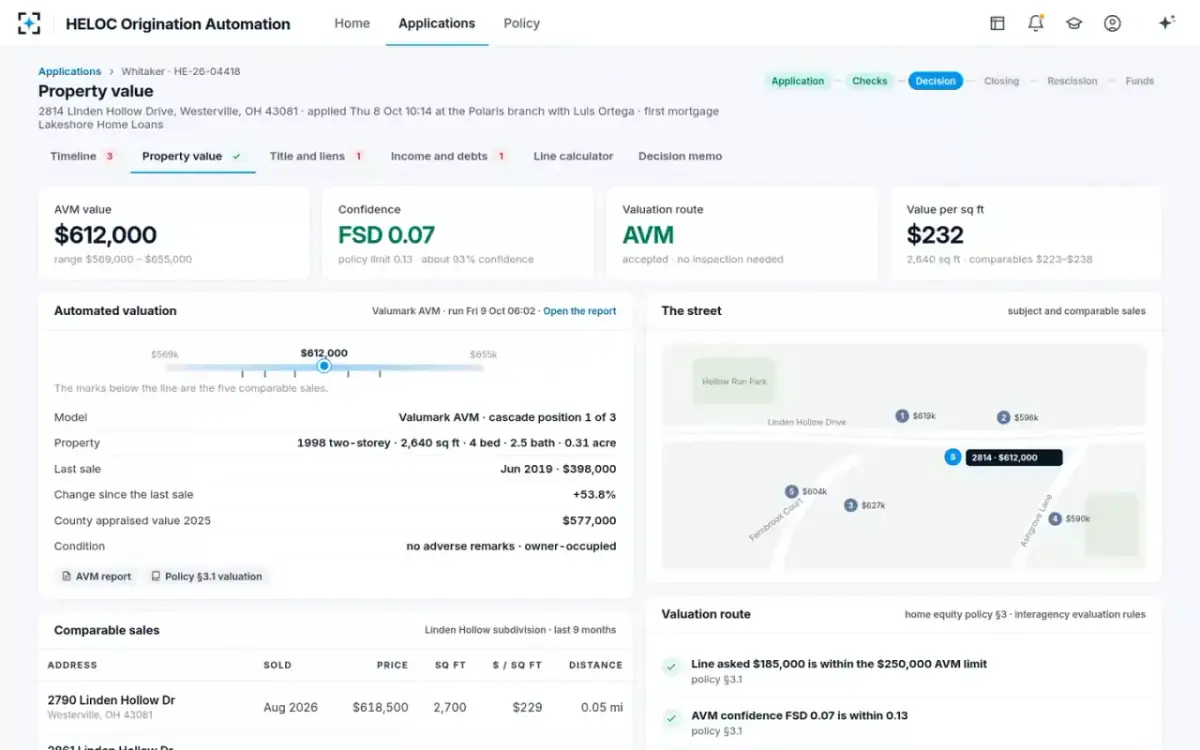
How the solution picks the valuation route by policy
In HELOC Origination Automation the valuation route is a setting, not a judgement made file by file. The sample bank allows an AVM for lines up to $250,000 when the forecast standard deviation is 0.13 or lower and CLTV is within policy; above that, an exterior-inspection evaluation up to $400,000; above $400,000, a full appraisal. The bank can set the AVM limit at $150,000, $250,000 or $400,000 and the confidence limit at 0.10, 0.13 or 0.15, and each change is versioned and approved by credit.
On the Whitaker file the first model in the cascade returned $612,000, with a range of $569,000 to $655,000 and a forecast standard deviation of 0.07, supported by five sales in the subdivision. The $185,000 line is inside the AVM limit, so the route is the AVM and no inspection is ordered. Had the confidence come back at 0.15, the file would have moved to an exterior inspection; the solution's "weaker AVM" what-if shows that without saving it to the file.
The value, the liens and the line, stacked on the parcel
Must a lender give the borrower a copy of a HELOC appraisal?
Only if the line is a first lien. Regulation B's valuation-copy rule applies to credit "secured by a first lien on a dwelling," with copies due by account opening for open-end credit (12 CFR 1002.14). Most HELOCs sit behind a first mortgage, so the rule does not reach them, although nothing stops a lender from sharing the valuation.
Valuation independence rules do reach second liens. Regulation Z's appraisal independence section "applies to any consumer credit transaction secured by the consumer's principal dwelling" (12 CFR 1026.42), which includes home equity lines, and the 2005 guidance adds that lenders should "ensure that an expected or estimated value of the property is not communicated to an appraiser or individual performing an evaluation." For lenders that ask the borrower what the house is worth on the application, that sets a boundary on where the answer can go.
To see the valuation route applied to a sample of your own files, start from HELOC Origination Automation.
Questions people ask
Do all HELOCs need an appraisal over $400,000?
At a bank, a residential transaction above $400,000 needs an appraisal by a state certified or licensed appraiser unless another exemption applies, such as a qualifying increase on an existing credit. At a credit union, the line is $400,000 or more. At $1 million or more, the appraiser must be state certified.
Can a lender open a HELOC without a full appraisal?
Yes, and most borrowers do: in 2024, 47% of home equity originations in the MBA study used an AVM and 26% a desktop valuation. Below the threshold the lender needs an evaluation, which can rest on a model, a desktop review or an exterior inspection if it meets the agencies' content rules.
Does a HELOC require an in-person appraisal?
Not by federal rule below the threshold. The 2010 guidelines leave the extent of inspection to the lender, which should "set criteria for determining the extent to which an inspection of the collateral is necessary," and the evaluation must describe how the property's condition was confirmed.
Can a lender run several AVMs and use the highest value?
No. The 2005 home equity guidance and the 2010 guidelines both require controls to "preclude 'value shopping'," and where several tools are used the lender should follow "a policy for selecting the most reliable method, rather than the highest value." A fixed order of models, set before any value is seen, is the usual control.
Does a HELOC appraisal have to follow USPAP?
An appraisal does: the agencies' rules require appraisals to conform to USPAP and to be reviewed for compliance with it. An evaluation does not have to follow USPAP, but it must meet the content expectations in the 2010 guidelines and be prepared by someone independent of loan production.
Does an appraisal waiver on a first mortgage cover a HELOC?
No. A waiver or exemption applies to the transaction it was granted for. A new HELOC is its own transaction, valued under the lender's rules for its line amount; at most, an existing valuation may be reused if the lender's criteria show it still reflects market value.