A HELOC title search is a search of the county land records for the house that will secure the line: who owns it, and every mortgage, lien, judgment and assessment recorded against it. Lenders use it because the 2005 interagency home equity guidance tells them to "verify the amount and priority of any senior liens prior to closing the loan," and because the credit report cannot do that job. Since April 2018 the three nationwide credit reports carry no tax liens or civil judgments at all, and a credit line paid and closed years ago can still sit on title as an open mortgage until its release is recorded. Botminds' HELOC Origination Automation reads the title report next to the credit report, matches every recorded lien to a tradeline, and makes each mismatch a condition before the underwriter decides.
Title practice for home equity lines is not set by any federal rule we found, so this page is a method rather than a rule summary. It uses one fictional sample file throughout: Daniel and Renee Whitaker's $185,000 line at Brookmere Bank, on a house valued by AVM at $612,000, whose title report shows a 2021 credit-union line their credit report says was paid off.
Every recorded lien, matched to the credit file before the CLTV is computed
Agent
Application and document readerFiles the title report, the credit report and the first-mortgage statement to the lien check, with page and line for every entry.
Never: Never infers a missing figure; it asks for the document.
Agent
Title and lien examiner: listLists vesting, every recorded mortgage and release, taxes, judgments, mechanic's liens and assessments, in recording order.
Agent
Title and lien examiner: matchMatches each recorded lien to a tradeline by creditor, date and amount; flags any lien with no tradeline and any tradeline with no lien.
Never: Never drops a lien without a recorded release or a payoff letter.
Agent
Credit policy checkerCounts every senior lien in CLTV under the bank's rule, an unreleased one at its full amount, and tests the result against the CLTV limit for the score.
Agent
Decision memo writerTurns each mismatch into a condition that names who clears it, and drafts the release request to the old lender.
A person decides
Loan processorSends the release request, collects the recorded release or payoff letter, and clears the condition.
A person decides
Home equity underwriterDecides: approve with the release as a condition, counter at the amount the policy allows with the lien counted, or decline.
Does a HELOC need a title search?
No federal rule we found names a title search, but the lender needs what one provides. The 2005 guidance's section on lien recording says lenders "should take appropriate measures to safeguard their lien position" and "verify the amount and priority of any senior liens prior to closing the loan. This information is necessary to determine the loan's LTV ratio and to assess the credit support of the collateral" (2005 home equity guidance). Amount can come from statements; priority can only come from the land records.
What lenders buy to see the records varies. Some home equity programs order a limited report, often called an owner and encumbrance or property report, that lists vesting and open liens without the insurance a full title policy carries; others require a lender's title policy above a line amount or CLTV. We found no federal rule requiring title insurance on a HELOC, so the choice is a credit-policy decision about how much title risk the bank keeps.
What a title search shows that a credit report doesn't
A credit report shows debts a creditor has reported; title shows claims recorded against the property. The two overlap on the first mortgage and usually on earlier home equity lines, and diverge on everything else. The gap widened in 2017 and 2018, when the nationwide credit bureaus stopped carrying most public records. After the change, civil judgments "disappeared entirely" from credit records, and "almost half of tax liens survived the July 2017 removals, but by April 2018, none remained" (CFPB, Quarterly Consumer Credit Trends, 2019).
The 2005 guidance's own definition of a senior lien reads like a list of what is now missing from credit reports: "Senior liens include first mortgages, outstanding liens for unpaid taxes, outstanding mechanic's liens, and recorded judgments on the borrower." Three of those four are no longer on the nationwide reports, and the CFPB notes that while "other consumer credit reporting agencies continue to offer lenders access to civil judgment and tax liens," a standard tri-merge does not carry them.
Eight things a title search can find, and what each does to a HELOC
| Recorded item | On the credit report? | What it does to the line |
|---|---|---|
| First mortgage | Yes, with balance and payment | Senior lien; counted at the current balance from the statement |
| Earlier HELOC, open with a balance | Yes, with balance and limit | Senior lien; many policies count the full limit, as Fannie Mae's HCLTV does |
| Earlier HELOC, paid and closed, release recorded | Shown closed, $0 | Gone; nothing to count |
| Earlier HELOC, paid and closed, no release | Shown closed, $0 | Still a lien of record; counted in full until a release or payoff letter is in |
| Federal or state tax lien | No, since April 2018 | Senior lien under the 2005 guidance; usually paid or released before closing |
| Judgment lien | No, since July 2017 | Senior lien under the 2005 guidance; paid, released or the line declined |
| Mechanic's lien | No; not a credit account | Senior lien under the 2005 guidance; resolved before closing |
| PACE assessment | Paid through the property tax bill | Priority "similar to that of other real property tax liens," per the CFPB |
Assessments deserve a line of their own. Property assessed clean energy loans are repaid through the property tax bill and, as the CFPB put it in its 2025 rule, "the liens securing PACE loans typically have priority under State law similar to that of other real property tax liens, which are superior to other mortgage liens on the property, including those that predated the PACE lien" (CFPB PACE final rule). A home equity lender that misses one is behind a lien it never counted.
What happens if an old lien isn't released?
It stays a lien of record, and a careful lender counts it until the release is recorded. That is the most common title surprise on a home equity file: a borrower pays off and closes a line, the old lender never records the satisfaction, and the land records still show an open mortgage. The credit report shows the account closed with a $0 balance, so a check that reads only the credit report sees nothing to count.
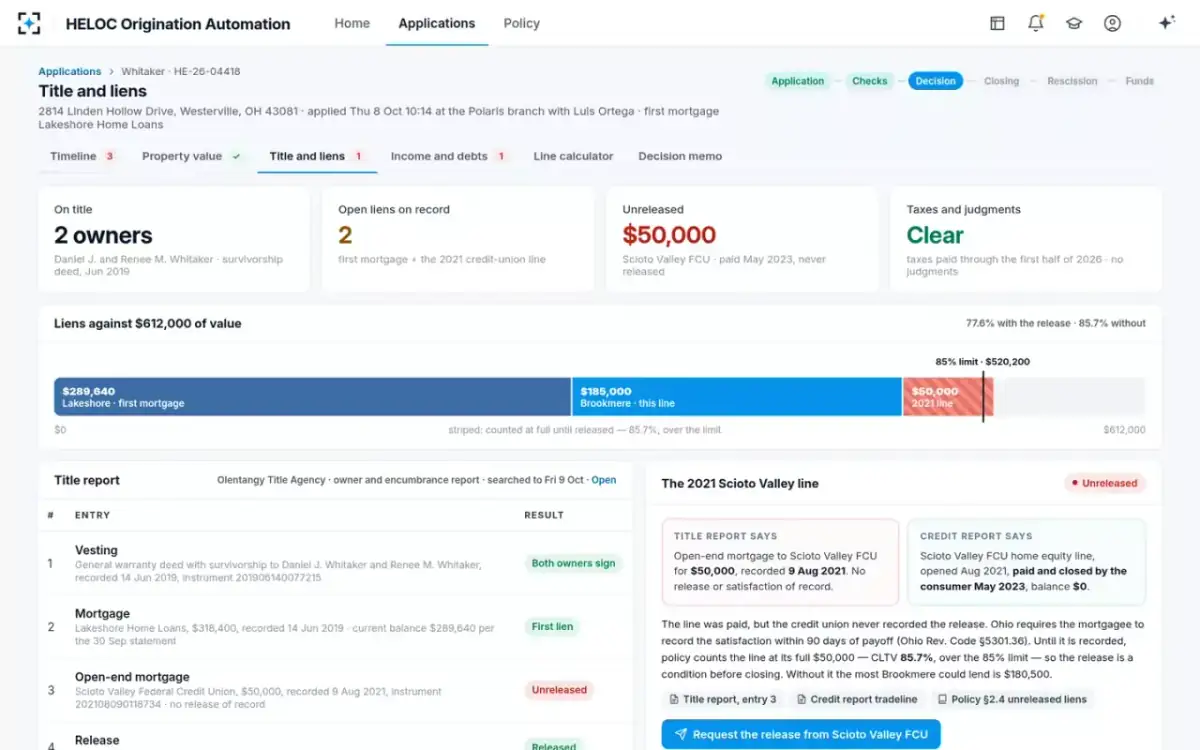
The sample file has exactly this. The owner and encumbrance report shows an open-end mortgage to Scioto Valley Federal Credit Union for $50,000, recorded 9 August 2021, with no release. The credit report shows the same line "paid and closed by the consumer May 2023, balance $0." The sample bank's policy counts an open lien on title "at its full amount until a release or payoff letter is in," so the solution computes the CLTV both ways.
One unreleased $50,000 line moves the Whitaker file from inside the limit to over it
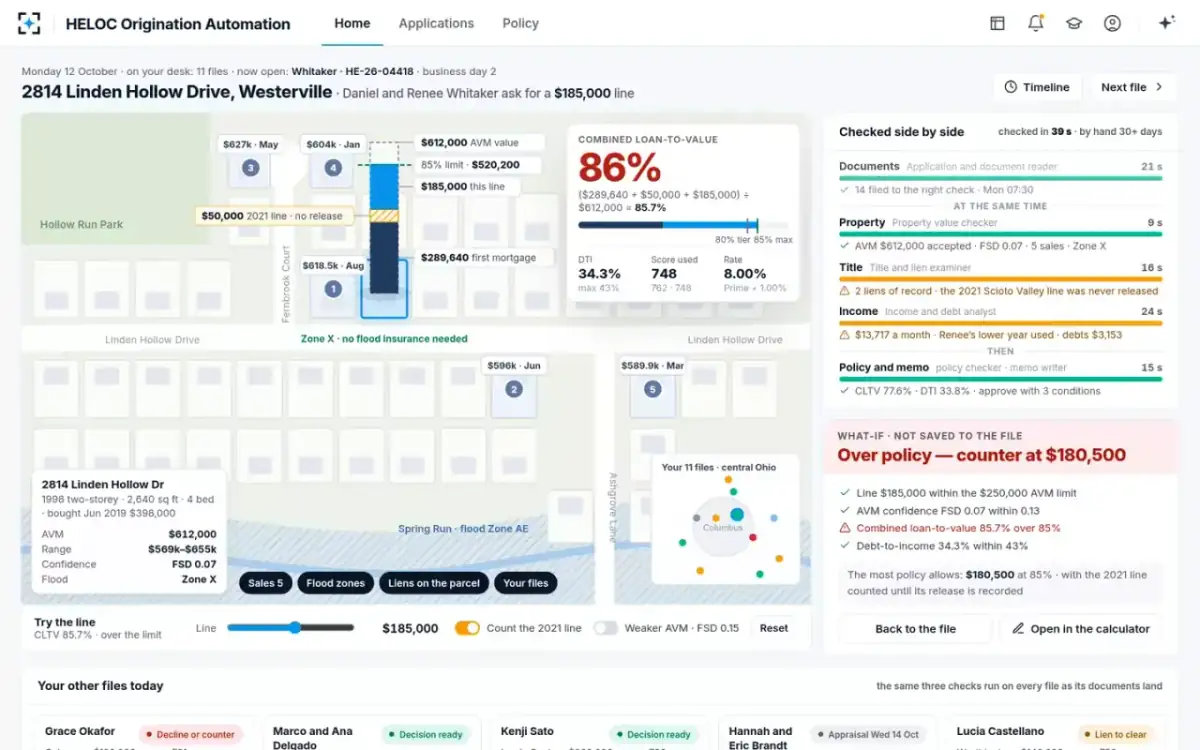
The decision that follows is the underwriter's, and the solution lays out both paths. Approve $185,000 with the recorded release as a condition before closing; or, if the release cannot be obtained, counter at $180,500, the most an 85% CLTV allows with the old line counted. The decision memo writer drafts the request to the credit union's lien release department with the 2023 payoff from the credit report attached, and the processor sends it. The underwriter picks the path; the agents never drop the lien on the strength of a credit report alone.
Title report and credit report, side by side, on the line that was never released
How does lien position affect a HELOC?
Lien position decides what the bank recovers and which rules apply. Every lien ahead of the line comes out of the house's value first, so the combined loan-to-value is computed over "all senior liens," as the 2005 guidance puts it, and the guidance treats a combined LTV of 90% or more over an owner-occupied home as a high-LTV exception unless mortgage insurance or readily marketable collateral covers it.
Position also switches rules on and off. Regulation B's right to a copy of the valuation applies only to credit "secured by a first lien on a dwelling" (12 CFR 1002.14). HOEPA's high-cost rate trigger is 6.5 points over the average prime offer rate for most first liens and 8.5 points "for a subordinate-lien transaction" (12 CFR 1026.32). And for flood insurance on a second lien, the agencies say the lender must make sure coverage reaches "the combined total outstanding principal balance of the first and second loan," subject to the program's caps, which flood insurance on a HELOC works through.
Senior liens include first mortgages, outstanding liens for unpaid taxes, outstanding mechanic's liens, and recorded judgments on the borrower.
Interagency Credit Risk Management Guidance for Home Equity Lending, 2005
Can a HELOC be in third lien position?
Yes, if the lender's policy allows it; no federal rule caps lien position. The Whitakers' line would have been third behind their first mortgage and the unreleased 2021 line had the release not been recorded, which is one reason the release is a condition rather than a note. A lender that allows them has reason to limit or price them, because each lien ahead takes its share of value first and the lender is further from control in a default.
The 2005 guidance asks lenders to watch this at the portfolio level as well as the file level: management should analyse the home equity portfolio by segments including "lien position" and "size of credit relative to prior liens." A program that has quietly drifted into third liens shows up there before it shows up in losses.
How do you match recorded liens to the credit report?
Line by line, in both directions. Each recorded lien should find its tradeline by creditor, origination date and original amount; each mortgage-type tradeline should find its recorded lien. The four outcomes each mean something different: matched and open (count it), matched and paid with a recorded release (drop it), matched and paid with no release (count it and condition the release), and unmatched on either side (find out why).
The unmatched cases are where the risk hides. A recorded lien with no tradeline may be a tax lien, a judgment, a private mortgage to a relative or a seller, or a PACE assessment. Fannie Mae's rule for first mortgages makes the same point for any second lien: "If any subordinate financing is not shown on a credit report, the lender must obtain documentation from the borrower or creditor" (Selling Guide B2-1.2-02). A tradeline with no recorded lien may be unsecured after all, or secured by another property. The HELOC underwriting guidelines explain why the numerator of CLTV is where these errors land.
Count the old line: the what-if that shows the counter-offer
Does the title need checking again before closing?
Often, yes. The 2005 guidance asks lenders to verify senior liens "prior to closing the loan," and a report searched at application can be weeks old by the closing table. Liens recorded in between, such as a judgment, a tax lien or a mechanic's lien from work on the house, would sit ahead of a line recorded after them. Lenders handle the gap differently: some order an update or bring-down of the search shortly before closing, some rely on the title agent's gap coverage, and some accept the risk on small lines.
The sample file shows why the timing matters. The owner and encumbrance report was searched to Friday 9 October; the closing was on Tuesday 20 October, eleven days later, and the borrowers were planning a kitchen and rear addition, the kind of work that produces mechanic's liens. Whatever a lender decides, the decision belongs in the policy, with a line amount or a number of days above which an update is ordered, rather than in the habits of whoever is closing the file that week.
What evidence clears an unreleased lien?
A recorded release is the clean answer; a payoff letter is the usual bridge. Which documents a lender accepts, and whether it will close before a release is recorded, is a policy choice, and the sample bank writes it into a setting: an open lien on title counts at its full amount "until a release or payoff letter is in." State law governs how quickly a paid-off lender must record a satisfaction and what a borrower can do if it does not, and it varies.
What a home equity lender can accept to stop counting an old lien
- A recorded release or satisfaction
The land records now show the lien discharged. The title report is updated and the lien drops out of CLTV.
- A zero-balance payoff letter from the lienholder
Confirms the debt is paid and the account closed, pending recording. Many policies accept it with the recording as a post-closing follow-up.
- A payoff at closing
For a lien with a balance: paid from the new line's proceeds or the borrower's funds, with the release ordered at funding.
- A subordination agreement
For a lien that will stay: the holder agrees to sit behind the new line. The lien still counts in CLTV.
- Not enough: the credit report alone
A closed tradeline says the account is paid, not that the lien is released. It is evidence for the request, not for the decision.
Lien work is also where a home equity file waits longest on someone outside the bank, which is why turning it into a dated condition with a named owner matters. In the sample, all three conditions were due a day before closing, and the closing date was set only once the decision was signed. To see the lien check on your own files, start from HELOC Origination Automation.
Questions people ask
What is a HELOC lien search?
It is the same search of the county land records as a title search, often delivered as a limited owner and encumbrance or property report rather than a full title commitment. It lists the owners of record and the open liens, which is what a home equity lender needs to establish lien position and compute CLTV.
Do you need title insurance for a HELOC?
We found no federal rule that requires it. Lenders decide by policy, for example a property report for smaller lines and a lender's title policy above a set line amount or CLTV. Borrowers' own owner's policies from a purchase do not protect the HELOC lender.
Why doesn't my paid-off HELOC show as released?
Because paying the debt and releasing the lien are two steps. The credit report reflects the account being paid and closed; the land records change only when the old lender records a release or satisfaction. Until then the lien remains of record, and a new lender may count it or ask for the release.
Are tax liens on credit reports?
Not on the three nationwide credit reports. The CFPB found that almost half of tax liens were removed in July 2017 and none remained by April 2018; civil judgments were removed entirely in 2017. A tax lien or judgment against the borrower now shows up in the land records, which is where a title search looks.
What liens come ahead of a HELOC?
Any lien recorded earlier, plus liens that take priority by law. The 2005 guidance lists first mortgages, unpaid tax liens, mechanic's liens and recorded judgments as senior liens, and the CFPB notes that PACE liens typically have tax-lien priority, ahead even of mortgages recorded before them.