A subscription is an investor buying new units or shares of a fund, paying cash in; a redemption is an investor selling units back to the fund, which pays cash out. Both happen at the next net asset value after the order, and both settle on a date the fund's documents set, often a day or two later. For the fund's cash forecast they are the largest and latest-arriving flows: a fund often learns the full day's orders only after it has struck the NAV, and sometimes the next morning. Botminds' Fund Cash Forecasting reads each transfer agent's dealing report as it lands, keeps each order beside its source row, books dealt orders on their settlement date and labels the rest as estimates until the file arrives.
The examples come from a fictional sample firm, Quillfield Capital, whose treasury forecasts cash for 140 funds; rules and SEC findings are linked where they appear. Checking whether a redemption request is valid is investor services' work, and Botminds' Redemption Processing covers it; this guide is about the data the cash forecast needs.
A US fund often learns the day's orders hours after it has priced them
- About half in4–6 p.m.
- NAV out6–8 p.m.
- More orders arrive8 p.m.–midnight
- A significant portion after midnight; retirement plans next morningmidnight–9 a.m.
- Yesterday’s projection, orders estimatedto 5:48
- Built and signed5:48–9:00
What is a subscription and a redemption?
In a fund, a subscription is a purchase of new units from the fund itself, and a redemption is a sale of units back to it. The fund creates units when investors subscribe and cancels them when they redeem, so its size moves with its flows. That is what makes it open-ended, and it is why its cash has to absorb flows it does not control. A UCITS "shall repurchase or redeem its units at the request of any unit-holder," subject to limited exceptions (Directive 2009/65/EC, Art. 84(1)).
Both are priced forward. In the US, Rule 22c-1 requires funds and intermediaries to sell and redeem at a price based on the NAV "next computed after receipt" of the order, even though, as the SEC put it in its T+1 release, cash from purchases may be invested and assets sold "in subsequent days" (88 FR 13872). An investor sending an order at 3 p.m. New York time gets that day's 4 p.m. price; the fund pays or receives the cash on the settlement date. A switch, or exchange, between two funds of the same family is a redemption from one and a subscription to the other, and should appear as both in the two funds' forecasts.
When does a fund know about today's orders?
Later than most people assume. The SEC's 2022 swing pricing proposal described the US order flow in detail. An order placed with an intermediary before the pricing time gets that day's price, but "the fund, however, might not receive information about that order until much later, sometimes as late as the next morning" (87 FR 77172). NAVs are typically disseminated between 6 and 8 p.m. ET, and the release adds that a large share of orders often reaches the transfer agent or the clearing agency only after midnight, on the next day (cut-off times themselves are covered in Redemption Processing's guide to the mutual fund redemption cut-off time).
How late a US fund's order information arrives
~½
of daily volume received by 6 p.m. ET at some funds, from SEC staff outreach
6–8p.m. ET
when funds typically disseminate the NAV, before many orders arrive
7days
the general limit on postponing payment of a redemption in section 22(e)
Some channels are later than others. Based on staff outreach, the SEC understood that "some funds receive only around half of their daily volume by 6 p.m. ET," and that funds with large retirement plan investments get a larger share of their flow information after 6 p.m. than other funds. The reason is mechanical, and it is the line to remember when building a forecast:
"Most retirement plan recordkeepers currently do not process orders from investors until they receive a fund's NAV and funds typically receive orders from these intermediaries the next morning."
SEC, swing pricing proposal, December 2022
For the cash forecast this means the evening projection is built with part of the day's dealing missing, and the morning projection depends on files that may still be in flight. The SEC proposed a "hard close" to force orders in by the pricing time; the proposal was never adopted, and in its 2024 release the Commission said it was not adopting the swing pricing and liquidity amendments at that time. So a forecast must treat each fund's undealt orders as an estimate, by channel, and replace the estimate as each file lands. Cash projection methods for funds covers how to estimate them.
Which transfer agent fields matter for cash?
The ones that say how much cash moves, in which currency, on which day, and how sure that is. A dealing report carries much more: investor names, tax data, commissions. The forecast needs about a dozen fields, and the table says why each matters and when it is usually known.
Field-to-source map: what a cash forecast takes from a dealing report
| Field | Why the forecast needs it | When it is known |
|---|---|---|
| Fund, share class and ISIN | Which fund’s account, and which class’s currency and hedge | With the order |
| Transaction type | Subscription in, redemption out; a switch is both, in two funds | With the order |
| Deal date | Which NAV applies, and which day’s dealing the order belongs to | With the order |
| Units or amount | An order in units has no cash value until the NAV is struck | Amount: with the order; units × NAV: after the NAV |
| NAV per share used | Converts units into cash | After the NAV is struck |
| Settlement (payment) date | The day the cash moves, set by the fund’s terms and the channel | With the order, from the dealing terms |
| Settlement currency | Which account; a hedged class may settle in its own currency | With the order |
| Status: confirmed, pending, cancelled, amended | Only confirmed orders are booked; amendments change yesterday’s forecast | Through the dealing cycle |
| In cash or in kind | An in-kind redemption moves securities, not cash | With the order or the fund’s decision |
| Account, intermediary and channel | Concentration, likely timing, and which file it arrives in | With the order; omnibus accounts hide the underlying holders |
Two fields cause most forecasting misses. Status: a transfer agent that amends the day's dealing after the forecast moves cash between days, which is exactly what happened to the sample firm's euro credit fund on Friday 16 October, when a EUR 180,000 subscription moved to Monday's dealing. And channel: the SEC's 2016 liquidity guidance warns that shares held through omnibus accounts "could make it difficult for a fund to be fully aware of the composition of its underlying investor base" (81 FR 82142), which is the base from which flows are forecast.
Units or amount: why a redemption is not cash until the NAV is struck
An investor can redeem a number of units or an amount of money, and only the second is cash at the moment of the order. A redemption of 4,950 units has no cash value until the NAV for its deal date is known; the sample fund's dealing report shows it once priced, at EUR 5,100,000.00 to be paid on Wednesday. Before the NAV, the forecast can only estimate it from the last price, and the estimate moves with the market. An order for an amount is the reverse: the cash is known and the units are not.
One redemption, from the dealing file row to the ladder
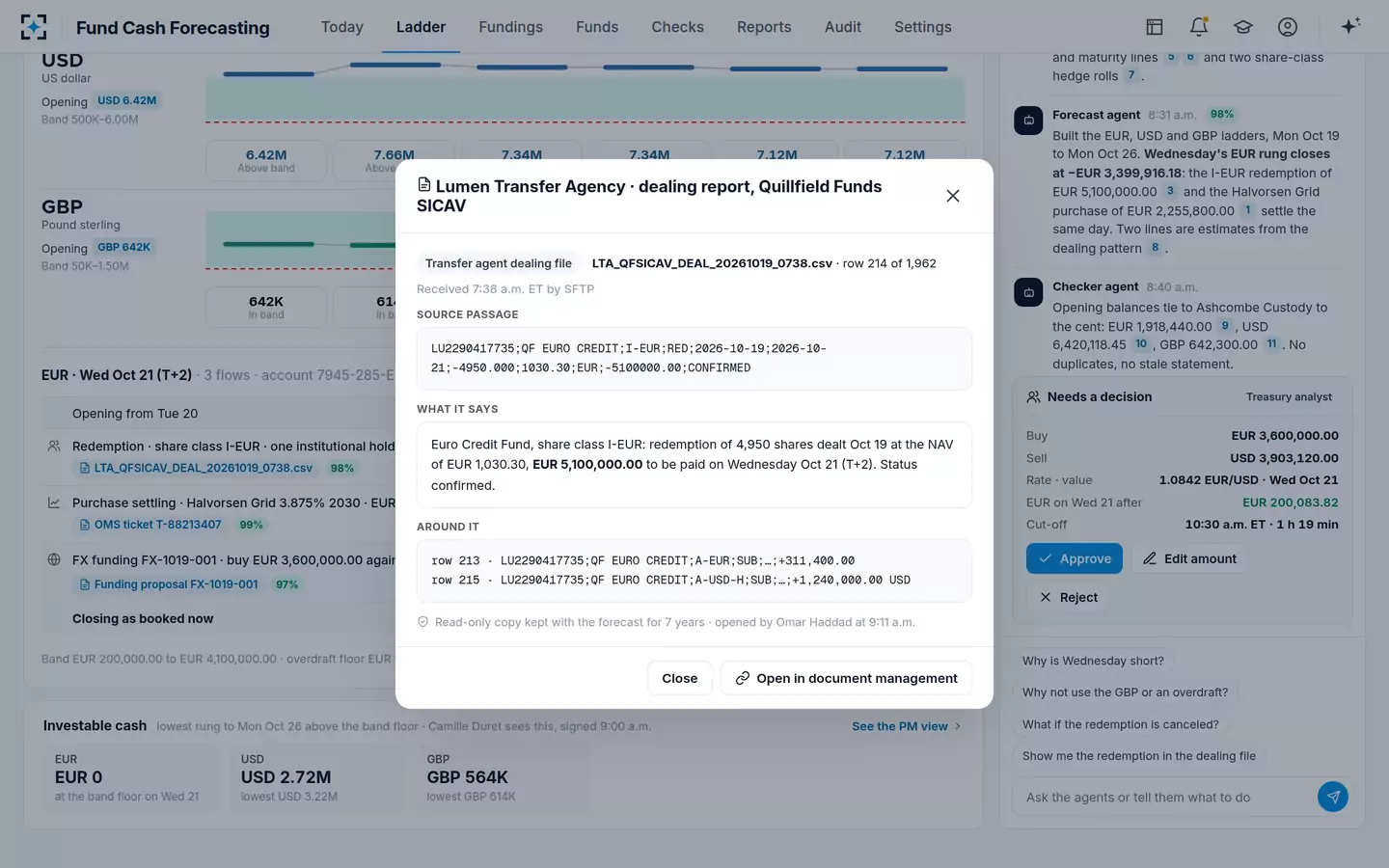
The rows around it show the currency point. Row 215 is a subscription to a dollar-hedged share class, settled in dollars, in a euro-based fund. A forecast that books it to the euro account is wrong twice: it overstates euros and misses dollars, and the share-class hedge roll that follows will move cash between the two. Investable cash, currency by currency explains why the fund's three accounts have three different answers.
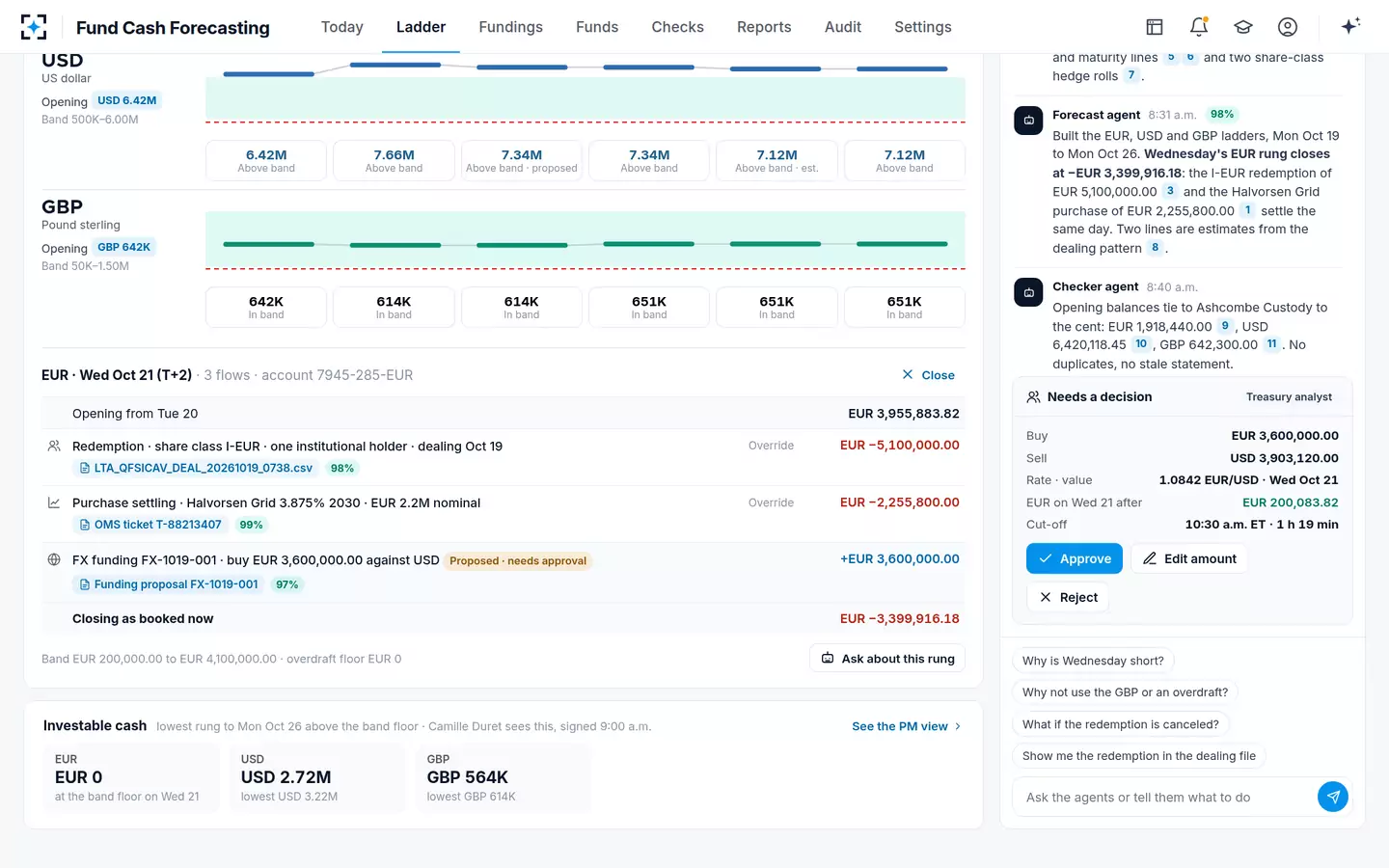
The redemption on the day it settles, beside the purchase it collides with
How do settlement periods for fund units differ?
By fund, by channel and by jurisdiction. In the US, the SEC noted in its T+1 release that mutual fund shares bought directly from the fund "generally settle on T+1," while those sold through broker-dealers follow the broker-dealer settlement cycle under Rule 15c6-1, which since 28 May 2024 is one business day for most trades (88 FR 13872). A UCITS sets its own dealing and settlement terms in its fund rules under national law; the Directive requires that units not be issued "unless the equivalent of the net issue price is paid into the assets of the UCITS within the usual time limits" (Art. 87). The sample Luxembourg fund pays redemptions two business days after dealing.
A direct order and an intermediated one, as the forecast sees them
Order placed directly with the fund: Usually the same day, from its own transfer agent.
Order through an intermediary or omnibus account: Possibly after the NAV is struck; for many retirement plans, the next morning.
Order placed directly with the fund: One investor, one order.
Order through an intermediary or omnibus account: Often netted or aggregated; the underlying investors are not visible to the fund.
Order placed directly with the fund: Fund’s own terms; in the US, generally T+1 for direct purchases.
Order through an intermediary or omnibus account: In the US, the broker-dealer cycle under Rule 15c6-1, now T+1.
Order placed directly with the fund: Booked once dealt.
Order through an intermediary or omnibus account: Estimated by channel until the file lands, then booked.
Order placed directly with the fund: Visible: the fund knows who holds what.
Order through an intermediary or omnibus account: Hidden: one intermediary’s decision can move many holders at once.
How long can a US fund take to pay a redemption?
Seven days at most, under section 22(e) of the Investment Company Act, except when the New York Stock Exchange is closed or trading is restricted, in an emergency, or as the SEC permits by order (15 U.S.C. 80a-22(e)). In practice the fund's own promises bind it sooner: many funds state in their prospectuses that they will generally pay the next business day, and the SEC noted in 2016 that such a policy magnifies liquidity risk compared with a fund that pays in three days, even if the flows are identical (81 FR 82142).
For the forecast, the binding date is the one the fund has promised and normally meets, not the legal outer limit. A fund that could pay in seven days but always pays in one has a one-day cash need. The liquidity rule's highly liquid investment definition, convertible to cash in three business days or less, sits between the two (Rule 22e-4(a)(6)).
What about large redemptions?
They are the reason the forecast needs people as well as files. A single holder's redemption can be most of a day's flow, as the sample fund's EUR 5.1 million redemption from one institutional holder of class I-EUR was. The SEC's 2016 release treats advance notice from large holders as a way to make a fund's cash flow projections more reliable, and also notes that holders are under no legal obligation to give it (how to use it in a projection is in cash projection methods) (81 FR 82142).
Funds have tools for large redemptions beyond cash. US funds that reserve the right to redeem in kind must have policies on how and when they will do so (Rule 22e-4(b)(1)(v)). In the EU, since 16 April 2026 every UCITS must select at least two liquidity management tools from a harmonised list, including notice periods, redemption fees, swing pricing and redemption in kind, and redemption in kind may be used only "to meet redemptions requested by professional investors and if the redemption in kind corresponds to a pro rata share of the assets held by the UCITS" (Directive (EU) 2024/927). Each tool changes what the forecast should expect: a notice period moves the cash later, a redemption in kind takes it out of the forecast entirely. Botminds' Liquidity Stress Testing guides explain the EU liquidity management tools in force from 2026.
Do subscriptions and redemptions affect NAV?
Not the NAV per share directly, but they can dilute the investors who stay. Orders are priced at the NAV, so the subscriber or redeemer pays or receives the fair value of a unit; but buying or selling the portfolio to absorb the flow costs spreads and fees that the remaining holders bear. Swing pricing passes those costs to the investors trading, and US funds have been allowed to use it since 2016 under Rule 22c-1(a)(3) (17 CFR 270.22c-1). The SEC's 2022 proposal to make it mandatory was never adopted, and in February 2026 the SEC wrote, "we are not aware of any funds that have engaged in swing pricing" (91 FR 5545).
One detail of the US rule ties swing pricing back to this guide's subject. The swing decision may be made on information sufficient "to allow the fund to reasonably estimate whether it has crossed the swing threshold(s) with high confidence," and that information "may include reasonable estimates where necessary" (Rule 22c-1(a)(3)(i)(A)). A rule that permits estimated flows is an admission of how late the flows arrive. What swing pricing is and who pays without it is covered in Botminds' Liquidity Stress Testing guides, and a fund treasury analyst's morning shows what the late files do to the desk.
Questions people ask
What does subscription and redemption mean in a mutual fund?
A subscription is an investor buying new shares from the fund, and a redemption is an investor selling shares back to it. Both are priced at the next NAV after the order and settled on the date the fund's terms or the selling channel set. The fund issues shares on subscription and cancels them on redemption.
What is the difference between redemption and withdrawal?
For an open-end fund they describe the same thing from different sides: the investor withdraws money by redeeming shares. In private funds and some hedge funds, "withdrawal" is used for taking capital out of a partnership account, often with notice periods and limits set in the fund documents.
How are subscriptions and redemptions recorded in accounting?
A subscription increases the fund's cash, or a receivable until settlement, and its capital; a redemption decreases capital and creates a payable until the cash is paid. The cash forecast uses the same dates as the receivable and payable: the settlement date, not the deal date.
What is subscription and redemption in hedge funds?
The same idea on a slower cycle. Hedge funds usually deal monthly or quarterly, with notice periods for redemptions, and may limit how much can be withdrawn at each dealing date. For the cash forecast the notice period is useful: the redemption is known well before it is paid.
How do ETF subscriptions and redemptions work?
Through authorised participants, who create or redeem ETF shares in large blocks, often in exchange for a basket of securities rather than cash. An ETF that meets redemptions in kind needs far less cash for them than a mutual fund, so its cash forecast is driven more by income, fees and any cash creations.