In fund treasury, investable cash is the amount a portfolio manager can spend today without any account of the fund falling below its floor on a later settlement day. It is calculated as the lowest projected balance in the horizon, usually today to five business days ahead, minus the minimum balance treasury keeps in that currency. It is smaller than the cash balance, often by most of it, because trades, redemptions, fees, FX and capital calls already have a claim on that money. Botminds' Fund Cash Forecasting builds each fund's projection from those flows overnight, ties the opening balance to the custodian, and shows each PM signed investable cash by fund and currency before the market opens.
The examples come from a fictional sample firm, Quillfield Capital, as its treasury runs 140 funds in 25 currencies through the solution on Monday 19 October 2026. The research and rules are linked where they appear.
A fund's cash is small, and it moves
1.8%
of its portfolio held in cash by the median US mutual fund in 2014
0.2%
or less in cash at about a quarter of funds; a quarter held 4.4% or more
7days
the longest a US fund may generally take to pay a redemption under section 22(e)
What is investable cash? The lowest rung, less the floor
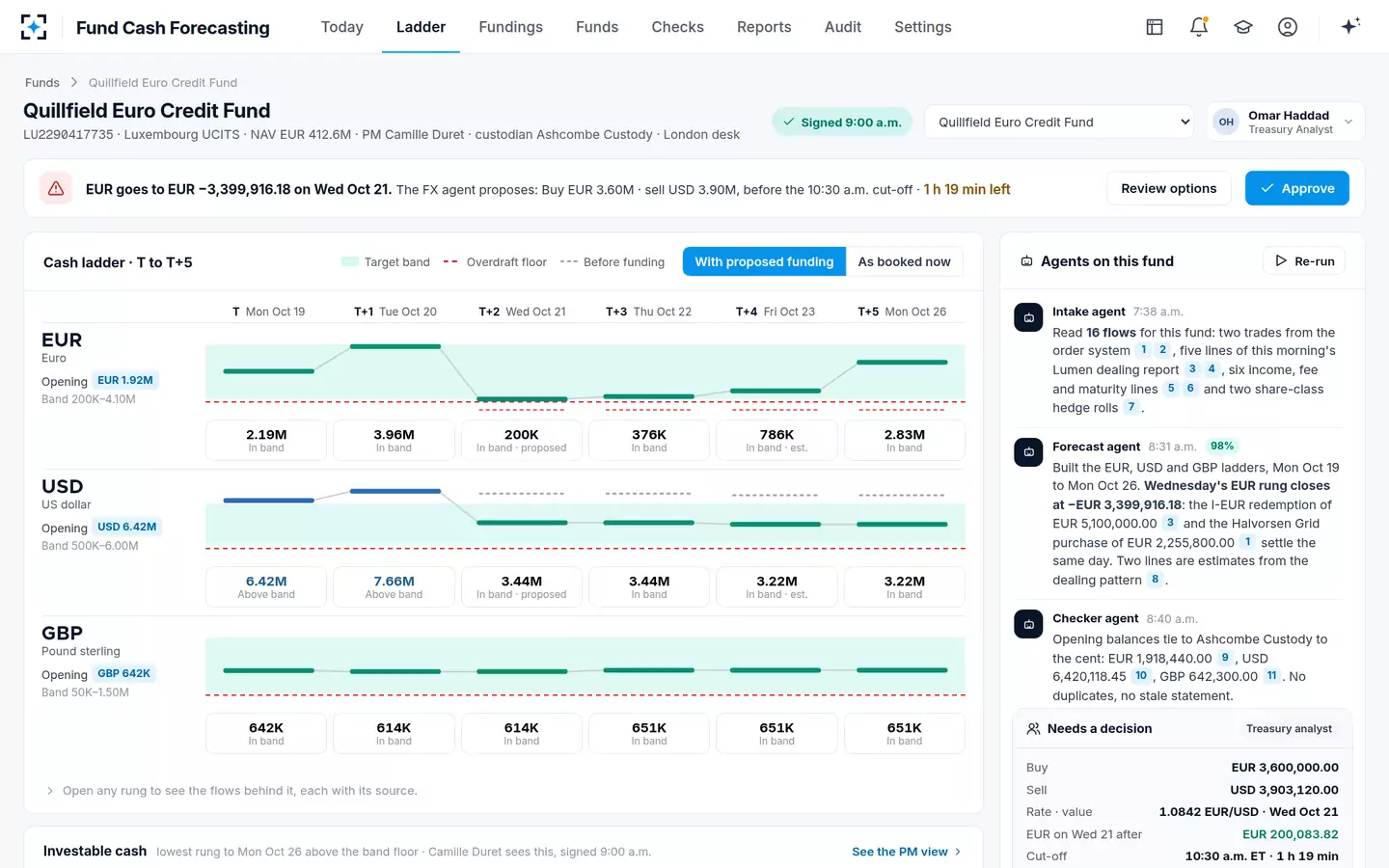
Investable cash is a forecast, not a balance. Take the projected closing balance of one account for each settlement day in the horizon, find the lowest, and subtract the floor. If the lowest projected balance of a fund's US dollar account over the next five days is USD 3.22 million and treasury keeps at least USD 500,000 in it, the PM can commit USD 2.72 million today. Spend more and some later day drops below the floor; spend much more and it goes overdrawn.
The reason for the lowest rung rather than today's balance is timing. A purchase made today settles tomorrow in US equities and later in many other markets, while redemptions, fees and FX sales already booked will settle on their own dates in between. Money that is in the account this morning but must leave on Wednesday is not available on Monday, even though the statement shows it. The minimum across the horizon is the only number that respects every one of those dates at once.
It is calculated separately for each currency. A fund with euros, dollars and sterling has three investable figures, and a large one in dollars does not make a negative one in euros go away. Converting between them takes an FX trade, which has its own settlement date and its own cut-off, so the move is a treasury decision with a cost, not an accounting line.
Of Tuesday's USD 7.66 million, the PM can commit USD 2.72 million
Quillfield Euro Credit Fund, US dollar account, Tuesday 20 October peak
- Sold to fund Wednesday’s euro shortfall · 51%
- Settling outflows to Friday, and the USD 500,000 band floor · 14%
- Investable cash · 35%
How is investable cash different from the cash balance?
The cash balance looks backward and investable cash looks forward. A custodian statement reports what the account held at the last close. Investable cash starts from that number, adds and subtracts every flow due to settle in the horizon, and keeps a buffer. On a quiet day the two can be close. On a day with a large redemption or a big purchase settling midweek, a fund can show millions on its statement and have nothing to invest.
Cash balance against investable cash, line by line
Cash balance: Last night’s close, as the custodian reported it.
Investable cash: Today to the end of the horizon, one figure per settlement day, then the lowest.
Cash balance: Settled cash only. A trade done yesterday that settles tomorrow is not in it.
Investable cash: Settled cash plus every flow due inside the horizon, known or estimated, each with its date.
Cash balance: One balance per account, in that account’s currency.
Investable cash: One figure per currency; a surplus in one does not cover a shortfall in another without an FX trade.
Cash balance: None. The statement is what it is.
Investable cash: Net of the band floor the fund’s policy sets for that currency.
Cash balance: Anyone, once it ties to portfolio accounting.
Investable cash: A PM, once treasury has checked the opening balance and signed the projection.
The other difference is who checks it. A statement is the custodian's figure; when portfolio accounting disagrees with it, the gap is a break, and neither number should reach a PM until someone has decided which is right. In the sample this morning, 608 of 612 opening balances tie to the custodian to the cent and one, a Norwegian krone account in a Nordic equity fund, is NOK 2,950,000 apart. That fund's investable cash waits until the cash management lead decides.
Which items are deducted from investable cash?
Everything that will leave the account before the end of the horizon is deducted on its settlement date, and everything that will arrive is added on its date. The list is longer than most spreadsheets carry, and the items people forget are the ones that cause the next morning's surprises.
A glossary of the morning number, from statement to investable cash
- Cash balance
- What the custodian statement says the account held at the close. A report of yesterday, before anything settles today.
- Book balance
- What portfolio accounting says the account holds. It should equal the custodian balance; when it does not, the gap is a break to explain before anyone relies on either.
- Projected balance (a rung)
- The balance expected at the close of one settlement day, after every flow due to settle that day: trades, orders, income, fees, FX, margin and notices.
- Committed cash
- Cash already spoken for by a flow that will settle inside the horizon: a purchase, a redemption payment, a capital call, an FX sale that funds another currency.
- Band floor
- The smallest balance the fund intends to hold in a currency. Below it treasury funds the account; it is a policy choice, not a rule.
- Overdraft floor
- Zero. A rung below it is an overdraft unless something is funded first.
- Investable cash
- The lowest projected balance in the horizon, less the band floor. The amount a PM can commit today without pushing any later day below the floor.
- Idle cash above band
- Cash above the top of the band. The part of a cash position that is neither committed nor needed as a buffer.
Settling purchases and sales from the order management system, including amendments booked after the forecast, are the largest items on most days. Then come the fund's own share dealing: subscriptions add cash and redemptions take it away, on the settlement date in the prospectus or the dealing agreement, not the deal date. Income and maturities arrive on their payment dates, net of any withholding tax, which matters because a forecast that books a foreign dividend gross is wrong by the tax every time. Fees and expenses leave on their schedule.
Three items are easy to miss. FX trades move cash between a fund's accounts: the sold currency leaves on the value date, and a forward or a share-class hedge roll does the same on its maturity. Margin calls on derivatives and collateral returns arrive with a day's notice or less. And for funds that hold private assets, capital calls and distribution notices arrive by email as PDFs, in the general partner's language, with a value date a few days out. In the sample, a German call on a multi-strategy fund for EUR 8,750,000, value 23 October, came in on the Friday afternoon before.
From the statement to investable cash: one fund's US dollar account
| Step | Amount | What it is |
|---|---|---|
| Opening balance, Monday 19 October | USD 6.42M | Custodian statement, tied to portfolio accounting to the cent. |
| Net flows settling Tuesday | + USD 1.24M | The rung rises to USD 7.66M, above the USD 6.00M top of the band. |
| Net flows settling Wednesday | − USD 0.32M | USD 7.34M as booked. |
| FX sale to fund the euro account | − USD 3.90M | Buys EUR 3.60M for Wednesday’s euro shortfall, through CLS. |
| Net flows to Friday, partly estimated | − USD 0.22M | Friday’s rung, USD 3.22M, is the lowest in the horizon. |
| Band floor for US dollars | − USD 0.50M | This fund’s policy minimum in the currency. |
| Investable cash, US dollars | USD 2.72M | What the PM sees, once the ladder is signed. |
Why a euro balance is not investable cash for a US fund
For a US open-end fund, the liquidity rule's idea of cash is US dollars. In its September 2024 guidance the SEC restated that "cash" in Rule 22e-4 means US dollars and excludes foreign currencies and cash equivalents, so a fund has to think about conversion to dollars when it decides how liquid a holding is (89 FR 73764). It went further: "non-U.S. dollar currencies are investments that would need to be classified considering conversion to U.S. dollars." For the liquidity rule, a euro balance is a position, not cash.
The guidance also says what staff found. Staff saw some funds treat every currency as highly liquid, however long it would take to turn into US dollars, on the reasoning that the definition mentions cash (SEC, 2024; how a liquidity programme tests its buckets is in the Risk guide to the highly liquid investment minimum). The rule's own definitions explain why the time matters: an investment is convertible to cash when it can be "sold, with the sale settled," and highly liquid when that can happen in three business days or less (17 CFR 270.22e-4(a)). A currency that needs an FX trade, a cut-off and a value date is a settlement, not a balance.
For treasury the lesson is practical rather than legal. Investable cash should be shown in the currency it will be spent in, and a PM who wants to buy a dollar bond with euros is asking for an FX trade with a cut-off, not using cash she already has. Which bucket each holding belongs in is the liquidity program's job; how the highly liquid investment minimum is set and tested is worked through in Botminds' Liquidity Risk Management Program guides. The sample fund above is a UCITS, which answers to different rules; the point about currency is the same.
One fund, three currencies, three investable figures
What is a cash projection, and how far ahead must it look?
A cash projection is the list of a fund's expected balances by currency and settlement day, built from the flows due in that period. Investable cash is read off it, so its horizon decides what the number protects. The horizon has to cover the longest settlement cycle the fund trades in plus the time it would take to fix a shortfall, which is why five business days is a common choice and why funds in slower markets look further.
Three dates set the floor of that horizon for a US fund. Since 28 May 2024 most US securities trades by broker-dealers settle one business day after the trade (88 FR 13872). Section 22(e) of the Investment Company Act caps the time a fund may generally take to pay a redemption at seven days, with exceptions (15 U.S.C. 80a-22(e)). And investor expectations are tighter than the law: in adopting the liquidity rule the SEC noted that "many investors expect to receive redemption proceeds in fewer than seven days as some mutual funds represent in their prospectuses that they will generally pay redemption proceeds on a next business day basis" (81 FR 82142).
The liquidity rule also asks every US open-end fund to consider short- and long-term cash flow projections, under both normal and reasonably foreseeable stressed conditions, when it assesses liquidity risk (Rule 22e-4(b)(1)(i)(B)). The treasury projection is the short end of that requirement, refreshed daily. How to build the projection itself, flow by flow, with ranges for the flows nobody knows yet, is the subject of its own guide.
How big should the floor under investable cash be?
The floor is a policy choice, and funds choose very differently. SEC economists who studied US mutual funds found that the median fund held 1.8% of its portfolio in cash in 2014, about a quarter held 0.2% or less and about a quarter 4.4% or more, and that cash levels varied more among funds with the same strategy than between strategies (SEC DERA staff white paper, 2015; the cost of carrying it is in cash drag). Two funds with the same strategy can carry very different buffers.
A floor that is too high is paid for in returns: cash that sits above what the fund needs earns the cash rate while the portfolio earns something else, and what that costs a fund's investors can be put in basis points. A floor that is too low is paid for in overdrafts and forced sales. The same white paper found that funds hold more cash when their flows are more volatile, which is the honest basis for a floor: size it to the flows the fund cannot see in advance, not to habit.
In the solution the floor is a setting the head of treasury approves: by default a band from 0.05% to 1.0% of net assets in the base currency, with fixed amounts for other currencies and 38 per-fund overrides in the sample firm. The sample euro fund's band is EUR 200,000 to EUR 4.10 million, which is roughly 0.05% to 1.0% of its EUR 412.6 million. Those numbers are one firm's policy, not a recommendation.
Why a PM should see only a signed figure
A PM who does not trust the number keeps a buffer of her own on top of treasury's, and two buffers are worse than one. The cure is not a faster email; it is a figure the PM knows has been checked. In the solution a PM sees investable cash only after the cash management lead has signed that fund's ladder, and only for the funds she runs. A fund whose opening balance does not tie, or whose forecast missed yesterday by more than the tolerance, shows "Being checked" and keeps the last signed figures.
The PM's view: signed investable cash by fund and currency
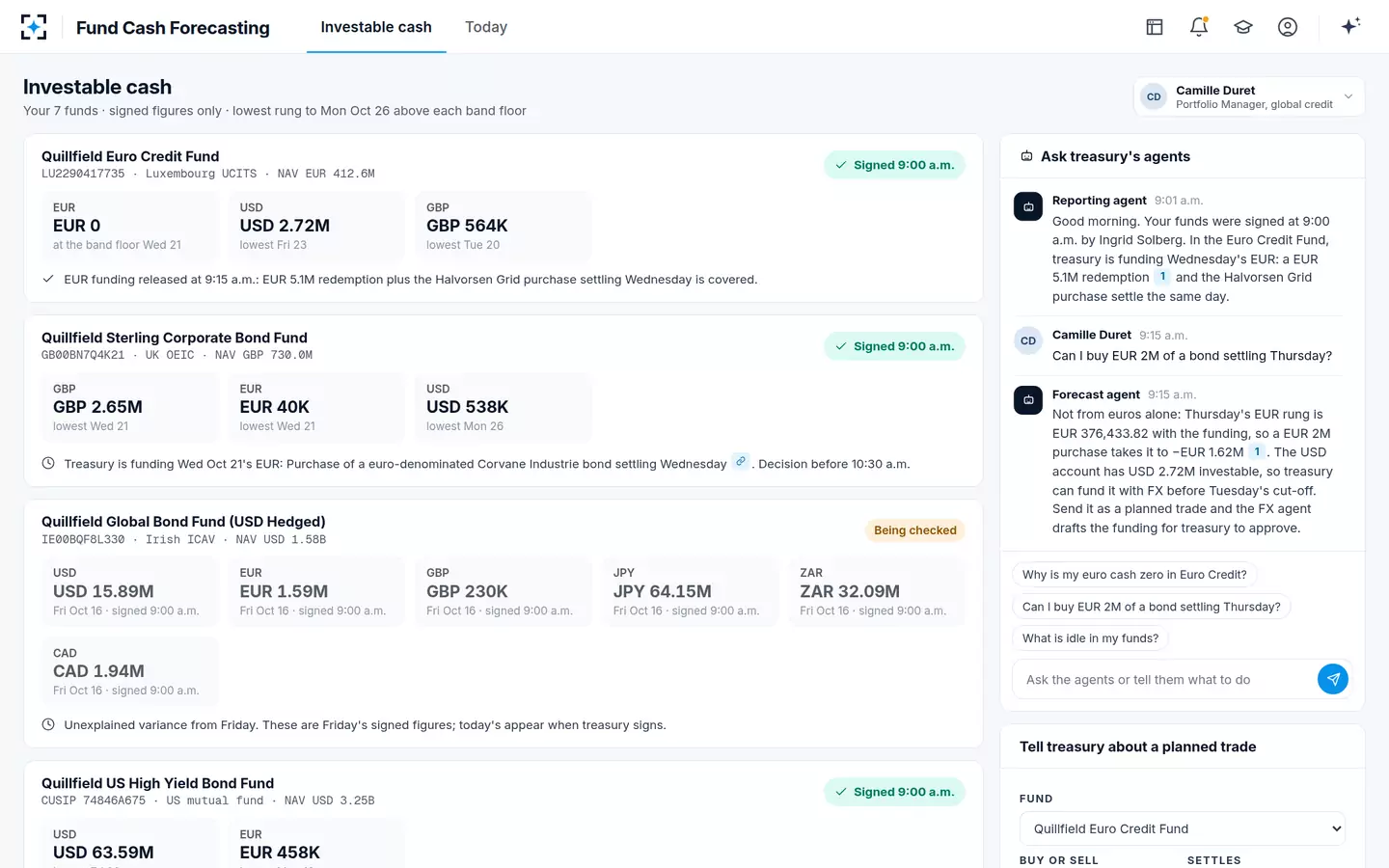
The sample PM asks whether she can buy EUR 2 million of a bond settling Thursday. The answer comes from the ladder: Thursday's euro rung is EUR 376,433.82 with the funding, so the purchase would take it to minus EUR 1.62 million. The dollar account has USD 2.72 million investable, so treasury can fund the trade with FX if she sends it as a planned trade. That is investable cash working as intended: one figure per currency, a clear reason when the answer is no, and a route to yes.
Who uses investable cash, and how it goes wrong
Portfolio managers use it to size trades before the open. Treasury uses the same projection to decide what to fund before each currency's cut-off, which is the other half of the job, and the CLS settlement process and a fund's FX deadlines set how early those decisions have to be made. Operations uses yesterday's projection to explain this morning's actual cash. Risk uses the longer projection for the liquidity program.
It goes wrong in three predictable ways. A flow arrives after the projection was built, such as a trade amended at 7 p.m. or a transfer agent file that is late. A flow is booked at the wrong amount, such as a foreign dividend booked gross when tax is withheld at source. Or the opening balance is wrong because a break nobody resolved has been carried forward. The first two are forecasting problems and show up in the next day's variance; the third is a control problem, which is why the opening balance is tied before anyone signs.
Questions people ask
What does investable cash mean?
It means the cash a fund can commit to new investments today without its account falling below the minimum balance on any day in the forecast horizon. In practice it is the lowest projected balance over the next few settlement days, by currency, less the floor treasury keeps. It is always a forecast, so it is only as good as the flows behind it.
Is investable cash the same as available cash?
Not usually. "Available cash" is often used for settled cash after today's known payments, which ignores flows that settle later in the week. Investable cash looks across the whole horizon, so a redemption due Wednesday reduces Monday's figure. Ask which horizon and which floor a figure uses before comparing them.
Does investable cash include money market funds or cash equivalents?
Not by default. A money market fund holding has to be redeemed, and the redemption settles on its own terms, so it is a source of cash on a date rather than cash today. For the US liquidity rule the SEC says cash means US dollars and does not include cash equivalents. Treasury can still plan a redemption as a funding, with its own value date.
How often should investable cash be updated?
At least once each morning, from the overnight files, and again whenever a flow lands or changes. The solution re-runs a fund's ladder when a late file arrives, an amendment is booked or a PM adds a planned trade, and keeps each version with its time.
Can investable cash be negative?
Yes. A negative figure means the fund is already committed beyond its floor in that currency on some day in the horizon, and treasury needs to fund the account, by FX from another currency, a transfer, a facility draw or a trade moved with the PM's agreement, before that currency's cut-off.