A cash management AI agent is software that does the reading, arithmetic and first-draft reasoning of fund treasury: it reads custodian statements, trades, dealing files and notices, builds each fund's projected cash by currency and day, finds the days that fall short, and proposes how to fund them, explaining its choice and citing its sources. It should not approve, book or release a payment; those stay with named people. Botminds' Fund Cash Forecasting splits the work across six agents, each with written limits, and leaves approval with a treasury analyst, release with payment operations and sign-off with the cash management lead. This guide traces one funding through all of them.
The decision is from a fictional sample: Quillfield Capital's treasury, Monday 19 October 2026, and its Euro Credit Fund, a Luxembourg UCITS whose euro account is projected to go overdrawn on Wednesday. Regulators' statements are linked where they appear.
One euro shortfall, from overnight files to a released funding
Agent
Intake agent, 5:48–8:45 a.m.Reads 18,426 flows from seven systems, including the transfer agent’s dealing report with a EUR 5.1 million redemption and the order ticket for a EUR 2.26 million bond purchase, both settling Wednesday.
Never: edits a source; an unreadable value goes to an analyst
Agent
Forecast agent, 8:31 a.m.Builds the euro, dollar and sterling ladders to the following Monday. Wednesday’s euro rung closes at minus EUR 3,399,916.18, at 98% confidence; two later lines are labelled estimates.
Never: hides an estimate; below 80% it names an owner instead
Agent
Checker agent, 8:40 a.m.Ties the three opening balances to the custodian statement to the cent, and finds no duplicates or stale statements.
Never: changes a balance; a break blocks signing
Agent
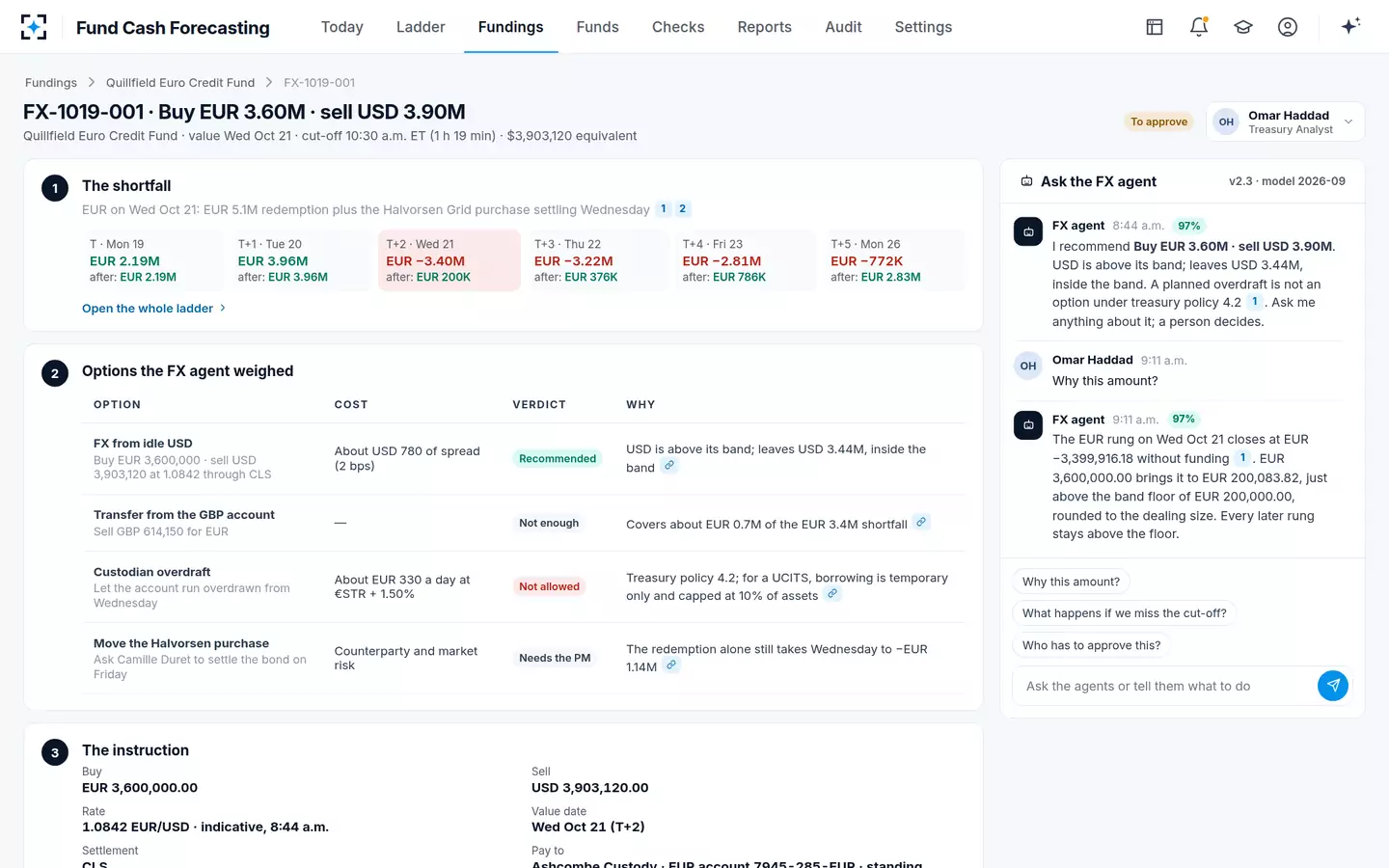
FX agent, 8:44 a.m.Weighs four ways to fund Wednesday and proposes buying EUR 3.60 million with USD 3.90 million of idle dollars through CLS, before the 10:30 a.m. cut-off.
Never: books, approves or releases, or proposes a planned overdraft
A person decides
Treasury analyst approves, 9:12 a.m.Asks why this amount, reads the answer, and approves with the reason code “Fund a projected shortfall”. Under USD 10 million, so no second approver.
A person decides
Payment operations releases, 9:15 a.m.A different person releases the instruction to the custodian against the verified standing instruction.
Agent
Checker and Reporting agents, 9:17 a.m.Match the custodian’s confirmation, re-sign the ladder with the release on it, and update the PM’s investable cash.
Never: shows an unsigned figure to a PM
What does a cash management AI agent do?
It turns overnight files into a decision a person can make in a minute. Fund treasury's inputs arrive in many formats and languages: camt.053 and MT940 custodian statements, CSV dealing reports, order tickets, PDF capital call notices in German or Korean, FX confirmations. A person can read them all; it takes most of a morning. An agent reads them as they land, keeps the original passage beside each value it extracts, builds the projection, checks it, and lays out what needs deciding, in order of deadline.
What separates a useful agent from a chatbot over a spreadsheet is the evidence. Every figure on the sample ladder opens to its source: the redemption to row 214 of 1,962 in the transfer agent's file received at 7:38 a.m., the bond purchase to its order ticket. When a figure is an estimate, it says so, with its method and confidence. And when the agent does not know, below an 80% confidence floor that the head of treasury sets, it says so and names the person who should.
Six agents, what each does, and what each never does
| Agent | Does | Never |
|---|---|---|
| Intake | Reads every flow overnight and through the morning, in the language it arrived, and chases late files | Edits a source |
| Forecast | Builds a ladder per fund and currency to T+5, labels each estimate with its method and confidence, re-runs when a file lands | Hides an estimate |
| Checker | Ties opening balances to the custodian, tests the ladder for arithmetic, duplicates, stale statements and misplaced cash | Changes a balance |
| FX | Proposes a funding for each rung below its floor before the currency’s cut-off, with the options it ruled out | Books, approves or releases; proposes a planned overdraft |
| Variance | Explains yesterday’s misses against actual cash, assigns what it cannot explain, proposes rules with back-tests | Turns on a rule |
| Reporting | Publishes signed investable cash to each PM for their own funds; prepares the committee report | Shows an unsigned figure |
Can a cash management AI agent move money?
It should not, and in this design it cannot. Moving a fund's money is the act that regulators, auditors and boards care most about, and the one where a confident wrong answer costs most. The sample firm's FX agent prepares the full instruction, buy EUR 3,600,000.00, sell USD 3,903,120.00 at an indicative 1.0842, value Wednesday 21 October, through CLS, to the custodian's euro account, and then waits. A treasury analyst approves it; a second approver is required above USD 10 million; payment operations releases it. One person can never approve and release the same funding.
The reason is not that the agent would get it wrong. In this case it was right. It is that a funding is a commitment of the fund's money and a choice between costs, and both need someone accountable. FINRA's 2026 oversight report names the risk directly: AI agents acting autonomously without human validation and approval, and agents acting beyond their intended scope and authority (FINRA, December 2025).
The funding decision as the analyst sees it
How does it choose and explain a funding?
By comparing the options a treasurer would, and writing down why each was or was not chosen. For Wednesday's EUR 3.4 million shortfall the FX agent weighed four. Buying euros with the fund's idle dollars would cost about USD 780 of spread and leave the dollar account inside its band: recommended. Moving sterling from the fund's GBP account would cover only about EUR 0.7 million: not enough. Letting the account run overdrawn at the custodian would cost about EUR 330 a day: not allowed under the firm's treasury policy, and for a UCITS an overdraft is borrowing, which Article 83 of the UCITS Directive permits only temporarily and up to 10% of assets (Directive 2009/65/EC). Asking the PM to move the bond purchase would still leave Wednesday short from the redemption alone: a PM decision.
The analyst asked one question, "Why this amount?", and the answer came from the ladder: EUR 3,600,000 brings Wednesday to EUR 200,083.82, just above the EUR 200,000 band floor, rounded to the dealing size, and every later rung stays above the floor. An explanation that a person can check in one line is the agent's real product. Why the overdraft option is ruled out is covered in the guide to fund overdrafts.
How does the agent explain a variance?
By finding the flow that differed and citing it. Each morning the Variance agent compares yesterday's projection with the custodian's actual cash for every ladder. On Friday 16 October, 597 of the sample firm's 612 ladders were inside the firm's tolerance of USD 25,000 or 0.02% of net assets. Of the 15 outside it, the agent explained 13 with their source: a US bond purchase whose settlement was moved earlier after the 6 p.m. forecast, a Hong Kong dividend paid net of 10% withholding where the forecast used the gross amount, a Japanese dividend credited on the issuer's date three days before the data vendor's, a euro subscription the transfer agent moved to Monday. Two remained open, each with an owner and a noon deadline.
When a cause repeats, the agent proposes a rule and back-tests it. For the dividends it proposed forecasting foreign dividends net of the treaty rate, with evidence from eleven similar misses in 90 days; for a habitually late Singapore file, using the last five dealing days rather than twenty, which cut the pattern error from 31% to 12% in a back-test from 3 August to 16 October. Neither rule is live until the head of treasury turns it on. How to measure forecast error and spot drift goes further into what those numbers should be.
What the agent does when a file is late
It says so, estimates in the open, and chases. On the sample morning the Singapore transfer agent's dealing report for six funds had not arrived. The Intake agent chased it at 8:00 and again at 8:45 a.m. against the expected-file calendar, and the Forecast agent built those six funds' ladders from a labelled estimate based on their recent dealing pattern. Those funds' figures were marked as estimates with their method, and the funds waited to be signed, so their PMs kept the previous signed figures rather than seeing a guess presented as checked cash.
When the file lands, the agents re-run the funds it touches, replace the estimates with booked orders and, if the difference is outside tolerance, show the change for a person to review. The behaviour matters more than the model. An agent that quietly fills a gap with yesterday's numbers produces a forecast that looks complete and is not; one that marks the gap, names the cause and tells the people waiting is one a treasury can rely on even on a bad morning.
Who approves FX and funding?
Named people, in a fixed order, under a written policy. In the sample firm a treasury analyst approves each funding with a reason code; a second treasury approver signs off above USD 10 million; payment operations releases; the custodian's confirmation is matched. Fundings under USD 10 million with agent confidence of 95% or more may be approved in bulk; anything else is skipped with its reason. Undecided fundings escalate to the cash management lead 30 minutes before the cut-off and to the head of treasury at 15.
Every one of those thresholds is a setting, proposed by an administrator and approved by the head of treasury, versioned and logged. The agents' own instructions and model versions are under the same change control, with evaluation results and rollback. That is the difference between an agent that a treasury governs and one that governs itself.
What is logged, and who can read it?
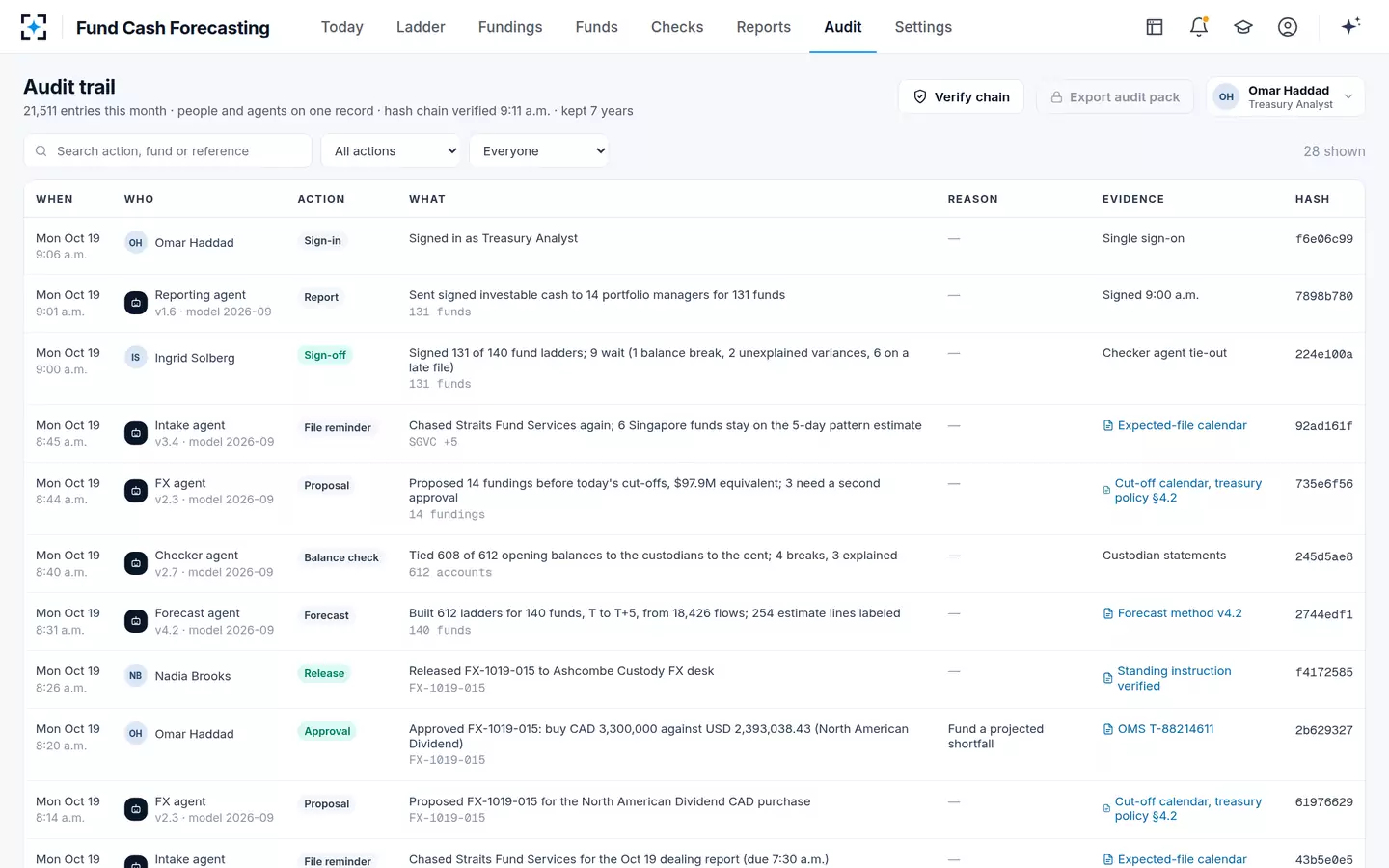
Everything that changes a number or moves money, with who, when, why and the evidence. The sample firm's audit trail held 21,511 entries for the month by 19 October: each forecast, sign-off, approval, release, override and setting change, by people and agents alike, with the agent's version and model, the reason code and a link to the evidence, on a hash chain that can be verified and is kept seven years. Internal audit, which used to piece together who decided what from email threads, can open any decision with its context.
People and agents on one audit trail
What regulators say about agent autonomy
They are watching, and they ask for human control, records and testing. FINRA's 2026 oversight report describes AI agents as systems that can carry out and complete tasks for a user on their own, and lists autonomy, scope and authority, and auditability and transparency among their risks (FINRA). The SEC's Division of Examinations, in its fiscal 2027 priorities, says registrants are increasingly using what it calls "super intelligence (SI)" and that it will prioritise examining policies and procedures for monitoring it, including in back-office operations (SEC, October 2026). ESMA warned in 2024 against over-reliance on AI for decisions at the expense of human judgment (ESMA).
Operations is where UK financial firms use AI most
22%
of reported AI use cases are in operations and IT, the largest area
55%
of use cases involve some degree of automated decision-making
2%
of use cases have fully autonomous decision-making
The survey's last figure is the telling one. Firms use AI widely in operations, often with some automated decisions, but almost never let it decide alone. A treasury agent that proposes and explains, with people approving and releasing, sits where most of the industry already is, and where examiners will expect a firm to be able to show its controls.
Questions to ask before you buy one
Buy for evidence and control, not for autonomy. The questions below separate an agent that a treasury can defend from one it will have to explain.
Eight questions for any cash management AI agent
- Can it show the source line for every number?
Row, ticket, statement entry or notice page, opened in one click, in the original language beside the reading.
- Does it mark estimates and say how they were made?
Method and confidence on every estimated flow; an honest “I do not know” below a floor you set.
- Can it move money?
The right answer is no. Ask to see the permissions that stop it, not the instructions that ask it not to.
- Does it know each currency’s cut-off and route?
Custodian deadlines, CLS or local sub-custodian, and the holidays that move them.
- Does it tie opening balances before anyone signs?
A forecast built on a wrong balance is wrong all week.
- Does it explain yesterday’s misses?
With causes and sources, and rules proposed with back-tests that a person approves.
- Is every action on an audit trail?
People and agents, with versions, reasons and evidence, in a form you can export and keep.
- Does it work with your systems as they are?
Custodian, transfer agent, order management, accounting, FX platform: read where they are, without replacing them.
For the integration questions, cash projection software beside the systems you already run sets out the feeds and the parallel run, and a fund treasury analyst's morning shows what the agents change about the desk.
Questions people ask
What is an AI agent in cash management?
A program that carries out a sequence of treasury tasks on its own, such as reading statements and files, building a cash projection and proposing fundings, rather than answering one question at a time. In fund treasury the tasks are bounded: agents read, calculate, propose and explain, while people approve and release.
How is AI used in cash forecasting?
To read inputs that arrive in many formats and languages, to estimate flows that have not been booked from a fund's own patterns, and to explain the difference between forecast and actual cash. The largest gain is usually in reading and checking, not in the statistical model.
Can an AI agent approve an FX trade?
It can be built to, but it should not be for a fund's money. Approval is a decision between costs that a named person should own, with a reason, and regulators' guidance on AI stresses human validation. In Fund Cash Forecasting no agent holds approval or release rights.
What if the agent is wrong?
The approving analyst sees the shortfall, the options and the sources, and can ask why before approving. The next morning the variance agent compares the forecast with actual cash, and repeated causes become rules only after a back-test and the head of treasury's approval.
Does a cash management AI agent replace the treasury analyst?
It replaces the assembly of the morning, not the decisions. Botminds' estimate, from the solution's design, is that one desk's morning falls from about seven hours of mostly assembly to about one hour of mostly decisions, an estimate rather than a measured result.