The CLS settlement process settles both currencies of a foreign exchange trade simultaneously, on payment-versus-payment terms, across accounts its settlement members hold with it, so that neither side can pay away one currency without receiving the other. Trades are submitted before midnight Central European Time at the start of the settlement day, settled from 07:00 CET, and funded by members' net pay-ins through the morning, which is the middle of the night in New York. For a fund that buys US securities with another currency, US T+1 squeezes the time to trade and instruct that FX into the hours after the US close. Botminds' Fund Cash Forecasting projects each fund's cash by currency and day, and plans each funding against that currency's cut-off and settlement route before the time runs out.
The CLS timetable here is the one the Bank for International Settlements' payments committee set out in 2008; confirm current deadlines with your custodian or settlement bank. Sample figures come from a fictional firm, Quillfield Capital, running 140 funds in 25 currencies through the solution.
From the US close to CLS settlement: about two hours to get the FX in
- To the CLS deadline2 h
- Waiting for the settlement day7 h
- CLS settles trades2 h
- Members complete pay-ins3 h
- Allocate, confirm, affirm by end of trade date8 h
- Overnight, before US settlement on T+16 h
What is CLS settlement?
CLS settlement is the main way the world's large FX trades settle without principal risk. ESMA describes CLS as a private financial infrastructure that operates "the global central multicurrency cash settlement system, used to settle foreign exchange transactions on a payment versus payment (PvP) basis, currently in 18 eligible currencies and on a T+2 cycle" (ESMA, November 2024). The BIS defines the protection simply: in a PvP mechanism, "the final payment of one currency occurs if, and only if, the final payment of the other currency takes place" (BIS Quarterly Review, December 2022).
It is large. In the BIS's April 2022 survey, USD 2.5 trillion of FX turnover a day was settled through CLS, and the BIS payments committee calls its settlement service "the only PvP arrangement with global reach" (CPMI, March 2023). Most funds are not CLS members. They reach it through their custodian or a settlement bank that is, which is why a fund's real deadline is that bank's FX desk cut-off, earlier than CLS's own.
FX settlement, by the BIS's count
$2.5T
of FX turnover a day settled through CLS, April 2022
18
currencies CLS settles, the most of any PvP arrangement
$2.2T
a day still settled with risk, almost a third of deliverable turnover
How does the CLS settlement process work through the day?
In four steps: submit, settle, pay in, pay out. The BIS payments committee's 2008 account of the daily cycle is still the clearest public description (CPSS, 2008, Annex 4). Trades "must normally be submitted by the members to CLSB before midnight (Central European Time) at the beginning of the settlement day." From 07:00 CET trades settle one by one across members' accounts, each debiting the currency sold and crediting the currency bought, and "Settlement of all trades submitted is normally completed by 09:00 CET."
Funding is netted. Members pay in only their net short position in each currency, either in one payment by 08:00 CET or in instalments until 10:00 CET for Asia-Pacific currencies and 12:00 CET for the rest. Netting, with in/out swaps between members, "reduces pay-ins and pay-outs to less than 2% of the gross value." That is why CLS saves liquidity as well as removing principal risk, and why its window has to sit where the central banks of all its currencies are open: "very early in the morning in North America (eg 01:00 to 06:00 in New York for most of the year)."
The window is also why same-day FX rarely goes through CLS. The same report noted that "Most same day trades cannot be settled through CLS because trades have to be submitted to CLS by 06:30 CET on settlement day." For a fund, the practical rule is that an FX trade for value tomorrow has to be agreed, confirmed and instructed today, in time for its bank to submit it before midnight in Frankfurt.
Why does US T+1 squeeze FX funding for funds outside the US?
Because the securities now settle a day after the trade while spot FX still settles two days after, so the FX that pays for a US purchase has to be traded for a shorter value date, in the few hours after the US close. A non-US fund buying US equities at the close on Monday has to deliver dollars on Tuesday. If it waits for the trade to be confirmed before it buys the dollars, as it would have under T+2, it is trading FX at the end of the New York day for value the next morning, with the CLS submission deadline at 6 p.m. New York time.
The SEC heard this in comments and accepted the point. One commenter described "the lack of time between the closure of the equity markets (at 4:00 p.m. ET in the U.S.) and the time when U.S.-based FX trading desks close for the evening (usually an hour or so later)" (88 FR 13872). The Commission said market participants could adapt, for example by extending FX desk hours or pre-funding, and admitted it could not size the problem: it was "unable to quantify the fraction of securities trades that depend on a corresponding FX transaction," because it knew of no data on how securities trades are funded.
"The Commission recognizes that financing U.S. market transactions that settle on T+1 with the proceeds of an FX transaction that settles on T+2 may become more difficult, and therefore more costly, than financing of T+2 transactions is today."
SEC, T+1 adopting release, March 2023
The options the SEC listed are the options a fund treasury has. Extend the FX desk's hours or hand over to another time zone. Pre-fund: hold the currency before the trade, which is cash drag by another route. Borrow for a day and repay from a later sale, at a day's interest. Or, in the SEC's words, "redeem money market positions, or rely on other financial resources." Each costs something; the cheapest depends on knowing, before the close, how much of which currency each fund will need.
What are the cut-offs a fund actually works to?
The fund's cut-off is its custodian's or settlement bank's deadline for accepting an FX instruction for a value date, which is earlier than the CLS deadline and differs by currency and route. ESMA put the European version plainly: "Each country has its own local currency cut-off time for same-day currency payments, which determines whether an FX transaction can be settled on time" (ESMA, 2024). Currencies outside CLS settle through local sub-custodians, often with earlier deadlines and local holidays.
One morning's funding deadlines at a sample fund treasury, New York time
| Cut-off (ET) | Currencies | What was due on Monday 19 October |
|---|---|---|
| 7:00 a.m. | INR | Passed: an India fund’s rupee purchase for value Tuesday, released at 6:52 a.m. |
| 10:30 a.m. | EUR, GBP, SEK, CHF, ZAR | Euro, sterling, krona, franc and rand fundings for value Wednesday and Friday, including the euro credit fund’s EUR 3.60 million |
| 11:00 a.m. | USD, BRL | A USD 12 million facility draw for a private credit fund, above the second-approval threshold |
| Local, moves with holidays | KRW and other restricted currencies | On 8 October Seoul’s Hangeul Day holiday moved the sub-custodian’s deadline to 5:00 p.m. Seoul; the fund drew its facility for a day |
A good funding calendar therefore holds three things per currency: the bank's cut-off for each value date, the route, and the holidays that move either. The sample firm's fix after the KRW miss was to fund restricted currencies a business day earlier. What happens to a fund that misses a funding is set out in the guide to fund overdrafts.
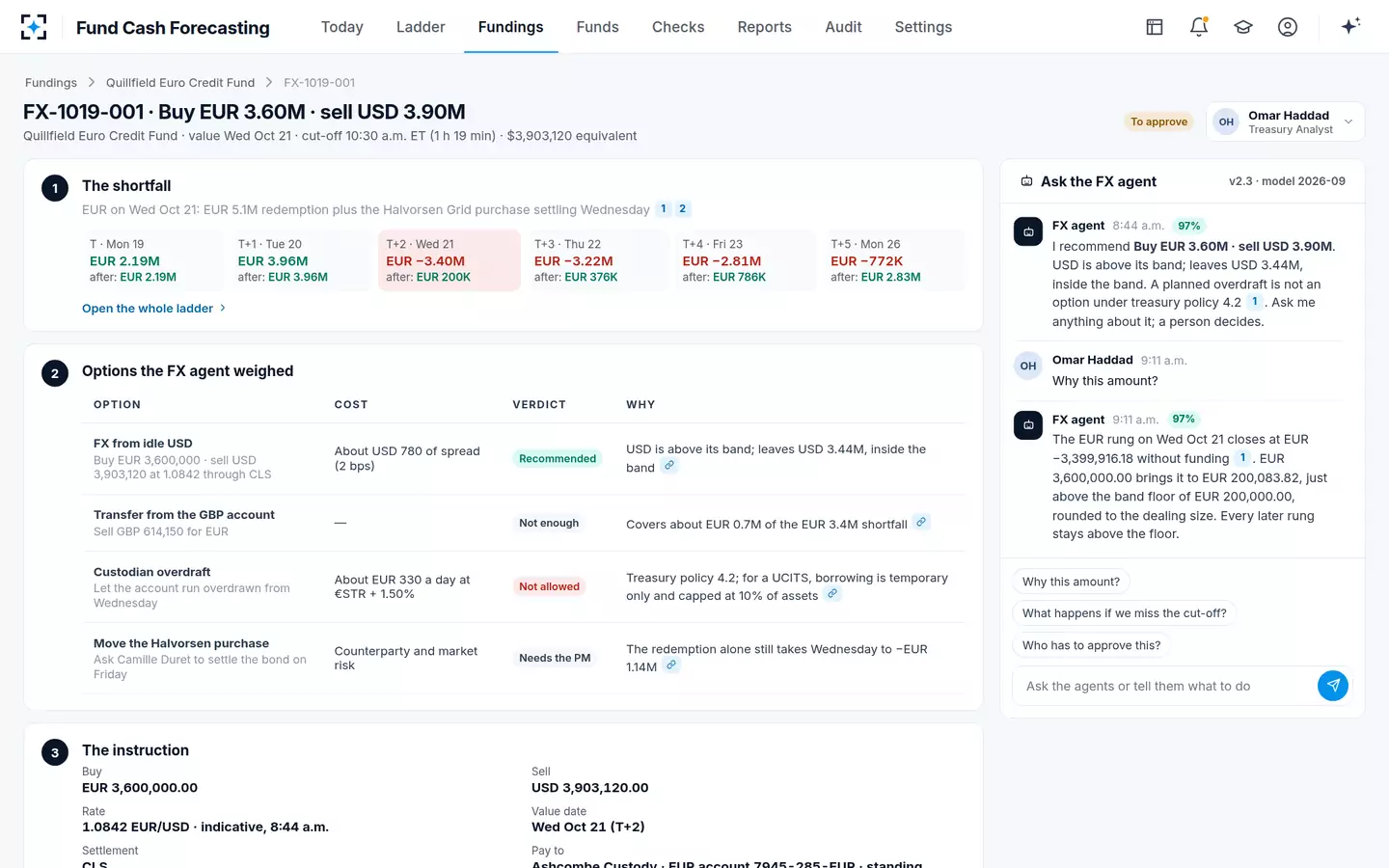
An FX funding instructed for settlement through CLS
What do the EU and UK T+1 plans say about FX?
Both move to T+1 on 11 October 2027, and both recognise FX as a pinch point. The EU's amendment to the CSD Regulation applies from that date (Regulation (EU) 2025/2075). The UK government has committed to legislate for T+1 from the same day, has published a draft statutory instrument, and says it intends to lay the final one in advance of that date (HM Treasury).
ESMA's 2024 assessment described today's practice and what has to change. FX is usually booked once the securities trade is confirmed, so "oftentimes the FX transaction is executed on T+1 and is settled on T+2 together with the securities transaction"; under T+1, "FX transactions should be executed earlier," and "The use of CLS might be more challenging in this environment" (ESMA, paras 103–104). For investors in other time zones it listed the available solutions, "prefunding, executing FX trades before confirmation of the securities transaction, bilateral FX trading, auto forex and other solutions provided by third parties such as custodians," and noted that they "would entail additional costs." Looking at the US move, ESMA found that "Nothing seems to indicate the materialisation of any negative impact on FX markets."
The UK Technical Group's plan has three FX actions. FX 01 keeps an industry workstream reviewing the US experience. FX 02: market participants "will review their practices to reduce FX settlement risk, in line with the FX Global Code, for any FX trades settling outside of PvP mechanisms." FX 03: "To ensure that CLS eligible FX transactions continue to settle in CLS, market participants must continue to engage with CLS/custodians and assess their instruction methods (e.g. cut-off alignment after UK market close, functions available to accommodate currency holidays etc)" (Accelerated Settlement Technical Group, February 2025). Both run to 11 October 2027 and beyond. The plan is an industry plan commissioned by government, not law.
What happens when an FX trade misses CLS?
It settles some other way, or later, and either costs risk or cash. If the bank cannot submit the trade to CLS in time, the two legs can settle bilaterally outside PvP, which means the fund or its bank pays one currency before it is sure of receiving the other: the principal risk CLS exists to remove. The BIS estimated that USD 2.2 trillion of FX a day was still settled that way in April 2022, and noted that existing PvP arrangements "may not operate within a time window that matches periods of peak liquidity" (BIS, 2022).
Funding a T+1 purchase through CLS, and outside it
Through CLS: None: each currency is paid only if the other is received.
Outside CLS: One leg is paid before the other is certain, unless both sit with one bank with loss protection.
Through CLS: Bank submits before midnight CET on the eve of value; the fund’s cut-off is the bank’s, earlier.
Outside CLS: The local payment system’s same-day cut-off, often later in the day.
Through CLS: Netted pay-ins, a small fraction of gross value.
Outside CLS: Gross payment of the full amount in each currency.
Through CLS: 18 eligible currencies.
Outside CLS: Any currency, including restricted ones through local sub-custodians.
Through CLS: Planned FX for value on the securities settlement date.
Outside CLS: Late trades, same-day trades, ineligible currencies.
If the FX cannot settle on the value date at all, the securities purchase is short of currency. The fund's account goes overdrawn for a day, the custodian lends the difference, or the purchase fails to settle. Each is a worse outcome than a funding planned the day before, which is why the deadline has to be in the forecast and not only in the FX dealer's head.
Why the US liquidity rule treats foreign currency as an investment
For a US open-end fund, an FX balance is not cash until it is converted. In its 2024 guidance the SEC restated that cash in Rule 22e-4 means US dollars, not foreign currency, so a fund must consider the time to convert a currency to dollars when classifying an investment's liquidity (89 FR 73764). The CLS cut-off is part of that time: a currency that cannot be converted for value tomorrow because the window closed this evening is a day less liquid than it looks. How investable cash is built currency by currency applies the same idea to the PM's morning number.
Building the forecast around the cut-off
A forecast that knows the deadlines can do something a spreadsheet rarely does: tell treasury, early, which fundings must be decided by when. The solution's FX agent plans a funding for each projected shortfall before its currency's cut-off, from a calendar of 25 currencies with the custodian FX desk's cut-off and settlement route for each: from idle cash in another currency, a transfer between the fund's own accounts, a facility draw, or asking the PM to move a trade. It never books, approves or releases a funding, and never proposes a planned overdraft.
Fundings grouped by cut-off, with the time left
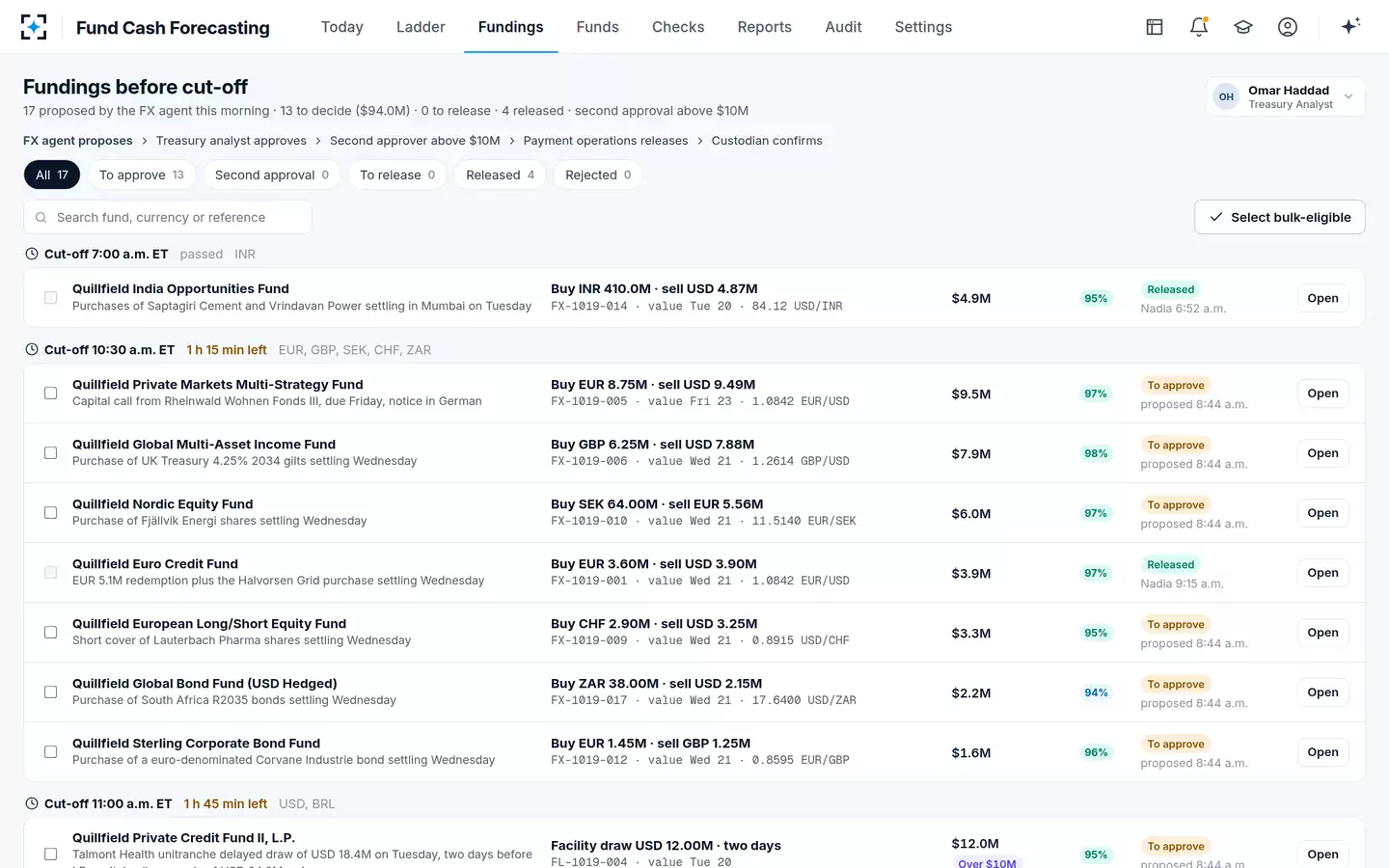
The order of the screen is the order of the morning. Rupees went first, at 7:00 a.m.; the European currencies close at 10:30; dollars at 11:00. A treasury that sees its fundings by cut-off, with the time left beside each, spends its attention where the clock is shortest. A fund treasury analyst's morning follows the same clock from the overnight files.
Questions people ask
What is CLS in banking?
CLS is the multicurrency settlement system that settles FX trades on a payment-versus-payment basis, so neither party pays one currency without receiving the other. It settles 18 currencies, more than any other PvP arrangement, and settled USD 2.5 trillion of FX a day in April 2022, according to the BIS.
What time is the CLS settlement window?
As the BIS payments committee described it, trades are submitted before midnight CET at the start of the settlement day, settle from 07:00 CET and are normally completed by 09:00 CET, with pay-ins until 10:00 CET for Asia-Pacific currencies and 12:00 CET for others. That is roughly 1:00 to 6:00 a.m. in New York. Check current deadlines with your bank.
Who are CLS settlement members?
Settlement members are banks that hold a multicurrency account with CLS and settle for themselves and for their customers. Funds and asset managers usually reach CLS indirectly, as third parties of a settlement member, often their custodian, and work to that bank's earlier cut-off.
Does CLS settle T+1 FX trades?
CLS settles trades for the value date they are submitted for, provided they arrive before the deadline for that day. A T+1 FX trade agreed on Monday for value Tuesday can settle in CLS if the bank submits it before midnight CET on Monday. Same-day trades mostly cannot, because of the window's timing.
How do funds avoid missing FX cut-offs under T+1?
By knowing the need earlier. Projecting each fund's cash by currency before the trade, pre-funding predictable needs, executing FX before the securities trade is confirmed where the risk is acceptable, and keeping a cut-off calendar per currency, route and holiday are the measures ESMA and the SEC both describe.