A fund overdraft happens when a fund's cash account at its custodian closes the day below zero: the custodian has paid out more than the account held and lends the difference, at interest, until it is covered. For a mutual fund or a UCITS it is more than a cost, because both regimes limit how and how much a fund may borrow, and an overdraft looks like borrowing. Most overdrafts are unplanned: they are the visible result of a flow the cash forecast missed. Botminds' Fund Cash Forecasting projects every account to five business days ahead, proposes a funding for each projected shortfall before that currency's cut-off, never proposes a planned overdraft, and traces each one that still happens to its cause.
The sample figures come from a fictional firm, Quillfield Capital, running 140 funds through the solution in October 2026. Statutes and rules are quoted from their official text and linked.
From a missed flow to an overdraft to a borrowing check
- 1A flow is missed
A trade amended after the forecast, a delivery that fails, a market holiday that moves a cut-off, a dealing file that lands late.
- 2The account closes below zero
The custodian pays out anyway and charges interest on the debit balance until it is covered.
- 3Is it a borrowing?
For a US open-end fund, section 18 allows bank borrowing with 300% asset coverage. For a UCITS, only temporary borrowing up to 10% where the home state allows it.
- 4Check the limits and the policy
Asset coverage, the 10% ceiling, the fund’s own stated borrowing policy and the treasury policy that may forbid overdrafts outright.
- 5Trace it to the forecast
Which flow did the projection miss, why, and what rule would have caught it? Fix the cause, not just the balance.
What is a fund overdraft?
A fund overdraft is a negative closing balance in one of a fund's cash accounts, in one currency, on one day. It can be intraday, covered before the close, or overnight, which is the kind that is charged and reported. It is account by account: a fund can be overdrawn in euros while holding millions of dollars, because the dollars cannot pay a euro debit without an FX trade that settles on its own date.
There are two kinds, and they deserve different treatment. A planned overdraft is one treasury chose, because borrowing from the custodian for a day looked cheaper than the alternatives. An unplanned overdraft is one nobody chose: a flow arrived that the forecast did not show, or a funding missed its cut-off. Many treasury policies, including the sample firm's, forbid the first kind outright; the second kind is what this guide is mostly about.
Can a mutual fund go overdrawn? The 1940 Act's borrowing rules
A US open-end fund may not issue senior securities, with one exception: it may borrow from a bank, provided that immediately afterwards its asset coverage for all borrowings is at least 300% (Investment Company Act §18(f)(1)). If coverage later falls below 300%, the fund must, "within three days thereafter (not including Sundays and holidays)," reduce its borrowings until coverage is restored. Asset coverage is total assets, less liabilities other than senior securities, divided by the senior securities representing indebtedness (§18(h)); by our arithmetic, 300% coverage allows borrowing of up to half the fund's net assets.
The Act also carves temporary loans out of "senior security." When used in section 18, the term does not include a note "in any case where such a loan is for temporary purposes only and in an amount not exceeding 5 per centum of the value of the total assets of the issuer at the time when the loan is made," and "A loan shall be presumed to be for temporary purposes if it is repaid within sixty days and is not extended or renewed" (§18(g)). How that carve-out sits with the bank-only rule for open-end funds, and whether a given custodian overdraft is a loan for these purposes, are questions for fund counsel; the conservative working assumption is that an overdraft is a borrowing and counts.
The SEC watches borrowing through reporting. Since the 2016 liquidity reforms, Form N-CEN asks each open-end fund whether it has a line of credit, whether it is committed, how much was drawn on average and "the number of days that the line of credit was in use," and whether it engaged in interfund lending or borrowing (81 FR 82142). The liquidity rule also asks funds to consider their "borrowing arrangements and other funding sources" when they assess liquidity risk (Rule 22e-4(b)(1)(i)(C)).
What are the UCITS borrowing limits?
A UCITS may not borrow, except as Article 83 allows. A Member State may authorise a UCITS to borrow "on a temporary basis," up to 10% of its assets for an investment company or 10% of the value of the fund for a common fund; borrowing to buy immovable property essential to its business is a separate 10%, and the two together may not exceed 15% (Directive 2009/65/EC, Art. 83). The same article adds one exception that matters for treasury: "A UCITS may, however, acquire foreign currency by means of a 'back-to-back' loan."
Borrowing limits for a US open-end fund and a UCITS, side by side
US open-end fund (1940 Act): No senior securities, except borrowing from a bank (§18(f)(1)).
UCITS (Directive 2009/65/EC): A UCITS shall not borrow (Art. 83(1)).
US open-end fund (1940 Act): Asset coverage of at least 300% for all borrowings, immediately after borrowing.
UCITS (Directive 2009/65/EC): Up to 10% of assets, temporarily, where the home Member State authorises it (Art. 83(2)(a)).
US open-end fund (1940 Act): Reduce borrowings within three days, not counting Sundays and holidays, until coverage is 300%.
UCITS (Directive 2009/65/EC): The Directive sets the ceiling; national rules and the fund documents set the remedy.
US open-end fund (1940 Act): Loans for temporary purposes up to 5% of total assets are carved out of “senior security” in section 18; repaid within 60 days is presumed temporary (§18(g)).
UCITS (Directive 2009/65/EC): All permitted borrowing for liquidity is temporary by definition.
US open-end fund (1940 Act): No specific provision in section 18.
UCITS (Directive 2009/65/EC): Foreign currency may be acquired through a back-to-back loan (Art. 83(1)).
US open-end fund (1940 Act): Board and annual Form N-CEN reporting of lines of credit and interfund borrowing.
UCITS (Directive 2009/65/EC): The depositary, which monitors the UCITS’ cash flows daily, and the competent authority.
A depositary is expected to notice. The 2016 delegated regulation on UCITS depositaries requires the depositary to spot, at the end of every business day, significant cash flows and any that look out of line with the fund's operations, and to reconcile cash flow movements daily (Delegated Regulation (EU) 2016/438, Art. 10). Its recitals put the matching duty on the fund: the UCITS "should ensure that the depositary receives without undue delay accurate information related to all cash flows." An overdraft the fund did not see coming is, by definition, a cash flow it did not tell the depositary about in advance.
What does a custodian overdraft cost?
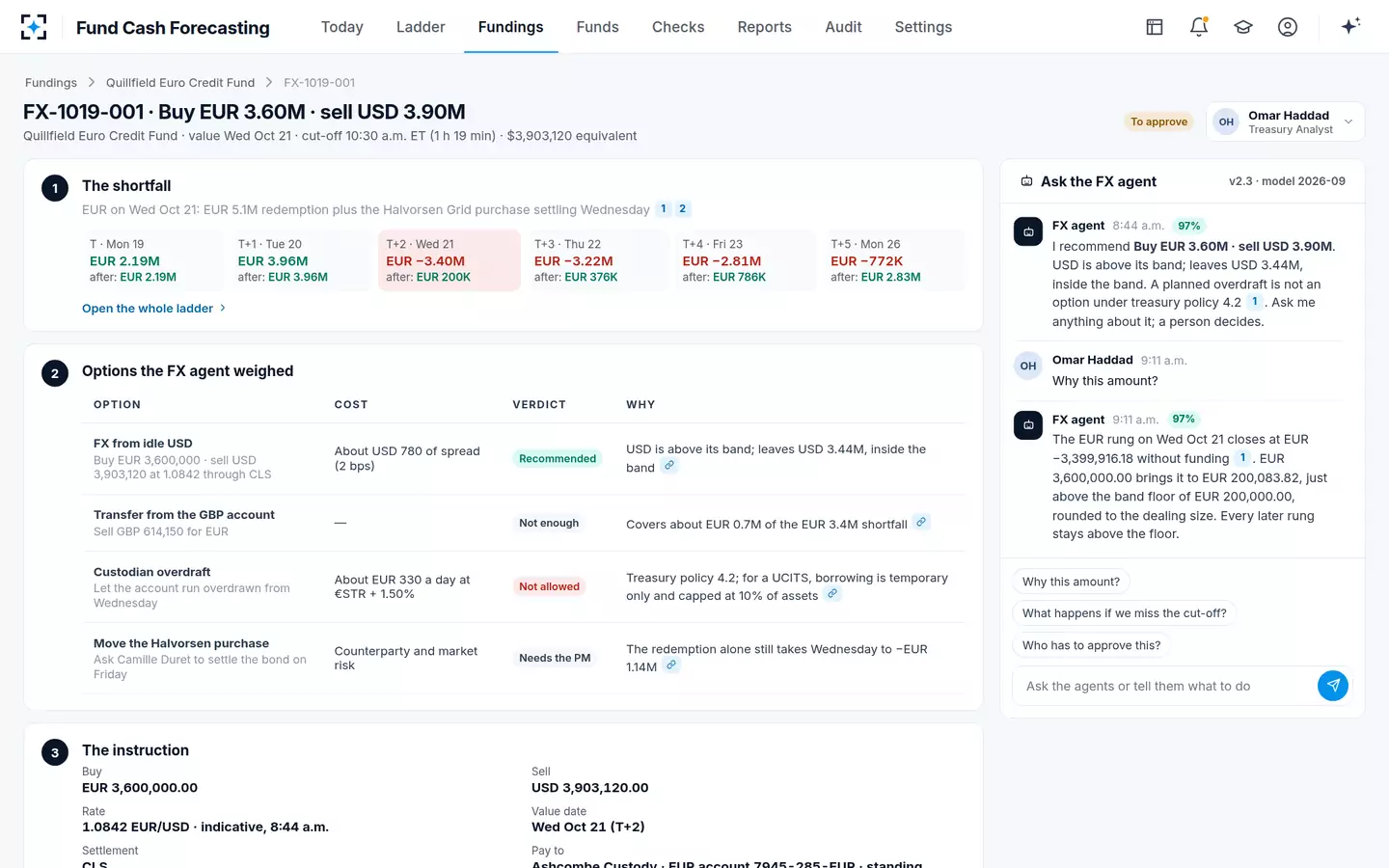
The direct cost is interest for the days the account is negative, at the custodian's rate, usually a reference rate plus a margin. In the sample firm's options for a EUR 3.4 million euro shortfall, the custodian overdraft was priced at about EUR 330 a day at €STR plus 1.50%, against about USD 780 of FX spread to fund it from the fund's idle dollars instead. A day's overdraft can look cheap next to a spread. That comparison is the trap.
The full cost includes what the overdraft risks. For a UCITS it uses headroom under a 10% limit that exists for liquidity emergencies. For a US fund it may count against asset coverage and the fund's own borrowing policy. And the SEC's view of the economics is plain: when funds sell or borrow to meet redemptions, "there are costs (such as interest rates) associated with such borrowings," costs "that would be borne mainly by non-redeeming shareholders" (81 FR 82142). In its T+1 release the SEC described the simplest version of this trade: borrow to meet payment obligations on T+1 and repay the next day from a sale of securities, "incurring the cost of one day of interest" (88 FR 13872).
One month of overdrafts and fundings at a sample firm
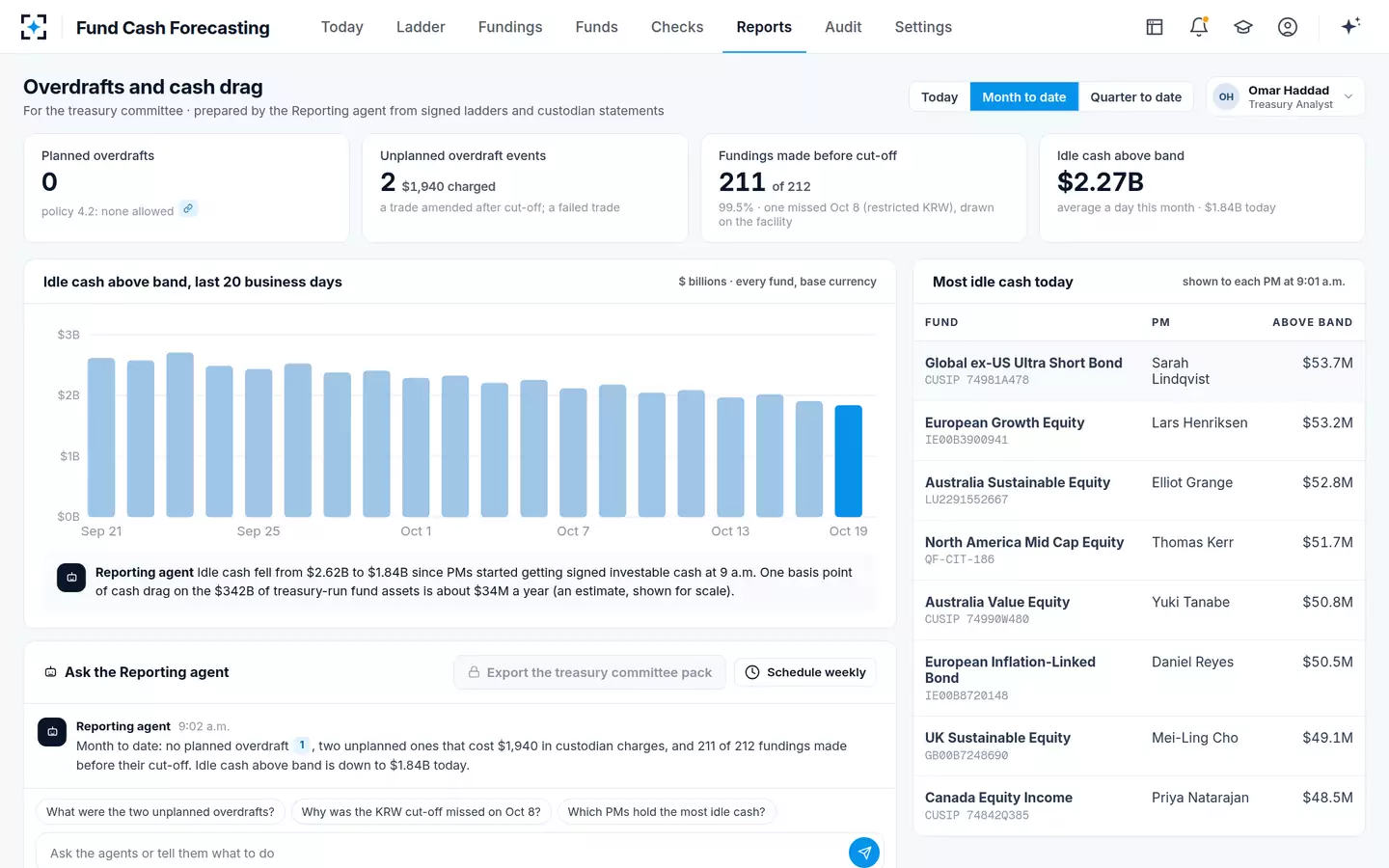
0
planned overdrafts; the sample firm’s treasury policy allows none
2
unplanned overdraft events, USD 1,940 charged by custodians
211of 212
fundings made before their currency’s cut-off
What causes unplanned overdrafts?
Almost every unplanned overdraft is a forecast miss with a deadline attached. The flow was either not in the projection, in it at the wrong amount or date, or in it correctly but funded too late for the currency's cut-off. The table lists the common causes, each with the sample firm's own example where it had one.
Why fund accounts go overdrawn, and what would have caught it
| Cause | Sample example | What would have caught it |
|---|---|---|
| Trade amended after the forecast | One of the month’s two overdrafts: a trade amended after the currency’s cut-off | Reading amendments as they are booked and re-running the fund’s projection |
| Failed trade | The other overdraft: a trade that failed to settle as projected | Treating expected proceeds in a thin account as uncertain until settled, and watching settlement status |
| A market holiday moves a cut-off | Seoul closed for Hangeul Day on 9 October; the Korean sub-custodian moved its KRW deadline to 5:00 p.m. Seoul and the notice arrived after the build | A cut-off calendar with each restricted currency’s local deadline, funded a business day earlier |
| Transfer agent file late | Six Singapore funds ran on pattern estimates until the file landed | Chasing the file on a schedule and labelling the estimate |
| Income booked gross | A foreign dividend paid net of 10% withholding | Projecting income net of the withholding rate that applies |
| Capital call or margin call missed | A German capital call arrived Friday afternoon by email | Reading notices in their own language as they arrive |
The KRW case shows why the forecast has to carry more than amounts. Restricted currencies settle through local sub-custodians with their own deadlines, and a public holiday can move a deadline at a day's notice. The sample firm's fix was a rule, approved by its head of treasury, to fund restricted currencies a business day earlier. The CLS settlement process and the FX cut-offs a fund works to explains why the deadline for an FX funding falls hours, not days, before the payment.
The planned alternatives: lines of credit, interfund lending, FX and timing
A projected shortfall has better answers than an overdraft, and the SEC listed most of them. In its T+1 release it noted that mutual funds whose share settlement does not match their portfolio settlement "may manage these particular liquidity needs by, among other methods, using cash reserves, back-up lines of credit, or interfund lending facilities to provide cash to cover the settlement mismatch" (88 FR 13872). Interfund lending needs an exemptive order, and the 2016 release explains its typical use: a timing mismatch "between when a fund is required to pay redeeming shareholders and when any asset sales that the fund has executed in order to pay redemptions will settle" (81 FR 82142).
Lines of credit are a backstop more than a tool: the same release observed that a fund may obtain cash through bank lines of credit, "but funds infrequently utilize this method to meet redemptions." For a fund with cash in several currencies, the everyday answer is usually the cheapest: an FX trade from a currency that is above its band, a transfer between the fund's own accounts in the same currency, or asking the PM to move a purchase. The sample euro shortfall was funded by selling USD 3.90 million for EUR 3.60 million through CLS, which left the dollar account inside its band.
Four ways to fund a shortfall, with the overdraft ruled out
Capital calls and Rule 18f-4's sufficient-cash test
For a US fund that commits capital to private funds or to future loans, the overdraft question arrives early. Rule 18f-4 lets a fund enter an unfunded commitment agreement only if it "reasonably believes, at the time it enters into such agreement, that it will have sufficient cash and cash equivalents to meet its obligations with respect to all of its unfunded commitment agreements, in each case as they come due" (17 CFR 270.18f-4(e)). The rule's definition covers a capital commitment to a private fund "that can be drawn at the discretion of the fund's general partner."
Two details make this a forecasting obligation. In forming its belief the fund must take into account its other obligations, "including any obligation with respect to senior securities or redemptions," and may not count cash from selling investments at prices that deviate significantly from market value, or from issuing new shares. And it must document the basis for the belief and keep it for five years. A fund that draws its credit line to meet a capital call it did not see coming has a cash forecasting problem and, possibly, a documentation problem. Botminds' plain-words guide to Rule 18f-4 covers the rest of the rule.
Overdrafts reported beside idle cash, for the treasury committee
Who needs to know about an overdraft?
Inside the firm, the treasury committee should see every overdraft, planned or not, with its cause, cost and fix; the head of treasury should see it the same morning. For a UCITS, the depositary will see it in its own daily cash monitoring, and a fund that tells the depositary first is in a better position than one that is asked. For a US fund, borrowings feed the annual Form N-CEN answers and any board reporting the fund's own policies require. If a borrowing pushes asset coverage below 300%, the three-day clock in section 18(f) starts.
Questions for reviewing any fund overdraft
- Was it planned?
If yes, who approved it, against which policy, and why was it cheaper than FX, a transfer or moving a trade?
- Which flow caused it?
Name the trade, order, notice or failed delivery, and whether it was in the morning projection.
- Was the cut-off known?
Check the currency’s funding deadline on that day, including holidays and the sub-custodian’s own deadline.
- How large, how long, at what cost?
Debit balance, number of days, rate and interest charged.
- What did it do to the limits?
For a UCITS, the share of the 10% temporary borrowing limit used; for a US fund, asset coverage and the fund’s stated borrowing policy.
- Who was told, and when?
Head of treasury, depositary or custodian relationship manager, compliance, as the fund’s procedures require.
- What changes?
A rule, a calendar entry, a file chase, a tolerance. An overdraft without a fix will recur.
The last question is the one that moves the numbers. Each overdraft is a free lesson in what the forecast does not see, and a firm that turns each into a rule ends up with fewer of them. How to measure forecast error over time shows how to tell whether that is happening, and what an idle buffer costs is the price of avoiding overdrafts by holding more cash instead.
Questions people ask
Is an overdraft a borrowing for a mutual fund?
The Investment Company Act does not use the word overdraft. An overdraft is a credit extended by the custodian, usually a bank, and the conservative working assumption is to treat it as a borrowing that counts toward section 18's asset coverage and the fund's own borrowing policy. Whether the 5% temporary-loan carve-out in section 18(g) applies to a particular overdraft is a question for counsel.
What is the UCITS borrowing limit?
Ten per cent of assets, for temporary borrowing that the UCITS' home Member State authorises, under Article 83(2)(a) of the UCITS Directive. Borrowing for immovable property is a separate 10% for investment companies, and the two together may not exceed 15%. Back-to-back loans to acquire foreign currency are allowed separately.
Can a fund use a credit line instead of an overdraft?
Yes, and a committed line is the usual backstop for redemptions and settlement mismatches. It is still borrowing, it counts toward the same limits, and Form N-CEN asks US funds how many days each line was used. The SEC noted in 2016 that funds infrequently use bank lines to meet redemptions.
What happens if asset coverage falls below 300%?
Under section 18(f)(1), the fund must reduce its borrowings within three days, not including Sundays and holidays, or a longer period the SEC sets by rule, so that coverage is at least 300% again. Coverage can fall without new borrowing, if the fund's assets fall in value.
How can treasury prevent fund overdrafts?
Project every account to the end of the settlement horizon, by currency; fund each projected shortfall before that currency's cut-off from the fund's own idle cash, a transfer or an approved facility; read amendments, notices and dealing files as they land; and trace every overdraft that still happens to its cause.