The cash projection methods a fund uses fall into two families, and a good projection uses both. Scheduled flows, such as settling trades, coupons, fees, FX and notices that have arrived, are taken from the system or document that booked them and placed on their settlement date. Unscheduled flows, mainly subscriptions and redemptions not yet dealt, margin calls and capital calls not yet noticed, are estimated from the fund's own patterns and shown as a range rather than a single number. Botminds' Fund Cash Forecasting builds both kinds into one cash ladder per fund and currency each morning, cites the source of every booked flow, and labels every estimate with its method and confidence.
The examples come from a fictional sample firm, Quillfield Capital, whose treasury projects cash for 140 funds in 25 currencies; the morning is Monday 19 October 2026. Rules and research are linked where they appear.
Scheduled flows are known for weeks; trades and dealing only a day or two ahead
- Known from the fee schedule10 d
- Known from the bond’s terms10 d
- Estimated from the commitment5 d
- Known from the notice5 d
- Estimated from the dealing pattern8 d
- Dealt2 d
- Not yet traded9 d
- Traded1 d
What cash projection methods do funds use?
Funds use a scheduled method for flows that exist and a statistical method for flows that do not exist yet, and the skill is in the boundary between them. A purchase executed this morning is a scheduled flow: its amount, currency and settlement date are on the trade ticket. Tomorrow's redemptions are a statistical flow until the transfer agent's dealing report arrives, and then they become scheduled. A projection that treats everything as scheduled understates the uncertainty; one that estimates what could be read wastes accuracy.
Within the statistical family the common methods are simple, and simple is usually right. The plainest is a recent average of net flows for the same fund and share class, often by weekday or by dealing day. Next comes a seasonal adjustment for month-end, quarter-end, distribution dates and known calendar events. Then come overlays that only a person or a document can provide: a large holder's notice of a redemption, a PM's planned trade, a capital call schedule from a limited partnership agreement. Elaborate time-series models are rarely worth their opacity at a one-week horizon, where the booked flows dominate.
The order of work matters more than the model. Read every source first, so that what can be known is known; estimate only the remainder; then compare yesterday's projection with today's actual cash and learn from the difference. Measuring that forecast error, flow type by flow type, is how a fund finds out which of its estimates deserve the name.
Which flows are known and which are forecast?
Known flows come from systems and documents; forecast flows come from history and people. The table sorts a fund's cash flows by where they come from, how the solution projects each, and the kind of miss that each produced in the sample firm's variance report for Friday 16 October.
Method by flow type: source, projection and the usual miss
| Flow | Where it comes from | How it is projected | The miss in the sample |
|---|---|---|---|
| Settling purchases and sales | Order management system, allocations and amendments | Booked: amount and date from the trade | A bond purchase moved to an earlier settlement after the 6 p.m. forecast: USD 1.60 million |
| Subscriptions and redemptions | Transfer agent dealing reports, by share class | Booked once dealt; before that, the fund’s recent dealing pattern | The transfer agent amended Friday’s dealing after the forecast: a EUR 180,000 subscription moved to Monday |
| Dividends, coupons, maturities | Portfolio accounting and corporate action notices | Booked on the payment date, net of withholding tax | A foreign dividend paid net of 10% withholding was projected gross; another was paid on the issuer’s date, the Friday, while the data vendor had said Monday |
| Fees and expenses | Accounting accrual schedules | Booked on the payment date | None in that day’s report |
| FX trades and share-class hedge rolls | FX platform and custodian confirmations | Booked on the value date, both currencies | None in that day’s report |
| Margin and collateral | Brokers, clearing members, custodians | Booked when called; a stressed estimate for planning | None on the day; a stress case is a separate projection |
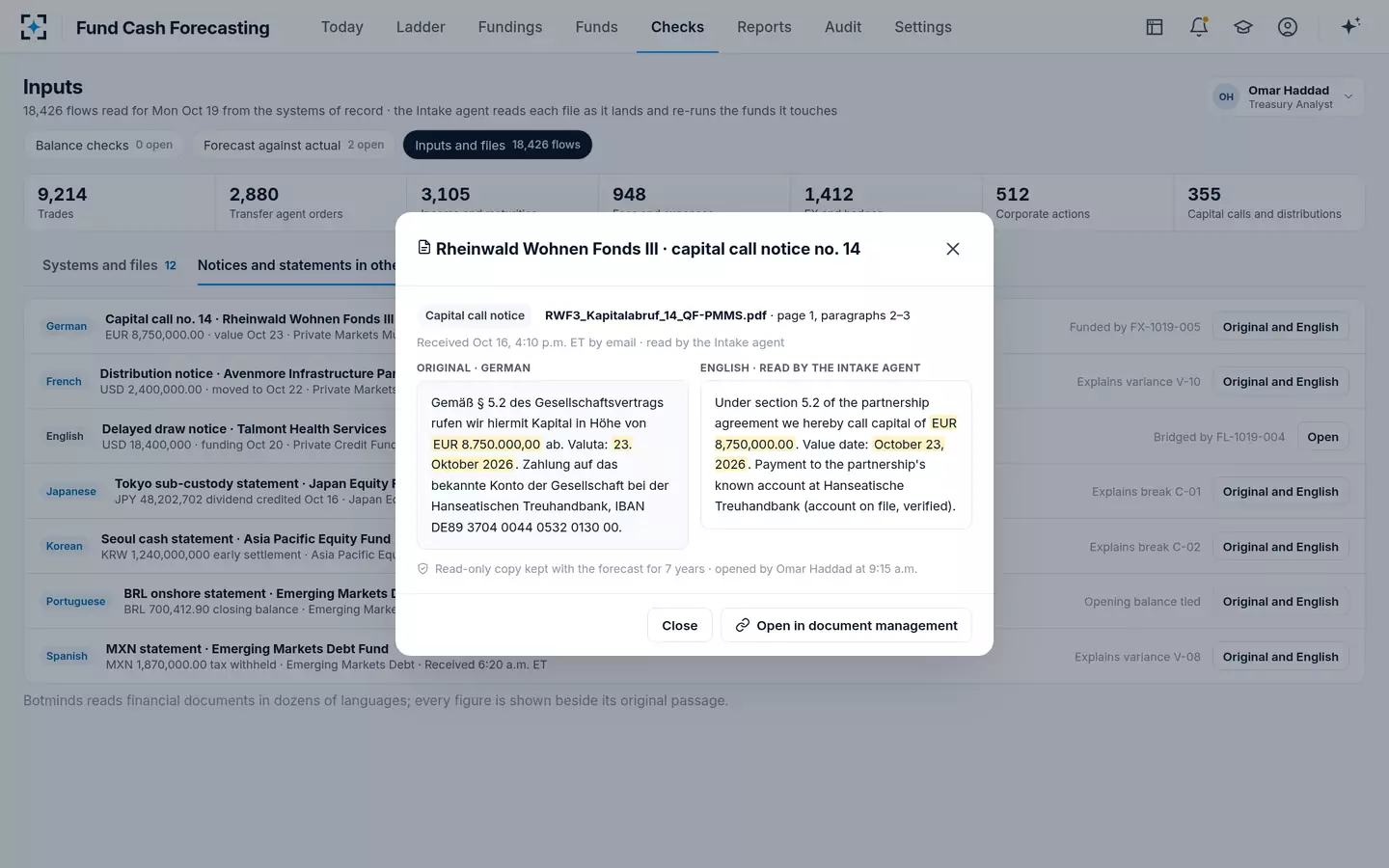
| Capital calls and distributions | Notices from general partners, often PDFs in other languages | Booked from the notice; before it, from the commitment and past calls | A distribution notice moved a payment’s date |
Two lines in the table carry most of the risk. Subscriptions and redemptions are the largest unknown in most open-end funds, and the dealing data often arrives late; which transfer agent fields matter, and when each becomes known, is set out in its own guide. Income is the most common avoidable miss: a dividend from a market that withholds tax at source should be projected net, at the rate that actually applies to the fund, or it misses by the tax every time.
How do you forecast redemptions and subscriptions?
Start with the fund's own history, then adjust for who holds it and how they reach it. When the SEC adopted the US liquidity rule in 2016 it chose not to write a list of cash flow factors into the rule, and instead set out five considerations as guidance (81 FR 82142). They are, in effect, a method for forecasting flows.
The SEC's five considerations for a fund's cash flow projections
- The size, frequency and volatility of past purchases and redemptions
In normal and reasonably foreseeable stressed periods. The SEC suggests knowing when the highest, lowest, most frequent and most volatile flows occurred over one, five, ten and twenty years.
- The fund’s redemption policies
A fund that pays next day has less time than one that pays in three days, even with identical flows.
- How concentrated ownership is
A few large holders can move a fund in one order; they are easier to talk to but under no obligation to warn.
- Distribution channels
Retirement and other planned-savings channels tend to be steadier; omnibus accounts hide who the investors are.
- The degree of certainty of the projection
Operating history, past stress and any advance-notice arrangements with large holders. Ranges are acceptable.
The guidance also names the patterns worth testing for: "seasonality, shareholder tax considerations, fund advertising, changes in fund performance ratings provided by third-party rating agencies, and the fund's investment strategy and size" (SEC, 2016). Each is a candidate adjustment to the plain average. Tax is the clearest example the release gives: taxable investors have a reason to delay purchases until after a capital gains distribution, while investors in tax-deferred accounts do not, so a fund's inflows around its distribution date depend on who owns it.
For a new fund, or a share class with little history, the SEC suggests looking at "purchase and redemption activity in funds with similar investment strategies." For a fund with a few large holders, the best input is a conversation: the release notes that advance notification "could increase the degree of probability surrounding its cash flow projections," and that staff understood such procedures to be "a relatively common liquidity risk management tool." It is also candid about the limit: large holders "are under no legal obligation to forewarn the fund of their redemptions and, particularly in times of stress, may not do so."
What the pattern should be computed on is a practical choice the sample firm had to make. Its Singapore transfer agent's file is often late, so six funds run on an estimate from their dealing pattern until it lands. The forecast had used the last 20 dealing days; the variance work found that the last five predicted better for those funds, and back-testing the change from 3 August to 16 October cut the pattern error from 31% to 12%. The head of treasury, not the agent, decides whether that rule goes live.
What does Rule 22e-4 ask of cash flow projections?
It asks a US open-end fund to consider short-term and long-term cash flow projections, in both normal and reasonably foreseeable stressed conditions, when it assesses, manages and reviews its liquidity risk, alongside its holdings of cash and its borrowing arrangements (Rule 22e-4(b)(1)(i)). The rule does not prescribe a method, a horizon or a format. It asks that projections be considered, and the program's administrator reports to the board on the program at least once a year.
That makes the daily treasury projection and the liquidity program's projection two views of the same flows over different horizons. Treasury needs days, by currency, to avoid overdrafts and to tell PMs what they can spend. The program needs weeks and months, in aggregate, including stress. They should not disagree about the history they are built from. The liquidity program itself, its classification buckets and its 15% limit on illiquid investments are covered in Botminds' guide to the mutual fund liquidity rule in 2026.
"A fund may use ranges in considering cash flow projections and their relationship to liquidity risk."
SEC, Rule 22e-4 adopting release, 2016
How far ahead should a fund project its cash?
Far enough to cover every settlement date that can still be changed, and then a little more. For a daily treasury projection that is usually today to five business days ahead, one figure per currency per day. It covers a US T+1 trade, a two-day European settlement, most fund dealing cycles and the time needed to arrange FX or a facility draw. Beyond that, projections are coarser: weekly for the next month, monthly for the quarter, which is the horizon at which the liquidity program and the board look.
The stressed horizon is longer than the normal one, for a reason the SEC spelled out in its 2022 swing pricing proposal: "We believe weekly outflows is a better proxy for the stressed trade size than daily outflows because stressed conditions may take some time to fully present in flows and often result in outflows that continue over several days or more" (87 FR 77172). The proposal was never adopted, but the observation about how stress arrives is a sound basis for a stressed projection: model a run of outflows, not one bad day.
How to show uncertainty without hiding it
Show every estimated flow as an estimate, say how it was made, and give a range. A projection in which a redemption read from a dealing file and a redemption guessed from last month's average look the same is worse than useless, because a PM cannot tell which number to lean on. The sample ladder marks estimated rungs "est." and shows each flow's confidence, and the forecasting agent will not give a number below 80% confidence: it says it does not know and names the person who should.
Every flow on the rung, with its source and confidence
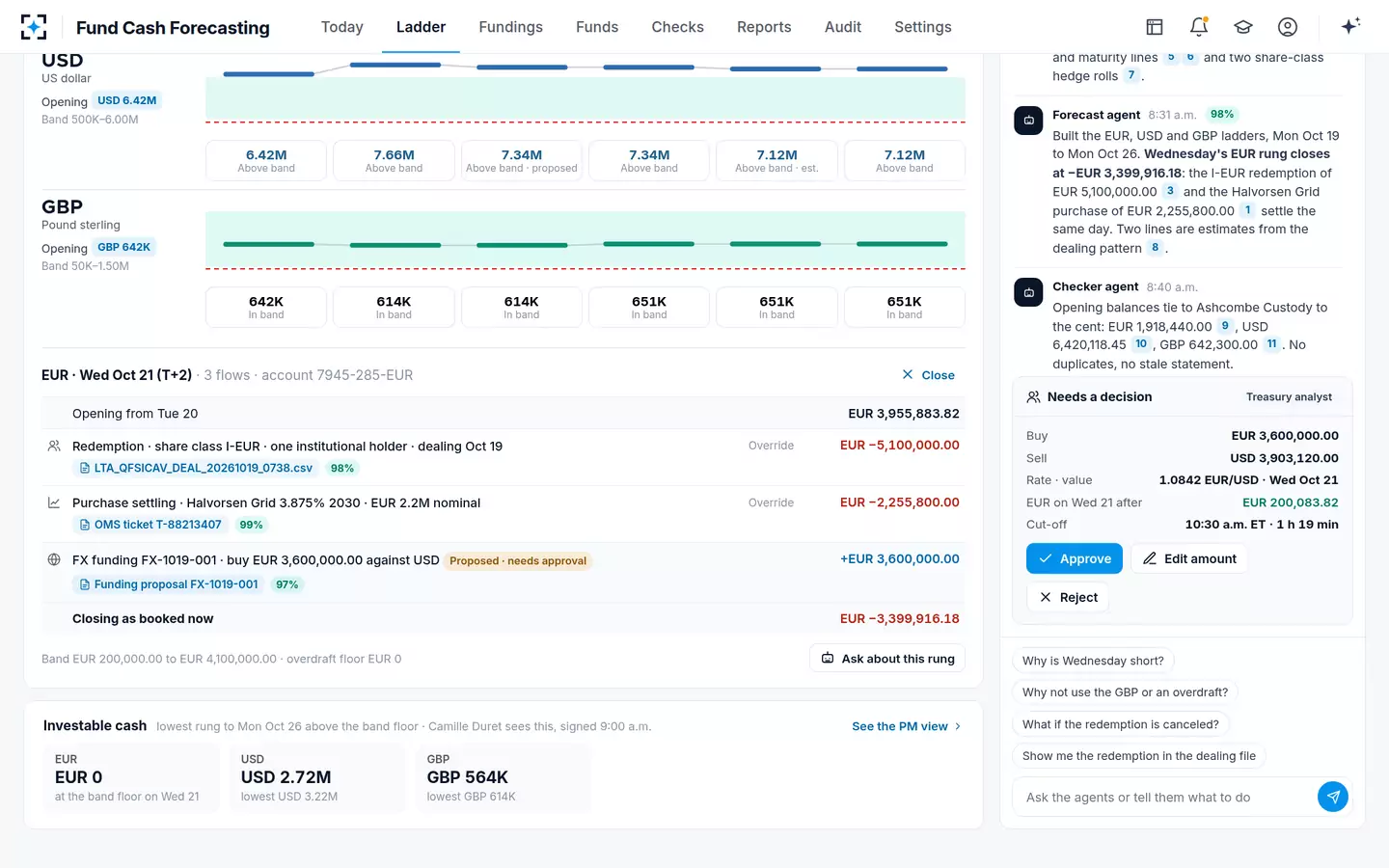
Ranges belong where they change a decision. If the low end of a range on Thursday still sits above the floor, nobody needs to act on it. If the low end crosses the floor, treasury has a choice between funding now, which costs an FX spread or a day of interest, and waiting for the dealing report, which risks missing the cut-off. A single-point forecast hides exactly that choice.
Projecting the stressed case: margin calls, redemptions and maturing financings
A stressed projection uses the same ladder with the unscheduled flows set to a bad case. The Financial Stability Board's 2024 recommendations on liquidity preparedness for margin and collateral calls describe the practice in an illustrative example: risk staff stress-test their ability to meet liquidity demands "by projecting cash flows arising from margin calls, redemptions, and maturing financings over appropriate time horizons" (FSB, December 2024). The same report asks market participants to set a tolerance for liquidity risk from margin calls and to keep contingency funding plans that work under extreme but plausible conditions. How fast such calls can arrive is shown in the LDI crisis hour by hour.
For a fund that uses derivatives, margin is the flow that can grow fastest. For an open-end fund, redemptions are. Research on US mutual funds shows why both matter for cash: Chernenko and Sunderam found that funds meet inflows and outflows mostly from sizeable cash holdings rather than by trading their portfolios, and that this is particularly true for funds with illiquid assets and in times of low market liquidity (NBER working paper 22391, 2016; what that cash costs is in cash drag). The stressed projection tells a fund whether its cash and its borrowing lines would cover the run, and for how many days.
SEC economists found the same pattern from the other side: funds with more volatile flows hold more cash (SEC DERA staff white paper, 2015). A stressed projection is how a fund decides whether its buffer is the right size or a habit, and Botminds' Liquidity Stress Testing guides go further into building stress scenarios from a fund's own holders.
A cash projection example, flow by flow
Take the sample firm's Euro Credit Fund, a Luxembourg UCITS with net assets of EUR 412.6 million, and its euro account for Wednesday 21 October. Tuesday is projected to close at EUR 3,955,883.82. Two outflows settle on Wednesday: a redemption of EUR 5,100,000.00 by one institutional holder of share class I-EUR, read from row 214 of the transfer agent's dealing report, and a bond purchase of EUR 2,255,800.00, read from the order ticket. Wednesday closes at minus EUR 3,399,916.18 unless something is funded.
Both of those flows are booked, so the shortfall is not a forecast risk; it is a funding decision with a deadline. The estimated lines sit further out, on Friday, where the dealing pattern stands in for orders not yet placed. The projection therefore says two things at once: Wednesday needs EUR 3.4 million before the 10:30 a.m. euro cut-off, and the later days are probably fine but rest partly on estimates. How the same ladder becomes each PM's investable cash follows from there.
A capital call read from its German notice
Questions people ask
What is the difference between the direct and indirect cash projection method?
In corporate finance, the direct method lists receipts and payments and the indirect method starts from profit and adjusts it. A fund's daily cash projection is always direct: it lists each trade, order, coupon, fee and FX settlement on its date. The indirect method has no use at a one-week horizon for a fund.
Can a fund build its cash forecasting model in Excel?
Yes, and many do. A spreadsheet handles the arithmetic; what it handles badly is reading dozens of files a morning, keeping each figure tied to its source, re-running when a file lands late, and showing who changed what. Those become the binding constraints as the number of funds and currencies grows.
How accurate should a fund cash projection be?
Accurate enough that the variance against actual cash is inside a tolerance the fund sets, on most days, for most accounts. The sample firm uses USD 25,000 equivalent or 0.02% of net assets, whichever is larger, and 597 of its 612 ladders were inside it on 16 October.
How do you project cash for a fund with large institutional holders?
Ask them. Agreements for advance notice of large redemptions are common, and the SEC treats them as raising the certainty of a projection, but holders are under no legal obligation to give notice and may not in stress. Project the notified flows as booked, and keep a stressed case for the unnotified ones.
Should a cash projection include pending FX trades?
Yes, both legs, each on its value date and in its own currency. An FX trade that funds one account empties another, and a projection that shows only the bought currency overstates the fund's cash by the amount sold.