Fund treasury is the team at an asset manager that projects each fund's cash, by currency and settlement day, funds every shortfall before that currency's deadline, and tells portfolio managers how much they can invest. Its analysts start early because the inputs arrive overnight, from custodians, transfer agents, the order management system, portfolio accounting and brokers, and the first FX cut-offs fall in the New York morning. Most of an analyst's morning has traditionally gone on gathering and assembling those numbers, not on the decisions they feed. Botminds' Fund Cash Forecasting reads the overnight flows, builds each fund's cash ladder, ties opening balances to the custodian and proposes the fundings, so the analyst's morning starts at the decisions.
The morning followed here is a fictional sample: Quillfield Capital's treasury, which runs cash for 140 funds in 25 currencies, on Monday 19 October 2026. Its analyst is Omar Haddad, on the New York desk. Statistics and rules are linked where they appear.
The fund treasury analyst and the people the morning depends on
Today
Starts at 6:30 a.m. building projections in spreadsheets, then races each currency’s cut-off with FX planned by hand.
With agents
Opens ladders already built and cited, with a funding proposed for each shortfall.
Still theirs: Approves each funding with a reason before its cut-off; asks why when an answer does not fit.
Today
Signs ladders built in spreadsheets, where a balance break is often found after the PM has traded.
With agents
Signs ladders whose opening balances the checker has tied to the cent.
Still theirs: Decides every break, with a reason; is the second approver above USD 10 million.
Today
Gets a cash-available email that may be a day old, so keeps a buffer just in case.
With agents
Sees signed investable cash per fund and currency at 9 a.m.
Still theirs: The trade decision, and telling treasury about planned trades early.
Today
Hears about overdrafts after the custodian charges them, and sees the same misses repeat.
With agents
Reports overdrafts and idle cash from signed figures.
Still theirs: Policy, thresholds and every new forecasting rule, each turned on only after a back-test.
Today
Pieces together who decided what, when and why from email threads.
With agents
Opens every forecast, approval, release and override with who, when, why and the evidence.
Still theirs: The independent review, and the questions nobody else asks.
What does fund treasury do?
Fund treasury manages the cash of the funds, not of the asset manager. That distinction matters: the money belongs to each fund's investors, sits in accounts at the fund's custodian, and can be moved only within the fund's rules and for its benefit. Treasury's job is to keep every account in every currency above zero, and inside a target band, on every settlement day, at the lowest cost, and to tell the investment team what is available.
The job has four parts. Projection: a daily cash ladder per fund and currency, a few business days ahead. Funding: FX, transfers between a fund's own accounts, facility draws or a request to move a trade, decided before each currency's cut-off. Reporting: signed investable cash for the PMs, and overdrafts and idle cash for the treasury committee. And explanation: comparing yesterday's projection with today's actual cash and finding out why they differ. In US funds, the projection also feeds the liquidity program, which must consider short- and long-term cash flow projections (Rule 22e-4(b)(1)(i)(B)).
Which files arrive overnight, and when?
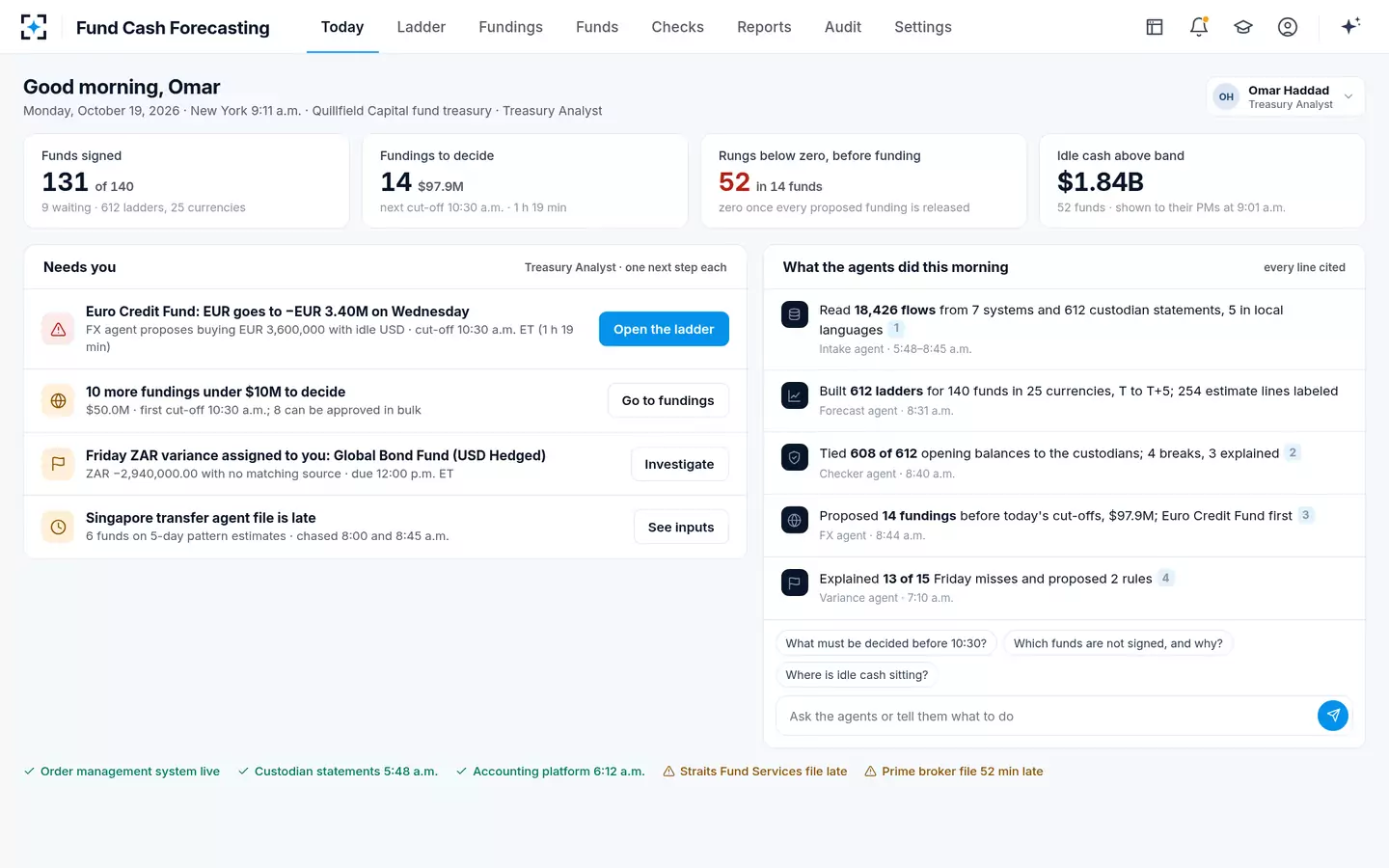
Every system that knows about a fund's cash sends something overnight, on its own schedule. In the sample firm the order management system was live early; custodian statements landed at 5:48 a.m., portfolio accounting at 6:12 a.m.; the Lumen transfer agent's dealing report for one Luxembourg fund range at 7:38 a.m.; the prime broker's file was 52 minutes late, and the Singapore transfer agent's file had not arrived by 8:45 a.m., so six funds ran on labelled pattern estimates. Each file is a different format: camt.053 and MT940 statements, CSV dealing reports, PDFs from sub-custodians and general partners in their own languages.
The dealing data is the latest and the least predictable. In its 2022 swing pricing proposal the SEC described how US funds often learn about the day's orders only after they have struck the NAV, with a significant share reaching the transfer agent after midnight; when each subscription and redemption field becomes known is traced in its own guide (87 FR 77172). The analyst's first job each morning is knowing which files are in, which are late and which funds are running on estimates as a result.
The analyst's 9:11 a.m.: four numbers and one next step each
What does a fund treasury analyst do before the market opens?
Traditionally, mostly assembly. The analyst downloads statements, pastes trades and dealing files into each fund's spreadsheet, ties the opening balances to the custodian, works out each currency's projected balances, finds the shortfalls, plans and books FX before each cut-off, answers PMs asking what they can spend, and explains why yesterday's forecast missed. Only a small part of that is judgment. The rest is copying numbers from one place to another under a deadline.
Where a treasury desk's morning hours go, by hand and with the agents
By hand: about 7¼ analyst hours
- Pulling statements, trades and dealing files · 21%
- Building each fund’s projection · 27%
- Tying opening balances · 14%
- Planning and booking FX · 14%
- Answering PMs · 10%
- Explaining misses · 14%
With the solution: about 1 analyst hour
- Pulling files · 9%
- Reviewing projections · 17%
- Deciding breaks · 17%
- Approving FX · 26%
- Answering PMs · 9%
- Reviewing explained misses · 22%
The estimate's point is the shape, not the totals. By hand, nearly half the morning is building projections and pulling files, and the FX decisions get what time is left. With the reading and building done before the analyst arrives, the largest share of a much shorter morning is approving fundings and reviewing explained misses: the two jobs where a person's judgment changes the outcome.
When must funding decisions be made?
Before each currency's cut-off at the custodian or settlement bank, which for the sample firm falls between 7:00 and 11:00 a.m. New York time. Rupees closed at 7:00 a.m.; euros, sterling, Swedish krona, Swiss francs and rand at 10:30; dollars and Brazilian real at 11:00. Restricted currencies settle through local sub-custodians with deadlines in local time that move with local holidays. The CLS settlement process explains why FX deadlines fall so early relative to the payments they fund.
The sample analyst's morning, by the clock
- Files read as they land5:48–8:45
- Signed9:00
- Fundings decidedto 10:30
- Last cut-offto 11:00
Every undecided funding has an escalation path in the sample firm's policy: the analyst is reminded 60 minutes before the cut-off, the cash management lead at 30 and the head of treasury at 15. Approval and release are separate people. A funding above USD 10 million needs a second approver. None of this is regulation; it is how a treasury makes sure that a deadline missed is a decision someone took, not a task nobody did.
How T+1 changed the job, and what changes in 2027
It shortened the gap between knowing and paying. Since 28 May 2024 most US securities trades settle one business day after the trade, so a fund buying US securities has a day, not two, to have the currency in place; spot FX still settles two days after the trade, so the FX that funds a US purchase now has to be traded the same evening for next-day value. The SEC accepted in its T+1 release that funding T+1 purchases with FX that settles on T+2 would be harder and costlier than before (88 FR 13872).
The EU and the UK follow on 11 October 2027: the EU by regulation, the UK by legislation the government has committed to and published in draft. For a European fund treasury that means the same compression on European securities, and a busier evening for every desk that funds trades across time zones. The analyst's morning in this guide is therefore also a preview: more of the decisions move to the evening before, and the morning becomes the check that they landed. The CLS settlement process sets out the FX timetable in detail.
Who the analyst depends on
Almost everyone upstream. The transfer agent decides when the dealing data arrives; the custodian when the statements do; the trading desk when amendments are booked; the PM whether a planned trade is shared in time. The SEC noted in 2016 that large shareholders owe the fund no advance warning of a redemption and, under stress, may give none (81 FR 82142). An analyst's forecast is only as early as the latest of these.
Downstream, three people rely on the analyst's work: the cash management lead who signs, payment operations who release, and the PMs who trade. The figure at the top of this page shows the lead and the PMs, with what their week looked like and what stays theirs. A practical habit follows: the analyst's most valuable call of the morning is often the one to the person whose file is late.
What does the BLS call this job, and what does it pay?
The Bureau of Labor Statistics has no occupation called fund treasury analyst. Treasurers fall within its financial managers occupation, and analysts in treasury are usually counted as financial and investment analysts. Its May 2025 estimates give both.
The nearest BLS occupations to fund treasury
841,710
financial managers in the US, the BLS occupation that includes treasurers
$166,570
median annual wage for financial managers
$102,740
median annual wage for financial and investment analysts
The numbers say more about the market for the skill than about the job. Treasury in a fund firm combines a financial manager's responsibility for cash with an operations analyst's daily workload, and the career path usually runs from analyst to cash management lead to head of treasury. What distinguishes a strong analyst is not speed at building a spreadsheet but judgment about which number to trust when two disagree.
What stays with the analyst when agents build the forecast?
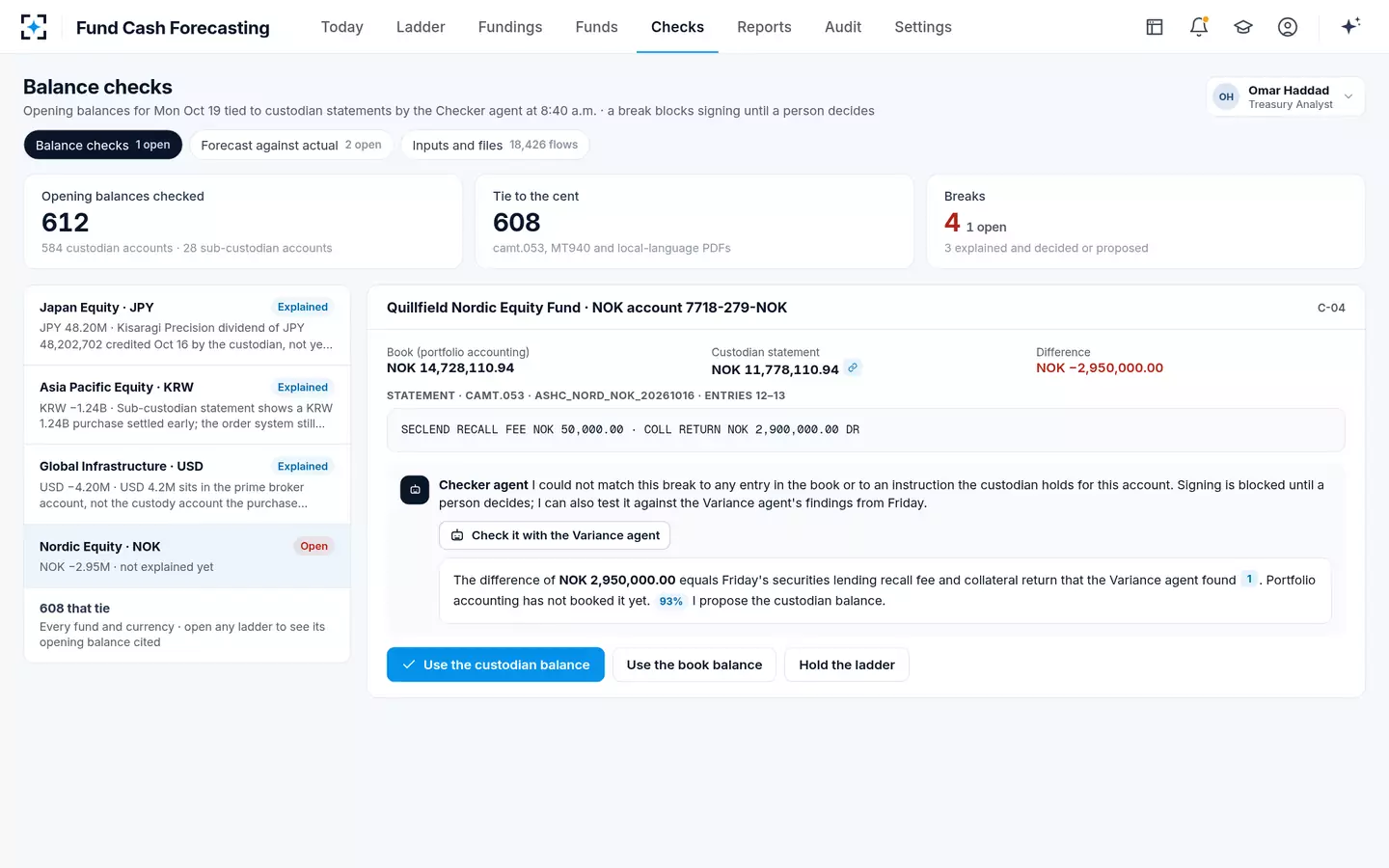
Every decision that moves money or changes what a PM sees. In the solution, six agents read the flows, build the ladders, tie the balances, propose fundings, explain variances and publish signed figures, and none of them can approve, release or sign. The analyst approves each funding with a reason code, the cash management lead decides each break and signs each ladder, payment operations releases, and only the head of treasury can turn on a new forecasting rule.
Regulators ask for exactly that line. FINRA's 2026 oversight report names autonomy, AI agents acting without human validation and approval, as a risk of agentic AI, and lists human-in-the-loop review of outputs among the practices it has seen (FINRA, December 2025). ESMA warned in 2024 that firms and clients might rely too heavily on AI for decisions and neglect human judgment (ESMA, May 2024). A cash management AI agent, traced through one funding decision, shows where each approval sits.
A balance break that only a person can decide
What a good 9 a.m. looks like
Most funds signed, the rest waiting for a named reason, and every shortfall with a proposed funding and a deadline. In the sample, 131 of 140 funds were signed at 9:00 a.m.; nine waited, one for a balance break, two for unexplained variances and six for the late Singapore file. At 9:11, fourteen fundings worth USD 97.9 million were waiting for decisions, the next cut-off was 79 minutes away, and the euro credit fund's shortfall was at the top of the list.
The test of a good morning is what happens to the exceptions, not how fast the routine goes. The euro funding was approved at 9:12 and released at 9:15. The krone break was decided by the lead with a reason. The two variances had owners and a noon deadline. That is a desk spending its attention on the few things that needed a person, which is the whole argument for letting agents do the rest.
Questions people ask
What is a fund treasury analyst?
An analyst in an asset manager's treasury team who projects the funds' cash by currency and settlement day, arranges FX and other fundings before cut-offs, and reports available cash to portfolio managers. The role sits between operations and the investment team, and usually reports to a cash management lead or head of treasury.
What is the difference between fund treasury and corporate treasury?
Corporate treasury manages a company's own cash, debt and risk. Fund treasury manages cash that belongs to each fund's investors, account by account and currency by currency, within each fund's rules on borrowing and liquidity. Its horizon is days, not quarters, and its deadlines are settlement cut-offs.
What time does a fund treasury analyst start?
Early, because the inputs arrive overnight and the first FX cut-offs fall in the morning. In the sample firm the analyst used to start at 6:30 a.m. in New York to build projections by hand; with the ladders built overnight, the morning starts from the decisions.
What skills does fund treasury need?
Settlement and FX mechanics, a working knowledge of each fund's dealing terms and borrowing limits, comfort with custodian statements and transfer agent files, and judgment about which number to trust. Increasingly, it also needs the ability to review and question an automated forecast rather than build one.
Who does fund treasury report to?
Usually to a head of treasury within operations or finance, with a treasury committee that sets policy and reviews overdrafts and idle cash. For US funds, treasury's projections also feed the liquidity program, which reports to the fund's board at least once a year.