Cash projection software for investment funds sits on top of the systems a fund's cash already passes through. It reads custodian statements, transfer agent dealing reports, trades from the order management system, income and fee schedules from portfolio accounting, FX and hedge rolls, and broker and administrator notices, and turns them into a projected balance per fund, currency and settlement day. Nothing upstream needs to change, so going live is a matter of connecting those feeds, mapping each cash account to its fund and running in parallel with the existing spreadsheets until the new forecast is measurably as good or better. Botminds' Fund Cash Forecasting is built that way: six agents read the feeds and build, check and explain the projection, and treasury approves, releases and signs.
Examples come from a fictional sample firm, Quillfield Capital, with 140 funds in 25 currencies. Where a step is our recommendation rather than the product's behaviour, it says so.
The six feeds cash projection software needs, and who owns each
- Custodian and sub-custodian statements
Opening balances and yesterday’s actual cash: camt.053, MT940 or PDF, per account. Owner: operations, with the custodian relationship manager.
- Transfer agent dealing reports
Subscriptions and redemptions by share class, with deal and settlement dates. Owner: transfer agency oversight.
- Order management system
Executed trades, allocations and every amendment, as they are booked. Owner: trading operations.
- Portfolio accounting
Book balances, income, maturities, fees and expenses on their payment dates. Owner: fund accounting.
- FX platform
Spot, forwards and share-class hedge rolls, both legs, on value dates. Owner: FX or treasury dealing.
- Brokers and fund administrator
Prime broker balances, margin calls, capital call and distribution notices. Owner: operations and private-markets operations.
Do we need new systems to automate cash projections?
No. A cash projection needs data that already exists in the fund's own systems; what it lacks is someone to read it all every morning, in time. Replacing portfolio accounting or the custodian's cash services to get a better forecast would be like replacing the bank to get a better spreadsheet. The software's job is to read, assemble, check and explain, and to leave each system as the owner of its own data.
The practical test for any product is what it does with a feed it cannot read. Files arrive late, change layout, or come as PDFs in another language. Software that needs every input in a clean, agreed format will spend its first year in a data project. Software that can read the files as they are, mark what it could not read and hand it to a person, can start on the funds' real inputs. The sample firm's notices arrive in German, French, Japanese, Korean, Portuguese and Spanish; each figure is shown beside its original passage and an English reading.
A redemption, down to the row in the dealing file
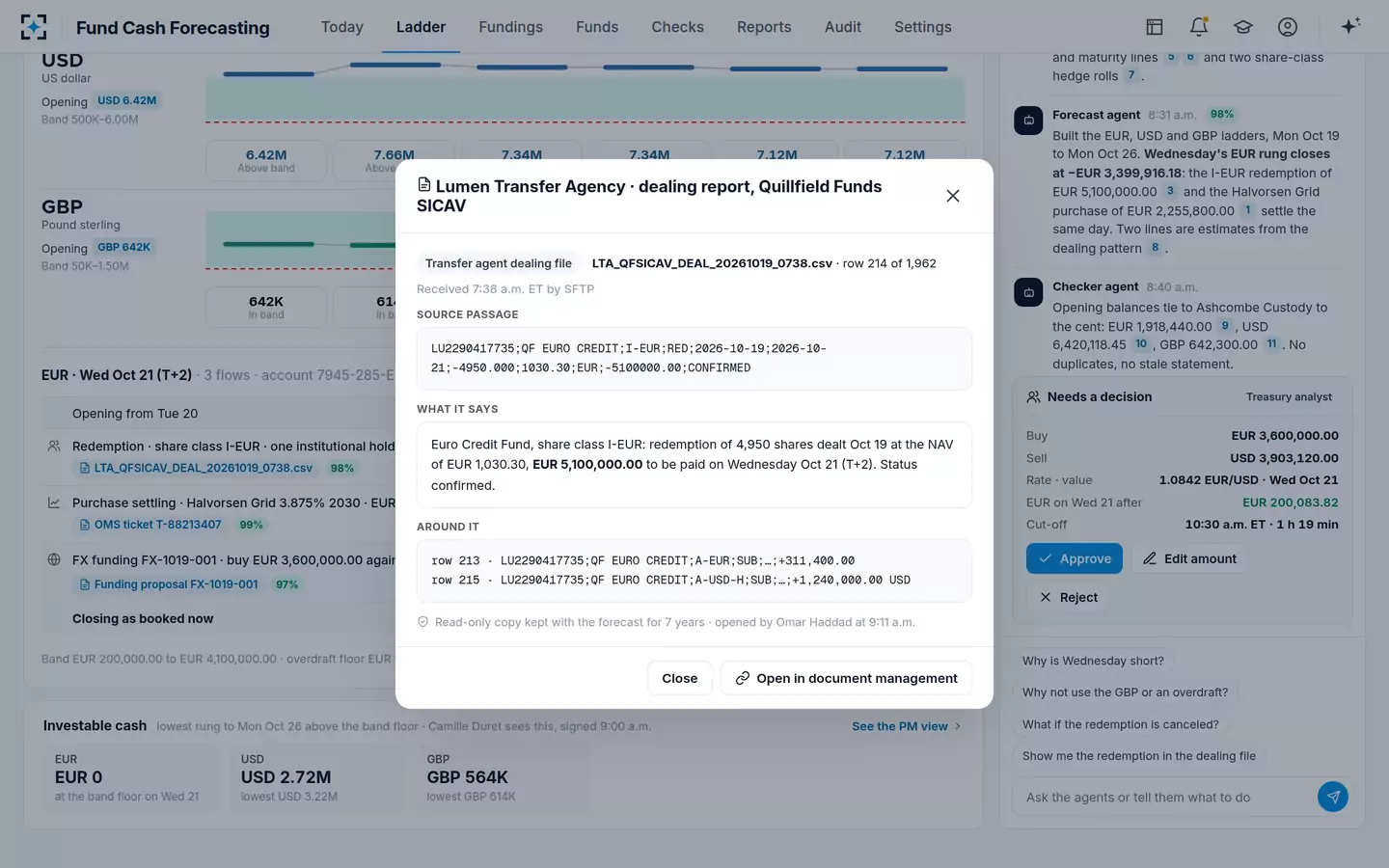
Which feeds does cash projection software need?
Six, plus the policy. The table sets out what each feed contributes, its usual form, and when it arrived at the sample firm on Monday 19 October. The times matter as much as the content: the forecast can be no earlier than its latest essential input.
Feeds, content, format and arrival time at a sample fund treasury
| Feed | What the forecast takes from it | Usual form | Arrived (New York) |
|---|---|---|---|
| Custodian statements | Opening balances; yesterday’s actual cash for the variance | camt.053, MT940, sub-custodian PDFs | 5:48 a.m. |
| Portfolio accounting | Book balances, income, maturities, fees | Extracts or reports | 6:12 a.m. |
| Order management system | Trades, allocations, amendments | Feed or extract | Live through the night |
| Transfer agents | Subscriptions and redemptions by share class | CSV dealing reports | 7:38 a.m. for the Luxembourg range; Singapore late |
| FX platform | Forwards and share-class hedge rolls | Confirmations | With the trades |
| Brokers and administrator | Margin calls, capital calls, distributions | Emails and PDFs, statements | Prime broker 52 minutes late; notices as received |
Two feeds need particular care. Transfer agent data arrives last and changes most. In its 2022 swing pricing proposal the SEC described US funds receiving a significant portion of orders only after midnight (87 FR 77172), and the subscription and redemption fields a forecast needs are set out in their own guide. And the custodian statement is both the start of today's forecast and the test of yesterday's: if it does not tie to accounting, both are in doubt.
What should it do that a spreadsheet cannot?
Keep the evidence, re-run on change, and remember. A spreadsheet can hold a projection; it cannot easily show where each number came from, rebuild a fund's ladder when an amendment lands at 7 p.m., keep yesterday's forecast to measure against today's cash, or show who changed what and why. Those are the four things a treasury needs most and a spreadsheet does worst.
A treasury spreadsheet against cash projection software
Spreadsheet: Pasted in; the link to the file is lost.
Cash projection software: Each flow opens to its source line, kept read-only with the forecast.
Spreadsheet: Noticed if someone looks; rebuilt by hand.
Cash projection software: Read as they land; the affected funds re-run and the change is recorded.
Spreadsheet: Look the same as booked numbers.
Cash projection software: Labelled with method and confidence.
Spreadsheet: A tick in a column.
Cash projection software: Tied to the custodian to the cent; a break blocks signing until a person decides.
Spreadsheet: Overwritten by today’s.
Cash projection software: Kept and compared with actual cash every morning.
Spreadsheet: Email and chat.
Cash projection software: Reason codes, second approval above a threshold, release by a different person, on an audit trail.
The US liquidity rule gives one more reason to keep evidence. A fund must keep its program's policies and the materials given to its board for five years (Rule 22e-4(b)(3)), and a treasury's projections and their sources are part of how the fund shows it considered its cash flows. For a UCITS, the depositary is expected to reconcile cash flows daily and question anything inconsistent with the fund's operations (Delegated Regulation (EU) 2016/438, Art. 10); an answer with a source line is a short conversation.
How do you run old and new forecasts in parallel?
From the same morning, against the same actual cash, at the same tolerance, for long enough to include the hard days. We suggest at least four weeks covering a month-end and the funds' busiest dealing days, after a few weeks of measuring the existing forecast on its own so there is a baseline; a twelve-week before-and-after test sets the plan out. Fund Cash Forecasting's first-time set-up maps every cash account to its fund and runs in parallel with the spreadsheets before go-live.
What should be true before the spreadsheet is switched off
| Check | Why it matters |
|---|---|
| Every cash account is mapped to its fund and currency, including sub-custodian accounts | An unmapped account is cash the forecast cannot see |
| Opening balances tie to the custodian every day of the parallel run, or each break was decided | Every later number starts from the opening balance |
| The share of accounts inside tolerance is at least the spreadsheet’s, at the same tolerance | Better is the reason to change; equal is the minimum |
| Every miss outside tolerance has a cause | An unexplained miss is a gap in understanding, not bad luck |
| The cut-off calendar is verified for every currency, route and holiday | A right forecast funded late is still an overdraft |
| Approval, second approval and release are assigned to named people | No funding should depend on who happens to be at a desk |
| Audit export tested with internal audit | The first time auditors ask should not be the first time it is tried |
What to write into the treasury policy before go-live
Every threshold the software applies should be a written, approved setting, not a vendor default. A forecast that decides on its own when a variance matters, how large a band is or who approves what has moved policy out of treasury's hands. The sample firm's settings show the kind of choices involved; the values are one firm's policy, not recommendations.
Settings a treasury should own, with one firm's values
| Setting | Sample firm’s value | Why it belongs in policy |
|---|---|---|
| Second approval above | USD 10,000,000 equivalent | Sets where one person’s judgement stops being enough |
| Bulk approval | Under USD 10 million and agent confidence of 95% or more | Saves time on routine fundings without hiding the large or doubtful ones |
| Agent confidence floor | 80%: below it the agent names an owner, not an answer | Decides when the software must say it does not know |
| Variance tolerance | USD 25,000 equivalent or 0.02% of net assets, whichever is larger | Defines what counts as a forecast miss |
| Default band, base currency | 0.05% to 1.0% of net assets, with 38 per-fund overrides | Sets the buffer that idle cash and investable cash are measured against |
| Money market fund band | 2% to 10% of net assets | Set with the Rule 2a-7 liquidity minimums in mind |
| UCITS borrowing guard | Alert at 2% of net assets; never plan above zero | Keeps well inside the 10% temporary borrowing limit |
| Funding escalation | Analyst 60 minutes before cut-off, lead at 30, head of treasury at 15 | Makes a missed deadline someone’s decision, not nobody’s task |
Two of these settings touch rules outside treasury. A US money market fund must keep at least 25% of its total assets in daily liquid assets and 50% in weekly liquid assets (Rule 2a-7(d)(4)), so its cash band is set with those minimums in view, which is why the sample firm's money market band is so much wider than its default. And a UCITS may borrow only temporarily and only up to 10% of its assets, so the borrowing guard sets an internal alarm far below the legal ceiling. What the borrowing rules allow is covered in the guide to fund overdrafts.
How long does cash projection software take to go live?
Long enough to connect the feeds and prove the forecast, which is usually a matter of weeks, not a systems project measured in quarters. The time goes on three things: getting each feed delivered, mapping accounts and loading the treasury policy and cut-off calendars, and the parallel run. The last cannot be shortened safely, because its purpose is to include the days when things go wrong. What you bring decides the rest: the treasury policy, the cut-off calendars, the account map and a sample of past statements, trades and dealing files.
No regulator or independent study publishes implementation times for fund cash forecasting, and any figure a vendor quotes depends on how many funds, currencies and transfer agents are in scope. Ask instead for a run on a sample of your own files, before contract, with the forecast measured against your own actual cash.
Who owns the forecast after go-live?
Treasury, exactly as before, with clearer lines. The software produces the projection; people own every decision about it. The ownership model below is the sample firm's, and it is worth writing down before go-live because the first disagreement about a number will test it.
Who owns what once the forecast is automated
Today
Heard about overdrafts after the custodian charged them, and saw the same misses repeat.
With agents
Approves every setting and every new forecasting rule, after a back-test.
Still theirs: Policy, thresholds, rules.
Today
Kept the spreadsheets’ formulas, links and fund lists up to date.
With agents
Proposes changes to bands, tolerances, calendars and accounts, which the head of treasury approves.
Still theirs: Configuration, under change control.
Today
Signed spreadsheets after a visual check.
With agents
Signs ladders only after the opening balances are tied; decides each break.
Still theirs: Sign-off and second approval.
Today
Built the projections every morning.
With agents
Reviews and questions them; approves each funding with a reason.
Still theirs: The funding decision.
Today
Reconstructed decisions from email.
With agents
Reads every forecast, approval and override with its evidence.
Still theirs: Independent review.
What does cash projection software cost?
Vendors don't publish prices, so build the case from your own costs. Three numbers do most of the work. Analyst time: the hours a desk spends assembling the morning, which Botminds estimates at about seven a morning for one desk by hand and about one with the solution, an estimate from the product's design rather than a measured result. Overdraft charges: the custodian interest the funds paid last year on unplanned overdrafts. And idle cash: the average cash above each fund's band, multiplied by the gap between the portfolio's return and the cash rate.
The third number is usually the largest and the least visible. On the sample firm's USD 342 billion of treasury-run fund assets, one basis point of cash drag is about USD 34 million a year, a figure the solution's report shows for scale. How to calculate cash drag shows the arithmetic. A case that rests on idle cash should also show overdrafts, because a buffer cut without a better forecast becomes the next quarter's overdrafts.
Where Fund Cash Forecasting fits, and where it does not
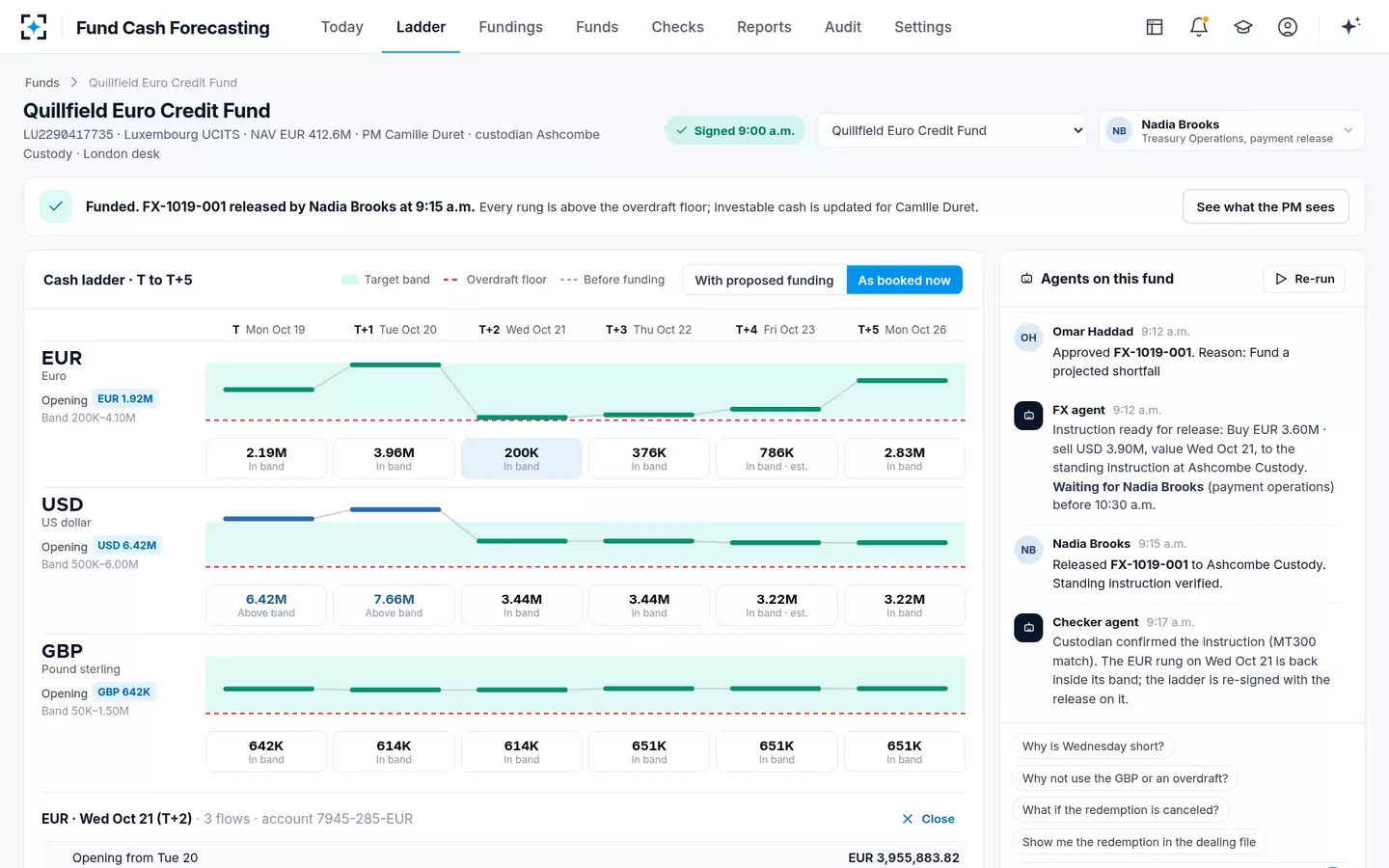
It fits where a treasury runs cash for many funds, currencies and transfer agents from files that arrive overnight in mixed formats and languages, and needs a signed, cited projection and proposed fundings before the morning's cut-offs. It reads the systems listed above and proposes fundings for people to approve and release; it keeps data in each fund's region, and logs every action on a hash-chained audit trail kept seven years.
Approved by one person, released by another, confirmed by the custodian
It does not execute FX, replace an FX platform or a custodian's cash services, keep the books, or act as the fund's liquidity risk program, which has its own classification, testing and board reporting; Botminds' guide to fund liquidity solutions covers that side. It is also not the place to check whether a redemption request is valid, which belongs to the transfer agent and investor services teams; Botminds' Redemption Processing covers that work. A fund treasury analyst's morning shows what the desk looks like with it in place.
Questions people ask
What is cash projection software?
Software that builds a projected cash balance for each account and day from the flows due to settle: trades, subscriptions and redemptions, income, fees, FX and notices. For investment funds it works per fund and currency, a few business days ahead, and is used to fund shortfalls before cut-offs and to tell portfolio managers what they can invest.
Is cash forecasting software different for funds than for companies?
Yes. Corporate cash forecasting looks weeks or months ahead across a company's bank accounts. Fund cash projection looks days ahead, account by account and currency by currency, and is driven by settlement dates, dealing cycles and FX cut-offs, with each fund's own borrowing limits in the background.
Does it need a data warehouse first?
No. It should read the feeds where they are, as they arrive, and keep the original alongside what it read. A warehouse can be one of its sources, but waiting for one delays the benefit by the length of the warehouse project.
Can we try it on our own data before buying?
You should insist on it. A run on a sample of your own statements, trades and dealing files, measured against your own actual cash, tells you more than any demonstration on a vendor's data.
Does it replace our treasury management system?
Not necessarily. If a treasury management system already executes and books FX and payments, cash projection software feeds it proposals and reads back confirmations. If treasury works from spreadsheets and the custodian's portal, the software becomes the place where projections, approvals and their evidence live.