The FSA guaranteed loan fee is simple arithmetic — the loan amount, times the percentage guaranteed, times a percentage FSA sets for the loan type — and it is the smallest part of the decision. What a lender is really buying is a share of any loss, a change in how the exposure is weighted, and an obligation to build a file to somebody else’s rules. A guaranteed loan is a capital decision made by a credit committee, not a favour done for a farmer, and it is worth pricing as one. This guide works through what the guarantee covers, what it costs, what it is worth, and the one way a bank can still lose it after the loan has closed. FSA Guaranteed Loan Origination, Botminds’ solution for ag lenders, is about the file that has to be right for any of it to hold.
The worked figures use a fictional sample file the solution runs on: a $1,016,000 operating loan at Prairie Junction Bank & Trust, at a 90 percent guarantee and the bank’s own 1.5 percent fee estimate. The regulation is 7 CFR part 762; the capital rule is 12 CFR 324.
The guarantee, in the numbers that decide it
90%
ceiling on the percent of guarantee, which FSA determines — 95 percent in five named cases
$2.56m
the most FSA will currently guarantee for one borrower across standard operating, farm ownership and conservation loans — $2,558,000, indexed each fiscal year
20%
risk weight on the portion of an exposure conditionally guaranteed by a U.S. government agency, against 100 percent for a corporate exposure
$13,716
the fee on the sample file — $1,016,000 × 90% × 1.5%
What “90% guaranteed” actually covers, and what it does not
Two readings of “90 percent guaranteed” circulate, and only one is right. It does not mean FSA will hand over 90 percent of the loan amount if things go wrong. It means the guarantee attaches to 90 percent of the loan, and FSA pays the loss the lender sustains on that share. On a $1,016,000 note that is a guaranteed portion of $914,400; if the lender ultimately loses $200,000 after liquidation, the guarantee answers for its pro rata share of that loss, not for $914,400.
The regulation defines the ceiling plainly. “The percent of guarantee will not exceed 90 percent based on the credit risk to the lender and the Agency both before and after the transaction. The Agency will determine the percentage of guarantee.” Ninety is a maximum, not a default, and the percentage is FSA’s call. Five cases are issued at 95 percent instead: a loan whose sole purpose is to refinance an FSA direct loan (with a weighted percentage when only part of it does), a farm ownership loan in the down payment loan programme, an operating loan to a farmer who has a down payment loan outstanding, an operating loan to a farmer whose land and security are subject to the jurisdiction of an Indian tribe, and a loan to a qualified beginning farmer. Conservation loans are issued at 80 percent, or 90 for a qualified beginning farmer. The list changed in July 2025, when USDA stopped using the race- and sex-based “socially disadvantaged” designation that had also put those farmers in it, so a guide or a policy written before then is out of date.
What the guarantee pays for is set out in 7 CFR 762.129(d): the maximum FSA will pay is any loss the lender sustains on the guaranteed portion, including the pro rata share of principal and interest, any loan subsidy due, the pro rata share on secured protective and emergency advances made under the subpart, and principal and interest on recapture debt under a shared appreciation agreement. One exclusion is worth knowing before a workout: late payment charges, including default interest charges, are not covered by the guarantee and may not be added to the principal and interest due under a guaranteed note.
The sample loan, from the note to the fee
The loan the bank makes
$1,016,000
An operating loan at the bank’s own rate and terms, inside the maximum rates FSA publishes.
The guaranteed portion, at 90%
$914,400
The share the guarantee attaches to. FSA determines the percentage; the regulation caps it at 90 percent, with named exceptions at 95.
The bank’s own exposure
$101,600
The unguaranteed 10 percent, which the same collateral secures — the bank may not take separate security for it.
The fee, at 1.5% of the guaranteed portion
$13,716
Loan amount × percent guaranteed × the percentage FSA sets for the loan type. Non-refundable, paid by the lender, may be passed to the borrower.
The FSA guaranteed loan fee: how it is calculated, and who pays it
The fee is written as a formula rather than as a rate, because the rate moves. The regulation sets the shape — for a farm ownership loan, the guarantee fee is the loan amount × the percent guaranteed × the farm ownership percentage established by FSA, and the same structure applies to operating and conservation loans — and tells you where to find the number: “The guarantee fee is established by the Agency at the time the guarantee is obligated. The current fee schedule is available at … any FSA office. Guaranteed fees may be adjusted annually based on factors that affect program costs.”
The fee, worked on the sample loan
| Step | Calculation | Result |
|---|---|---|
| 1. The loan amount | The note the bank will make | $1,016,000 |
| 2. The percent guaranteed | Requested at 90%; FSA determines it | 90% |
| 3. The guaranteed portion | $1,016,000 × 90% | $914,400 |
| 4. The percentage FSA sets for the loan type | The bank’s own estimate until obligation | 1.5% |
| 5. The guarantee fee | $914,400 × 1.5% | $13,716 |
| 6. As a share of the whole loan | $13,716 ÷ $1,016,000 | 1.35% |
Three details change the answer. The fee is non-refundable and is paid to FSA by the lender, though it may be passed on to the borrower and included in the loan funds — so it is a negotiation, not a fixed cost of either party. Some transactions carry no fee at all: loans involving interest assistance, loans where a majority of the funds refinance an FSA direct loan, and loans to beginning or veteran farmers in the direct down payment loan programme, or to beginning farmers in a qualified state beginning farmer programme. And the fee is quite separate from the lender’s own charges, which may be no greater than those the bank charges unguaranteed customers for similar transactions.
Who FSA’s customer is on a guaranteed loan — and why that matters
FSA states the relationship in one line that reorganises everything else: on a guaranteed farm loan, “Guaranteed loans are the property and responsibility of the lender.” The bank is the party FSA deals with. The bank submits the application with the applicant, receives the conditional commitment, closes the loan, advances the funds, and services it to conclusion; FSA issues the guarantee afterwards and reimburses a loss according to the guarantee’s own terms.
Three practical consequences follow, and all three are things lenders get wrong on a first guarantee. The borrower is not FSA’s applicant, so the borrower cannot chase FSA for progress. The bank’s own adverse decision is not appealable to anyone — appeal rights attach to FSA’s decision, not the bank’s. And the servicing obligations that come with the guarantee are the bank’s for the life of the loan: lenders are responsible for servicing the entire loan in a reasonable and prudent manner, protecting and accounting for the collateral, and remaining the mortgagee or secured party of record.
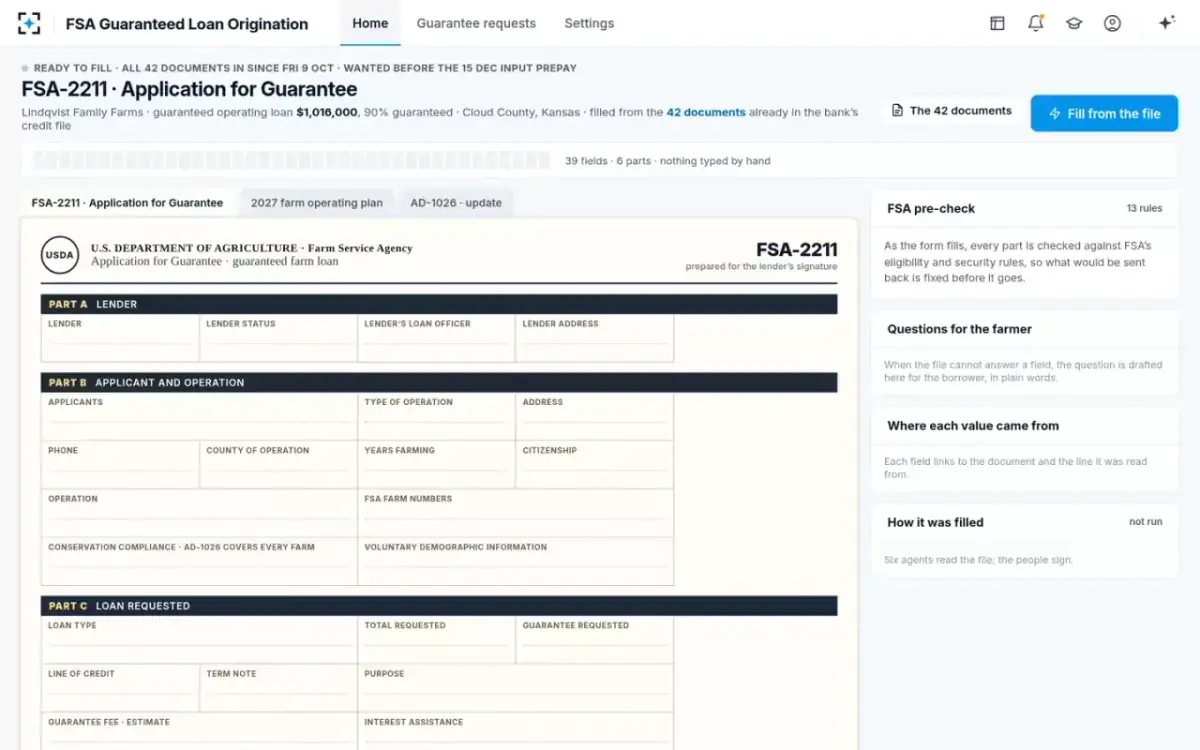
The application the lender and the applicant complete together
Why a lender would ask for less than the maximum guarantee
Asking for 90 percent when 80 would do is not free, and three considerations push the other way. The first is the fee, which scales directly with the percentage: at a 1.5 percent rate, each ten points of guarantee on the sample loan is about $1,524. The second is that FSA determines the percentage on the credit risk before and after the transaction, so a request that does not match the risk is an argument the bank has to make and may lose.
The third is structural and is the one most often missed. The guarantee does not let a bank carve its own exposure out: “All security must secure the entire loan or line of credit. The lender may not take separate security to secure only that portion of the loan or line of credit not covered by the guarantee.” Compensating balances or certificates of deposit may not be used to eliminate the lender’s exposure on the unguaranteed share either, though they are allowed in the ordinary course of business for both portions. The unguaranteed slice is genuinely at risk, on the same collateral, in the same position — and a bank that treats the guaranteed portion as the whole relationship has mispriced the rest.
What the guarantee is worth in capital, not just in a loss
The loss coverage is the part everyone discusses. The capital treatment is usually worth more, and it is the reason the guarantee turns up in a credit committee rather than only in a workout plan. Under the standardised capital rules, the risk weight on a guaranteed share of an exposure is not the weight on an ordinary commercial loan.
An FDIC-supervised institution must assign a 20 percent risk weight to the portion of an exposure that is conditionally guaranteed by the U.S. government, its central bank, or a U.S. government agency.
12 CFR 324.32(a)(1)(ii)
Against that, the same section requires a bank to assign “a 100 percent risk weight to all its corporate exposures”, with narrow exceptions. The FSA guarantee is conditional rather than unconditional, for reasons the next section sets out, which is why 20 percent rather than zero is the figure to work with. Whether a particular guarantee qualifies is a determination the bank makes with its own examiners; what follows is the arithmetic if it does.
The same loan, weighted two ways
| No guarantee | With a 90% guarantee | |
|---|---|---|
| Exposure | $1,016,000 | $914,400 guaranteed + $101,600 unguaranteed |
| Risk weight applied | 100% | 20% on the guaranteed share, 100% on the rest |
| Risk-weighted assets | $1,016,000 | $182,880 + $101,600 = $284,480 |
| Change in risk-weighted assets | — | 72% lower |
| Capital at an 8% total capital ratio | $81,280 | $22,758 |
| Guarantee fee, once, at 1.5% | — | $13,716 |
Read the last two rows together and the proposition is visible: a one-off fee of $13,716 against roughly $58,500 less capital required to carry the same credit, plus loss coverage on nine-tenths of it. That is why a guarantee is worth asking for on a loan a bank would otherwise decline — and it is also why the file has to be right, because every bit of it is contingent on a guarantee that holds.
Why demand for the guarantee rises when farm income falls
Guarantee volume is counter-cyclical by design: a guarantee exists for the borrower who cannot get credit on ordinary terms, and the number of such borrowers grows when margins shrink. The FDIC’s October 2026 review of farm bank performance describes a row crop segment under exactly that pressure, with three measures worth a lender’s attention.
Working capital is thinning. The FDIC cites “working capital balances at Illinois grain farms declined about 39 percent between 2022 and 2024”, and reports a national survey in which 43 percent of crop producers considered their working capital positions very strong or somewhat strong, against 56 percent of livestock producers. Borrowing is dearer than in the last downturn: interest rates on agricultural operating lines at the start of the current downturn were 218 basis points higher than at the start of the previous one, and remain 162 basis points higher at the comparable point. And the strain is partly hidden, because lenders carry unpaid balances forward into new loans where there is collateral and a plausible ability to cash flow them — “these carried-over balances do not appear in banks’ delinquent loan figures unless and until the borrower is unable to service the restructured debt.”
Stress is visible but still low on the banks’ own books
0.25%
median past-due and nonaccrual rate on agricultural loans at farm banks, second quarter of 2026
0.27%
the same measure in the second quarter of 2017, about three years into the last row crop downturn
65%
of farm banks reporting agricultural past-due and nonaccrual balances — the same share at both points
43%
of all agricultural loans held by farm banks, which hold about 1 percent of industry assets
Those numbers cut both ways for a credit committee, and that is the honest reading. Measured delinquency is low, farmland equity remains a real collateral cushion, and only a minority of farm banks charged off agricultural loans even at the end of the last downturn. But the stress indicators that precede losses are moving, and a guarantee is cheapest to arrange before a borrower needs it most. What a slow file costs when operating money is waiting is the other half of that calculation.
What a guarantee that cannot be enforced costs, after the loan has closed
This is the section a credit committee should read twice, because it is where the whole proposition can be lost after everything has gone right. The guarantee is strong: “The loan guarantee constitutes an obligation supported by the full faith and credit of the United States.” FSA may contest it only in cases of fraud or misrepresentation by a lender or holder, where that party knew of it, participated in it or condoned it.
But that strength is paired with a list of things the lender can do to make it unenforceable, and the list is about the file and the servicing rather than about the credit. Under 7 CFR 762.103(b) the lender cannot enforce the guarantee, however late FSA discovers the problem, to the extent a loss results from violating usury laws, negligent servicing, failing to obtain the required security, or using loan funds for purposes FSA did not specifically approve. What negligent servicing costs a lender on an FSA guarantee quotes the rule and prices the servicing half of it; the origination half is below.
Read the third item against everything a security file contains: lien position, the junior-lien arithmetic, the prior-lien clauses that had to be limited, perfection, the certification at closing that liens have been perfected and their priorities match the conditional commitment. A security requirement missed at origination is not a paperwork problem discovered at audit; it is a reduction in the guarantee at the moment the bank needs it, years later, regardless of when FSA finds out.
That is the strongest argument for building the file properly, and it is a capital argument rather than a tidiness one. A guarantee that the bank is relying on for its risk weight and its loss coverage is worth exactly as much as the security work behind it. The requirements that decide whether it holds are worth knowing before, not after.
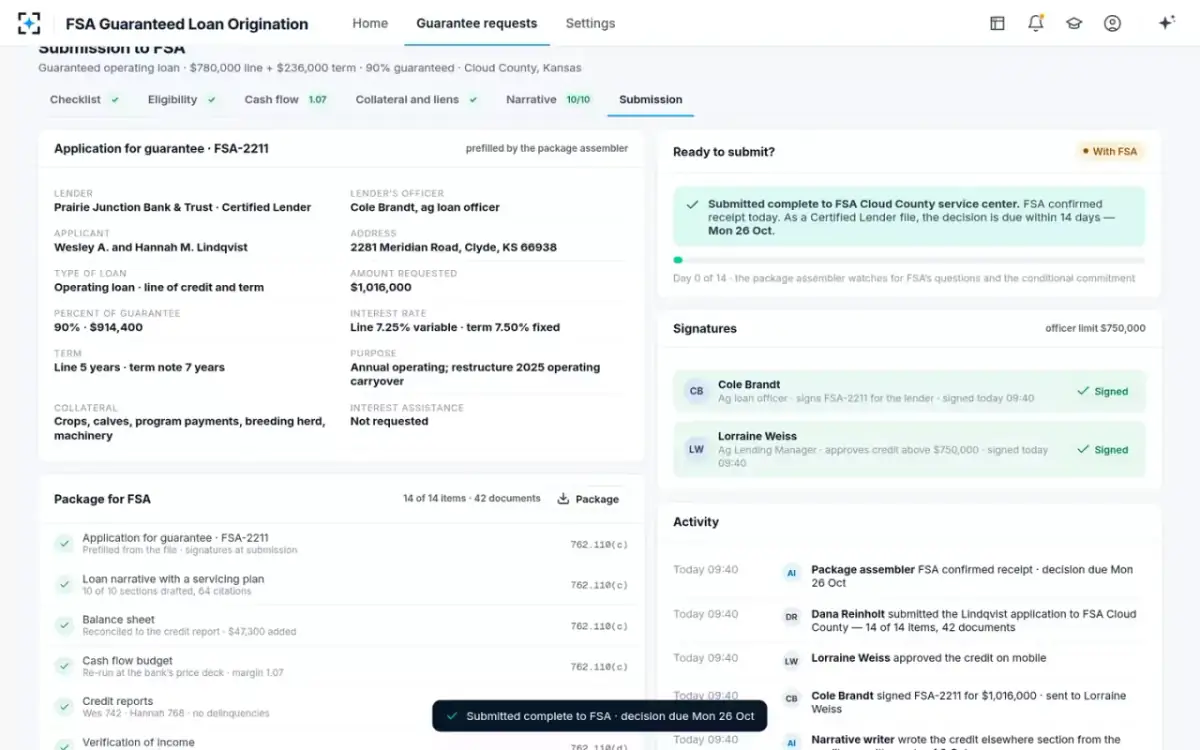
The complete package, both signatures, and the date FSA’s clock sets
The guarantee against a direct loan: two different customers
A borrower comparing a guaranteed loan with an FSA direct loan is comparing two programmes that differ in who holds the money, who services it and who the agency deals with. FSA describes the direct side plainly: “A direct loan is funded directly by the Agency. The money used for direct loans comes from annual Congressional appropriations received as part of the USDA budget. The Agency is responsible for making and servicing the loan.”
Guaranteed against direct: who holds what
Guaranteed loan: The commercial lender, from its own funds, at its own rate and terms inside FSA’s published maximums.
Direct loan: FSA, from annual congressional appropriations.
Guaranteed loan: The bank’s. The loan is the property and responsibility of the lender.
Direct loan: FSA’s. The agency is responsible for making and servicing the loan.
Guaranteed loan: The lender, for the life of the loan, with reporting obligations to FSA.
Direct loan: FSA.
Guaranteed loan: A share of any loss on the guaranteed portion, under the guarantee’s terms.
Direct loan: The whole loan.
Guaranteed loan: Up to $2,558,000 in the current fiscal year across standard operating, ownership and conservation loans, indexed each year; $500,000 for land contract guarantees.
Direct loan: Separate, lower limits set for the direct programmes.
Is a guaranteed loan safer for the lender, the borrower, or both?
For the lender, measurably safer, and in two ways that compound: a share of any loss on nine-tenths of the exposure, and a risk weight on that share far below a commercial loan’s. The price is a file built to someone else’s rules, a one-off fee, servicing obligations that continue for the life of the loan, and the possibility of losing the guarantee for a lender violation.
For the borrower, the honest answer is more conditional. The loan exists, which it otherwise would not — that is the whole point of the test for credit. The rate and terms are negotiated with the lender and may not exceed FSA’s published maximums, so the guarantee does not make credit cheap, it makes credit available. Against that, the borrower takes on a process with more documentation, a longer path to a yes, and a certification about conservation compliance that has to be kept current. And the structural asymmetry stands: the farmer waits while two institutions correspond.
Which is why the part of this that a bank can actually improve is the file. The guarantee percentage is FSA’s. The fee schedule is FSA’s. The risk weight is the capital rule’s. The days before FSA’s period starts, and whether the file holds up years later when a loss claim is read, are the bank’s — and those are the two the work in FSA Guaranteed Loan Origination is aimed at. How the approaches compare, if you are choosing between them.
Questions people ask
How much does an FSA guarantee fee cost?
It is calculated, not quoted: the loan amount × the percent guaranteed × a percentage FSA establishes for the loan type and publishes in its current fee schedule, charged once when the guarantee is obligated. On the fictional sample file — $1,016,000 at a 90 percent guarantee, with the bank planning on 1.5 percent — that is $13,716, or about 1.35 percent of the whole loan. The fee is non-refundable, paid by the lender, and may be passed on to the borrower and included in the loan funds.
What percentage does FSA guarantee?
Up to 90 percent, determined by FSA on the credit risk before and after the transaction. Five named cases are issued at 95 percent: refinancing an FSA direct loan, farm ownership or operating loans tied to the down payment loan programme, operating loans to farmers whose land and security are subject to the jurisdiction of an Indian tribe, and loans to a qualified beginning farmer. Conservation loans are issued at 80 percent, or 90 for a qualified beginning farmer.
Does a 90% guarantee mean 90% of the loan amount or 90% of a loss?
Of a loss. The guarantee attaches to 90 percent of the loan, and FSA’s maximum payment is the loss the lender sustains on that guaranteed portion — including its pro rata share of principal and interest, any loan subsidy due, and the pro rata share on secured protective and emergency advances. Late payment and default interest charges are not covered and may not be added to the principal and interest due under a guaranteed note.
How does an FSA guarantee help a lender’s capital position?
Through the risk weight. Under 12 CFR 324.32 a bank assigns 20 percent to the portion of an exposure conditionally guaranteed by a U.S. government agency, against 100 percent for a corporate exposure. On a $1,016,000 loan guaranteed at 90 percent, that is risk-weighted assets of about $284,000 rather than $1,016,000 — roughly 72 percent lower. Whether a particular guarantee qualifies for that treatment is a determination the bank makes with its examiners.
Why would a bank ask for less than the maximum guarantee?
Because the fee scales with the percentage, because FSA sets the percentage on the credit risk and a request that overshoots the risk has to be argued, and because the guarantee does not isolate the bank’s own slice anyway — all the security secures the entire loan, and the lender may not take separate security for the unguaranteed portion or use compensating balances to eliminate its exposure on it.
Can a lender lose the guarantee after the loan has closed?
Yes, to the extent the loss results from a lender violation. 7 CFR 762.103(b) makes the guarantee unenforceable, regardless of when FSA discovers the violation, where the loss results from violating usury laws, negligent servicing, failure to obtain the required security, or failure to use loan funds for purposes FSA specifically approved. FSA may separately contest the guarantee for fraud or misrepresentation the lender or holder knew of, participated in or condoned.