Agentic AI loan origination means software that does not merely pull fields out of documents but carries a loan file through a sequence of jobs — reading, checking, computing, drafting, assembling — with each job owned by a separate agent that has its own instructions, its own sources and its own stopping point. On a USDA guaranteed farm loan that distinction stops being academic, because the file is a submission to a federal agency: FSA-2211, eight pages in sixteen lettered parts, a lender narrative, a cash flow that must rest on prices the lender can document, and a set of eligibility and security rules in 7 CFR part 762 that decide whether the request is even considered. Botminds' FSA Guaranteed Loan Origination runs six agents over that file. This guide is about what each one does, and about the line all six stop at.
The file used throughout is a fictional sample as it runs through the solution: a $1,016,000 guaranteed operating loan for Wes and Hannah Lindqvist of Cloud County, Kansas, with Prairie Junction Bank & Trust as the lender. The bank, the farm and the people are invented. The rules quoted are the real ones, linked under each figure.
One file, one pass in FSA Guaranteed Loan Origination
42
documents in the bank’s credit file, read and filed against the application checklist
90s
for the six agents to read them and fill the application
35
of the 39 answers in the solution’s view of FSA-2211 filled from the file on the first pass, each linked to the line it came from
3reasons
the agency would have sent the file back for, found before it went
What is agentic AI loan origination?
Three things separate it from the document-extraction tools that came before. The first is division of labour: instead of one model asked to "process the loan file", the work is cut into jobs narrow enough that each can be given rules, sources and a test. The second is that each agent acts — it files a document, requests a limitation from a prior lienholder, drafts a message to the borrower — rather than only returning text. The third, and the one that decides whether any of this is usable on a federal application, is that each agent has an explicit boundary: a list of things it does not do, enforced by the design rather than by a sentence in a prompt.
On a conventional commercial loan the boundary is a matter of taste. On a guaranteed farm loan it is a matter of law, because the lender's submission carries certifications and the agency, not the lender, makes the determination at the end. An agent that quietly decides a borrower is eligible has not saved anyone time; it has put a conclusion into a federal file that nobody at the bank formed.
Six agents, six jobs, one file
The six jobs follow the shape of the file rather than the shape of the software. A guarantee request is a pile of documents, a set of rules, a cash flow, a security position, a written case and a package. One agent each.
The chain in FSA Guaranteed Loan Origination, and where each link stops
Agent
Document sorterReads every document in the file and files it against the application checklist for the loan size and the lender’s status, reading dates, parties, farm and tract numbers and signatures.
Never: accepts an unsigned or out-of-date form, or cites a value without its page
Agent
Eligibility checkerRuns each applicant eligibility rule and conservation compliance for every person on the note, with the evidence and the rule reference beside each result.
Never: makes the eligibility determination — it flags, and the agency decides
Agent
Cash flow analystRebuilds the borrower’s cash flow at the bank’s own price deck, applies the production history, and reports the margin, the breakeven and the stress results.
Never: changes the borrower’s plan, or prices it from anything but the bank’s deck
Agent
Collateral and lien reviewerLists the security for each note, reads the lien search and every prior-lien statement, flags future advance clauses and tests the junior-lien limit.
Never: assumes lien priority without a search, or changes a figure silently
Agent
Narrative writerDrafts the lender narrative and servicing plan, every figure cited to the document it came from.
Never: writes a figure it cannot cite, and never sends
Agent
Package assemblerFills FSA-2211, builds the package in the agency’s order with its open-items list, and routes signatures by credit authority.
Never: submits without both signatures, or with an item still open
A person decides
Ag loan officerSigns the application for guarantee, with the meaning that signature carries, within the credit authority the bank’s policy sets.
Never: approves credit above that authority
A person decides
FSA Farm Loan OfficerAt the agency: reviews the request for eligibility, repayment ability, collateral adequacy and compliance, and approves or rejects it.
Never: works for the lender
The document sorter: 42 documents against the agency's own checklist
The first agent does the job a new hire is given and nobody enjoys: open every document, work out what it is, and put it where the checklist says it goes. What makes it more than filing is that the checklist is conditional. The items the agency expects change with the loan size and with the lender's status, so "the FSA checklist" is not one list but a family of them, and picking the wrong member is itself a defect.
The sorter reads for the things that make a document usable rather than merely present: the date, the parties, the farm and tract numbers, and whether it is signed. It will not pass an unsigned form, and it will not pass a form whose date puts it outside the window the item requires. On the sample file it read 42 documents and held 17 of them as the answer to a specific field, which is the second half of the job — a document is not filed until the agent knows which question it answers.
The failure that matters here is the quiet one. A sorter that marks an item complete because a file with the right name exists has produced a checklist that reads green and a package that comes back. That is why every item it passes carries the page it was read from, and why the open-items list is the thing the coordinator looks at first.
Does AI decide whether a farmer is eligible? The checker flags, FSA decides
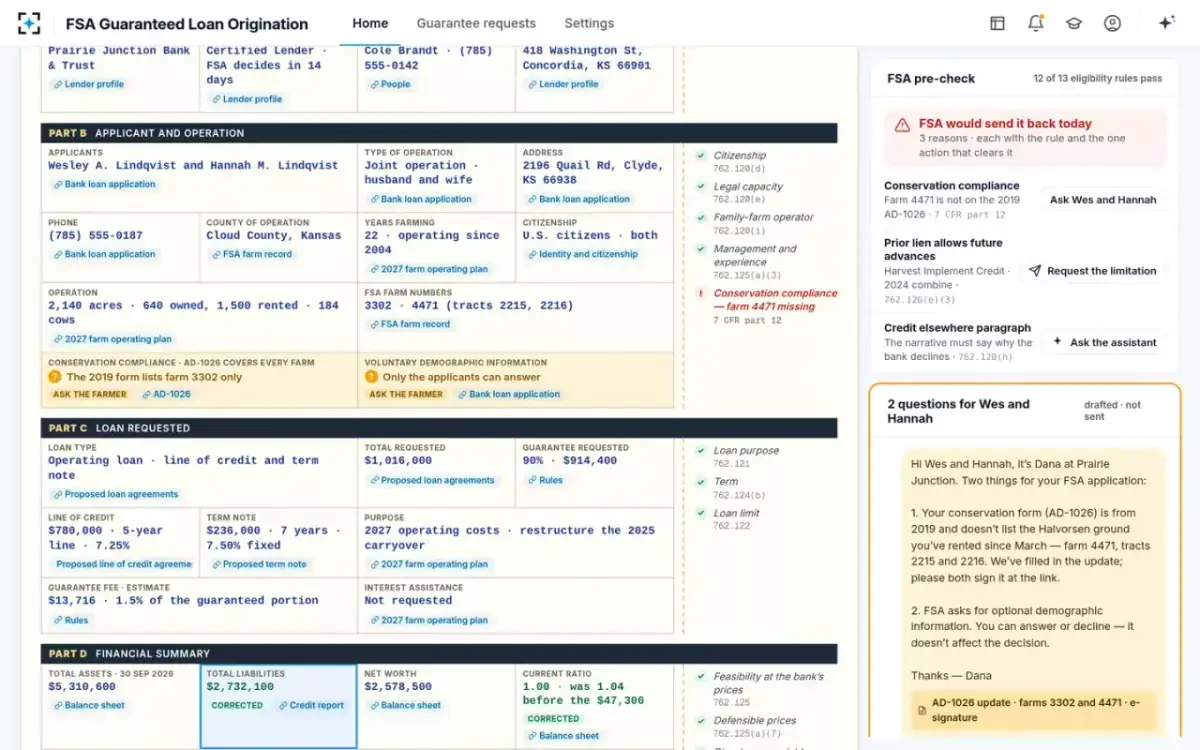
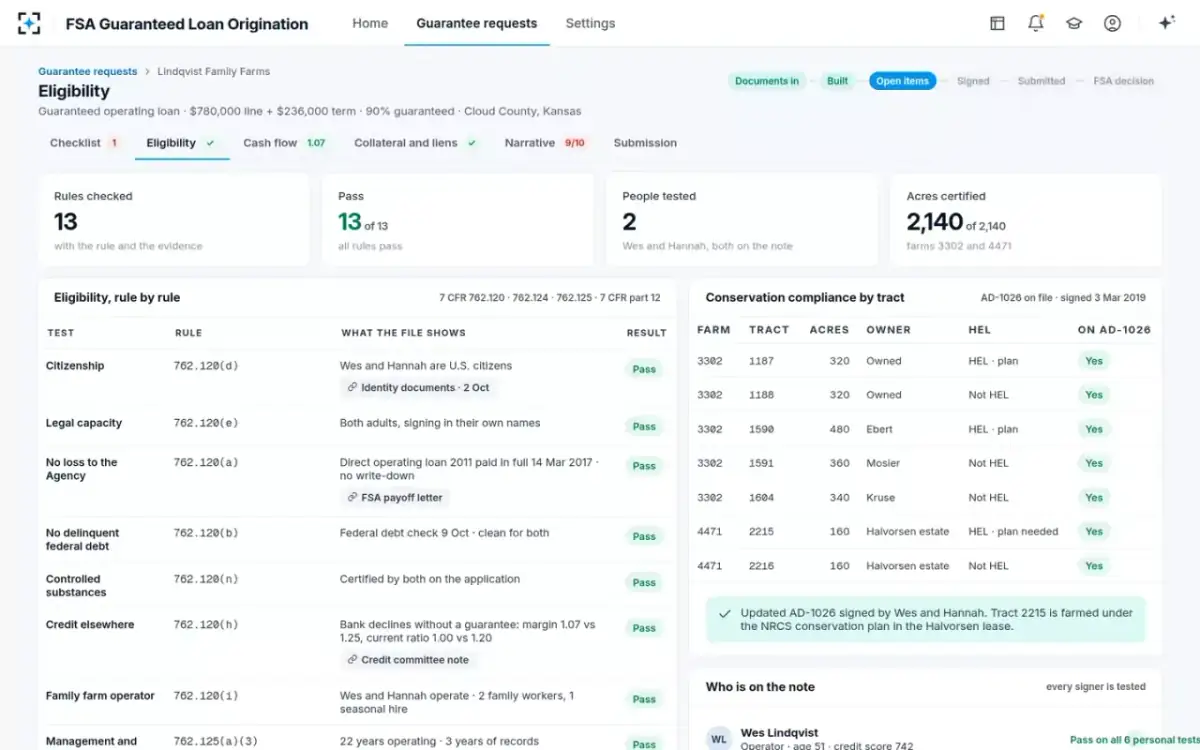
No, and this is the single most important boundary on the file. The eligibility checker runs each rule in 7 CFR 762.120 — citizenship, legal capacity, no prior loss to the agency, no delinquent federal debt, controlled substances, family-farm operator, the test for credit elsewhere — and for each one it shows the rule, what the file demonstrates, and the document behind it. On the sample file 12 of 13 rules pass and one does not, because the conservation compliance form on file lists one farm when the operation now includes two.
What the checker produces is an answer to a different question than the one the agency answers. The checker asks: on the evidence in this file today, would this request be sent back? The agency asks: does this applicant meet the requirements? FSA's own description of its process is unambiguous about who answers the second one: its Farm Loan Officer reviews the application for eligibility, repayment ability, collateral and compliance, and approves the request only if the applicant meets those requirements (USDA Farm Service Agency; the seats on a guarantee file quotes it in full).
The practical value of the narrower question is that it is answerable before submission, and each failure comes with the one action that clears it. Missing farm on the conservation form: send the borrower an update to sign. Prior lien with an open future-advance clause: ask the lienholder to limit it. Narrative missing the credit-elsewhere paragraph: write it from the credit committee's own note.
Would the agency send it back today?
The cash flow analyst: a second cash flow, never a changed one
The third agent rebuilds the borrower's projection at the bank's own price deck and leaves the borrower's version untouched beside it. That design choice is not politeness; it is what the rule asks for. The program requires that "the applicant's proposed operation must project a feasible plan" (7 CFR 762.125(a)(2)), and five paragraphs later it sets a separate test for the prices the lender used to check that plan. Two different things are being tested: the borrower's plan, and the lender's evidence about it.
Lenders must use price forecasts that are reasonable and defensible. Sources must be documented by the lender and acceptable to the Agency.
7 CFR 762.125(a)(7)
An agent that reprices a plan therefore has to be able to say where every price came from, and the only answer that survives a review is "the bank's own deck, dated, versioned, and approved by credit". On the sample file the borrower's plan at $4.60 corn shows a repayment margin of 1.30; at the bank's October deck — corn $4.30, soybeans $10.40, wheat $5.55, weaned calves $1,520 — the same plan returns 1.07, with a $20,755 surplus after all debts and breakeven corn at $4.14.
Production gets the same treatment. The analyst uses the operation's own history and substitutes a county average for a year lost to a declared disaster, which is what the rule contemplates when it tells standard eligible lenders to base projections on the applicant's proven record of production and financial management. Every substitution is marked and cited rather than folded into the total, so the officer can see what the analyst did and disagree with it.
The collateral and lien reviewer: the future-advance clause a reader can miss
This agent earns its place on a single sentence of the rules that is easy to read past. Prior lien instruments, the security rules say, "will not contain future advance clauses (except for taxes, insurance, or other reasonable costs to protect security), or cancellation, summary forfeiture, or other clauses that jeopardize the Government's or the lender's interest or the borrower's ability to pay the guaranteed loan, unless any such undesirable provisions are limited, modified, waived or subordinated by the lienholder for the benefit of the Agency and the lender" (7 CFR 762.126(e)(3)).
In practice that means a sentence buried in an implement dealer's security agreement — "all present and future indebtedness" — can stop a guarantee, and the only cure is a document from a third party who has no particular reason to hurry. On the sample file the prior lienholder on a 2024 combine holds exactly such a clause; the request to limit it goes out from the pre-check, and comes back capped at the $286,000 balance.
The agent also does the arithmetic the rules attach to junior positions, and reconciles the credit report against the balance sheet. On the sample file that reconciliation found a $47,300 supplier account on the credit report that was not on the balance sheet. It was added and marked corrected, and the current ratio moved from 1.04 to 1.00 — a correction that changes a credit conclusion, which is precisely why it is shown rather than absorbed.
The narrative writer: never a figure it cannot cite
The lender narrative is the part of the file that reads like prose and behaves like evidence. It explains the applicant, the operation, the request, the security, the repayment case and how the lender will service the loan, and every number in it is checkable against something else in the package.
The fifth agent drafts it with each figure linked to its document, and — this is the useful half — leaves a section open when the file does not support it. On the sample file nine of ten sections drafted and one did not: credit elsewhere, because the reason the bank will not lend without a guarantee lives in a credit committee note, not in the borrower's paperwork. Asked to write it from that note, the drafted paragraph says what the committee said: the bank will not extend this credit without a guarantee, at a repayment margin of 1.07 against a policy minimum of 1.25 and a current ratio of 1.00 against 1.20.
An agent that had instead produced a confident paragraph about credit elsewhere from nothing would have been more impressive in a demonstration and worse in every other way. A blank section is a question for a person; an invented one is a defect nobody will find until the agency does.
The package assembler: never an incomplete file
The last agent fills the form and builds the package: FSA-2211 with the lender’s parts completed and the applicant’s parts ready to sign, the supporting documents in the order the service center reads them, the open-items list, and the routing of signatures by credit authority. It is also the agent that watches the agency's clock after submission.
Its limit is the bluntest of the six — it does not submit without both signatures, and it does not submit with an item open. That is a rule about arithmetic rather than judgement: the agency's processing clock runs on complete applications, and a request that goes in short does not buy time, it spends it. What a late guarantee file costs, and whose clock it is works through both clocks and what each day on them is worth.
Filled from the file, with the two gaps left visible
What agentic AI may never do on a government loan application
Gather the six limits in one place and they resolve into four rules, each of which is a different way of saying that the software produces evidence and people produce decisions.
The limits matrix: what each agent may do, and where it stops
| Agent | What it is allowed to do | Where it stops, and who takes over |
|---|---|---|
| Document sorter | File every document against the right checklist for the loan size and lender status; read dates, parties, farm and tract numbers and signatures. | It will not pass an unsigned or out-of-date form. A person decides whether to chase it or to ask for something else. |
| Eligibility checker | Run each rule, show the evidence and the citation, and say what would be sent back today. | It never makes the eligibility determination. FSA does, through its own Farm Loan Officer. |
| Cash flow analyst | Rebuild the plan at the bank’s documented price deck; apply the production history; report margin, breakeven and stress. | It never edits the borrower’s projection. The credit analyst owns the view the committee sees. |
| Collateral and lien reviewer | Read the lien search and every prior-lien statement; flag future advance clauses; test the junior-lien limit; reconcile the credit report. | It never assumes priority without a search, and never changes a figure silently. The officer decides what to request. |
| Narrative writer | Draft every section the file supports, each figure cited to its document. | It never writes an uncited figure and never sends. A person approves or rewrites every paragraph. |
| Package assembler | Fill the application, build the package in the agency’s order, route signatures by authority, watch the clock. | It never submits without both signatures, or with an open item. |
Who signs if agents prepare the whole file?
People do, and on a guarantee file there are two distinct acts. The ag loan officer signs FSA-2211 — a certification to a federal agency about the file behind it — within the credit authority the bank's policy gives them. Above that authority the bank's own credit approval comes from someone senior; in the sample bank, the Ag Lending Manager up to $2,500,000. Nothing is submitted without both, and the five seats on a guarantee file sets out which seat owns which decision.
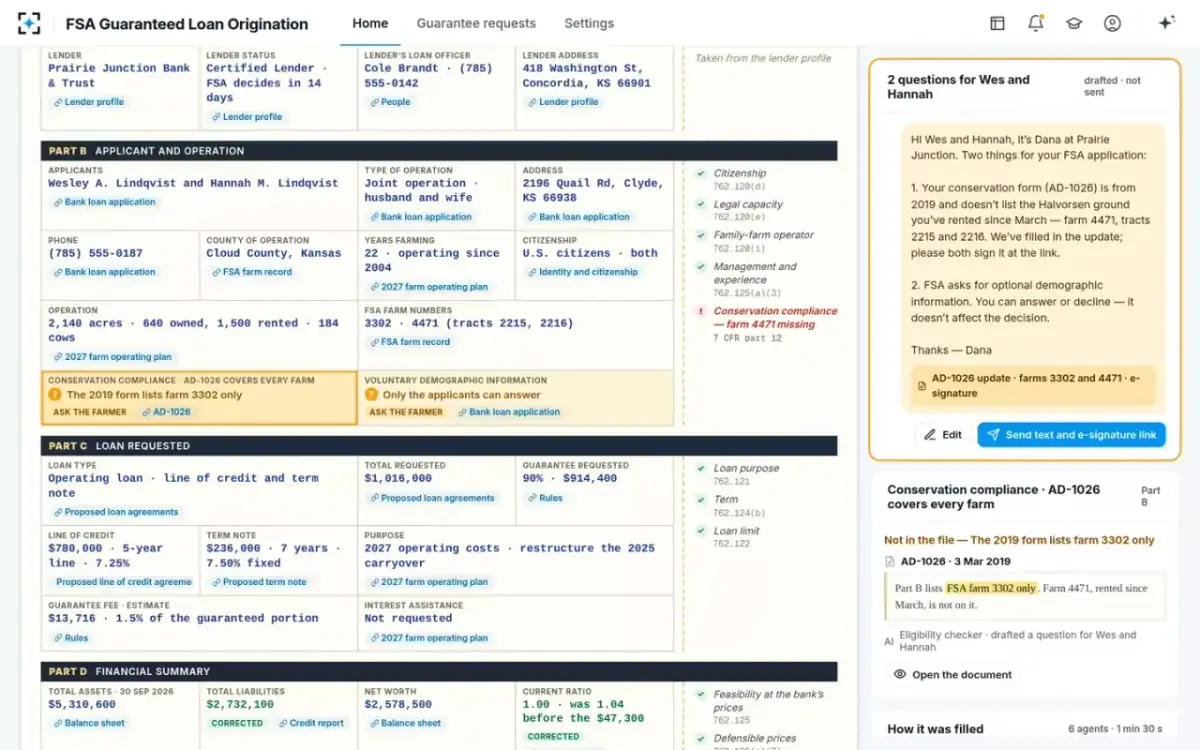
The borrowers sign their own parts, including anything the file could not answer for them. On the sample file that is a conservation compliance update covering the newly rented ground, sent for signature with a plain-words explanation of why it is needed, and the voluntary demographic question, which the applicants may answer or decline without it affecting the decision.
What the agents change is not who signs but what the signature means. Signing a package assembled by hand is partly an act of faith in whoever assembled it. Signing a package where every field opens the line it was read from is a different act, and a reviewer can reconstruct it afterwards.
Every rule with its evidence, and compliance tested tract by tract
Agentic AI against a single chat assistant: why the file needs six roles, not one
The obvious alternative is one capable assistant with the whole file in front of it. On a short task that is often the better tool. On a guarantee file it loses on four counts, and all four are about accountability rather than capability.
One assistant with the whole file, or six agents with six jobs
One assistant, one prompt: The output as a whole. If the package is wrong you know the assistant was wrong, not which step failed.
Six agents, six limits: Each job separately: did the sorter file this document right, did the checker read this rule right, did the analyst use this price deck.
One assistant, one prompt: In the instructions, which the next long document can crowd out.
Six agents, six limits: In the design: the checker has no authority to determine eligibility, whatever it is asked.
One assistant, one prompt: The likeliest completion. On a form, that is a plausible figure with nothing behind it.
Six agents, six limits: An amber field and a drafted question to the person who can answer it.
One assistant, one prompt: A conversation.
Six agents, six limits: Which agent read which document, at which line, and what it concluded.
One assistant, one prompt: Asking a question of the file: why can this not go yet, what is the margin at $4.00 corn, write this paragraph from the committee note.
Six agents, six limits: Building and checking the file itself, every time, the same way.
The last row matters more than it looks. The point is not that conversational tools are weak; it is that a conversation is a poor container for an obligation. A guarantee file has to be the same file next year, when a loss claim or an examiner asks how a figure got there. Six narrow agents, each citing its source, produce that. How accurate the fill has to be, and what to measure turns the same question into numbers you can demand from a vendor. To watch the six run on one file, start at FSA Guaranteed Loan Origination.
Questions people ask
What is agentic AI loan origination?
It is loan origination software in which the work is divided into jobs — reading and filing documents, checking rules, rebuilding a cash flow, reviewing security, drafting the written case, assembling the package — and each job is given to an agent with its own sources, its own instructions and its own explicit limits. The agents act on the file rather than only describing it, and each one names the document and line behind every value it produces.
Can AI fill out a government loan application?
It can fill the fields whose answers are already in the lender's documents, which on the fictional sample file was 35 of the 39 answers the solution’s working view of FSA-2211 asks for, each linked to the line it was read from. It cannot answer a field the file does not contain — a conservation form that has not been updated, a voluntary question only the applicants can answer — and the useful behaviour there is to flag the gap and draft the request, not to guess.
Does AI decide if a farmer is eligible for an FSA loan?
No. The eligibility checker runs each rule in 7 CFR 762.120 with the evidence and the citation and flags what would be sent back, but the determination belongs to FSA. The agency's Farm Loan Officer reviews the request for eligibility, repayment ability, collateral adequacy and compliance with other regulations, and approves it only if those requirements are met.
What happens when the file cannot answer a field?
The field turns amber and the question goes to whoever can answer it, drafted in plain words — on the sample file, a text to the borrowers with a conservation compliance update attached for signature. The field fills when the answer comes back, and the package will not submit while it is still open, because the agency's processing clock only runs on a complete application.
Who signs if agents prepare the whole file?
The ag loan officer signs the application for guarantee, within the credit authority the bank's policy sets, and the bank's own credit approval comes from someone senior above that limit. The borrowers sign their own parts. The agents prepare, cite and flag; the signatures, and the certifications they carry, stay with people.
Is one AI assistant enough, or do you need several agents?
For asking questions of a file, one is usually enough. For building a federal submission, several narrow agents are easier to test, easier to bound and easier to audit: you can check whether the one that reads liens reads them correctly, which you cannot do for a single assistant that did everything at once. The practical test is whether a tool can tell you which of its steps produced a given value, and where that step stops.