AI loan origination accuracy is usually quoted as one number, and on a government form one number is not enough to decide anything. Filling FSA-2211, the Application for Guarantee, from a bank's own credit file is four tasks, not one: reading a value correctly, saying where it came from, admitting when the file cannot answer, and never passing something wrong as answered. A tool can be excellent at the first and dangerous at the fourth. Botminds' FSA Guaranteed Loan Origination fills that form from the documents the bank already holds and links every field to the line it was read from, which is the design this guide tests rather than praises — because the way to evaluate any such tool, ours included, is to measure the four things separately on files whose answers you already know.
The worked figures below come from the solution's own fictional sample file: a $1,016,000 guaranteed operating loan for Wes and Hannah Lindqvist, filed by Prairie Junction Bank & Trust of Concordia, Kansas. Where a number is an illustration of a method rather than a result from that file, the caption says so.
What one file produced in FSA Guaranteed Loan Origination, and what each number proves
2questions
raised for the applicants instead of filled — the two answers no document in the file could give
13
eligibility rules checked, each with its citation and the document behind it
2,140acres
tested for conservation compliance tract by tract, not farm by farm
64
citations in the drafted lender narrative, one for every figure in it
Why "is the AI accurate?" is the wrong question for a cited form
Accuracy is a useful word when there is one right answer and one way to be wrong. Filling a form from a file is not that situation, because there are at least four distinct ways for an answer to be unsatisfactory, and they have different costs.
A field can be wrong: the value does not match what the document says. A field can be right but unsourced: the value is correct and nothing in the system can show where it came from. A field can be flagged when it did not need to be: the file held the answer and a person was asked anyway. And a field can be unflagged when it should have been: the file could not really answer, and the system filled it with something plausible. The last is the one that ends up in a federal submission.
A vendor's single "98% accurate" answers only the first, and usually on a sample it chose. The rest of this guide gives each of the four a name, a formula and a test.
Four measures, four different failures
| Measure | The question it answers | What a poor score actually looks like on a guarantee file |
|---|---|---|
| Field match rate | Of the fields the system filled, how many match the value a competent person would have entered from the same documents? | The form is wrong in ways that are individually small and collectively fatal: a farm number, an acreage, a total that does not tie to the balance sheet. |
| Citation rate | Of the fields it filled, how many open the document and the line they were read from? | The form is right today and unverifiable next year, when a loss claim or an examiner asks how a figure got there. |
| Flag precision | Of the fields it raised as questions, how many genuinely could not be answered from the file? | Amber everywhere. The reviewer stops reading the flags, which quietly destroys the value of the ones that are real. |
| Flag recall | Of the fields that could not be answered from the file, how many did it actually raise? | A confident, complete-looking form with invented values in it. This is the failure that reaches the agency. |
Field match rate: how many of the 39 answers does it get right unprompted?
Field match rate is the simplest of the four and the one every vendor will quote. Take a file whose correct answers you already know, let the system fill the form with no human help, and count: matched fields divided by fields attempted. State both numbers, because a system that attempts fifteen of 39 fields and gets all fifteen right has a 100% match rate and has not done the job.
Three details decide whether the number means anything. First, define a match before you run the test: is a total liabilities figure of $2,732,100 a match for $2,732,098, and is a name in a different order a match? Write the rule down, because otherwise you will write it afterwards, in the system's favour. Second, test on the form the bank actually files, with the parts that are hard — the operation's description, the farm and tract numbers, the financial summary — rather than on the identifying fields at the top, which are easy and numerous enough to flatter any score. Third, count attempted fields and skipped fields separately. The second number is the subject of the next three sections.
On the fictional sample file, 35 of the 39 answers in the solution’s working view of FSA-2211 were filled from the bank's 42 documents on the first pass and four were left open. The two that matter for this measure were questions only the applicants could answer — a conservation compliance form that pre-dated newly rented ground, and a voluntary demographic question — and both were raised with a drafted message rather than filled. That is the pattern to look for: an open answer should come with a reason a person can check.
Citation rate: what is an unsourced field, and why does it matter more than a wrong one?
An unsourced field is a value on the form that the system cannot trace to a document and a line. It matters more than a wrong field for a simple reason: a wrong field with a citation is discoverable in seconds by the person reviewing it, and an unsourced field is not discoverable at all until something goes wrong.
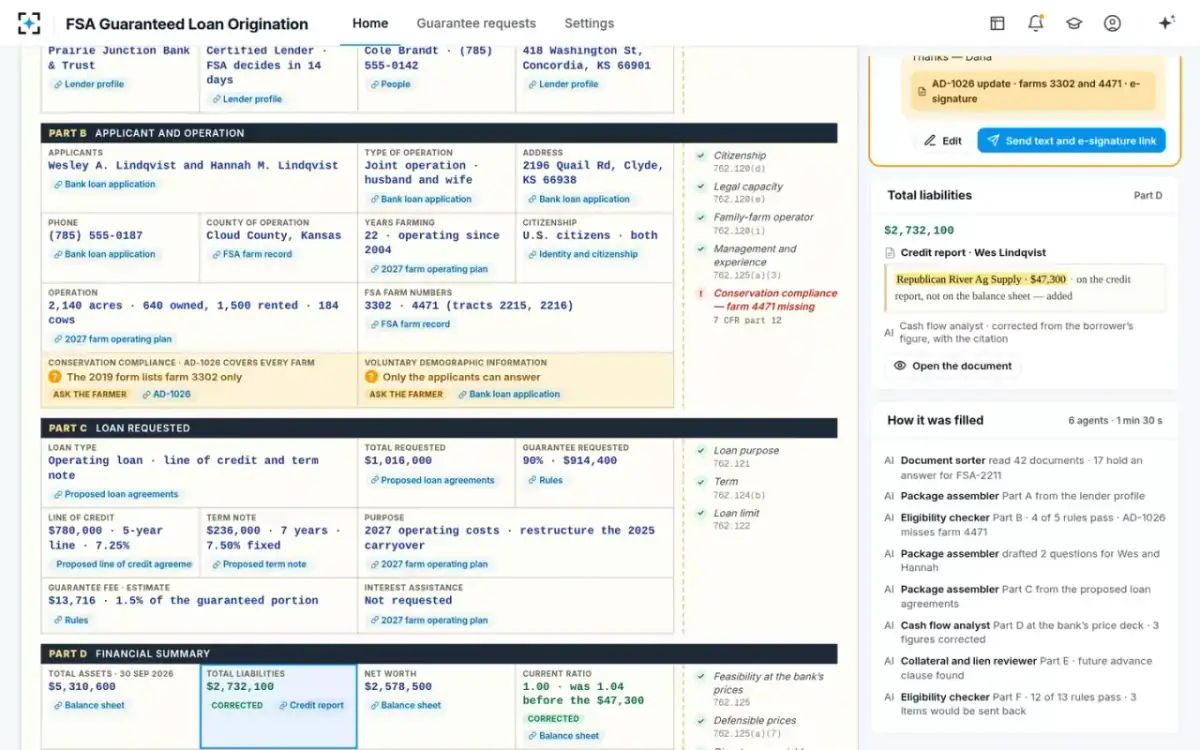
Citation rate is the share of filled fields that open their source. Measure it as a count, not an impression, and measure the quality of the link as well as its existence: a citation that points at a 60-page tax return is weaker than one that points at the line. On the sample file the test is visible on screen — click total liabilities and the credit report opens on the exact line, showing a $47,300 supplier account that was not on the balance sheet, added and marked corrected, with the current ratio moving from 1.04 to 1.00 as a result.
That example is also the best argument for the measure. The correction changed a credit conclusion. If it had been applied silently, the file would still have been right and nobody at the bank would have known why a ratio moved. Corrections that are shown can be argued with; corrections that are absorbed cannot.
A field in FSA Guaranteed Loan Origination, opened on the line it came from
Flag precision: does amber mean the file truly cannot answer?
Flag precision is the share of raised questions that were genuinely unanswerable from the documents in the file. It is the measure that decides whether anyone will keep reading the flags after week three.
A system with poor precision is not merely annoying. It trains the reviewer to clear amber fields quickly, which is exactly the habit that lets a real one through. The test is easy to run and rarely run: take the questions the system raised on a closed file, and for each one go and find the answer in the file yourself. Every one you find is a false flag.
On the sample file both raised questions survive that test. The conservation compliance form on file is dated 2019 and lists one farm; the operation now includes a second farm with two tracts rented since March, so the answer genuinely is not in the file and a borrower signature is genuinely required. The demographic question is voluntary and can only be answered by the applicants. Two of two is not a measurement — it is one file — but it is the right shape of evidence to ask a vendor for across twenty.
Flag recall: does a wrong field ever go green by mistake?
Flag recall is the mirror: of the fields that could not honestly be answered from the file, how many did the system raise? This is the measure that protects the submission, and it is the hardest to test, because by definition you are looking for the thing the system did not tell you about.
There is one reliable way to measure it, and it is to break the file on purpose. Remove a document, stale-date a form, delete a page from a lien statement, change a figure so it no longer ties — then run the fill and see whether the system raises the question or fills the field anyway. Any tool can look careful on a complete file. A seeded-error test is what separates one that is genuinely reading from one that is confidently pattern-matching.
A seeded-error test, worked through: twelve defects planted in one closed file
Read the two amber bars together. The two defects filled anyway are the ones to study one by one: what kind of gap was invisible to the system, and would it have been invisible to a tired coordinator too? The three false flags are a cost, but a recoverable one. The trade-off between the two is real — a system tuned to raise everything scores perfectly on recall and uselessly on precision — which is why both numbers have to be quoted together, by you, from your own test.
How do you test AI accuracy on a government form? Start with files you have already closed
The best test file is one the bank has already submitted, because the gold answers exist and cost nothing to produce: the form as filed, the cash flow as the credit analyst built it, the eligibility conclusions as the agency ruled on them, and the narrative as it was signed. A vendor's demonstration file proves that the vendor can prepare a demonstration file.
Pick files that are different from each other rather than representative on average. One operating loan and one farm ownership loan; one borrower with a clean file and one whose documents arrived over three months; one with a prior lienholder and a junior position, because that is where the security rules bite; one from a year with a declared disaster, because the production history rules behave differently. Six well-chosen files will tell you more than sixty similar ones.
What to ask for before you trust a first pass
- Both numbers, not one
Fields matched and fields attempted, on a file you chose, with your definition of a match written down first.
- A citation on every filled field
And ask what it points at. A link to a document is weaker than a link to the line, and much weaker on a 60-page return.
- The seeded-error run, shown to you
Not a summary. The defects it missed, named, so you can judge whether your own team would have missed them too.
- Precision and recall quoted together
A system tuned to flag everything has perfect recall and no value. Ask for both, from the same run.
- The behaviour on a gap
Watch what it does when the answer genuinely is not there. Filling a plausible value is a disqualifying behaviour on a federal form, however good the rest is.
- Who made each value
A fill you cannot attribute to a step is a fill you cannot debug when it goes wrong at volume.
Should every AI-filled field be reviewed, or only the amber ones?
At the start, every one. Not because the fill is untrustworthy, but because the first twenty files are the measurement: that is how a bank learns its own field match rate and its own flag recall, on its own documents, rather than a vendor's.
After that the answer should follow the evidence. A field whose source is a single, structured, signed document — the loan amount from the proposed loan agreement, the applicants' names from the application — is a different risk from a field assembled from several documents, such as a financial summary that depends on reconciling a balance sheet against a credit report. A sensible policy reviews the second kind every time and samples the first, and revisits the sampling rate whenever the documents change.
What should never shrink is the review of the agency-facing conclusions. The eligibility read-out, the feasibility result and the lender narrative are the parts a person is certifying, and the signature on the application is a statement about the file behind it. What the six agents may never decide sets out where each one stops, which is the other half of this question: the reason review can be proportionate at all is that the agents are not making the calls that matter.
What a 35-of-39 first pass should make you ask next
Not "is 90% good enough?" — that question has no answer without the rest of the behaviour. Ask these three instead.
Which four did it not fill, and why? If the answer is "they are not in the file", the system is working as intended. If the answer is "it was unsure", that is a different and much less comfortable system, and you want to know what it does when it is unsure but slightly less so.
How many of the 35 did a person change on review, and why? The count converts a match rate into hours saved, and it is the one number a bank can only produce for itself. The reasons matter as much: a change that corrects a misreading is an accuracy problem, and a change that substitutes one defensible judgement for another is not.
And what happened to the figures that moved? On the sample file the reconciliation with the credit report moved the current ratio from 1.04 to 1.00 and the disaster-year yield was replaced by a county average, both marked and cited. A system that makes such changes without marking them has a worse accuracy problem than one that gets a field wrong, because the error has been laundered into agreement.
What "12 of 13 rules pass" measures, and what it does not
An eligibility read-out that says twelve of thirteen rules pass is a statement about the lender's file, not a prediction of the agency's decision. It means: on these thirteen tests, with the documents here today, twelve are supported by evidence and one is not. On the sample file the one that is not is conservation compliance, because the form on file lists one farm and the operation now includes two.
That is a genuinely useful measurement and a genuinely limited one. It cannot tell you how the agency will weigh repayment ability, or whether the service center will read a borrowed-ground lease the same way the bank does. FSA is explicit about where the determination lives: its own Farm Loan Officer reviews the application for eligibility, repayment ability, collateral and compliance, and approves the request only if those requirements are met (USDA Farm Service Agency). Who holds each seat on a guarantee file sets that seat beside the bank's own.
So the honest reading of a pre-check is: here are the reasons this file would come back today, each with the one action that clears it. Measured against that claim, it is testable — take twenty closed files, run the check against the file as it stood at first submission, and compare the flagged reasons with the agency's actual return reasons. A bank that runs that comparison once knows more about its own tooling than any vendor's percentage will tell it.
The claim a vendor makes, and the claim you can test
What is usually quoted: "98% accurate" on an unnamed sample.
What to ask for instead: Fields matched over fields attempted, on six files you chose, with the match rule agreed in advance.
What is usually quoted: "Fully auditable."
What to ask for instead: Citation rate, and what the citation points at: the document, the page, or the line.
What is usually quoted: "Flags anything uncertain."
What to ask for instead: Flag precision and flag recall from one seeded-error run, with the misses shown.
What is usually quoted: "Checks against the regulations."
What to ask for instead: Which rules, with their citations, and a comparison against the return reasons on your own closed files.
What is usually quoted: "Minutes instead of days."
What to ask for instead: Hours after review, measured on your files — the fill is only part of the elapsed time.
What the agency's completeness rule does, and does not, tell you about accuracy
There is one place where the program itself sets a standard, and it is about completeness rather than correctness. For the purposes of the processing timeframes, an application is not considered complete "until all information required to make an approval decision, including the information for an environmental review, is received by the Agency" (7 CFR 762.130(a)(3)).
That rule rewards flag recall above everything else. A missing item does not merely cost accuracy points; it stops the agency's clock from starting, and what a late guarantee file costs, and whose clock it is prices the consequence. What the rule does not do is say anything about whether the values on the form are right. A complete application full of small errors is complete.
It is worth holding that distinction next to a wider lesson about measurement. The FDIC's October 2026 study of farm bank performance makes the point about credit, not software, but it is the same point: examiners "have observed more borrowers with reduced working capital and an increased need for carryover financing, suggesting that stress is building beneath the reported metrics" (FDIC, An Update on Farm Bank Performance). A headline number that looks healthy can sit on top of a problem the number was never designed to see. The response in both cases is the same: measure the thing you are actually worried about, separately, and on data you chose. To see the fill, the sources and the pre-check on one file, start at FSA Guaranteed Loan Origination.
Questions people ask
How accurate is AI at filling a loan application?
There is no honest single figure, because filling a form from a file is four tasks with four different failure modes. On the fictional sample file in this solution, 35 of 39 answers filled from the bank's documents on the first pass, and the two the file could not give were raised as questions for the applicants. What that does not tell you is the citation rate, the share of raised questions that were real, or how often a gap was filled with a plausible value instead of raised — and those are the numbers to insist on.
What is a field match rate?
The share of the fields a system filled whose values match what a competent person would have entered from the same documents. Quote it with the number of fields attempted, agree what counts as a match before the test, and test on the hard parts of the form rather than the identifying fields at the top, which are easy and plentiful enough to flatter any score.
Can an AI agent cite a wrong source and still look right?
Yes, and it is the reason citation quality has to be checked rather than counted. A value that is correct and a link that points at the wrong document will pass any automated tally of citation rate. The practical defence is to check where links point on a sample — document, page, or exact line — and to prefer tools that highlight the line, because a reviewer can verify those in seconds and will therefore actually do it.
What is an unsourced field, and why does it matter more than a wrong one?
An unsourced field is a value nobody can trace back to a document. A wrong field with a citation is found by the first person who looks; an unsourced field is found by an examiner, or by nobody. On a federal submission the second case is worse, because the bank has certified a file it cannot reconstruct.
How do you build a seeded-error test for loan origination?
Take a file you have already closed, make a copy, and plant defects of the kinds you really see: a stale conservation form, a missing page from a prior-lien statement, a figure that no longer ties to the balance sheet, a document for the wrong farm number. Record what you planted, run the fill, and count what was raised, what was raised for the wrong reason, and what was filled anyway. The last count is the one that matters.
What does a "12 of 13 rules pass" read-out actually measure?
It measures the lender's own file against a list of tests: twelve are supported by the evidence in the file, one is not. It is not a prediction of the agency's decision, which belongs to FSA's Farm Loan Officer and covers repayment ability and collateral adequacy as well as eligibility. The way to test the read-out is to run it against twenty closed files as they stood at first submission and compare its reasons with the reasons the agency actually gave.