Ag lending software is not one category, and a bank choosing between options is usually comparing three things that do different jobs. A checklist spreadsheet tracks what is missing. A loan origination system routes documents, holds the file and enforces the bank’s own workflow. An agentic layer reads the documents and puts their values on the government’s form, tested against the government’s rule. Only the third addresses the part of a USDA guaranteed farm loan that actually takes the week, and it is also the newest and the least understood. FSA Guaranteed Loan Origination is Botminds’ version of the third, and this guide is an honest map of all three, including what the agentic approach does not do.
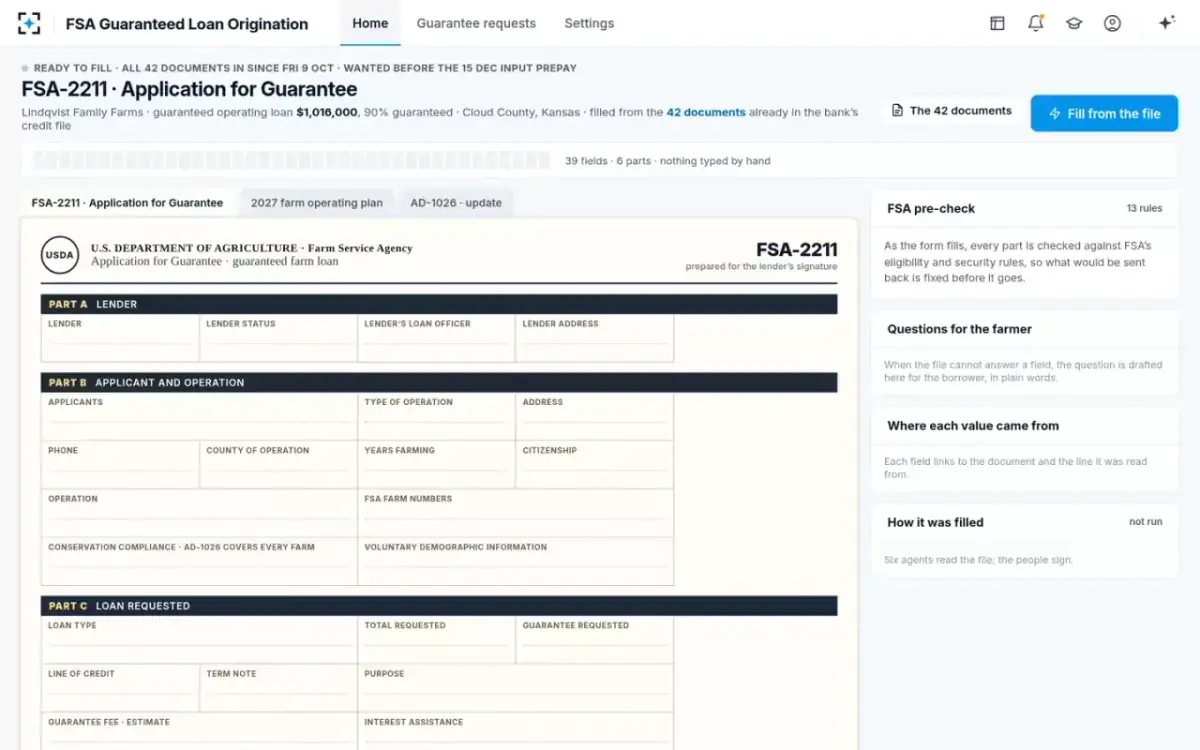
Where a file appears below it is a fictional sample used in the solution — a $1,016,000 operating loan for the Lindqvist family at Prairie Junction Bank & Trust, 42 documents and the 39 answers the solution’s view of FSA-2211 asks for. The market figures come from the FDIC and the rules from 7 CFR part 762.
The market this software is sold into
917
farm banks as of the second quarter of 2026 — 21.6 percent of all FDIC-insured institutions
32states
hold them, with 83 percent of farm banks in the top ten states by count
6agents
in the sample file, between the documents arriving and the application being signed
42documents
in one guarantee file, from the bank’s credit file to the lien search and the prior-lien statements
What a spreadsheet checklist does, and where it stops
Most banks that file a handful of guarantees a year run on a list. It is usually one person’s list, built from the last file, and it works better than outsiders expect: it is free, it is exactly as detailed as that bank needs, and it is edited the moment it turns out to be wrong. For tracking presence — is the balance sheet here, has the lien search been ordered, has the borrower signed — it is genuinely adequate.
It stops at the difference between present and correct. A list asks whether a document exists under a name. It cannot ask whether the conservation certification lists both farms, whether the prior lienholder’s wording allows future advances, whether the balance sheet and the credit report agree, or whether the projection’s prices are documented. Those are the four things that send a file back, and all four look complete on a list.
It also has a staffing problem that is invisible until it bites. The list lives with the person who maintains it, and a bank filing six guarantees a year has one such person. When they are away, the next file starts from memory — which is the ordinary condition at a bank where the guaranteed-loan coordinator rebuilds the checklist from memory every time.
What a loan origination system adds, and the FSA-specific gap it leaves
A loan origination system is a real step up and should be judged on what it is for. It gives the file one home, routes approvals by credit authority, enforces the bank’s own policy, keeps an audit trail, and connects to core banking. For a bank doing volume in ordinary ag credit, that is worth buying on its own merits, and almost nothing in this guide argues against it.
The gap is specificity. A general system encodes the bank’s policy, because that is what every customer shares. The guarantee file is governed by somebody else’s rules — 7 CFR part 762 and 7 CFR part 12 — which no two banks can configure identically and which change when USDA changes them. The tests are not generic: whether total debt against junior-lien security is within 85 percent of its value; whether three years of production history is used, with county averages substituted for a declared disaster year; whether price forecasts are documented and acceptable to FSA; whether every signer, not just the applicant, clears the eligibility rules.
Some of that can be built as configuration in a general system, and some banks have. The honest question is who maintains it afterwards, and against what. A rule encoded once in a configuration screen is a snapshot of a regulation; the regulation is not a snapshot.
What an agentic layer adds on top of either
What an agentic layer does that neither of the others does is read. Not ingest a structured feed — read the documents a farm bank actually holds: a scanned prior-lien statement, a county UCC search, a balance sheet prepared by the borrower’s accountant, three years of crop insurance production reports, a conservation certification signed in 2019. Reading them is what turns a list of document names into a filled form.
In the sample file that is six agents with one job each: a document sorter that files every document against the application checklist for the loan size and the lender’s status, an eligibility checker, a cash flow analyst, a collateral and lien reviewer, a narrative writer and a package assembler. Thirty-five of the thirty-nine fields fill from the file on the first pass, each value linked to the line it was read from.
The second thing it adds is the test. Having read the documents, it can ask the agency’s question rather than the bank’s: would this come back today, and for what? In the sample file the answer is yes, for three reasons — a conservation certification that lists one of two farms, a prior lien that secures future advances, and a narrative section that asserts rather than evidences. Each carries its 7 CFR reference and the one action that clears it. What those requirements are, in full is a guide of its own.
What “reads the documents” looks like: the government’s form, not the bank’s screen
Three approaches, job by job
A checklist spreadsheet: Tracking presence. Free, precise to this bank, edited the moment it is wrong.
An agentic layer: Reading documents, filling the form, citing each value, and testing the file against the agency’s rule.
A checklist spreadsheet: Tell correct from present. Survive the holiday of the person who keeps it.
An agentic layer: Make the eligibility determination, inspect the farm, or replace servicing after the guarantee is issued.
A checklist spreadsheet: One person’s attention, continuously.
An agentic layer: A pilot on closed files, then the bank’s own settings: lender status, price deck, credit policy, approval limits.
A checklist spreadsheet: Above the spreadsheet: one home for the file, routing by credit authority, policy enforcement, audit trail, core integration.
An agentic layer: Beside it, not instead of it. The origination system owns the bank’s workflow; the agentic layer owns the reading and the rule test.
Why most guaranteed-loan teams are too small to justify a system of their own
The economics of this market are unusual, and they explain why the spreadsheet has survived. Farm banks are numerous and small: 917 of them in the second quarter of 2026, “comprising 21.6 percent of all FDIC-insured institutions”, and nearly all of them community banks by the FDIC’s own research definition. They are concentrated, too — headquartered in 32 states, with 83 percent of them in the top ten states by number.
A market of many small banks, concentrated in ten states
FDIC-insured institutions, Q2 2026
- Farm banks · 21.6%
- All other institutions · 78.4%
Where the 917 farm banks are headquartered
- The top ten states by count · 83%
- The other 22 states · 17%
A desk at a bank like that does not file enough guarantees to amortise a dedicated system, and does not file few enough to stay fluent. That is the worst of both: too rare to be routine, too frequent to ignore. It is also why “buy a loan origination system” is often the wrong first answer. The system is sized for the bank’s whole lending book; the problem being described is a handful of files a year that each take a week.
The question that decides it: who reads FSA’s own rule into the file?
Strip the category names away and one question separates the three approaches. When the file is assembled, who compares it against 7 CFR 762 — and what do they compare, a list of document names or the documents themselves?
With a spreadsheet, a person does, from memory, usually once, at the end. With a general origination system, a person does, assisted by whatever configuration someone built, against the bank’s policy. With an agentic layer, it is done continuously as the form fills, against the rule, with the evidence attached — and a person then reads the flags and decides. That last clause matters: the determination is FSA’s and the decisions are the bank’s. The checker flags; FSA decides.
The regulation itself keeps drawing that line. Security is explicitly the bank’s responsibility, not anyone’s system’s:
The lender is responsible for ensuring that proper and adequate security is obtained and maintained to fully secure the loan, protect the interest of the lender and the Agency, and assure repayment of the loan or line of credit.
7 CFR 762.126(a)(1)
So software that quietly takes that responsibility on, or that presents a rule test as a determination, is selling something it cannot deliver. What it can honestly do is make sure the person who is responsible has read everything relevant before they sign.
What to ask a vendor before you buy: field linkage, not just field count
Demonstrations of this kind of software converge on one number — how many fields it filled. It is the wrong headline. A field that is right and unsourced costs the same phone call as a field that is wrong, because neither can be checked without reopening the file. The questions below separate a filled form from a trustworthy one.
Questions worth asking before you buy ag lending software for guarantee files
- Show me a field, then show me the line it came from
Every value should open its source document on the exact line. Ask to click three at random, including one the system corrected.
- What happens when two documents disagree?
The balance sheet against the credit report is the standard case. A system that silently prefers one is worse than one that flags both.
- Which rules does it actually test, and against what text?
Ask for the citation beside each test. Eligibility for every signer, conservation compliance by tract, the 85 percent junior-lien arithmetic, prior-lien clauses, documented price forecasts.
- What does amber mean, precisely?
It should mean the file genuinely cannot answer the field. If it also means “unsure”, your coordinator will learn to click past it.
- Who signs, and can it submit without them?
Routing by credit authority, and a hard stop on submitting with an open item. FSA’s decision period does not start on an incomplete application.
- What does it do with a voluntary question?
A borrower is entitled not to answer one. Chasing it as missing data is a design error, not a feature.
- What happens after the guarantee is issued?
Default reporting at 30 days past due, status reports as of 31 March and 30 September, and for lenders below Preferred an annual analysis of every line of credit and of term loans whose balances total more than $500,000. Ask what covers that, because an origination tool may not.
- Can we test it on files we have already closed?
A closed file has a known answer. Replaying one is the only honest measure before go-live.
What changes for the farmer, not just for the bank
Software decisions at a bank are usually argued in the bank’s terms — hours, headcount, cycle time. On a guarantee file the person with the most at stake is not in the room. The farmer is waiting on operating money, and has fewer rights in this process than people assume.
The regulation is explicit that the bank’s own decision is not appealable: “A decision made by the lender adverse to the borrower is not a decision by the Agency, whether or not concurred in by the Agency, and may not be appealed.” Appeal rights attach to FSA’s decision, and FSA states that where an application is not approved, both the lender and the applicant are notified in writing of the specific reasons, and “loan applicants are provided reconsideration and appeal rights.”
So the practical effect of better software on the farmer is upstream of all of that: fewer weeks before the request is complete, and fewer requests that come back. There is a second effect worth naming. When a field cannot be answered from the file, the borrower is the one who has to answer it — and the quality of that question matters. “Please provide an updated AD-1026” is a form number. “Your conservation form is from 2019 and doesn’t list the Halvorsen ground you’ve rented since March” is a sentence a farmer can act on from a phone, in a field.
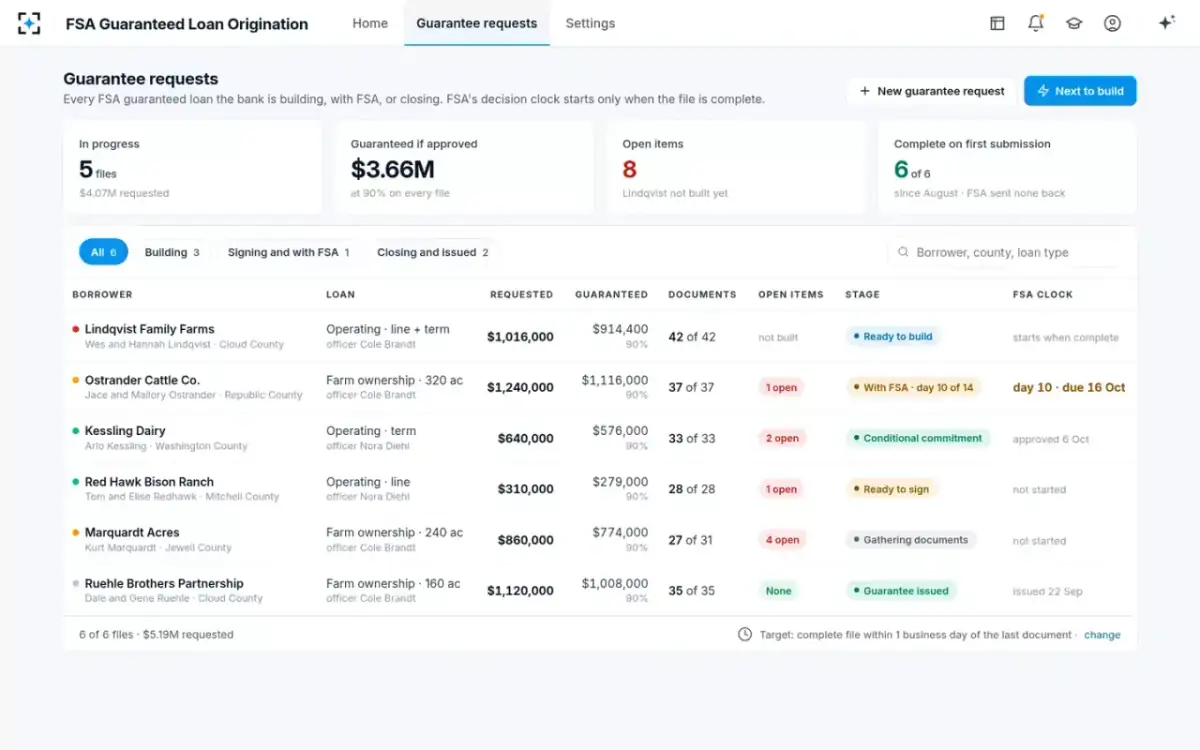
One desk, every guarantee the bank is building
A three-way scorecard: tracks, routes, reads the rule
The table below is the comparison reduced to jobs. It is our scorecard, not a product matrix, and the last row is the one most buyers skip.
Seven jobs a guarantee file needs doing, and which approach does each
The jobKnows what is missing
SpreadsheetYes, if someone keeps the list current
Loan origination systemYes, and it chases
Agentic layerYes, from the documents themselves
Why it mattersThe easiest job, and the one three approaches all do.
The jobRoutes the file to the right people
SpreadsheetNo — email does it
Loan origination systemYes, by credit authority and queue
Agentic layerYes, by credit authority
Why it mattersA real strength of a general origination system.
The jobReads a document and puts the value on the form
SpreadsheetNo — a person types it
Loan origination systemPartly, for structured feeds it already ingests
Agentic layerYes, with the line it came from attached
Why it mattersWhere most of the week goes.
The jobReconciles two documents that disagree
SpreadsheetNo
Loan origination systemRarely — it stores both
Agentic layerYes, and shows the correction with its reason
Why it mattersThe credit report against the balance sheet is the classic case.
The jobTests the file against the agency’s own rule
SpreadsheetNo — the list is document names
Loan origination systemAgainst the bank’s policy, not 7 CFR 762
Agentic layerYes, rule by rule, with the citation and the evidence
Why it mattersThe job that decides whether a file comes back.
The jobWrites the narrative with every figure cited
SpreadsheetNo
Loan origination systemTemplates, filled by hand
Agentic layerDrafted, each figure linked to its document
Why it mattersA narrative is prose, which is why it is left to last and done worst.
The jobKeeps the servicing obligations after closing
SpreadsheetNo
Loan origination systemYes — this is what it is for
Agentic layerPartly; the origination file is its scope
Why it mattersDefault reporting, status reports and the annual analysis do not stop at the guarantee.
Read the last two rows together and the conclusion is not “replace your origination system”. It is that the guarantee file has a reading problem and a rule problem that general lending software was never built to solve, and that servicing obligations continue long after the origination work ends. Most banks will end up running more than one of these.
What ag lending software cannot do, and should not claim
Three things on a guarantee file are closed to software entirely, and a vendor that implies otherwise is worth less trust on everything else.
The first is the eligibility determination. The rules can be tested and the evidence assembled; FSA decides. The second is the lender’s own credit judgement — whether the bank will make this loan, at what margin, against what policy — which is also the evidence behind the credit-elsewhere requirement and therefore cannot be generated by the thing that reports it. The third is physical: “Before submitting an application the lender must make an inspection of the farm to assess the suitability of the farm and to determine any development that is needed to make it a suitable farm.” Someone drives out to the place. No amount of document reading substitutes for it.
What is left, after those three, is most of the week: sorting, reconciling, filling, citing, testing and drafting. That is the work FSA Guaranteed Loan Origination is built for, and the fair way to evaluate it — or anything else in this category — is on a file whose answer you already know. What a pilot on your own closed files looks like sets that out.
Questions people ask
What is ag lending software?
It is a loose category covering at least three different things: tracking tools that record what a farm credit file is missing, loan origination systems that hold the file and route it through the bank’s own approvals, and agentic tools that read the documents and fill and check the forms an agency requires. They solve different problems, and a bank comparing them is usually comparing one of each rather than three of the same thing.
Can a generic loan origination system check FSA’s eligibility rules?
Only to the extent someone configures them into it, and then only as a snapshot. The rules live in 7 CFR parts 762 and 12 — eligibility for every signer, conservation compliance by tract, an 85 percent junior-lien ceiling, prior-lien clauses needing limitation, three years of production with county averages for a declared disaster year, documented price forecasts. A system built to enforce a bank’s own policy enforces that policy well; the agency’s rules are a different body of text, maintained by somebody else.
What does agentic ag lending software add that a checklist spreadsheet cannot?
Reading. A spreadsheet knows a document’s name; an agentic layer reads its contents, puts values on the form with the line each came from, reconciles documents that disagree, and tests the assembled file against the agency’s rule with the citation attached. A checklist can tell you the conservation certification is present. Only something that reads it can tell you it lists one farm and the operation now works two.
Does ag lending software replace the loan officer?
No, and on a guaranteed file it cannot. The bank’s credit judgement, the signature and its meaning, and the pre-application farm inspection all stay with people, and the eligibility determination stays with FSA. What changes is what the loan officer reads before signing: a file where every value shows its source and every rule shows its evidence, rather than a package assembled by hand and hoped to be current.
Do I need a loan origination system for a handful of FSA loans a year?
Probably not for the guarantees alone. An origination system is sized for a bank’s whole lending book and earns its place there. A desk filing six guarantees a year has a different problem — each file takes about a week and the knowledge lives with one person — and that is a reading and rule-checking problem rather than a routing one. If the bank is buying an origination system anyway, buy it on its own merits and solve the guarantee file separately.
What should a small ag lender look for before buying anything?
Linkage over field count: every value traceable to the line it came from, and every rule test showing its citation and its evidence. Then the behaviour at the edges — what happens when two documents disagree, what a flag means precisely, whether it can submit with an open item, and how a voluntary question is handled. Finally, insist on testing it against files you have already closed, where the right answer is already known.