FSA-2211 instructions usually tell you what each box is called. The more useful question, and the one that decides whether a box stays blank, is which document in the credit file answers it. The current Application for Guarantee, revision 04-17-25, is eight pages lettered A to P: the applicant completes Parts A to F, the lender Parts G to M, FSA keeps Part N for itself, and co-applicants, entity members and co-signers complete Parts O and P. Around it travels the package the regulation requires — the narrative, the balance sheet, the cash flow, the credit report and, above $125,000, six more items. Almost every answer already sits in documents the bank holds. The boxes that stall are the ones only the applicant can answer, or that FSA makes voluntary. FSA Guaranteed Loan Origination, Botminds’ solution for ag lenders, fills the application from those documents and links each value to the line it was read from.
The figures on this page describing a particular file come from a fictional sample the solution runs on: Prairie Junction Bank & Trust and the Lindqvist family’s $1,016,000 operating loan, with 42 documents behind it. The people, the bank and the farm are invented. The form is quoted from FSA’s own current revision, and the rules from 7 CFR part 762.
One application, counted
16parts
lettered A to P on the current FSA-2211 — A to F for the applicant, G to M for the lender, N for FSA, O and P for co-applicants
35
of the 39 answers in the solution’s working view of the form filled from the bank’s own documents on the first pass
5
sources answer almost everything: the credit file, the cash flow, the lien search, the conservation certification and the credit report
2kinds
of question no document can answer — one only the applicant knows, one FSA makes voluntary
Who completes which part of FSA-2211
The form says who owns what in its first lines: “All Loan Applicants will complete Part A. If the Loan Applicant is an entity, they will complete Part B. If the Applicant is an individual, they will complete Part C. All Loan Applicants will complete Parts D, E, and F. Lender will complete Parts G through M.” That division is the first instruction worth following, because it tells a coordinator which half of the form waits on the farm and which half waits on the bank.
It also settles a question that trips up first-time filers: what to do with a married couple who farm together. The form treats them as a joint operation, and when both spouses are applying, one completes Part C and the other completes Parts O and P. In the sample file Wes and Hannah Lindqvist farm together, so each of them answers the applicant questions, signs the certifications, and is tested against every eligibility rule that reaches anyone who will sign the note.
The parts of the application, and the document that answers each
PartA to C · Who is applying
What it asksThe type of operation — individual, joint operation, trust, partnership, corporation, cooperative, LLC — and then either the entity’s details or the individual’s: legal name, address, birthdate, tax number, county, marital status, citizenship status.
Where the answer livesThe bank’s loan application, the entity papers and identity documents
Why that source settles itSpouses applying together are a joint operation: one completes Part C and the other Parts O and P, so the form is filled once per person, not once per farm.
PartD · Other names, and the voluntary questions
What it asksAny other business names, then ethnicity and race, sex and veteran status, which FSA asks for monitoring and to see whether targeted funds apply.
Where the answer livesOnly the applicant
Why that source settles itThe form says in terms that the applicant is not required to answer. No document in the credit file can, and none should be made to.
PartE · Eligibility statements
What it asksA description of the operation, whether the applicant will operate a family farm, years farming, acres owned and rented, and eleven yes-or-no statements: no loss to FSA, no delinquent federal debt, no federal judgment, citizenship, legal capacity, controlled substances, crop-insurance disqualification, no tie to a lender or FSA employee, credit elsewhere, no false statements, no debarment.
Where the answer livesThe operating plan, the leases and farm records, the credit report and the bank’s searches
Why that source settles itThe applicant attests; the bank’s file is what shows the attestation is true for every person who will sign the note.
PartF · The applicant’s certifications and signature
What it asksPrivacy Act and equal credit notices, lobbying and controlled-substance certifications, the federal-debt acknowledgment, and the signature on the statement that the application is true, complete and correct.
Where the answer livesThe applicants themselves
Why that source settles itIt is also where the applicant acknowledges that the approval period does not begin until a complete application has been filed.
PartG to I · What the bank is asking for
What it asksLoan type, amount or line ceiling, rate, the guarantee percentage requested, repayment period and terms; the purposes and amounts; and each item of security with its lien position, estimated value, prior lien and collateral value.
Where the answer livesThe bank’s own credit approval, the cash flow, the lien search, the prior-lien statements and the appraisals
Why that source settles itPart G is the bank describing its own decision. Part I is only as good as the search behind it — a prior lien the borrower forgot is still a prior lien.
PartJ and K · Interest assistance and EZ Guarantee
What it asksNet cash flow with and without interest assistance, for an interest-assistance request; ability to repay and acceptable credit history, for an EZ Guarantee.
Where the answer livesThe cash flow budget and the credit report
Why that source settles itEach is headed for one kind of request, but read the field guidance before leaving Part J blank: it asks for the net cash flow without interest assistance on every request, and the second figure only when assistance is sought.
PartL · Environmental information
What it asksAnswered from a site visit: whether the AD-1026 is certified and filed for the period of the loan, land use, floodplain, historic and archaeological sites, hazardous substances, endangered species, environmental lawsuits or liens, and whether it is a livestock operation.
Where the answer livesThe AD-1026 and the FSA farm and tract records, the farm inspection and the floodplain map
Why that source settles itEvery answer is a statement about the farm as it is today, which is why these go stale without anyone editing them.
PartM · The lender’s certification and signature
What it asksThe lender’s status — Preferred, Certified, Standard Eligible or Micro — seven certifications, the date of its lender’s agreement, and the authorised representative’s signature.
Where the answer livesThe whole file behind the form
Why that source settles itThis is the line the bank signs. Parts N to P are FSA’s own boxes and the co-applicants’ details and certifications.
Two things stand out once the parts are laid out. The first is how little of the form is about money. The balance sheet, the cash flow and the credit report are not copied onto FSA-2211; they are items in the package that goes with it, and the form’s own questions about the loan sit in Parts G to I, where the bank describes its own decision — the amount, the rate, the term, the purposes, the security and the share of the loan it wants guaranteed. The second is how much of the form is attestation. Part E is eleven sentences the applicant signs as true, Part L is eight statements about the farm, and Part M is the bank’s certification. Each of those is only as good as the documents behind it.
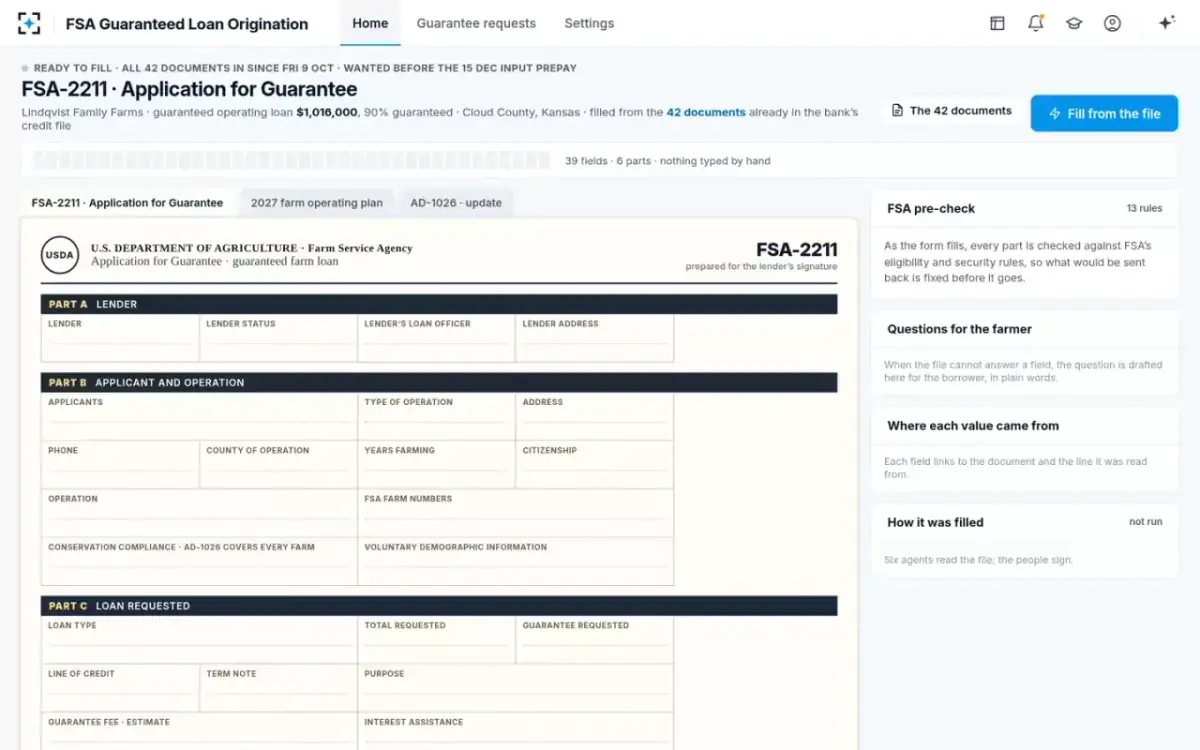
The solution’s working view of the form, before anything is filled
What the balance sheet and the tax returns answer — in the package, not on the form
The financial position is the part of a guarantee request most often built from a single document and most often wrong because of it. It does not live on FSA-2211 at all: the balance sheet, the cash flow budget and the credit report are separate items of a complete application under 7 CFR 762.110, and above $125,000 so are three years of financial history and verifications of income and debts. A balance sheet states what the borrower told the bank. The credit report states what the borrower’s other creditors told the bureaux. Where they disagree, the package has to carry the reconciled figure, and the disagreement itself is usually the interesting part of the file.
In the sample file the two disagree by $47,300: a supplier account at Republican River Ag Supply that appears on the credit report and not on the balance sheet. Added, it moves the current ratio from 1.04 to 1.00 — through the bank’s own 1.20 policy line. The figure is small and the consequence is not, which is the argument for reconciling before the package is assembled rather than after a Farm Loan Officer asks.
Three years of financial history is a separate item from the balance sheet, and it is what makes the current year readable. A current ratio of 1.00 in a single year is a number; the same ratio after three years of decline is a trend the lender narrative has to address — and the narrative, with its servicing plan, is itself one of the five items in every standard application.
What the cash flow and the production history answer
Feasibility has the strictest rules of anything in the package, because FSA cares less about the projection’s conclusion than about what it was built from. Three of them decide most of the work. Almost none of it lands on the form itself: the cash flow budget is an item of the package, and the form carries only its bottom line, the net cash flow in Part J, with a second figure when the bank asks for interest assistance.
The first rule is that production comes from the record, not from an estimate. For existing farmers, “actual production for the past 3 years will be utilized.” The second is what happens when one of those three years was a disaster. The regulation does not let a lender simply drop it, nor leave it in to drag the average down: “County average yields are used for the disaster year if the applicant’s disaster year yields are less than the county average yields.” If county averages are not available, state averages are used; a crop year with the lowest actual or county yield may be excluded only where the applicant’s yields were hit by disasters in at least two of the previous five consecutive years.
The third rule is about prices: the lender must use price forecasts that are reasonable and defensible, with sources it documents and FSA accepts — the cash flow agent’s section of the six-agent guide quotes the rule and what it asks of software. Documented is the operative word. A price deck the bank publishes monthly, reviewed by credit, is documented; a figure typed into a spreadsheet to make the margin work is not, however reasonable it looks. In the sample file the borrower’s own projection uses $4.60 corn and shows a repayment margin of 1.30; rebuilt at the bank’s October deck — corn $4.30, soybeans $10.40, wheat $5.55, calves $1,520 — it is 1.07, a $20,755 surplus after all debts, with breakeven corn at $4.14. Both projections stay in the file, and the borrower’s plan is never overwritten.
What the lien search and the prior-lien statements answer: Part I
Part I is where the form asks for facts that only a search can supply. For each item of proposed security it wants a description, the lien position, an estimated value, the amount of any prior lien and the collateral value, with totals. The prior-lien column is not knowable from anything the borrower hands over, because the borrower may not know: a filing by an equipment dealer two seasons ago sits in the state’s index whether or not it is on anyone’s list.
Two numbers in this part have to be built rather than copied. The value comes under the appraisal rules in 7 CFR 762.127, which differ by asset: a current appraisal, not more than twelve months old, is required on primary personal property security, with exceptions for annual-production crop security and for loans of $50,000 or less where a strong equity position exists. Real estate on a loan above $500,000 (or the current OMB threshold, if higher) needs a current appraisal, not more than eighteen months old, by a State Certified General Appraiser to USPAP, and a restricted report is not acceptable; at or below that line the lender documents value the way it does for its own unguaranteed loans.
The other built number is the junior-lien test: total debt against the collateral, including the new position, as a share of its value, which may not exceed 85 percent. In the sample file that is 56.7% of $1,126,000 of machinery. Getting it right means having read every filing, which is the same work that surfaces a prior lien’s future advance wording. The requirements that send a file back takes both of those apart.
What the conservation certification and the farm records answer: Part L
Part L looks like the easiest part of the form and behaves like the hardest, because every statement in it is about the present, and the lender answers it “Based on a site visit to the loan applicant's operation and discussion of the operating plan.” Its first statement is the one that catches files: “Applicant has certified compliance on AD-1026 covering the period of the loan and filed AD-1026 with the applicable Farm Service Agency Service Center.” The other seven cover land use, floodplains, historic and archaeological sites, hazardous substances, endangered species, environmental lawsuits and liens, and livestock.
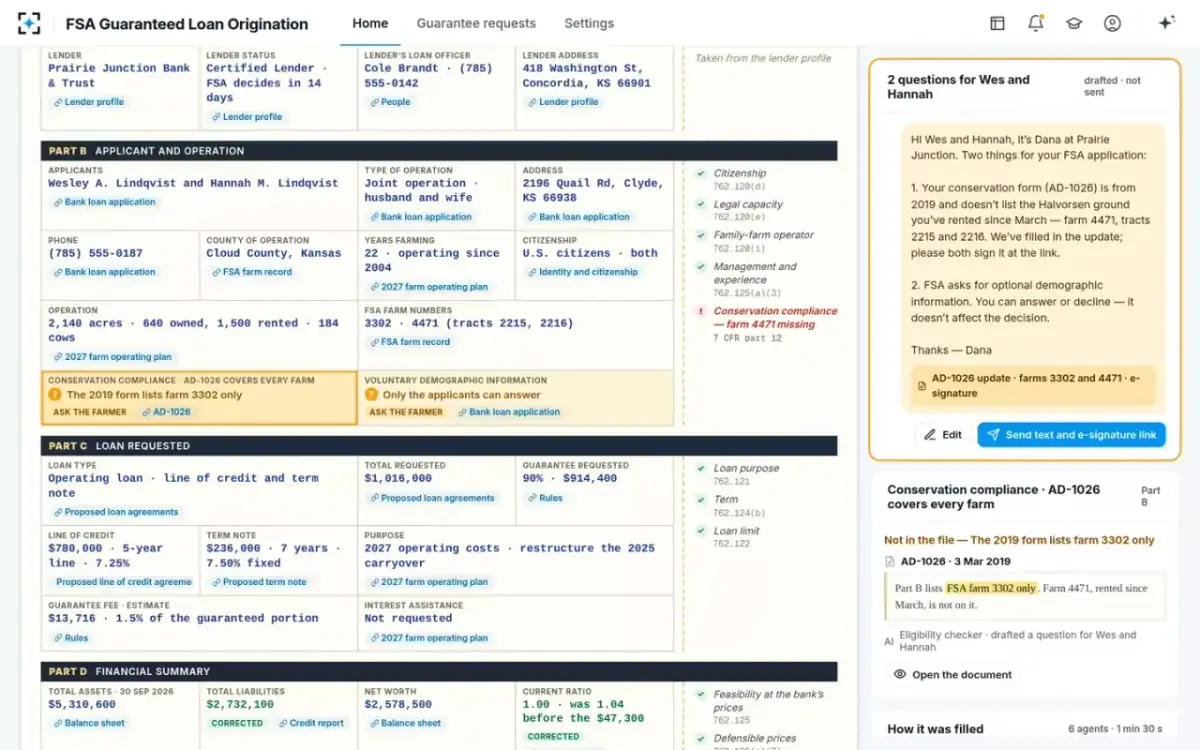
What makes these answers quietly wrong is that they rest on a form signed at some point in the past, against a farm that has grown since. In the sample file the AD-1026 on hand is from 2019 and lists FSA farm 3302 only; the operation now also works farm 4471, tracts 2215 and 2216, rented since March. No answer on the application is false yet. The certification underneath it is describing a smaller farm than the one the loan will operate. The solution checks it tract by tract rather than farm by farm, and drafts the plain-words message that asks the borrowers to sign an updated certification.
The filled application, each value linked to the line it came from
The lender certification in Part M: what the bank signs to
The certification in Part M is the part people skim, and it is the part with the most weight, because it is the bank vouching for everything behind the form. It begins with the lender’s status — Preferred, Certified, Standard Eligible or Micro — and then seven statements. Two deserve reading twice. One is the test for credit in the bank’s own words: “The Lender would not make the loan without an FSA guarantee.” The other is the promise about everything FSA does not see: “All documentation required by 7 C.F.R. Part 762, but not required to be submitted with the loan application, has been obtained and supports the data presented in this application.”
The rest certify that the applicable requirements of part 762 and of the lender’s agreement have been or will be met, that the applicant shows the ability to repay, that the proposed collateral is adequate, that a Preferred Lender will lend under its approved credit management system, and the date of the lender’s agreement that governs the application. Together they explain why the signature is not a formality, why the solution routes it by credit authority — in the sample file the officer signs up to $750,000 and the Ag Lending Manager approves above it — and why nothing is submitted with an item still open.
A second certification comes later and is often confused with this one. Before FSA issues the guarantee, after the loan has closed, the lender certifies on another agency form to the eleven statements in 7 CFR 762.130(d)(1) — among them that “There has been no material adverse change in the borrower's condition, financial or otherwise, since submission of the application” and that liens have been perfected with priorities consistent with the conditional commitment. Part M speaks to the file as submitted; the closing certification speaks to what has happened since.
The two questions no document can answer
Four of the thirty-nine answers in the solution’s working view stayed open on the first pass of the sample file, and two of them stayed amber after everything that could be read had been read. They are worth separating, because they need opposite responses.
The first kind is a question only the applicant can answer. The conservation certification covering a farm rented in March is one: no document in the bank’s possession knows about the lease until the borrower says so, and no amount of better reading finds it. The right response is a short, plain message to the borrower with the form attached — in the sample file, the borrowers signed and the answer filled.
The second kind is a question the applicant is entitled not to answer. The monitoring questions in Part D — ethnicity and race, sex and veteran status — come with the form’s own words: “You are not required to furnish this information but are encouraged to do so.” A tool that chases them as if they were missing data is working against the form. The right response is to offer them once and record the answer, including a decision not to give one; in the sample file the borrowers declined. A system that cannot tell these two kinds apart will either submit an incomplete file or badger a borrower about an optional question, and both are worse than leaving the box alone.
The documents to have in hand before you start the form
- The credit file
The bank’s loan application, entity papers, leases, balance sheets, tax returns and the proposed loan agreements. Answers Parts A to E and most of the package.
- The cash flow budget and the operating plan
The borrower’s projection, at prices the bank can document, over the operating cycle it represents. Answers feasibility, and Part J when interest assistance is asked for.
- Three years of production history
Actual yields, with county averages for a declared disaster year. Required of a standard eligible lender above $125,000.
- The lien search and every prior-lien statement
Answers Part I, the junior-lien test and the clauses that need a prior lienholder’s signature.
- The AD-1026 and the farm and tract records
Answers the first statement in Part L, if and only if the certification lists the farm as it is operated today.
- The credit report
Answers nothing on its own and corrects everything: it reconciles the balance sheet with what other creditors report, and tests the Part E statements about federal debt.
Why the evidence behind the form changes with the lender’s status
The same form can rest on different evidence depending on who files it, and the difference is written into the feasibility rules. For a standard eligible lender, the projected income and expenses used to determine a feasible plan “must be based on the applicant's proven record of production and financial management.” For a Certified Lender the test is stated differently — based on the applicant’s financial history and proven record of financial management — and a Preferred Lender follows its own internal procedures on financial feasibility, as agreed with FSA when its status was approved, and since 1 October 2026 certifies feasibility under delegated authority.
What the package has to rest on, by lender status
What the regulation requires: Projections based on the applicant’s proven record of production and financial management; three years of production history is a required application item.
What it changes about filling the form: The production behind the cash flow has to be evidenced from the record. A projection the lender believes but cannot source will not do.
What the regulation requires: Projections based on the applicant’s financial history and proven record of financial management.
What it changes about filling the form: FSA tells the lender which items to submit; the rest stay in the bank’s own file, which Part M certifies are held and support the application.
What the regulation requires: The lender follows its internal procedures on financial feasibility, as agreed with FSA; the application itself is an application form and a loan narrative, plus whatever the lender agreement adds.
What it changes about filling the form: The package is shorter, but Part M now certifies more, and under delegated authority the feasibility and security analysis is the bank’s to certify. The work moved; it did not disappear.
One set of answers is set by neither the documents nor the status. Rate and terms in Part G are negotiated, inside a ceiling: FSA states that “The Guaranteed loan interest rate and payment terms are negotiated between the lender and the applicant and may not exceed the maximum rates established by FSA.” Operating loans are normally repaid within seven years and farm ownership loans cannot exceed forty, with advances on a line of credit made within five years of the guarantee. Part G also asks for the guarantee percentage, with a box for the maximum and a box for a lower figure, which is a pricing decision the guide to the guarantee’s value and fee works through. What a bank’s lender status changes covers the rest of the ladder.
What 35 of 39 on a first pass should, and should not, tell you
A fill rate is a useful number and a poor one to buy on. Thirty-five of thirty-nine says the documents in that file answered most of what the bank had to answer. It does not say the thirty-five are right, and it does not say the four left open were the right four to leave open. Both of those are better questions, and both are answerable on a file a bank has already closed.
The question that separates a filled form from a trustworthy one is whether every value shows the line it came from. A value that is right and unsourced costs a Farm Loan Officer the same phone call as a value that is wrong, because neither can be checked without reopening the file. In the sample file every value opens the document on the exact line — total liabilities opens the credit report on the $47,300 account, marked as a correction with its reason.
The second question is what the amber means. Amber is only worth anything if it means “the file genuinely cannot answer this”. If it also fires when the system is merely unsure, a coordinator learns to click past it, and the first time it is right about something important, it is ignored. How to measure that on your own closed files is a separate exercise worth doing before a pilot, not after.
What a fill rate does buy, honestly, is the first day back. The hours in a guarantee file are spent sorting, reconciling, rebuilding and writing, not typing — and a form that arrives already filled, already linked and already checked against the rule is a file whose remaining work is the judgement a lender is paid for. The applicant’s own certification in Part F ends on the sentence that explains why it matters: “I understand that the approval period will not begin until a complete application has been filed.” See it on a file of your own at FSA Guaranteed Loan Origination.
Questions people ask
What is FSA-2211?
FSA-2211 is the Application for Guarantee: the form a lender and a loan applicant complete together and submit to the FSA service center for the lending area, asking FSA to guarantee a farm operating, farm ownership or conservation loan the lender will make. The current revision, dated 04-17-25, runs to eight pages in parts lettered A to P. On a guaranteed loan the lender, not the farmer, is the party FSA deals with, and the loan remains the lender’s property and responsibility.
What are the instructions for FSA-2211?
The form’s own first instruction divides the work: every applicant completes Part A, an entity completes Part B and an individual Part C, every applicant completes Parts D, E and F, the lender completes Parts G to M, and co-applicants, entity members and co-signers complete Parts O and P. Spouses applying together are a joint operation, with one completing Part C and the other Parts O and P. Part N is for FSA, which records there the dates the application was received and found complete.
How many parts does the Application for Guarantee have?
Sixteen, lettered A to P, on eight pages. Parts A to F belong to the applicant — the type of operation, who is applying, other names and the voluntary monitoring questions, eligibility statements and certifications. Parts G to M belong to the lender — the request, the purposes, the security, interest assistance, EZ Guarantee, environmental information and the lender’s certification. Part N is FSA’s, and Parts O and P are for co-applicants and co-signers.
What documents does FSA-2211 need?
For a request over $125,000 from a standard eligible lender, 7 CFR 762.110 requires the application form, a loan narrative with a servicing plan, a balance sheet, a cash flow budget, a credit report, verification of income, verification of debts above FSA’s threshold, three years of financial history, three years of production history, the proposed loan agreements, and construction plans where applicable. Items not sent to FSA must still be held by the lender, which certifies in Part M that they have been obtained and support the application.
Why would a field on FSA-2211 stay blank?
Usually for one of two reasons, and they need opposite handling. Either only the applicant knows the answer — a lease signed after the conservation certification was last filed is the classic case — or the question is voluntary, as the Part D monitoring questions are, and the applicant has chosen not to answer it. The first is chased with a short message and a form to sign; the second is recorded as declined.
What is the lender certification on FSA-2211?
Part M. The lender states its status and certifies that the requirements of 7 CFR part 762 and its lender’s agreement have been or will be met, that it would not make the loan without an FSA guarantee, that the applicant shows the ability to repay, that the collateral is adequate, and that the documentation it has not submitted has been obtained and supports the application. A separate certification of eleven statements, under 7 CFR 762.130(d)(1), follows at closing, before FSA issues the guarantee.