The FSA guaranteed loan approval timeline for lenders has a published answer and a real one. The published answer is in the regulations: a complete application from a Standard Eligible Lender is approved or rejected within 30 calendar days of receipt, one from a Certified Lender within 14, and — since 1 October 2026 — one from a Preferred Lender using its delegated authority within 5, once the environmental requirements are met. The real answer, for most of a lender's files, is that number plus the days the file sat on the lender's desk incomplete — days the agency never saw and never counted. Botminds' FSA Guaranteed Loan Origination builds the application from the documents the bank already holds and shows what would be sent back before it goes, which is a bet on the second number being the one worth attacking. This guide tests that bet: where each kind of delay comes from, who owns it, and what a week of it is worth to the bank and to the farm.
The file used for the worked figures is a fictional sample as it runs through the solution — Prairie Junction Bank & Trust of Concordia, Kansas, asking FSA to guarantee 90% of a $1,016,000 operating loan to Wes and Hannah Lindqvist, wanted before a 15 December input prepayment. The regulation and the agricultural figures are real and linked under each figure.
Two clocks: the days before FSA's clock starts, and the 5, 14 or 30 after
Conversations about guaranteed loan turnaround routinely conflate two separate periods, and the conflation is why banks argue with the agency about something the agency does not control.
The first period runs from the borrower's request to the moment the lender's file is complete. It belongs entirely to the lender: gathering documents, chasing signatures, rebuilding the cash flow, searching liens, writing the narrative, filling the form. No rule measures it. The second period is the agency's, it is written into the rules, and it begins only when the file arrives complete.
The same loan, three ways: where the elapsed days actually go
- The bank builds the fileabout a week
- FSA decides14 calendar days
- The bank builds the fileabout a week
- With FSA, incomplete — nothing runninguntil the gap closes
- FSA decides14 calendar days
- The bank builds the fileabout a week
- FSA decides30 calendar days
The asymmetry between the two is what makes the second one easy to blame. The agency's period is published, bounded and confirmed in writing, so it is the one everybody quotes. The lender's period has no published length, no confirmation and nobody whose job is to shorten it, so it is the one that grows. A guarantee desk that measures only the first half is measuring the half it does not control.
Read the middle lane as the common case rather than the unlucky one. A bank that files half a dozen guarantees a year is working from memory, and the item that is missing is usually not a document nobody thought of — it is a form that exists and is out of date, or a lien statement that arrived without its last page.
How long does FSA take to approve a guaranteed loan?
The rule gives three answers, by lender status. For the slower tier: "Complete applications from Standard Eligible Lenders will be approved or rejected, and the lender notified in writing, no later than 30 calendar days after receipt." For the two certified tiers: "Complete applications from CLP or PLP lenders will be approved or rejected not later than 14 calendar days after receipt" (7 CFR 762.130(a)). And since 1 October 2026 the Preferred tier has a third, shorter answer: every Preferred Lender now holds delegated authority under 7 CFR 762.108, and a complete application it files under that authority is approved or rejected within 5 calendar days of receipt, if the environmental requirements have been met.
Three things are worth noticing in those sentences. They are calendar days, not business days. They are deadlines, not durations: the agency may decide sooner. And every one of them begins with the same word — complete — which the next section is about.
The agency also confirms in writing the date an application is received, which gives the lender a fixed, checkable start point rather than an argument. A guarantee desk that tracks the confirmed receipt date against the rule's deadline for its own tier always knows where every file stands, and the difference between a Certified Lender's 14 days and a Standard Eligible Lender's 30 is large enough to be a strategic question in itself.
Lender status is therefore worth more than the fortnight it saves on paper. A bank that moves from Standard Eligible to Certified more than halves the agency's maximum, but the tiers also change what the agency expects to see in the file and how deeply it re-does the lender's own analysis, so the gain is larger than 16 days and the obligations behind it are real. It is a decision about how the desk works, not a form to file.
What happens if a lender's FSA application is incomplete?
Nothing starts. For the purposes of the processing timeframes, an application is not considered complete until all the information required to make an approval decision — including the information for an environmental review — has reached the agency. Until then there is no 14 days and no 30 days; there is a file sitting somewhere, and a borrower who believes the bank has applied.
This is the single most expensive rule in the program, because it converts a small clerical gap into an open-ended delay. One conservation compliance form that pre-dates a newly rented farm does not cost the days it takes to re-sign it. It costs those days plus however long it takes for someone to notice, plus the agency's full clock afterwards.
What starts, stops and restarts each clock
| Event | The lender’s period | The agency’s clock |
|---|---|---|
| The borrower asks for the loan | Starts. Nobody is counting it but the borrower. | Not running. |
| The file is built but one item is missing | Still running, and now invisible: the file looks finished. | Not running. |
| A complete application reaches the service center | Ends. | Starts, from the receipt date the agency confirms in writing. |
| An incomplete application reaches the service center | Still running. | Still not running. The agency asks for what is missing, with a deadline. |
| The lender misses the agency’s deadline for the missing item | Ends badly: the request is treated as withdrawn by the lender. | Never started. |
| 14 days pass on a Preferred Lender’s complete application with no decision | Ended. | Expires: the loan is automatically approved, subject to funding, at the percentage the rule sets for that loan type. |
| A Preferred Lender files a complete application under its delegated authority | Ends. | Runs for 5 calendar days, once the environmental requirements are met. |
What happens when FSA misses its own deadline: the automatic approval
The rule cuts both ways, and the lender-facing half is rarely discussed. If a Preferred Lender's complete application is not approved or rejected inside the 14 days, the proposed guaranteed loan is automatically approved, subject to funding, at the guarantee percentage the rule prescribes for the loan type (7 CFR 762.130(a)(2)). What a bank's own tier changes about its paperwork, its review and its clock is a subject of its own; the point here is only that the deadline is a real obligation on both sides, and the lender's half of it is enforced by a complete file.
That symmetry is a good argument for measuring the lender's own period. A bank that cannot say how long its files take to become complete is arguing about an agency deadline while ignoring the one period it fully controls.
Why would FSA withdraw an application the lender is still working on?
Because the rules say so, and the trigger is a missed deadline rather than a judgement about the credit: "If the lender does not provide the information needed to complete its application by the deadline established in an Agency request for the information, the application will be considered withdrawn by the lender" (7 CFR 762.110(h)).
Read the last four words. It is not rejected, and it is not pending — it is considered withdrawn by the lender. The bank is recorded as having given up on a request it believes is still live, and the farmer, who has been told the bank has applied, is now not in a queue at all. Recovering from that costs a new submission and the agency's full clock afterwards.
The defence is unglamorous: never submit with an open item, and treat an agency request for information as a deadline with a name on it rather than an inbox item. In the solution the first half is a rule the package assembler cannot be talked out of — it will not submit a file with an item still open — and what the six agents may never decide sets out the rest of those limits.
What does a farmer waiting on operating money actually lose?
Three things, in rough order of how much they hurt.
The first is a price. Operating credit is usually wanted for something with a date on it: seed and fertilizer booked before a prepayment deadline, a feeder purchase at a particular weight, a rent payment due before the landlord re-lets the ground. On the sample file the borrowers want the money before 15 December for 2027 input prepayment, and that deadline does not move because a conservation form needed re-signing.
The second is substitution. A farm that cannot wait borrows elsewhere — a supplier account, a dealer floor plan, an operating line at a rate it would not have chosen — and that debt is often still there at the next renewal. The $47,300 supplier account the sample file's credit report turned up, which was not on the borrower's balance sheet, is exactly the shape of a debt that appears while someone waits.
The third is the relationship. A farmer whose bank took a month to submit an application, and then had it returned, is a farmer who takes the next request somewhere else. Of the three, this is the one that never shows up in a turnaround metric.
Why a slow file costs more in this cycle than in the last one
Because the borrowers absorbing the delay have less cushion than they did. The FDIC's October 2026 study of farm bank performance describes a row crop segment that has been under pressure since 2023 from "sharply lower crop prices and persistently high production costs", and sets out what has happened to the buffer underneath.
The cushion a delay now eats into
39%
fall in working capital balances at Illinois grain farms between 2022 and 2024
162bp
higher rates on agricultural operating lines than at the same point in the last downturn
43%
of crop producers rated their working capital very or somewhat strong, against 56% of livestock producers
336
Chapter 12 farm bankruptcies in the twelve months to June 2026 — more than double the June 2023 figure, though about half the 2020 peak
Each of those numbers changes what a delayed operating loan means. A farm with the working capital it had in 2021 can carry a fortnight on its own balance sheet. A farm that has spent that cushion cannot, and borrows at a rate 162 basis points above the last cycle's to bridge the gap. The delay has not changed; the cost of it has.
The same report is careful about the other side, and so should a lender be: farm banks entered this downturn with strong capital, credit quality indicators remain favourable, and actual losses are low. The argument here is not that farm credit is in crisis. It is that the borrower absorbing a lender's clerical delay is less able to absorb it than the same borrower three years ago.
There is a fourth loss worth naming, because it falls on the bank rather than the farm. A guarantee request that is submitted, returned and resubmitted is re-underwritten in practice: balance sheets age past the window, a price deck is superseded, a credit report has to be pulled again, and the cash flow that was built in October is tested against November's prices. None of that is error correction. It is the same work done twice because the calendar moved while the file waited, and it falls on the credit analyst rather than the coordinator who caused it.
Pricing a week: what six hours of chasing documents costs a small bank
The staff-time arithmetic is the easiest part of the cost and the smallest part of it, which is worth saying plainly rather than inflating. At the Bureau of Labor Statistics' 2025 median hourly wage for loan officers of $36.87, ten hours spent twice on the same file — sorting a package that comes back, re-checking what changed — is a few hundred dollars of wages (BLS Occupational Outlook Handbook). That is a real cost and nobody would restructure a desk for it.
A file that goes back once, term by term
Staff hours, spent twice
≈ 10 h × $36.87
Re-sorting the package, re-checking what changed, re-routing signatures. The smallest term, and the only one most business cases count.
BLS 2025 median hourly wage, loan officers (wages only; a loaded cost is higher)
The agency's clock, not started
0 days → 14 or 30, from scratch
The time already spent waiting buys nothing. The published deadline begins at the receipt of a complete application, not the first one.
7 CFR 762.130(a)
The borrower's window
days × what the money was for
An input prepayment deadline, a feeder purchase, a rent date. This term is usually larger than every other term combined, and it is the farm that pays it.
The borrower
The withdrawal risk
missed deadline → start again
If the missing item is not in by the agency’s deadline, the request is treated as withdrawn by the lender and the file begins from nothing.
7 CFR 762.110(h)
The order of those terms is the argument of this guide. Automation sold on the first term is sold on the weakest ground. Automation that removes the third and fourth — by making the file complete the first time — is doing something a bank cannot do by working harder, because the hours were never the constraint.
Where the hours go on one guarantee file, by hand and in FSA Guaranteed Loan Origination
How a complete-on-first-submission file changes both clocks
It shortens the lender's period, which is the obvious half, and it removes the risk of the second clock never starting, which is the valuable half. A desk that can say "complete on first submission, six of six since August" is making a claim about the second thing, and it is a claim a bank can audit against its own files.
What makes it achievable is unremarkable in description and hard in practice: know which items this loan size and this lender status require, read every document for the things that make it usable rather than merely present, and run the agency's own rules over the file before anyone sends it. On the sample file that pre-check finds three reasons the request would come back — a conservation form that lists one farm when the operation has two, a prior lien that secures future advances, and a narrative section the file could not support — each with the one action that clears it, and all three are closed the same morning.
Both clocks on one screen in FSA Guaranteed Loan Origination
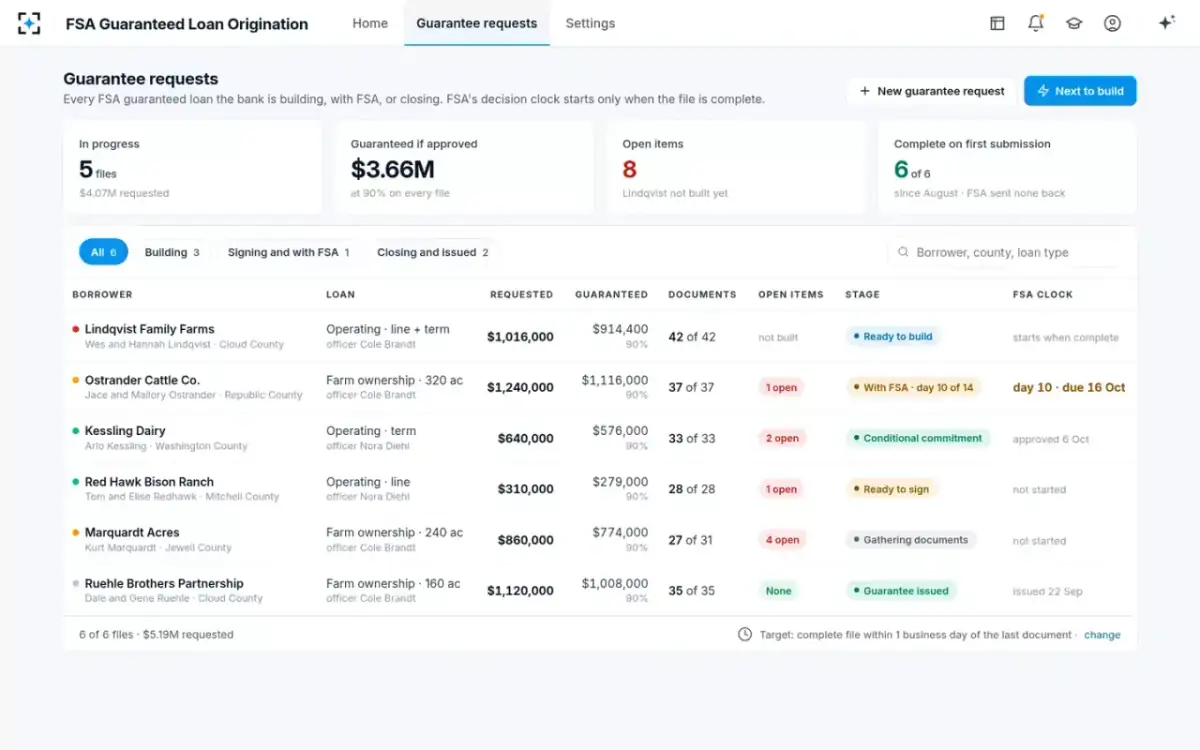
The last detail on that screen is the one worth copying whatever software a bank uses: a target expressed as a complete file within one business day of the last document arriving. It measures the period the lender owns, in the unit the borrower feels, and it is falsifiable. How accurate the fill has to be, and what to measure is the companion question, because a first-pass file that is fast and wrong starts the same cycle again. To see the clocks, the pre-check and the open items on one file, start at FSA Guaranteed Loan Origination.
Questions people ask
How long does FSA take to approve a guaranteed loan?
A complete application from a Standard Eligible Lender is approved or rejected no later than 30 calendar days after receipt and one from a Certified Lender no later than 14; since 1 October 2026 a Preferred Lender using its delegated authority gets a decision within 5, once the environmental requirements are met. Those are maximums rather than targets, they are calendar days, and the agency confirms the receipt date in writing. The elapsed time a borrower experiences is that number plus however long the lender's file took to become complete.
Does the FSA clock start when the lender applies or when the file is complete?
When it is complete. For the purposes of the processing timeframes, an application is not considered complete until all the information needed to make an approval decision, including the information for the environmental review, has reached the agency. An incomplete submission does not begin a 5-, 14- or 30-day period; it begins a request for the missing item, with a deadline attached.
What happens to an incomplete guaranteed loan application at FSA?
The agency asks for what is missing and sets a deadline for it. If the lender does not supply the information by that deadline, the application is considered withdrawn by the lender — not rejected, and not held open. Recovering means submitting again and starting the agency's clock from the new receipt date.
What happens if FSA does not decide a Preferred Lender's application in 14 days?
The proposed guaranteed loan is automatically approved, subject to funding, at the guarantee percentage the rule sets for that loan type. It is a genuine obligation on the agency and not a loophole worth planning around: it applies only to complete applications, so the lender's own discipline is what makes it reachable at all.
What does a farmer waiting on operating money actually lose?
Usually a date rather than an interest rate: an input prepayment deadline, a purchase at a particular weight, a rent payment before the ground is re-let. They also tend to substitute — a supplier account or a dealer line at terms they would not have chosen — and that debt is frequently still on the balance sheet at the next renewal, where it shows up as a surprise in the credit report.
Why is a delayed guarantee file worse now than a few years ago?
Because borrowers have less working capital to absorb it. The FDIC reported in October 2026 that working capital balances at Illinois grain farms fell about 39% between 2022 and 2024, that rates on agricultural operating lines remain 162 basis points above the same point in the last downturn, and that 43% of crop producers rated their working capital strong against 56% of livestock producers. Farm banks themselves entered the cycle with strong capital; it is the borrower who absorbs the lender's delay.