FSA guaranteed loan requirements come in two kinds, and the two fail for completely different reasons. The first kind is eligibility: fifteen lettered paragraphs in 7 CFR 762.120 that an applicant either meets or does not — citizenship, legal capacity, credit history, no prior loss to the Agency, no delinquent federal debt, family-farm operator, and the test for credit. The second kind is completeness: the application form, a loan narrative with a servicing plan, a balance sheet, a cash flow budget, a credit report and, once the request passes $125,000, six further items. Eligibility is usually known on day one. Completeness is what sends a request back, because an item can be present, signed and wrong. FSA Guaranteed Loan Origination is Botminds’ solution for ag lenders: it fills USDA’s Application for Guarantee from the documents the bank already holds and tests each part against FSA’s own rules before anyone signs.
The file on this page is a fictional sample used throughout the solution: Prairie Junction Bank & Trust asking FSA to guarantee 90% of a $1,016,000 operating loan for Wes and Hannah Lindqvist. The bank, the people and the farm are invented. The rules are not, and every one is linked to the text it comes from.
Two kinds of requirement, counted
15
lettered paragraphs of applicant eligibility in 7 CFR 762.120, lettered (a) to (o)
11items
in a complete application for a loan over $125,000, from a standard eligible lender
85%
ceiling on total debt against security the guaranteed loan takes in junior position
3reasons
the sample file would have come back for — all three of the second kind
What FSA counts as a complete application, item by item
There is no single national checklist. The items FSA requires depend on two things: how large the request is, and what status the lender holds. 7 CFR 762.110 sets out four different packages — an EZ Guarantee, a loan up to $125,000, a loan above it, and a Preferred Lender’s application — and a lender that files a handful of guarantees a year can meet two of them in the same season.
For a loan up to $125,000 that is not an EZ Guarantee, the regulation lists five items: “(1) The application form; (2) Loan narrative, including a plan for servicing the loan; (3) Balance sheet; (4) Cash flow budget; and (5) Credit report.” Above $125,000 those five remain and six more are added: verification of income, verification of debts above a threshold FSA sets, three years of financial history, three years of production history for a standard eligible lender, the proposed loan agreements, and — if anything is to be built — the plans, specifications and development schedule.
How many items a complete application holds, by request size and lender status
Two details in the same section catch lenders out. The first is a floor on the bank’s own work: a lender “must perform at least the same level of evaluation and documentation for a guaranteed loan” as it performs for a non-guaranteed loan of a similar type and amount. The guarantee does not buy a lighter file. The second closes the obvious workaround: “A lender must not split a loan into two or more parts in order to fall below the threshold in order to avoid additional documentation.” The threshold applies to any single loan or to a package of loans put up for consideration at one time.
The third detail is the one most likely to be forgotten, because it is the one nobody has to post. Not every item goes to the service center — FSA tells a Certified Lender which items to submit — but every lender must compile and keep a complete application in its own files, and “All lenders must certify that the required items, not submitted, are in their files.” A file that is thin at the bank is a certification problem, not merely an untidy drawer.
The eligibility rules, each with its own citation
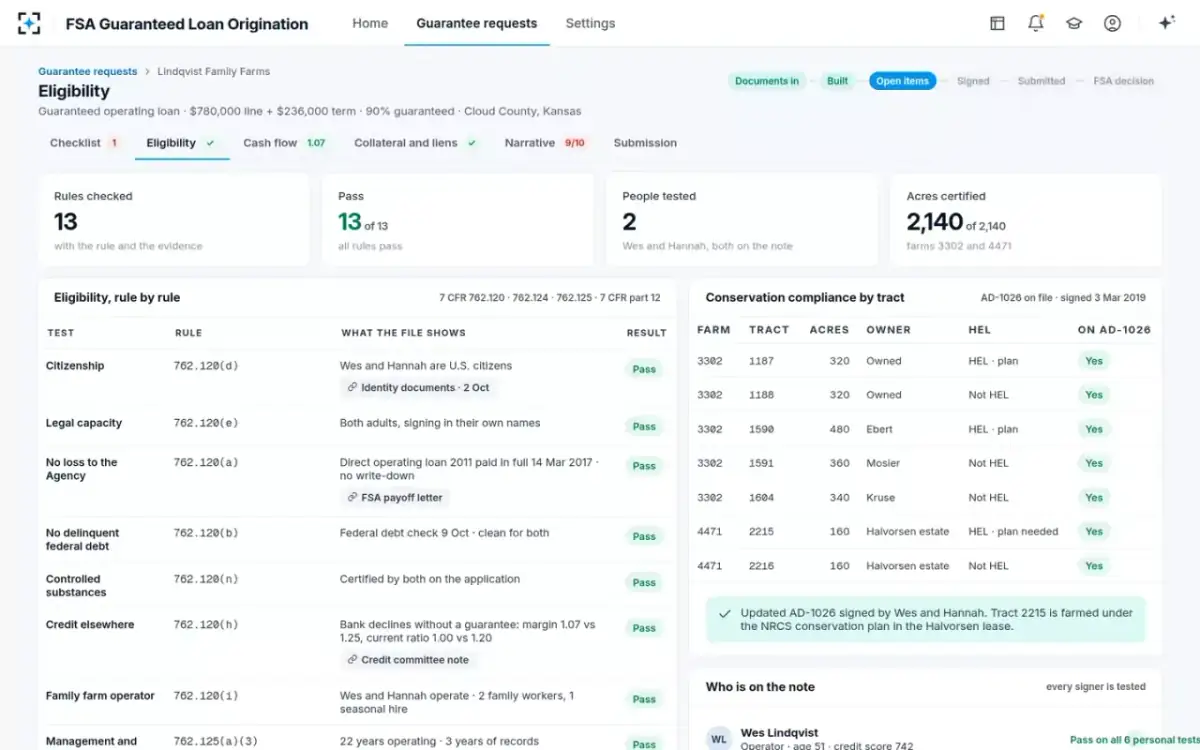
Applicant eligibility is one section, 7 CFR 762.120, and it opens with the sentence that makes it a list rather than a balance: “Unless otherwise provided, applicants must meet all of the following requirements to be eligible for a guaranteed OL, FO, or CL.” Each lettered paragraph is a separate test with a separate evidence trail, and several of them reach past the main applicant to everyone who will sign the note.
The eligibility rules a guarantee request has to clear, and who each one reaches
Citation762.120(a)
RuleNo prior loss to the Agency
What has to be trueNobody who will execute the promissory note has caused FSA a loss through debt forgiveness — more than three times on or before 4 April 1996, or once at all after it.
Who it reachesEvery signer, not only the main applicant
Citation762.120(b)
RuleNo delinquent federal debt
What has to be trueNo signer is delinquent on a federal debt other than one under the Internal Revenue Code, which the lender may still weigh in cash flow.
Who it reachesEvery signer
Citation762.120(c)
RuleNo unpaid federal judgment
What has to be trueNo outstanding unpaid judgment obtained by the United States in any court, excluding the U.S. Tax Courts.
Who it reachesEvery signer
Citation762.120(d)
RuleCitizenship
What has to be trueA citizen, a U.S. non-citizen national or a qualified alien; for an entity, the majority interest must be held by them.
Who it reachesApplicant and entity members
Citation762.120(e)
RuleLegal capacity
What has to be trueThe applicant and all borrowers possess the legal capacity to incur the obligations of the loan.
Who it reachesApplicant and all borrowers
Citation762.120(f)
RuleNo false or misleading information
What has to be trueIn past dealings with FSA, no false or misleading documents or statements.
Who it reachesApplicant
Citation762.120(g)
RuleAcceptable credit history
What has to be trueDemonstrated by debt repayment. Isolated late payments beyond the applicant’s control, and no credit history at all, are explicitly not disqualifying.
Who it reachesApplicant and all entity members
Citation762.120(h)
RuleTest for credit
What has to be trueUnable to obtain sufficient credit elsewhere without a guarantee, at reasonable rates and terms. Does not apply to Conservation Loan guarantees.
Who it reachesApplicant — proved by the lender
Citation762.120(i)–(j)
RuleFamily-farm operator, and owner for ownership loans
What has to be trueOperator of not larger than a family farm after closing; for a farm ownership loan, also the owner.
Who it reachesApplicant, with extra tests for entities
Citation762.120(n)–(o)
RuleControlled substances and crop-insurance violations
What has to be trueNot ineligible under 7 CFR part 718 for a controlled-substance conviction or a federal crop-insurance disqualification.
Who it reachesEvery signer, and all entity members
Read that way, most of the list is a search problem rather than a judgement: a federal-debt check, a judgment search, a citizenship document, a part 718 certification. The two that are judgements — credit history and the test for credit — are also the two the regulation takes the most trouble to bound. On credit history it says what does not count against an applicant: isolated late payments that do not represent a pattern and were clearly beyond the applicant’s control, and lack of credit history at all. What does count is narrower and harder: “A history of failures to repay past debts as they came due when the ability to repay was within their control will demonstrate unacceptable credit history.” Within their control is the whole test. A season destroyed by a declared drought is not a credit history failing, and a file that treats it as one is arguing against its own borrower.
Credit elsewhere: the one requirement that has nothing to do with the farm
Every other eligibility rule asks something about the applicant. The test for credit asks something about the bank. The applicant must be unable to obtain sufficient credit elsewhere without a guarantee, to finance actual needs at reasonable rates and terms — and the party who knows whether that is true is the lender that just declined to make the loan unguaranteed. It is the only requirement whose evidence lives in the bank’s credit committee minutes rather than in the farmer’s drawer, which is exactly why it is the paragraph most often still blank when a file is otherwise ready.
The regulation also says how availability is judged, and both sentences surprise people. Assets the operation does not need are in scope:
The potential for sale of any significant nonessential assets will be considered when evaluating the availability of other credit.
7 CFR 762.120(h)(2)
And so is wealth held outside the operation: “Ownership interests in property and income received by an individual or entity applicant, and any entity members as individuals will be considered when evaluating the availability of other credit to the applicant.” A narrative that says only “the bank declined” has not met the test. One that says what the bank measured, against which policy, and why the non-farm assets do not change the answer, has. In the sample file the paragraph is written from the bank’s own credit committee note: a repayment margin of 1.07 against a policy minimum of 1.25, and a current ratio of 1.00 against 1.20, at the bank’s October price deck. Those are the bank’s numbers, cited to the bank’s document, which is what makes the paragraph evidence instead of assertion.
One honest caveat for buyers: no software can decide this test. It can find whether the paragraph exists, whether it cites a document and whether the figures in it match the cash flow — and that is most of what goes wrong — but the determination is FSA’s. Comparing the ways a bank can build the file turns on exactly that distinction.
Conservation compliance: why an AD-1026 goes stale without anyone changing it
Conservation compliance is a certification, not a document review, and the certification is written in 7 CFR part 12. A person applying for an FSA direct or guaranteed farm credit loan must “certify that such person shall not use the proceeds of the loan for a purpose that will contribute to excessive erosion on highly erodible land or to conversion of wetlands for the purpose, or to have the effect, of making the production of an agricultural commodity possible.” The same section also requires the applicant to authorise USDA representatives access to all land in which such person has an interest, for the purpose of verifying the certification.
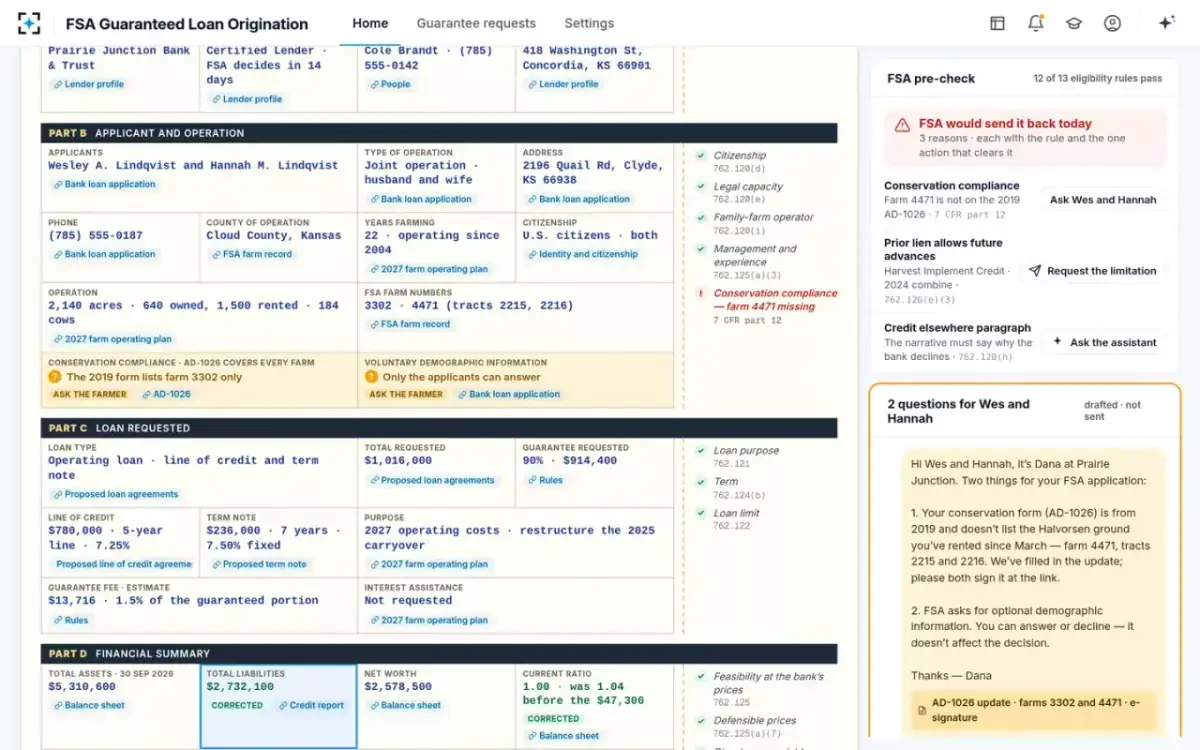
That phrase is where a signed form quietly stops being true. The certification is about the land the applicant has an interest in, and that set changes every time a lease is signed. Nobody edits the form; the farm does. In the sample file the AD-1026 on hand is from 2019 and lists FSA farm 3302 only. The borrowers have rented the Halvorsen ground on farm 4471, tracts 2215 and 2216, since March. Nothing about the form is incorrect. It is simply describing a smaller farm than the one the loan will operate, and the request is not complete until the form describes the farm as it is now.
The practical rule is therefore not “is there an AD-1026 in the file” but “does the AD-1026 list every farm and tract the operation now touches”. A lender that checks it by farm will miss the tract added last spring. The solution checks it tract by tract, and in the sample file ends at 2,140 of 2,140 acres certified across both farms — after the borrowers e-sign an updated form the solution drafted the message for.
The pre-check: three reasons, each with its rule and its one clearing action
The junior-lien limit: 85 percent, and the future advance clause FSA will not accept
Security has its own requirements, and they are the ones most likely to be discovered late, because they depend on a search rather than on a document the borrower hands over. All guaranteed loans must be secured by the best lien obtainable. Where the guaranteed loan takes a junior position, two further rules apply, and they are separate tests that a file can pass one of and fail the other.
The first is arithmetic: “Junior lien positions are acceptable only if the total amount of debt with liens on the security, including the debt in junior lien position, is less than or equal to 85 percent of the value of the security.” In the sample file the machinery is valued at $1,126,000 and total debt against it is 56.7%, comfortably inside. That number is easy to compute once every lien on the collateral is known, and impossible to compute before.
The second is about the wording of somebody else’s paperwork. When the guaranteed loan takes a junior lien, the prior lien instrument must not contain a future advance clause — beyond taxes, insurance and reasonable costs to protect the security — or any cancellation or forfeiture clause that jeopardises the government’s, the lender’s or the borrower’s position, unless the prior lienholder limits, modifies, waives or subordinates it. A clause that secures “all present and future indebtedness” is the common case, and it is not unusual or improper: it is ordinary equipment-finance wording. It simply means a third party can grow its claim ahead of the guaranteed loan without anyone asking.
The remedy is a signature from someone who is not the borrower and not the bank. In the sample file Harvest Implement Credit holds a first lien on a 2024 combine and signs a limitation capping future advances at the $286,000 balance. That takes days, and the days only start once somebody has read the prior lienholder’s statement closely enough to notice the sentence.
What “incomplete” means to FSA’s clock, exactly
Lenders often describe FSA’s decision period as starting on submission. It does not. 7 CFR 762.130(a)(3) is explicit that an application is not complete until all the information needed to make an approval decision — including the information for the environmental review — has reached FSA, and FSA confirms the date of receipt in writing to the lender. Everything in this guide is therefore a clock problem as much as a compliance problem: the five, fourteen or thirty days a lender is counting on, depending on its status, do not begin while one item is open.
The environmental clause is the part most often missed in the count. 7 CFR 762.128 requires the lender to supply environmental information, to determine whether a 100-year floodplain is affected, to examine the security for structures or archeological sites that may be eligible for the National Register of Historic Places, and, where real estate is involved, to perform due diligence on contamination. A Certified or Preferred Lender may certify that the documentation sits in its own file; a standard eligible lender must submit the evidence. Either way the information has to exist before the clock can start. What the days before and after the clock actually cost follows that sequence through.
Which requirement fails quietly, and which fails loudly
A useful way to sort the requirements is not by severity but by how loudly each one fails. A loud failure announces itself: a missing form is visible on any checklist, a delinquent federal debt turns up on a search, a missing signature is obvious. A quiet failure looks complete. The form is there and signed; it is describing last year’s farm. The lien search was run; nobody read the prior lienholder’s clause. The narrative has ten sections; one of them asserts rather than evidences.
The three open reasons on the sample file, and why each is a quiet failure
| What the file shows | Why it still fails | The one action that clears it |
|---|---|---|
| A signed AD-1026 from 2019 listing FSA farm 3302 | The operation now also works farm 4471, tracts 2215 and 2216, rented since March. The certification covers land the applicant has an interest in, and that set has grown (7 CFR 12.7). | Send the borrowers an updated AD-1026 listing both farms, for e-signature. |
| A UCC search and a prior-lien statement, both obtained | Harvest Implement Credit’s first lien on the 2024 combine secures all present and future indebtedness, and the new term note takes a second lien on the same machinery (7 CFR 762.126(e)(3)). | Ask the prior lienholder to limit its future advances to the current balance, and file the signed limitation. |
| A lender narrative with all ten sections drafted | The credit elsewhere section states the conclusion without the bank’s own measured reason for declining unguaranteed credit (7 CFR 762.120(h)). | Write the paragraph from the credit committee note, with the margin and current ratio against the bank’s policy minimums. |
This is the argument for checking a file against the rule rather than against a list of document names. A list answers “is it here”. The rules ask “does it say what it has to say, about the farm as it is now”. The two questions have the same answer on most files and a different answer on the ones that come back.
How to check your own file against FSA’s requirements before you submit
A pre-submission pass that catches quiet failures asks a different set of questions from the one a coordinator asks while assembling. These are the checks worth running in order, whatever software a bank uses.
A pre-submission pass over an FSA guaranteed loan file
- Count the items against the right threshold
Five items up to $125,000, eleven above it, with the production-history item applying to standard eligible lenders. Confirm which bracket the whole package falls in, not each note separately.
- Name every signer, then run eligibility against each
Prior Agency loss, delinquent federal debt, unpaid federal judgment and the part 718 certifications reach everyone who will execute the promissory note, not only the applicant.
- Re-read the AD-1026 against this year’s farm and tract list
Compare the farms and tracts on the certification with the leases and the operating plan. A form that is correct for 2019 is not a form for a farm rented in March.
- Read every prior-lien statement for the clause, not the balance
Future advance, cancellation and forfeiture wording in a prior instrument needs a limitation, modification, waiver or subordination before the junior lien is acceptable.
- Do the 85 percent arithmetic with every lien in it
Total debt secured by the collateral, including the new junior position, against the collateral’s value. Missing one filing changes the answer.
- Test the narrative’s figures against the cash flow they came from
Every figure in the lender narrative should be traceable to the balance sheet, the cash flow or the credit report. The credit elsewhere paragraph needs the bank’s own decline reason, measured.
- Confirm the environmental information is in hand before you count days
Floodplain, historic-property and, for real estate, contamination due diligence. FSA’s decision period does not start without it.
- Check what you are certifying that you hold
For items not submitted, the bank certifies they are in its own file. Confirm they actually are, under the names the application lists.
Eligibility, rule by rule, with conservation compliance checked tract by tract
What happens if FSA’s deadline for the missing items passes
When an application is short, FSA asks for the missing information and sets a deadline. 7 CFR 762.110(h) is one sentence, and it is the one worth printing out: if the lender does not provide what is needed by that deadline, the application is treated as withdrawn by the lender. Not denied, not held — withdrawn, by the bank, with no appeal to take because there is no adverse decision to appeal.
The consequences fall almost entirely on the farmer. The file goes back into the queue whenever it is rebuilt, and 7 CFR 762.130(b) ranks approved applications by the date a complete application was received when funding is short. A withdrawal does not just cost the weeks it took to answer; it costs the place in line. For an operating loan meant to prepay inputs before a planting season, that is the difference between a guarantee and a conversation about next year.
There is a quieter version of the same loss, which is the request that is never sent because the lender cannot face assembling it. The qualification list FSA publishes for borrowers is short enough to read in a minute — “be unable to obtain a loan without an FSA guarantee” is one line of seven — and the gap between that list and the file behind it is where small lenders decide a handful of guarantees a year is not worth the hours. Closing that gap is the point of FSA Guaranteed Loan Origination: the file is built from documents the bank already holds, each value linked to the line it was read from, and what FSA would send it back for is answered before anyone signs.
Questions people ask
What are the FSA guaranteed loan requirements, in short?
Two sets. The applicant must meet every eligibility rule in 7 CFR 762.120 — citizenship, legal capacity, acceptable credit history, no prior loss to FSA, no delinquent federal debt or unpaid federal judgment, family-farm operator, and the test for credit — and the lender must file a complete application under 7 CFR 762.110, which is five items up to $125,000 and eleven above it, plus the security, environmental and conservation-compliance requirements that attach to the particular loan.
What documents does FSA require for a guaranteed loan?
For a request over $125,000 from a standard eligible lender: the application form, a loan narrative including a servicing plan, a balance sheet, a cash flow budget, a credit report, verification of income, verification of debts above FSA’s threshold, three years of financial history, three years of production history, the proposed loan agreements, and construction plans if anything is to be built. Items not submitted must still be in the lender’s own file, and the lender certifies that they are.
What does credit elsewhere mean, and who has to prove it?
It means the applicant cannot obtain sufficient credit elsewhere without a guarantee, at reasonable rates and terms, and the lender proves it. The regulation widens the question past the farm: the potential sale of significant nonessential assets is considered, and so are ownership interests in property and income held by the applicant or by entity members as individuals. Conservation Loan guarantees are exempt from the test entirely.
Is conservation compliance checked by farm or by tract?
By tract. The certification in 7 CFR part 12 covers the land the person has an interest in and authorises USDA access to all of it, so a farm rented after the form was signed leaves the certification describing a smaller operation than the one the loan will fund. A file that checks only that an AD-1026 exists will pass a stale one.
Why would FSA send an application back?
Often because something in it is incomplete rather than because the borrower is ineligible — a certification that no longer covers the whole farm, a prior lien whose future advance clause has not been limited, a narrative section that asserts instead of evidencing. FSA requests the missing information with a deadline, and under 7 CFR 762.110(h) an application whose deadline passes is considered withdrawn by the lender.
What is the difference between an eligibility rule and a security requirement?
An eligibility rule is about the applicant and is tested once: citizenship, credit history, federal debt. A security requirement is about the collateral and the paperwork of third parties, and it can change after the file is built — a new filing against the machinery alters the 85 percent test, and a prior lienholder’s clause needs that lienholder’s signature to fix. Eligibility is usually knowable on day one; security often is not.