FSA guaranteed loan file roles at a bank start with the ag loan officer, who underwrites and signs farm credit. The officer meets the borrower, collects the operating plan, the balance sheet and the production history, forms a view on whether the farm can repay, and signs the application that commits the bank — within a credit limit set by policy, above which someone more senior signs with them. On a USDA guaranteed farm loan that job narrows and sharpens, because the bank is not lending alone: it is asking the Farm Service Agency to guarantee most of the loan, and the agency brings its own form, its own eligibility rules and its own officer at the other end. Botminds' FSA Guaranteed Loan Origination fills that form, FSA-2211, field by field from the documents the bank already holds. The work that is left is the work this guide is about: five seats, and who may decide what.
The file on this page is a fictional sample as it runs through the solution. Prairie Junction Bank & Trust, a Certified Lender in Concordia, Kansas, is asking FSA to guarantee 90% of a $1,016,000 operating loan to Wes and Hannah Lindqvist of Cloud County. The bank, the farm and the four people at it are invented; the rules, the pay figures and the agency's own description of its role are from the sources linked under each figure.
The two seats a bank must staff, and the one that is getting scarcer
283k
loan officers at work in 2025, a number projected to grow 1% by 2035 — the seat that signs the application for guarantee
64.7k
credit analysts at work in 2025, a number projected to fall 4% by 2035 — the seat that rebuilds the cash flow
The five seats on one guaranteed loan file
A conventional farm loan has two or three seats: an officer who underwrites it, an analyst who spreads the numbers, and whoever has to sign above the officer's limit. A guaranteed loan adds two more. One is at the bank — the person who owns the agency's paperwork, often called the guaranteed-loan coordinator — and one is not at the bank at all. FSA describes the division plainly on its own page for lenders: "The lender and loan applicant complete the Application for Guarantee and submit it to the FSA Service Center in their lending area. The Service Center works with the commercial lender to process the guarantee" (USDA Farm Service Agency).
That sentence hides the thing most new hires get wrong. The bank does not submit a loan to FSA for approval of the credit; the bank keeps the credit decision and asks FSA to stand behind part of it. FSA then makes its own decision, on its own grounds, about whether the request meets the program's rules. Two institutions, two decisions, one file — and five seats to carry it.
The five seats, and the one thing each may not do
A person decides
Guaranteed-loan coordinatorOwns the checklist for the loan size and the bank’s lender status, chases what is missing, builds the package and submits it.
Never: signs the application, or decides whether a document is good enough on credit grounds
A person decides
Ag loan officerKnows the borrower and the operation, recommends the structure, and signs FSA-2211 with the meaning the signature carries.
Never: approves credit above the limit in the bank’s policy
A person decides
Credit analystRebuilds the borrower’s cash flow at the bank’s own prices, applies the production history, and reports the margin and the breakeven.
Never: changes the borrower’s own projection; both are shown
A person decides
Ag Lending ManagerApproves the credit above the officer’s limit, and owns the bank’s appetite for farm risk.
Never: replaces the officer’s signature on the application itself
A person decides
FSA Farm Loan OfficerAt the agency, not the bank: reviews the request against the program and approves or rejects it.
Never: works for the lender, or builds the lender’s file
The guaranteed-loan coordinator: owns the checklist
The coordinator is the seat that only exists because of the guarantee. Their job is the file as an object: which documents the program requires for this loan size and this lender status, which of them are in, which are signed, which are stale, and what the package looks like in the order the agency reads it. In the sample bank that is Dana Reinholt, who owns every FSA guarantee the bank files.
The checklist is longer than a conventional file and it is unforgiving in a specific way. A balance sheet two months old is a judgement call on a conventional loan; a conservation compliance form that lists one farm when the borrower now rents two is a defect, because the form has to cover every farm the applicant operates. The coordinator is therefore reading for dates, parties, farm and tract numbers and signatures across dozens of documents — exactly the reading that is mechanical, high-volume and easy to get wrong at four in the afternoon.
It is also the seat that lives with the consequence. FSA's decision clock does not start until the application is complete, so a document the coordinator misses is not a day of their own time; it is a round trip to the farm and back, measured in weeks. What a late guarantee file costs, and whose clock it is, prices that round trip.
Where the forty hours go, by hand and in FSA Guaranteed Loan Origination
By hand · about 40 hours across the four seats
- Sorting the file against the checklist · 15%
- Eligibility, conservation, collateral and liens · 30%
- Cash flow at the bank’s prices · 20%
- The narrative and the form itself · 35%
With agents · about 8 hours across the same four seats
- Sorting the file against the checklist · 6%
- Eligibility, conservation, collateral and liens · 25%
- Cash flow at the bank’s prices · 19%
- The narrative and the form itself · 50%
The ag loan officer: signs, within a credit limit
The Bureau of Labor Statistics describes the occupation in one line: loan officers "evaluate, authorize, or recommend approval of applications for personal and business loans" (Occupational Outlook Handbook). On a guarantee file the three verbs separate, and knowing which one you are doing is the whole job.
The officer evaluates: they know the operation, the landlords, the equipment line and whether the 2027 plan is the one the borrower will actually farm. They recommend: the structure, the term, the guarantee percentage to request. And they authorize only up to a number in the bank's own policy. In the sample bank that number is $750,000 for the officer, Cole Brandt, and $2,500,000 for the Ag Lending Manager above him. The Lindqvist request is $1,016,000, so Cole signs the application and Lorraine Weiss approves the credit.
Two signatures on one file is not bureaucracy. The officer's signature on FSA-2211 is a certification to a federal agency about the file behind it; the manager's approval is the bank's own credit decision. They answer different questions, and in a well-run desk they are made by different people on purpose. Nothing goes to the agency without both, and nothing goes with an item still open.
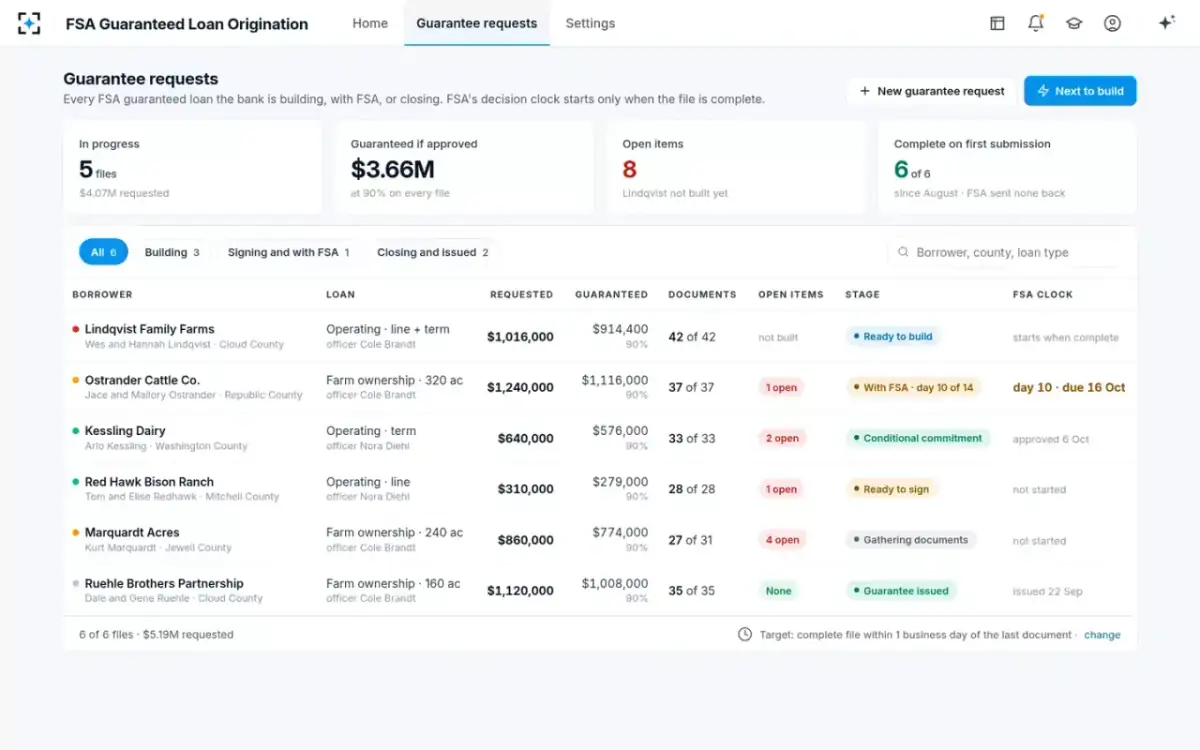
The guarantee desk on a Monday morning
The credit analyst: rebuilds the cash flow at the bank's own prices
A credit analyst at an ag lender does what a credit analyst anywhere does — spreads the statements, tests the plan — with two differences that matter on a guarantee file. The first is prices. A farm's projection is a forecast of what its crop will be worth, and the borrower's forecast is not the bank's. The analyst re-runs the plan at the bank's own price deck, so the margin the credit committee sees is the bank's view and not the borrower's optimism. In the sample file the borrower's plan at $4.60 corn shows a repayment margin of 1.30; at the bank's October deck of $4.30 corn, $10.40 soybeans, $5.55 wheat and $1,520 calves, the same plan returns 1.07, with breakeven corn at $4.14.
The second difference is the floor. The program requires the applicant's proposed operation to project a feasible plan (7 CFR 762.125(a)), and a plan that repays all debts and family living clears it at 1.00. The bank's own policy, without a guarantee, asks for 1.25. The gap between those two numbers is the entire reason the file exists: 1.07 is not enough for the bank alone and is enough with a guarantee behind it. An analyst who understands that is not computing a ratio, they are locating the credit on a map with two edges.
Both numbers stay on the file. The borrower's projection is never overwritten — it sits beside the bank's version, which is what lets the officer have an honest conversation about the difference rather than an argument about whose spreadsheet is right.
The Ag Lending Manager: the second signature above the line
The manager's seat is the shortest to describe and the hardest to automate, because its work is appetite. How much of the book should be row crop? What does the bank do when a borrower's working capital has been falling for three seasons? Is this farm one the bank wants in ten years? None of that is on the application form, and none of it is a rule the agency publishes.
What the manager needs from the rest of the desk is a file they can approve without re-reading it: every figure traceable to the document it came from, every program rule shown with its citation and its evidence, every open item closed. In the sample bank Lorraine Weiss approves the Lindqvist credit on her phone, which is only sensible if the file behind the button is complete. The seat below hers does not exist to produce a recommendation; it exists to produce a file that can be trusted quickly.
The same file, four seats, before and after
Today
Six guarantees a year, so each one starts from a blank checklist and a week of chasing documents.
With agents
Fills the application from the file, sees what the agency would send back, and clears it the same morning.
Still theirs: the relationship with the service center, and the decision about when a file is ready to go
Today
Signs a package assembled by hand and hopes nothing in it was stale.
With agents
Signs a file where every field links to its source and every checklist item is closed.
Still theirs: the credit recommendation, and the certification the signature carries
Today
Re-keys the borrower’s projection to test it at the bank’s prices, and checks yields by hand.
With agents
Reviews a cash flow already rebuilt at the price deck, with the disaster-year yield applied and a stress test ready to run.
Still theirs: the judgement about whether the plan is real
Today
Knows a file that goes back to the agency twice can cost the bank the farmer.
With agents
Approves a complete file with the agency’s clock in view.
Still theirs: the bank’s appetite, and the decision to lend at all
The FSA Farm Loan Officer: a government seat nobody at the bank fills
Search for "farm loan officer" and you will find two different jobs wearing one name. One is at a bank. The other is a federal employee at an FSA service center, and the agency is specific about what that person does: "The Farm Loan Officer reviews the application for applicant eligibility, repayment ability, adequacy of collateral, and compliance with other regulations, and if the applicant meets those requirements, the request is approved" (USDA Farm Service Agency).
Read the four things in that list. Eligibility, repayment ability, collateral adequacy, compliance — those are the same four questions the bank's own seats have been answering all week. The difference is authority. The bank's answers are evidence; the agency's answer is the decision. A coordinator who writes "eligible" on a checklist has recorded a finding. A Farm Loan Officer who approves the request has bound the United States to a guarantee.
This is also the line every agent in the solution stops at. The eligibility checker runs each rule with its citation and the document behind it, and flags what fails; it never makes the determination. What six agents may never decide on an FSA file sets out where each one stops and why the boundary is drawn there and not somewhere more convenient.
Who signs, who recommends, who only flags, in FSA Guaranteed Loan Origination
| The question | Who gathers the evidence | Who signs or decides |
|---|---|---|
| Is every required document in, signed and current? | The document sorter reads and files them; the coordinator reviews what it flags. | The coordinator decides the file is ready to build. |
| Does the applicant meet the program’s eligibility rules? | The eligibility checker runs each rule with its citation and evidence. | FSA decides. The bank only states what its file shows. |
| Is the plan feasible at defensible prices? | The cash flow analyst rebuilds it at the bank’s price deck; the credit analyst reviews it. | The credit analyst owns the view; FSA tests it against the program’s floor. |
| Is the security adequate, and are prior liens acceptable? | The collateral and lien reviewer reads the lien search and each prior-lien statement. | The officer decides what to request; the prior lienholder decides whether to limit. |
| Does the bank want this credit at all? | The narrative writer drafts the case, every figure cited to its document. | The officer to the policy limit; the Ag Lending Manager above it. |
| Does the file go to the service center today? | The package assembler builds it in the agency’s order and lists what is open. | The coordinator submits, and only with both signatures and nothing open. |
What does an ag loan officer do, hour by hour?
The answer, on a guarantee week, is that most of the hours are not underwriting. Of the roughly forty hours one file takes by hand at the sample bank, about six go to sorting documents against a checklist, six to eligibility and conservation compliance, six to collateral and liens, eight to the cash flow, ten to the narrative and four to the form. Only a minority of that is judgement; the majority is finding a number in one document and putting it in another, correctly, twice.
That ratio is why an ag loan officer's calendar looks nothing like the role's textbook description. It is also why the first thing a lender notices when agents read the file is not that the week is shorter — though it is — but that the remaining hours are differently coloured. The reading and the transcription collapse. What is left is the conversation with the farmer about the 2027 plan, the decision about how much of the combine's value to count, and the paragraph explaining why the bank will not extend this credit without a guarantee.
The reverse is worth stating too. If an agent's first pass is wrong often enough that every field must be re-checked by hand, none of this holds: the hours move from transcription to verification and the desk is no better off. How accurate the fill has to be, and what to measure is the test that decides which of the two you have bought.
Who approves an FSA guaranteed loan — and who only recommends it?
Two approvals, in order, and they are not interchangeable.
The bank approves the credit. That is an internal decision made under the bank's own policy, by the officer within their limit or by whoever sits above it — in the sample bank, the Ag Lending Manager to $2,500,000, and the loan committee above that. It answers one question: will we lend this money, on these terms, to this farm?
FSA approves the guarantee. That decision belongs to the agency's Farm Loan Officer, on the four grounds quoted above, and the agency documents what happens next: the service center issues a conditional commitment setting out the terms of the guarantee, the lender closes the loan and advances the funds, and the service center then issues the guarantee itself (USDA Farm Service Agency). Everyone else recommends. The coordinator recommends that the file is complete; the analyst recommends a view of the cash flow; the agents flag, cite and draft. Six of the seven participants in that paragraph are recommending, and the two who decide are a bank officer and a federal employee.
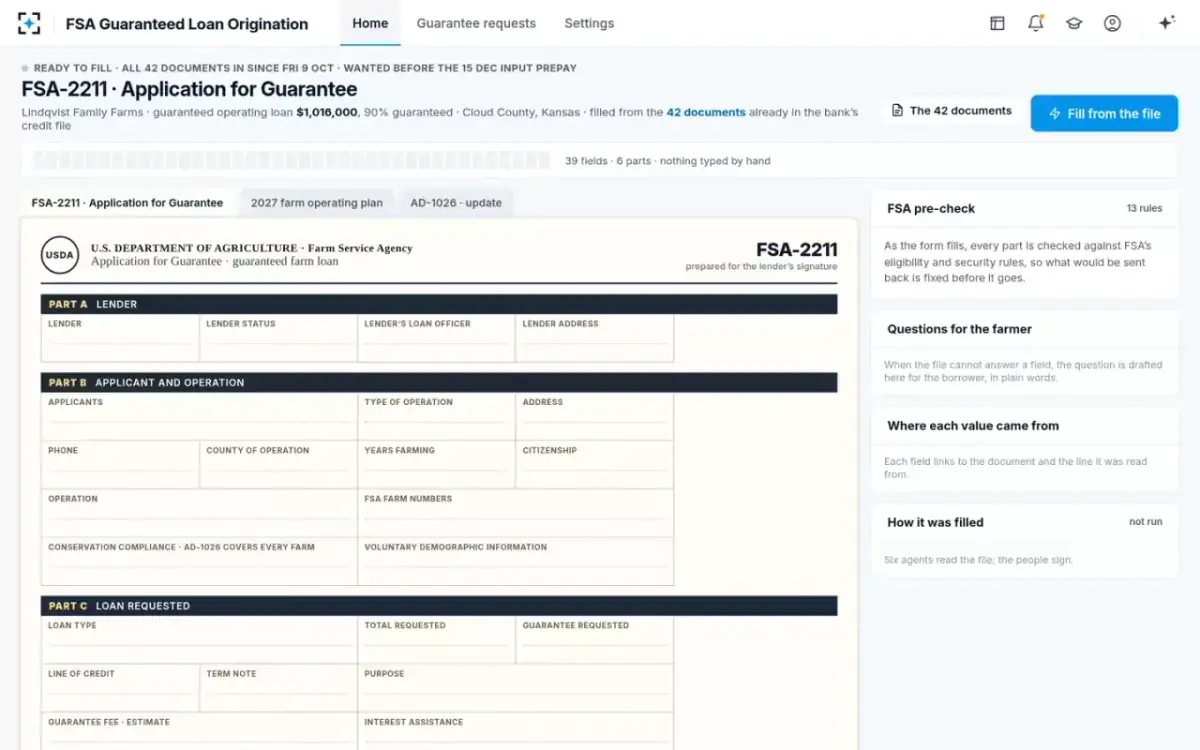
FSA-2211 before anything is filled
Why a community bank files a handful a year, and rebuilds the checklist from memory each time
The structural fact behind the whole problem is that guarantee work is concentrated in small institutions that do it rarely. The FDIC's October 2026 study of farm bank performance notes that "nearly all farm banks also qualify as community banks under the FDIC's research definition", and that they are tightly clustered: farm banks are headquartered in 32 states, "with 83 percent of farm banks located in the top ten states by number of farm banks" (FDIC, An Update on Farm Bank Performance).
A bank of that shape does not have a guarantee department. It has a coordinator who files perhaps half a dozen a year, between everything else, and who is the only person in the building who knows the paperwork. The checklist lives in their head and in a folder of last year's file. When they are on leave in March, the knowledge is on leave too.
That is a different automation problem from the one a large lender has. A high-volume desk wants throughput; a desk that files six a year wants the checklist to be right the first time, every time, without anyone having had to remember it. The six agents in the solution are built for the second problem: they encode the program's requirements for this loan size and this lender status, so a coordinator who has not filed one since October starts from a complete list rather than from memory. What a bank's own lender status changes about that list — Standard Eligible, Certified or Preferred — is a question of its own, and it changes both the paperwork and the agency's clock.
The seats, then, are not the thing agents remove. They are the thing agents give back: the coordinator gets a checklist that is already right, the officer gets a file they can certify, the analyst gets a cash flow to interrogate rather than retype, and the manager gets a decision rather than a reading assignment. To see the five seats on one file from end to end, start at FSA Guaranteed Loan Origination.
Questions people ask
What does an ag loan officer do?
An ag loan officer develops and underwrites credit for farms and ranches: they meet the borrower, collect the operating plan, balance sheet and production history, recommend a structure and term, and sign the loan within an authority set by the bank's policy. On a USDA guaranteed file they also sign the Application for Guarantee, which is a certification to a federal agency about the file behind it. The Bureau of Labor Statistics puts the 2025 median pay for loan officers of all kinds at $76,690 a year.
Is an FSA farm loan officer the same job as the bank's loan officer?
No, and the shared name causes real confusion. The bank's officer works for the lender and recommends and signs the request. The FSA Farm Loan Officer is a federal employee at a service center who reviews the request for eligibility, repayment ability, collateral adequacy and compliance with other regulations, and approves it if those requirements are met. One builds the file; the other decides on it.
Who signs an FSA-2211?
At the bank, the loan officer signs the application for guarantee, and the borrowers sign their own parts of it. If the request is above the officer's credit authority, the bank's own approval comes from whoever holds the higher limit — at the fictional sample bank, the Ag Lending Manager up to $2,500,000 and the loan committee above that. A well-run desk will not submit without both the signature and the approval.
What does a guaranteed-loan coordinator do?
They own the agency's paperwork end to end: the checklist for the loan size and the bank's lender status, chasing documents and signatures, assembling the package in the order the service center reads it, submitting it, and tracking the agency's clock afterwards. At a small bank it is rarely a full-time title — it is usually one person's extra job, which is exactly why the checklist is the part worth encoding.
What does a credit analyst do at an ag lender?
They spread the borrower's statements and test the plan, with two agricultural twists: the projection is re-run at the bank's own price deck rather than the borrower's, and production is taken from several years of actual yields, with a county average substituted for a declared disaster year. The output is a repayment margin, a breakeven price and a stress test. The Bureau of Labor Statistics puts the May 2025 median pay for credit analysts at $83,510, on employment of 64,700 that is projected to fall 4% by 2035.
Who decides FSA eligibility — the bank or FSA?
FSA. The bank gathers the evidence for each rule and says what its file shows, and good software will show each rule with its citation and the document behind it. The determination itself belongs to the agency's Farm Loan Officer, who approves the request only if the applicant meets the eligibility, repayment, collateral and compliance requirements. A lender that treats its own pre-check as the answer has mistaken a recommendation for a decision.