Ag finance software is unusually easy to demonstrate and unusually hard to evaluate, because the work it claims to do — reading a credit file, applying a federal program's rules, rebuilding a farm cash flow — produces output that looks correct to anyone who has not built the same file by hand. The way through that is not a longer demonstration. It is a pilot on guarantee files your own bank has already closed and signed, where the right answer exists and cost nothing to produce. Botminds' FSA Guaranteed Loan Origination fills FSA-2211 from the documents a bank already holds, and a pilot is simply this: give it files whose answers you know, and compare. This guide sets out what to bring, what to test, how to tell a good result from a flattering one, and what has to be true before it touches a live file.
Where this page describes the solution's own behaviour, the figures come from a fictional sample bank and file — Prairie Junction Bank & Trust of Concordia, Kansas, and a $1,016,000 guaranteed operating loan. The rules and the published figures are real and linked under each figure.
What do you need to bring to an ag lending software pilot?
Four things, and three of them already exist in the bank. A pilot that asks for less is not configuring itself to your institution, which means its results will not transfer.
What to bring to an FSA Guaranteed Loan Origination pilot, and why each one matters
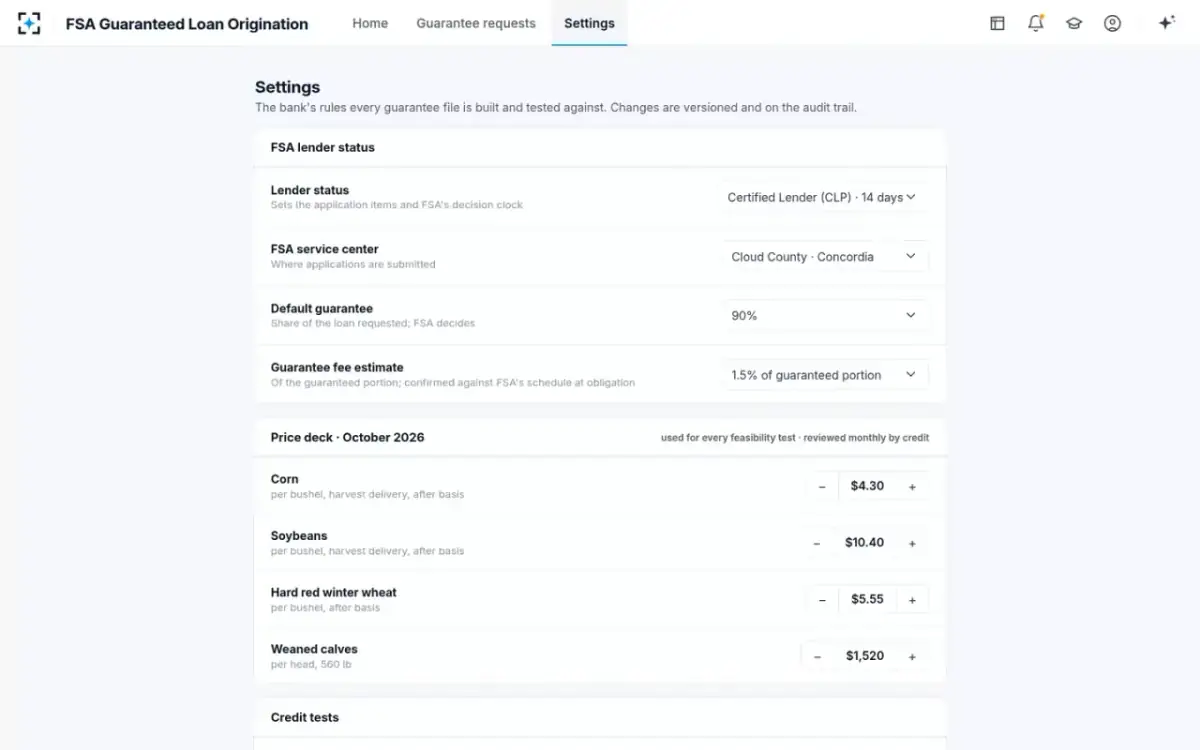
- Your FSA lender status
Standard Eligible, Certified or Preferred. It decides which items the application needs, how deeply the agency re-does your analysis, and whether the decision clock is 30 days, 14, or — for a Preferred Lender using its delegated authority since 1 October 2026 — 5. A pilot run at the wrong status is testing someone else’s checklist.
- Your price deck, dated
The prices every feasibility test runs at, with the date and the person who approved them. A cash flow rebuilt at a vendor’s prices is not a rebuild of your cash flow.
- Your credit policy thresholds
The repayment margin and current ratio below which you ask for a guarantee, and the credit authority at each level. These are what turn a ratio into a decision.
- A sample of past guarantee files, complete
Six is better than sixty, if they are different from each other. Include the awkward ones: a junior lien, a disaster year, a file whose documents arrived over three months.
- The signed outcome of each of those files
The form as filed, the cash flow as your analyst built it, the narrative as signed, and what the agency said. This is the answer key, and a pilot without it can only be judged on impressions.
- One person who has built a guarantee file by hand
Not a sponsor and not a project manager. Someone who will notice that a tract number is wrong, which nobody else in the room will.
The first three are the same inputs the solution is configured from, and they are worth assembling even if no pilot follows: a bank that cannot produce a dated price deck and a written credit threshold has a harder problem than its software.
The bank's own rules in FSA Guaranteed Loan Origination, before any file is built
Can you test agentic AI on a loan you have already closed?
Yes, and it is the best test available, for a reason that has nothing to do with software: the answer key already exists and nobody had to write it for the pilot. On a closed guarantee file you have the application as submitted, the cash flow your analyst actually built, the eligibility conclusions the file supported, the narrative that was signed and — most valuable of all — what the agency did with it.
Replaying a closed file gives you four comparisons that a demonstration cannot. How many fields match what your own team entered. Whether every filled field opens the document and line it came from. Whether the margin it computes at your price deck matches the one your analyst computed at the same deck. And whether the reasons it says would have sent the file back match the reasons the agency actually gave, if it gave any.
The fourth is the one worth insisting on, because it is the only external check in the set. A system that agrees with your analyst is agreeing with a colleague; a system whose flagged reasons line up with the service center's actual return reasons across ten files is telling you something about the agency's view that you can use. How accurate the fill has to be, and what to measure sets out the four measures in detail, including the seeded-error run that belongs in every pilot.
A pilot that can be judged: five steps on files you already own
A person decides
1 · Choose the filesSix closed guarantee files that differ from each other, with their signed outcomes and the agency’s response, picked by someone who built one by hand.
Never: files chosen by the vendor, or by how clean they are
Agent
2 · Replay the fillThe agents read each file as it stood at first submission and fill the application, cite every field and raise what the file cannot answer.
Never: sees the answer key, or the file as it was later corrected
A person decides
3 · Compare against the signed fileField by field: matched, mismatched, unsourced, raised. Separate misreadings from differences of judgement — only the first is an accuracy problem.
Never: a summary score instead of a field-level comparison
A person decides
4 · Break a file on purposePlant defects you really see — a stale conservation form, a lien statement missing its last page, a figure that no longer ties — and count what is raised and what is filled anyway.
Never: skipped because the first three steps went well
A person decides
5 · Decide, against a written barHold the result against criteria agreed before the pilot started, and record what failed as well as what passed.
Never: a bar written after the numbers are in
What price assumptions does a cash-flow pilot need?
Yours, dated, and documented — and this is not a preference, it is what the program asks of the lender. The rules require the lender's price forecasts to be reasonable and defensible, from sources the lender documents and FSA accepts (7 CFR 762.125(a)(7); the six-agent guide quotes the rule). A pilot that rebuilds a cash flow at prices nobody at the bank approved has tested nothing you could use.
So fix the deck before the pilot and version it. On the sample bank's October deck — corn $4.30, soybeans $10.40, hard red winter wheat $5.55, weaned calves $1,520 — a borrower plan that shows a repayment margin of 1.30 at the borrower's own $4.60 corn returns 1.07, with breakeven corn at $4.14. The number to compare is not 1.07 against anything; it is 1.07 against what your analyst got from the same inputs on the day. A difference of a few hundredths is worth understanding, because it is usually a definitional difference — which debts count, how family living is treated — and definitions are configurable in a way that competence is not.
Two more things belong in the cash-flow part of a pilot. Test a file from a year with a declared disaster, because the production history rules behave differently and the substitution has to be marked and cited rather than quietly applied. And test a file where the borrower's own projection is the more optimistic one, then check that it is still there, unchanged, beside the bank's.
Testing the eligibility check against a decision the agency already made
The eligibility part of a pilot has a structure the rest does not: there is an external answer. The file was submitted, and the agency either approved it, returned it with reasons, or asked for more information.
Run the check against the file as it stood at first submission — not the corrected version — and compare its reasons with the agency's. Three outcomes matter. Reasons it found that the agency also raised are the system working. Reasons the agency raised that it missed are the serious failures, and each one deserves a sentence of explanation. Reasons it raised that the agency did not raise are not automatically wrong: a bank that fixes something before submitting has prevented a return, which is the whole point, but too many of them is noise and will train your coordinator to stop reading.
Keep the boundary clear while you do this. The check is not predicting the agency's determination and should not be scored as if it were. FSA's Farm Loan Officer reviews the request for eligibility, repayment ability, collateral adequacy and compliance, and the agency's own description of the sequence that follows is worth having in front of the pilot team: "The lender closes the loan and advances funds to the applicant, after which the Service Center staff issues the guarantee" (USDA Farm Service Agency). The bank's software produces evidence; the agency decides. What the six agents may never decide sets out where each one stops.
What "every quality check has passed" should mean before you go live
It should mean a written list, agreed before the pilot, with numbers on it. Otherwise it means whatever the room feels on the day, and the room has by then spent six weeks on the project.
A go-live bar for a guarantee desk, criterion by criterion
| What is tested | How it is measured | A defensible bar |
|---|---|---|
| Fields filled correctly | Fields matched over fields attempted, against the signed application, on all pilot files, with the match rule written down first. | No file below the bank’s agreed threshold, and every mismatch explained rather than averaged away. |
| Every value traceable | Share of filled fields that open the document and the line they came from. | Every field. A single untraceable value on a federal submission is a policy failure, not a score. |
| Gaps raised, not filled | The seeded-error run: defects raised, defects filled anyway. | Zero defects filled with a plausible value. This is the one criterion with no acceptable non-zero number. |
| Flags worth reading | Share of raised questions that were genuinely unanswerable from the file. | High enough that the coordinator still reads them in week eight. Measure it again then. |
| Feasibility agrees with your analyst | The margin and breakeven at your deck, against the figures your analyst produced from the same inputs. | Differences understood and traced to definitions, not tolerated as noise. |
| Eligibility reasons match reality | Flagged reasons on the first-submission file, against the agency’s actual response. | No reason the agency raised that the check missed, across the pilot set. |
| The controls hold | Attempt to submit with an open item and without the second signature. | Both refused. Test it rather than reading about it. |
The program itself offers a useful template for the shape of such a list. To reach Preferred Lender status a lender must have a credit management system satisfactory to the agency, built on eleven named areas — from written credit policies and underwriting standards, loan documentation and exceptions to policy, through the analysis of new requests, file, funds and collateral management, portfolio management, loan reviews, internal credit review and loan monitoring, to the board's responsibilities (7 CFR 762.106(c)(2); the lender-status guide lists them). Every one of those eleven is a thing a pilot can ask to see working rather than described.
What changes in week one, week two and week eight
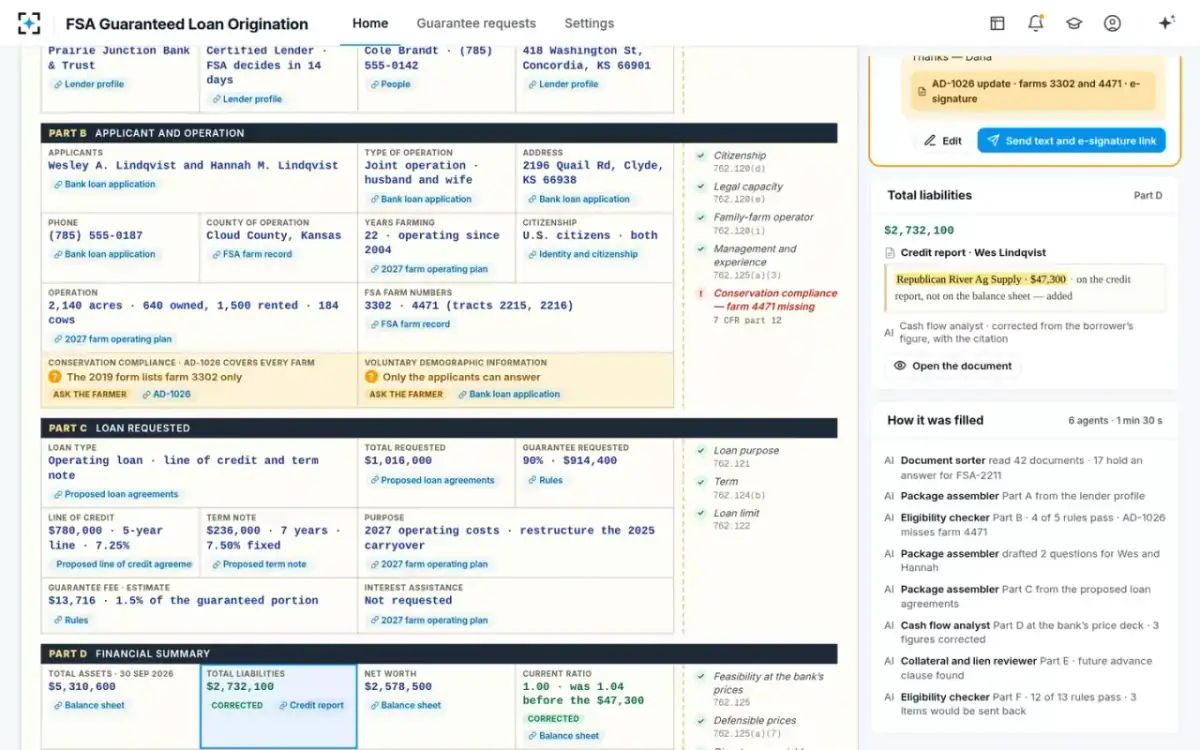
In week one the pilot is about reading. The files go in, the fills come out, and almost all of the useful findings are field-level: a tract number taken from the wrong farm, a liability that ties to the credit report but not to the balance sheet, a date read from the wrong form. This is also when the configuration gets fixed — the deck, the thresholds, the authorities — and most of what looks like an accuracy problem in week one turns out to be a configuration problem.
In week two the pilot should become about behaviour. Break the files. Watch what happens at a gap. Try to submit something incomplete. Hand a file to someone who was not in the first week and see whether the open-items list makes sense to them cold, because at a bank that files six guarantees a year, cold is the normal condition.
By week eight, if it has gone live, the question has changed again: is the coordinator still reading the flags? That is the measure that decays, and it decays quietly. A desk that re-runs the flag-precision count at week eight and at six months is a desk that will notice before the first real flag is cleared without being read.
Three numbers to carry out of the pilot, and one you cannot
0
seeded defects the system filled with a plausible value, across every pilot file
100%
of filled fields that open the document and the line they came from
6
closed files, deliberately different from one another, replayed as they stood at first submission
?h
hours saved — a number no pilot can give you honestly, because it only appears once the desk has changed
How long does it take to go live with ag lending software?
The configuration is not the long pole; the agreement about the bar is. A bank that arrives with its lender status, a dated price deck, written credit thresholds and six closed files with their outcomes can be running replays within days, because every one of those inputs is a setting rather than a project. What takes the time is the part this guide is really about: agreeing in advance what result would justify going live, then producing it.
Be sceptical of two timelines in particular. One is a go-live date fixed before the pilot's criteria are written, which makes the criteria a formality. The other is an open-ended pilot with no decision point, which is how a pilot becomes a free trial that never converts and never concludes. Pick a date for the decision, not for the go-live.
It is worth being honest about why the pressure to move quickly is real at the moment. The FDIC's October 2026 study notes that lower capital positions among producers "have contributed to greater agricultural loan demand at farm banks and growing instances of loan restructurings to replenish working capital" (FDIC, An Update on Farm Bank Performance). More files, more restructurings, the same small team. And hiring is not the obvious release valve: the Bureau of Labor Statistics projects the whole loan officer occupation to add about 3,100 jobs in total between 2025 and 2035, slower than average growth across the economy (BLS Occupational Outlook Handbook). That is an argument for doing something, not an argument for skipping step four.
Who signs off on moving from pilot to live?
Credit, not technology — and specifically the person who owns the consequence of a file going back. At most banks that is the chief credit officer or the head of ag lending; at the fictional sample bank it is the Ag Lending Manager who approves credit above the officer's authority and who knows what a second return costs in farmer relationships.
Three people should sign, for three different reasons. The credit owner, because the output is credit evidence. The coordinator who will live with it, because they are the one who will stop reading the flags if the flags are not worth reading. And whoever owns the bank's examination and audit position, because every field on a submitted application has to be reconstructable years later when a loss claim or a review asks how a figure got there.
What they are signing is narrower than "we approve the software". It is: the pilot met the criteria we wrote down, here are the ones it did not meet, and here is what we are doing about those. A sign-off that lists nothing in the second category almost always means nobody looked hard enough.
The thing a reviewer will ask for, two years later
What happens to past files during a pilot?
Nothing, and that should be explicit in writing before the first file is loaded. A replay is a read of a closed file, and the closed file is the answer key — a pilot that modifies, re-rates or re-files anything it reads has destroyed its own test as well as raising a question nobody wants to answer later.
Two practical consequences. Replays belong in a workspace of their own, separate from live files, so that nothing a pilot produces can be mistaken for a submission. And the pilot's own outputs are working papers, not loan file documents, unless the bank consciously decides otherwise; a replayed narrative that ends up in a closed credit file is a document nobody signed.
Questions to ask before you pilot anything on a guarantee file
Most of these are not about the technology, which is the point.
A vendor's pilot, and the one you should ask for
What is usually proposed: A prepared sample file, or a handful of your cleanest.
What to ask for instead: Six closed files you chose, including the awkward ones, replayed as they stood at first submission.
What is usually proposed: A demonstration, and a summary score afterwards.
What to ask for instead: A field-level comparison against your signed application, with misreadings separated from judgement differences.
What is usually proposed: Not proposed.
What to ask for instead: A seeded-error run on a copy, with the defects it missed shown to you individually.
What is usually proposed: A reasonable-looking deck supplied by the vendor.
What to ask for instead: Your deck, dated and versioned, because the rules require the lender to document its own price sources.
What is usually proposed: A go-live date fixed in advance.
What to ask for instead: A decision date, against criteria written before the pilot began.
What is usually proposed: Rarely offered.
What to ask for instead: A written answer to: what does this not do, and what still needs a person every time?
And one last question, for your own side of the table: what will the desk stop doing? A pilot that adds a system without removing a spreadsheet, a checklist folder and a re-keying step has bought a second place for the truth to live. The point of running the agents over the file is that the checklist, the fill and the citations become the same object. To see that object on one file, start at FSA Guaranteed Loan Origination, or read what a late guarantee file costs and whose clock it is for the number a pilot is ultimately arguing about.
Questions people ask
How do you pilot loan-origination software before going live?
Replay files you have already closed. Pick six that differ from one another, feed each one as it stood at first submission, and compare the output field by field against the application you actually signed, the cash flow your analyst built and the agency's response. Then break a copy of one on purpose and count what the system raises and what it fills anyway. Decide against criteria you wrote before you started.
What do you need to bring to an ag lending software pilot?
Your FSA lender status, a dated price deck with the person who approved it, your written credit thresholds and authorities, and a sample of past guarantee files with their signed outcomes. You also need one person who has built a guarantee file by hand, because they are the only one in the room who will notice a wrong tract number.
Can you test agentic AI on a loan you already closed?
Yes, and it is the strongest test there is, because the answer key already exists: the form as filed, the cash flow as built, the narrative as signed and what the agency did. Replay the file as it stood at first submission rather than the corrected version, so the comparison measures what the system would have caught rather than what it can repeat.
What price assumptions does a cash-flow pilot need?
The bank's own, dated and documented. The program requires lenders to use price forecasts that are reasonable and defensible, with the sources documented by the lender and acceptable to the agency, so a pilot run at a vendor's prices has not tested anything you could file. Fix the deck first, version it, and compare the resulting margin against the one your analyst produced from the same inputs.
How long does it take to go live with ag lending software?
The configuration is fast — lender status, price deck, thresholds and authorities are settings — so replays can start within days of the inputs arriving. What sets the real timetable is agreeing what result would justify going live and then producing it. Set a decision date rather than a go-live date, and treat a fixed go-live before the criteria are written as a warning sign.
Who signs off on moving from pilot to live?
Credit should own the decision, usually the chief credit officer or head of ag lending, with the coordinator who will use it daily and whoever owns the bank's audit and examination position signing alongside. What they sign is specific: the pilot met these criteria, missed these, and here is the plan for the ones it missed.