The FSA Preferred Lender Program is the top of a three-rung ladder for banks that make USDA guaranteed farm loans, and the thing it actually buys is speed and self-reliance: a complete application from a Certified Lender must be approved or rejected within fourteen calendar days rather than thirty, and since 1 October 2026 a Preferred Lender holds delegated authority, certifying the credit analysis itself and getting a decision within five calendar days once the environmental requirements are met. What it costs is a track record. Every rung is earned with a published loss rate, a count of loans made, and — at the top — a credit management system FSA has reviewed and accepted. FSA Guaranteed Loan Origination, Botminds’ solution for ag lenders, is about the other half of the equation: the days before FSA’s clock starts, which status does not shorten at all.
Everything below is from 7 CFR part 762, the regulation that governs guaranteed farm loans. Where a bank appears by name it is the fictional sample lender the solution runs on, Prairie Junction Bank & Trust of Concordia, Kansas, drawn as a Certified Lender.
What the ladder is worth, and what it asks
5days
to decide a complete application from a Preferred Lender using its delegated authority, from 1 October 2026 — against 14 for a Certified Lender and 30 for a standard eligible lender
5years
maximum term of Certified or Preferred status before a new lender’s agreement is needed
11areas
a Preferred Lender’s credit management system must cover, from written policies to the board’s responsibilities
80% floor
on any guarantee issued to a Certified or Preferred Lender
Three lender statuses, and the fourth that only makes small loans
Most descriptions of the programme name three tiers. The regulation names four, and the fourth is easy to miss because it is not a rung on the same ladder. Standard eligible, Certified and Preferred are progressive: each builds on the one below. The Micro Lender Program sits beside them, with authorities “limited to originating and servicing EZ Guarantee loans.” A lender that only ever makes small guarantees may be better served there than by climbing.
What each status must show FSA, what it files, and what FSA still does itself
StatusStandard eligible lender
What it must show FSAExperience making and servicing agricultural loans; no loss or servicing deficiencies that indicate an inability to handle a guaranteed loan; supervision by an acceptable State or Federal regulator; an office near enough to the collateral, or approved agents; not debarred, suspended or delinquent on a government debt.
What it filesThe full application for the loan size — five items up to $125,000, eleven above it, including three years of production history.
What FSA still doesFSA underwrites the request itself, against the applicant’s proven record of production and financial management.
StatusCertified Lender (CLP)
What it must show FSAEverything a standard eligible lender must show, plus a loss rate within the maximum FSA publishes, a minimum number of guaranteed loans made, proven ability to process and service them, no regulatory enforcement action based on financial condition, a trained person designated at each office, and FSA-acceptable forms.
What it filesThe items FSA tells the lender to submit. The rest stay in the bank’s own file, certified as held.
What FSA still doesFSA reviews a shorter package, and feasibility rests on the applicant’s financial history and proven record of financial management.
StatusPreferred Lender (PLP)
What it must show FSAEverything a Certified Lender must show, plus a credit management system satisfactory to FSA across eleven named areas, a loss rate within the PLP maximum, a consistent practice of accurate applications and deficiency-free processing, and above-average servicing.
What it filesAt least an application form and a loan narrative, plus whatever the lender agreement adds.
What FSA still doesSince 1 October 2026 the lender holds delegated authority: it certifies credit history, the test for credit, feasibility and security itself, and FSA decides a complete application within 5 calendar days once the environmental requirements are met.
StatusMicro Lender (MLP)
What it must show FSAExperience making and servicing business loans, staff and resources to discharge the work, oversight as FSA establishes, a loss rate within the MLP maximum, a minimum number of loans, and no debarment or suspension.
What it filesAn EZ Guarantee application form, for loans up to $50,000 from an MLP lender.
What FSA still doesAuthorities are limited to originating and servicing EZ Guarantee loans — a narrow lane, not a rung.
Read down the last column and the programme’s logic is obvious. FSA is not giving faster service to banks it likes; it is doing less of the work itself, because the lender has shown it does that work well. The fourteen-day period is not a courtesy. It is what remains after the underwriting FSA no longer repeats.
Standard eligible lender: what FSA still underwrites itself
Standard eligible is not a lesser status; it is the baseline every lender has to meet before any other, and three of its five criteria are about institutional fitness rather than about farm lending. A lender must “have experience in making and servicing agricultural loans and have the capability to make and service the loan for which a guarantee is requested”; must not have losses or servicing deficiencies at a level that would indicate an inability to handle a guaranteed agricultural loan; and must “be subject to credit examination and supervision by an acceptable State or Federal regulatory agency.”
The fourth criterion is geographic and more interesting than it looks. The lender must keep an office near enough to the collateral to discharge its making and servicing responsibilities, or use FSA-approved agents, correspondents or branches — and must be a local lender unless it normally lends in the region where the operation is, or can demonstrate specific expertise in making and servicing loans for that kind of operation. The fifth is the compliance floor: the lender, its officers and its agents must not be debarred or suspended from government contracts or programmes, or delinquent on a government debt.
For a standard eligible lender, FSA underwrites the request in full, and the application reflects that: the full item list for the loan size, including three years of production history, which the regulation requires of standard eligible lenders specifically. The requirements behind those items are the same for every tier; what changes is how many of them FSA wants in its own hands.
Certified Lender: the loss rate and the track record FSA tests
Certified status adds six requirements to the baseline, and only one of them is about paperwork. The others are a performance record FSA can measure. The lender must have “a lender loss rate not in excess of the maximum CLP loss rate established by the Agency and published periodically in a Federal Register Notice”, with a waiver available where a disaster substantially affected the rate. It must have made the minimum number of guaranteed loans FSA publishes — a volume test, which is why the status is hard for a bank that files two or three guarantees a year.
It must also have proven an ability to process and service, and the regulation says exactly how that is proven: by showing that the lender has “Submitted substantially complete and correct guaranteed loan applications” and serviced all guaranteed loans according to FSA regulations. That is the sentence worth pinning above a guaranteed-loan desk. The quality of the files a bank has already sent is not a soft impression; it is a published criterion for the status that makes the next files faster.
Two more are easy to overlook. The lender must not be under a regulatory enforcement action — a cease and desist order, a written agreement, an appointment of conservator or receiver — based on financial condition. And it must designate a qualified person at each office that will process Certified Lender loans, qualified meaning they have attended FSA-sponsored training in the past twelve months or will attend in the next, and agree to attend every year. Status attaches to people as well as to the institution.
The FSA Preferred Lender Program: a credit management system FSA has to approve
Preferred status is the only rung where FSA inspects how the bank runs its credit, rather than what the bank has produced. A Preferred Lender must meet every Certified Lender criterion and then show a credit management system, satisfactory to FSA, built on eleven named things.
The eleven areas a Preferred Lender’s credit management system must cover
- Written credit policies and underwriting standards
The rules the bank lends by, written down rather than carried by its longest-serving officer.
- Loan documentation requirements
What must be in a file for each kind of credit, as a standard rather than as a habit.
- Exceptions to policies
How a departure from policy is approved and recorded — the part that proves the policy is real.
- Analysis of new loan requests
The method applied to a request before it is approved.
- Credit file management
How files are organised, kept current and found again.
- Loan funds and collateral management system
Control over disbursement and over the security behind it.
- Portfolio management
How the book as a whole is watched, not only each credit.
- Loan reviews
Periodic re-reading of credits already made.
- Internal credit review process
A review function independent of the officer who made the loan.
- Loan monitoring system
Ongoing watch on performance between reviews.
- The board of directors’ responsibilities
Where accountability for all of the above finally sits.
Three further Preferred criteria are judgements about consistency rather than thresholds. The lender must “Show a consistent practice of submitting applications for guaranteed loans containing accurate information supporting a sound loan proposal” and “Show a consistent practice of processing Agency guaranteed loans without recurring major or minor deficiencies.” It must also demonstrate “a consistent, above average ability to service guaranteed loans”, measured on borrower supervision and assistance, timely and effective servicing, and communication with FSA. Recurring minor deficiencies are named explicitly — the small, repeated file errors a bank stops noticing are a stated reason the top rung stays out of reach.
Delegated authority: what changed for Preferred Lenders on 1 October 2026
The top rung moved this autumn. FSA’s final rule of 4 September 2026, effective 1 October, added a new section, 7 CFR 762.108, which lets a qualified lender certify parts of the guaranteed loan process itself “without the need for a more detailed review by the Agency.” Only Preferred Lenders qualify, and every one of them gets it: all lenders that hold PLP status receive and exercise the authority, for a period no longer than their PLP lender’s agreement, and it lapses with that agreement unless status is renewed.
What the lender now certifies, rather than evidences, is the heart of the credit analysis. For each application it certifies that the credit-history requirement, the test for credit, the financial feasibility rules and the security requirements — 762.120(g) and (h), 762.125 and 762.126 — and the matching parts of its own credit management system have been met. FSA’s explanation in the rule is plain about the purpose: it “will further shift feasibility (cash flow) and security analysis responsibilities to PLP lenders, reducing FSA workload at the time of loan making” (Federal Register, 4 September 2026).
The clock moves with the work. A complete application from a lender exercising delegated authority is approved or rejected no later than five calendar days after receipt, provided the environmental requirements have been met. That proviso matters on a farm file: the environmental review is still FSA’s, and a file whose environmental information is thin does not get the five days.
The authority comes with a sharper downside. FSA may revoke it for approving loans that do not meet the agency’s requirements for eligibility, financial feasibility and loan security, for unacceptable portfolio performance, or for any of the causes that cost PLP status itself, and it monitors lenders through loan-level data and lender monitoring reviews. The same rule adds negligent origination of a loan made under delegated authority to the grounds on which FSA reduces a final loss claim (7 CFR 762.149(i)(6)). A Preferred Lender’s certification is now the thing FSA relies on, which makes the file behind it the thing the lender is relying on too.
What happens when FSA misses the clock for a Preferred Lender
This is the provision people quote and the one most often half-remembered. Under 7 CFR 762.130(a)(2)(ii), if FSA does not meet the fourteen-day period on a Preferred Lender’s complete application, the proposed guaranteed loan is automatically approved, subject to funding, at the guarantee percentage the regulation sets for that loan type. It is a real consequence for the agency, and it is a narrow one. Three conditions limit it.
First, it belongs to Preferred Lenders only. A Certified Lender has the same fourteen-day period and no automatic approval behind it. Second, the clock runs from a complete application, and completeness is FSA’s determination, confirmed to the lender in writing. Third, the automatic approval is subject to funding: an approved loan can still join the preference list when appropriations are short, ranked by the date a complete application was received.
Automatic approval is also not the same as no review. FSA may request additional information from any lender, or review the lender’s loan file as needed to make eligibility and approval decisions, and Certified and Preferred lenders must provide information and access to records on request so that FSA can audit compliance. Status changes who does the underwriting first, not who may look.
Why status is a lender’s agreement, not a one-time approval
Certified and Preferred status are granted for a period not to exceed five years, and they expire with the lender’s agreement unless a new one is executed. The regulation is blunt about what happens next.
Renewal of PLP or CLP status is not automatic.
7 CFR 762.106(f)(2)
A renewal request must update the material in the original application and address any new criteria FSA has established since. For a Preferred Lender there is a further condition that runs for the whole term: status is conditioned on the lender actually carrying out the credit management system it proposed, plus any extra making or servicing requirements in its agreement. Where the agreement is silent on a particular action, the Preferred Lender acts according to the regulations governing Certified Lenders. The agreement is the operating document, not the certificate.
A status term, from approval to renewal — and the two detours
- Status granted with the lender’s agreementgrant
- Carrying out the system as proposedup to 5 years
- Written renewal request: update the material, address new criteriarenew
- Document in writing why the rate is beyond the lender’s controlwhy
- A written plan to return within the maximum2-year plan
- FSA revokes if the maximum is not met, unless a second extension is grantedor revoke
- Notify FSA; a new lender’s agreement is executednew agreement
- Certified, Preferred or Micro Lender status reconsideredstatus reconsidered
What moving up a tier is actually worth, in calendar days
The honest answer is: up to twenty-five days at the end of a process whose length is mostly decided before it starts. Thirty days becomes fourteen at the Certified rung, and five for a Preferred Lender exercising its delegated authority once the environmental requirements are met. But FSA’s period begins only when the application is complete, and the days a bank spends getting it complete are not in anyone’s regulation.
Where the days sit, and which of them status moves
Decided by the bank: Sorting documents against the checklist for the loan size, chasing what is missing, reconciling the balance sheet against the credit report.
Decided by status: Nothing. A Preferred Lender files fewer items with FSA but must still hold and certify the rest.
Decided by the bank: Eligibility for every signer, conservation compliance by tract, the junior-lien arithmetic, the clauses in prior liens.
Decided by status: Nothing. The rules are the same at every tier; what changes is who checks them first.
Decided by the bank: The servicing plan, the credit-elsewhere paragraph, the projection at documented prices.
Decided by status: The evidence base shifts: proven production record, financial history, or the lender’s own approved procedures.
Decided by the bank: Starts only when FSA has everything needed to decide, including the environmental information.
Decided by status: 30 days for a standard eligible lender, 14 for a Certified Lender, and 5 for a Preferred Lender using its delegated authority once the environmental requirements are met.
That is the practical case for treating the two halves separately. A bank with six guarantees a year will not reach the Certified volume test soon, and can still take a week out of every file by making the assembly faster and the rule-checking earlier. A bank already Certified gains the most from the same work, because its fourteen-day period only starts once the file is complete. What the two clocks cost works that arithmetic through.
Every guarantee the bank is building, with FSA’s period in view
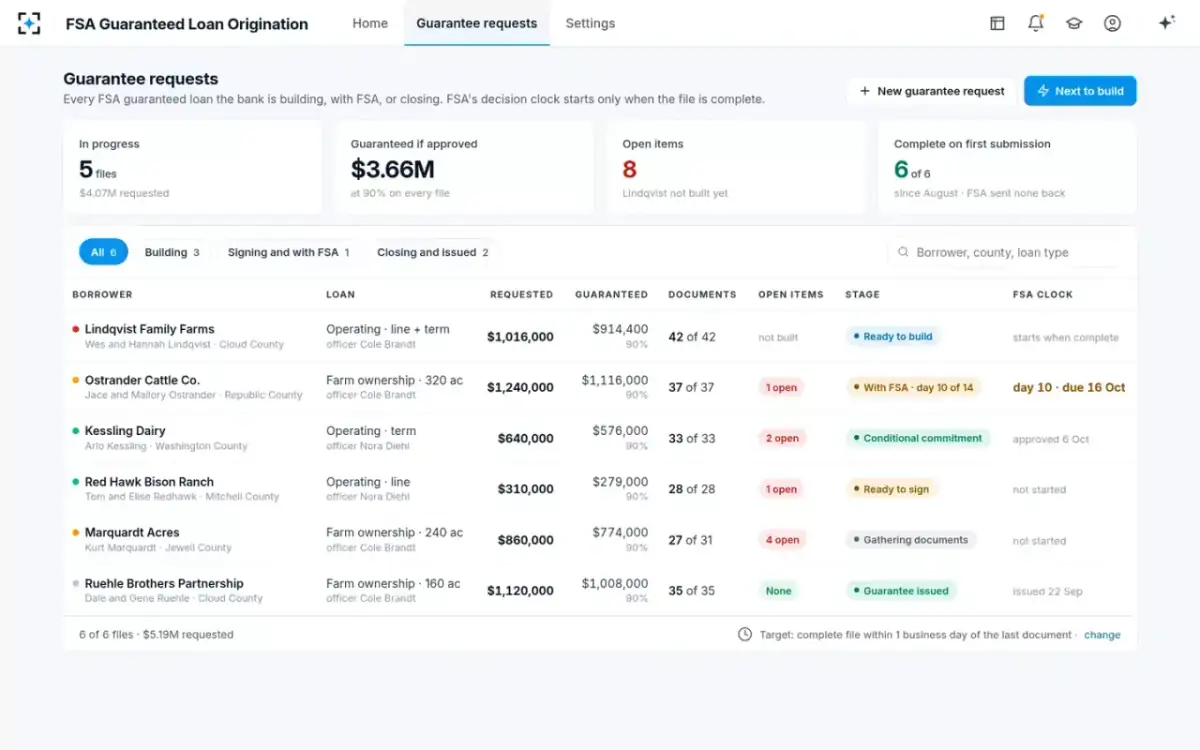
Where status stops being a certificate and starts changing the file
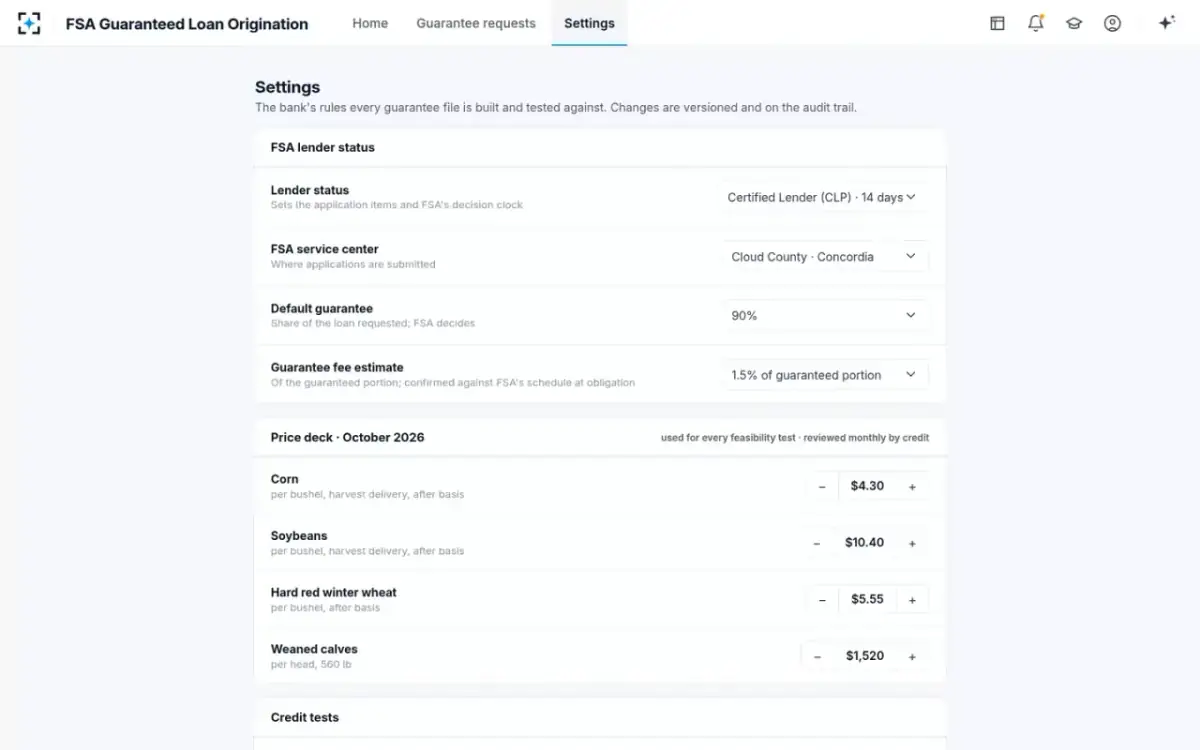
Why most of the uncertainty in a status decision is the loss rate, not the paperwork
A bank weighing an application for Certified or Preferred status can read the criteria in an afternoon. What it cannot read off the page is where it stands, because two of the hard thresholds are not in the regulation at all. The maximum Certified loss rate and the maximum Preferred loss rate are established by the Agency and published periodically in a Federal Register notice, and the minimum number of guaranteed loans is published the same way. The regulation deliberately leaves the numbers outside itself so they can move.
That has two consequences. The first is that a bank must check the current notice rather than a figure a colleague remembers. The second is that a loss rate is a property of a portfolio built over years, which makes it the slowest thing on the list to change and the only one that cannot be fixed by better process this quarter. Everything else — accurate applications, deficiency-free processing, a trained designated person, written policies, an internal credit review — is work a bank can start now.
There is also relief written in for the case a farm lender should care about most. FSA may waive the loss-rate criterion where a lender’s rate was substantially affected by a disaster, which recognises that an ag portfolio’s losses are not purely a measure of underwriting quality. A bank whose rate was wrecked by one regional event is not automatically shut out.
How a status can be revoked, and the two-year way back
FSA may revoke Certified or Preferred status at any time during the five-year term for cause, and the list of causes is specific: violating the lender’s agreement, failing to maintain the eligibility criteria, knowingly submitting false or misleading information, basing a request on information known to be false, deficiencies indicating an inability to process or service, failing to correct cited deficiencies after notification, failing to submit status reports on time, failing to use accepted forms or to follow the approved credit system, and failing to meet certain reimbursement requirements.
Three of those are about file quality, which closes the circle: the same thing that earns the status loses it. The exception is the loss rate, which has a structured way back. A Preferred Lender above the maximum may keep status for two years if it documents in writing why the excessive rate is beyond its control, provides a written plan to return within the maximum inside two years, and FSA agrees the cause was outside the lender’s control — with examples the regulation names, including a local freeze, a local economic downturn, a drop in local land values and biological or chemical damage. If the maximum is not met at the end of the two years, FSA revokes, unless a second extension is granted.
A lender that loses status is reconsidered for the rung below rather than thrown out, and may reapply once the problem is resolved. Which is the final argument for treating every file as if the status depended on it, because in a measurable way it does. A file that is substantially complete and correct the first time is simultaneously the fastest route to a guarantee and the evidence a status application rests on. That is the work FSA Guaranteed Loan Origination is built to do.
Questions people ask
What is the FSA Preferred Lender Program?
It is the top status a lender can hold in FSA’s guaranteed farm loan programmes. A Preferred Lender meets every Certified Lender criterion and in addition shows FSA a credit management system covering eleven named areas, a loss rate within the published Preferred maximum, consistently accurate applications, deficiency-free processing and above-average servicing. In return it files a short application — at least an application form and a loan narrative, plus whatever its lender agreement adds — and, since 1 October 2026, holds delegated authority: it certifies credit history, the test for credit, feasibility and security itself, and FSA decides a complete application within five calendar days once the environmental requirements are met.
What is the difference between CLP and PLP?
Certified status is earned on track record: loss rate, loan volume, substantially complete and correct applications, proper servicing, a trained designated person, no regulatory enforcement action based on financial condition. Preferred status requires all of that plus FSA’s acceptance of how the bank runs credit internally. A Certified Lender’s complete application is decided within fourteen days. A Preferred Lender has, since 1 October 2026, delegated authority to certify the credit analysis itself and a five-day decision once the environmental requirements are met, and the rule still gives it an automatic approval, subject to funding, if FSA misses its fourteen-day period.
What is a Standard Eligible Lender?
Any lender meeting the baseline criteria in 7 CFR 762.105: experience making and servicing agricultural loans, no disqualifying losses or servicing deficiencies, supervision by an acceptable State or Federal regulator, an office near enough to the collateral or approved agents, and no debarment, suspension or government-debt delinquency. It files the full application for the loan size and waits up to thirty days for a decision on a complete file.
What does it take to become a Certified Lender?
A written request to the FSA state office for the state where the lender is headquartered, naming the states in which it wants the status and addressing each criterion. Substantively: standard eligible status, a loss rate within the published Certified maximum, the published minimum number of guaranteed loans made, a demonstrated record of substantially complete and correct applications and proper servicing, no financial-condition enforcement action, a trained designated person at each participating office, and forms FSA accepts.
How long does Certified or Preferred status last once granted?
Not more than five years from the date the lender’s agreement is executed, and it expires unless a new agreement is executed. Renewal is not automatic: the lender submits a written request updating the original material and addressing any criteria FSA has added since. FSA may also revoke for cause at any time during the term, and an ownership change puts the status up for reconsideration.
Does Preferred status mean FSA never reviews the file?
No. FSA may request additional information from any lender or review the lender’s loan file as needed to make eligibility and approval decisions, and Certified and Preferred lenders must provide information and access to records on request so FSA can audit compliance with the regulations. Delegated authority adds loan-level monitoring and lender monitoring reviews, and FSA may revoke the authority for approving loans that miss its requirements. What status changes is how much of the underwriting FSA repeats up front, not whether it may look.